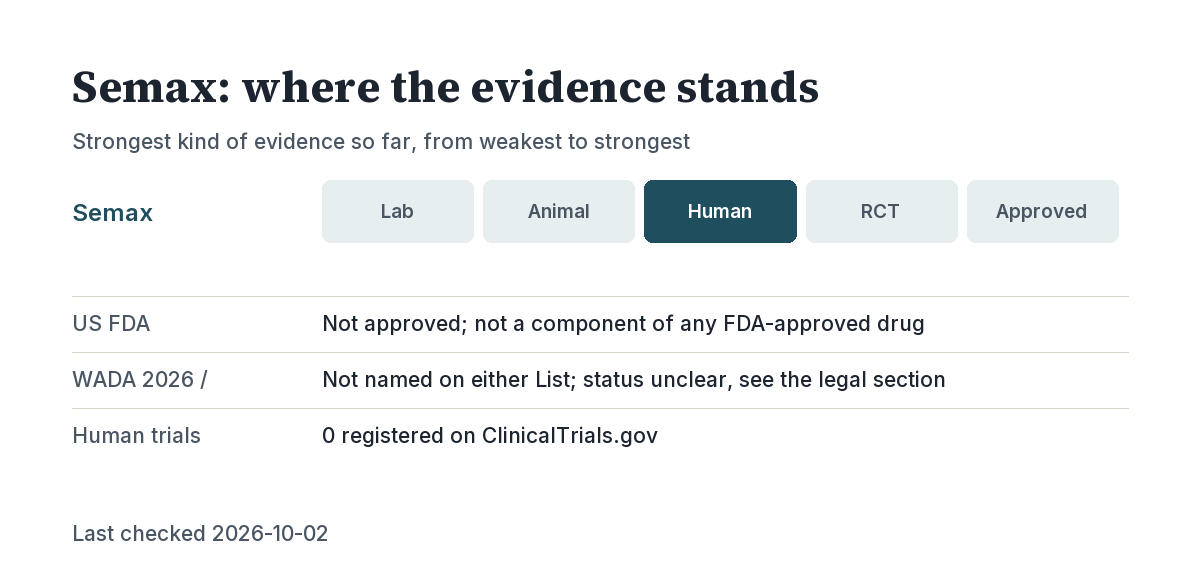
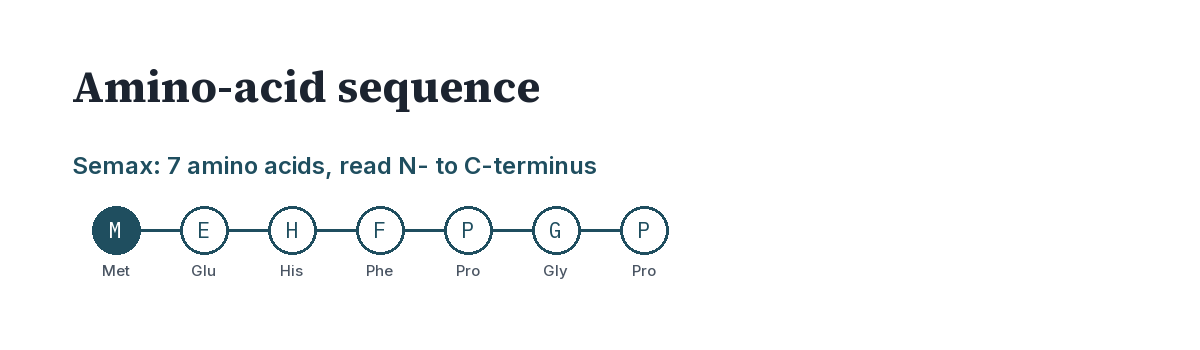
Semax is a synthetic seven-amino-acid peptide (Met-Glu-His-Phe-Pro-Gly-Pro) derived from a fragment of adrenocorticotropic hormone (ACTH), sold as nasal drops in Russia but not approved by the FDA; its best human evidence is small, mostly unblinded studies.
In rats, semax raises brain-derived neurotrophic factor (BDNF), a protein that supports nerve-cell survival [Animal] (Dolotov 2006), and it reduced infarct size after experimental stroke [Animal] (Romanova 2006). Those findings are consistent, but they come from animals. In people, the FDA’s July 2026 review found insufficient evidence of effectiveness and “insufficient clinical information to characterize the safety profile”; ClinicalTrials.gov lists no registered semax trial.
| Item | Status |
|---|---|
| US FDA | Not approved; not a component of any FDA-approved drug (FDA briefing, 2026) |
| Compounding (503A/503B) | Withdrawn from Category 2 by nominators (FDA, page of April 22, 2026); on July 24, 2026 FDA’s advisory committee voted 8–5 with one abstention in favor of adding it to the 503A Bulks List, as reported by legal and trade press; the vote is advisory, not binding, and semax is not on the 503A Bulks List |
| WADA 2026 / 2027 | Not named on either List; status unclear, see the legal section (WADA 2027 List) |
| Russia | Registered drug, 0.1% and 1% nasal drops (FDA briefing) |
| Strongest evidence | Human, small and mostly unblinded studies (n=12 to 187), most in Russian; no blinded efficacy trial found |
| Human trials | 0 registered on ClinicalTrials.gov |
| Last checked | 2026-10-02 |
Key points:
- FDA found no human pharmacokinetic study of semax by any route and no safety data for injection (FDA briefing).
- Human exposure in the literature FDA reviewed totals roughly 33–47 healthy adults, 69 adults with medical conditions and 451 children, all by the nasal route.
- FDA’s adverse-event database held one semax report through December 3, 2025: eye pain and burning after nasal drops bought online, with hospitalization.
- In rats, semax lowers clotting activity, which FDA flags as a possible bleeding risk [Animal].
- The July 24, 2026 advisory committee vote is advice to FDA; FDA says it will not issue a final determination until that input has been considered.
| Identity | Value |
|---|---|
| Sequence | Met-Glu-His-Phe-Pro-Gly-Pro (7 amino acids) |
| Molecular formula | C37H51N9O10S (free base) |
| Molecular weight | 813.9 g/mol (free base); acetate salt 874.0 g/mol |
| CAS | 80714-61-0 |
| PubChem CID | 9811102 |
| Half-life | Not measured in humans; rapidly broken down in rat blood, main fragment Pro-Gly-Pro (Shevchenko 2006) |
| Routes studied | Intranasal (humans); intranasal, intraperitoneal, intravenous (animals) |
| Class | Synthetic ACTH(4-10) analogue without hormonal activity (nootropic / neuropeptide) |
What is Semax?
Semax comes from Moscow research groups; study material described in the FDA review was made at the Institute of Molecular Genetics of the Russian Academy of Sciences. The peptide joins the ACTH(4-7) fragment, Met-Glu-His-Phe, to a Pro-Gly-Pro tail that is thought to slow breakdown by enzymes (FDA briefing). It keeps the neurobehavioral effects attributed to ACTH fragments but lacks ACTH’s hormonal effects. Its developers summarized fifteen years of work in 1997, reporting effects on attention, memory and tolerance of low oxygen in animals and people (Ashmarin 1997). Semax is a registered medicine in Russia, and Russian clinical studies tested it mainly in stroke and other brain disorders. Outside Russia it is unapproved and is sold online as a “nootropic” (a substance claimed to improve cognition), usually as a nasal spray. The PubChem record lists the sequence and the CAS number 80714-61-0.
How does Semax work?
No single receptor explains semax. The proposed mechanisms below come from animal and lab work; none has been confirmed in people.
- BDNF and TrkB signalling: one dose raised hippocampal BDNF protein up to 1.4-fold and activation of its receptor TrkB 1.6-fold in rats [Animal] (Dolotov 2006).
- Specific binding sites: labelled semax bound rat basal forebrain membranes with high affinity (KD 2.4 nM), and nasal doses raised BDNF there within 3 hours [Animal] (Dolotov 2006b).
- Serotonin and dopamine: in rodents the serotonin metabolite 5-HIAA rose to 180% in the striatum, and semax amplified amphetamine-driven dopamine release [Animal] (Eremin 2005).
- Enkephalinase inhibition: semax blocked enzymes in human serum that break down enkephalins, the body’s own opioid peptides (IC50 10 µM) [Lab] (Kost 2001).
- Immune and vascular genes: after experimental stroke in rats, over half of the genes semax changed were immune-response genes [Animal] (Medvedeva 2014).
What the research shows
The table grades each common claim by the strongest evidence behind it. Human rows are small and mostly unblinded; animal rows describe rodents, not people. The grading follows the site’s editorial policy and methodology.
| Claim | Evidence level | Best study and result |
|---|---|---|
| Raises brain BDNF | Animal | Dolotov 2006, rats: BDNF protein up to 1.4-fold |
| Limits stroke damage | Animal | Romanova 2006, rats: smaller infarcts, better memory retention |
| Speeds stroke recovery | Human, controlled (n=30 vs 80) | Gusev 1997: faster regression of motor deficits |
| Raises blood BDNF after stroke | Human, unblinded (n=110) | Gusev 2018: higher BDNF, better Barthel index |
| Changes brain networks | Human, placebo-controlled (n=24) | Lebedeva 2018: fMRI change; no cognitive outcome |
| Relieves migraine pain | Human, uncontrolled (n=12) | Koroleva 1996, per FDA: pain stopped in 4 of 12 |
| Slows motor neuron disease | Human, open-label (n=27) | Serdiuk 2007: no effect on course; quality of life improved |
| Antidepressant effect | Animal | Inozemtseva 2024, rats: reversed stress-induced anhedonia |
| Alzheimer’s disease | Animal | Radchenko 2025, transgenic mice: fewer amyloid deposits |
| Spinal cord repair | Animal | Liu 2025, mice: better functional recovery |
| Protects cells from copper | Lab (in vitro) | Tabbì 2015: less copper toxicity in cell lines |
| Treats ADHD | Hypothesis only | Tsai 2007: proposal, no study |
Stroke and brain ischemia
This is the best-developed research area. In rats with a photochemically induced stroke, six days of nasal semax reduced infarct volume and preserved memory [Animal] (Romanova 2006), and a second rat study restored water-maze learning [Animal] (Silachev 2009). In a Russian clinical study, adding semax to standard care in 30 patients with acute ischemic stroke had “some influence” on the speed of recovery, mainly of motor deficits, compared with 80 patients on standard care alone [Human, controlled, n=110] (Gusev 1997). A 2018 study of 110 rehabilitation patients linked semax to higher plasma BDNF and better daily-living scores, without reported randomization or blinding [Human, n=110] (Gusev 2018). The FDA did not weigh these papers because no full English translation was available (FDA briefing).
Cognition and mood
The nootropic reputation rests mainly on rodent learning tests and on BDNF findings. The only placebo-controlled human data located are brain-imaging studies: in 24 healthy adults, nasal semax changed the default mode network on fMRI within 20 minutes [Human, placebo-controlled, n=24] (Lebedeva 2018), and a 52-person study found changed amygdala connectivity [Human, n=52] (Panikratova 2020). Neither measured memory or attention. In stressed rats, daily semax reversed anhedonia, the loss of interest in reward [Animal] (Inozemtseva 2024).
Pain, eyes and neurodegeneration
In 12 migraine patients, one nasal dose stopped headache in 4; in typical trigeminal neuralgia, pain did not change, and the authors concluded semax has no analgesic activity by itself [Human, uncontrolled, n=37] (FDA briefing). A Russian ophthalmology study reports better visual function in optic nerve disease when semax was added to standard treatment, but the abstract does not give patient numbers [Human] (Polunin 2000). In motor neuron disease, semax did not alter the disease course in 27 patients but improved quality-of-life scores [Human, open-label, n=27] (Serdiuk 2007). In Alzheimer’s model mice, semax improved maze performance and reduced amyloid deposits [Animal] (Radchenko 2025).
Human studies and trials
No semax trial is registered on ClinicalTrials.gov (searched 2026-10-02). The published human record is listed below; most papers are in Russian with English abstracts.
| Study | Design, n | Result |
|---|---|---|
| Gusev 1997, acute stroke | 30 semax vs 80 controls | Faster motor recovery |
| Gusev 2005, cerebrovascular insufficiency | 187 patients; design not stated | Fewer strokes and TIAs reported; few side effects |
| Serdiuk 2007, motor neuron disease | Open-label, 27 | No effect on course; better quality of life |
| Gusev 2018, stroke rehabilitation | Subgroups, 110 | Higher BDNF, better Barthel index |
| Alekseeva 1999, post-hypoxic brain injury | Case series, 73 | Helped memory problems; EEG paroxysms in some |
| Lebedeva 2018, healthy adults | Placebo-controlled, 24 | fMRI network change |
| Panikratova 2020, healthy adults | Placebo-controlled, 52 (with Selank arm) | Amygdala connectivity change |
| Koroleva 1996, migraine and neuralgia | Uncontrolled, 37 | Migraine pain stopped in 4 of 12; no effect in typical neuralgia |
Status: 0 registered trials and 0 published double-blind efficacy trials found. The FDA briefing notes that semax has also been given to 451 children with depression or tic disorders in studies known only from meeting abstracts, where adverse events were not discussed.
Doses used in studies
These amounts are reported for scientific context only. They are not recommendations, and the human studies were small and mostly uncontrolled.
| Route and amount | Species | Study |
|---|---|---|
| Intranasal, 50 µg/kg once | Rat | Dolotov 2006 |
| Intranasal, 250 µg/kg daily for 6 days | Rat | Silachev 2009 |
| Intraperitoneal, 0.15 mg/kg once | Rodents | Eremin 2005 |
| Intraperitoneal, 60 nmol/kg daily | Rat | Inozemtseva 2024 |
| Intranasal, 12–18 mg per day | Human, acute stroke | Gusev 1997 |
| Intranasal, 6,000 µg per day | Human, stroke rehabilitation | Gusev 2018 |
| Intranasal, 12 mg per day | Human, motor neuron disease | Serdiuk 2007 |
| Intranasal, 0.5 mg/kg once | Human, migraine and neuralgia | Koroleva 1996, per FDA |
No established human dose exists outside approved labels.
Side effects and safety
Semax’s safety in people is largely unmeasured rather than shown to be good or bad. The Russian clinical papers describe it as well tolerated, with a “minor percent of side-effects” in 187 patients [Human, n=187] (Gusev 2005). The FDA, reviewing the same literature, found that most papers did not report adverse events at all and that no human pharmacokinetic study exists by any route (FDA briefing).
- Reported effects: in 73 patients with post-hypoxic brain injury, EEG showed episodes of paroxysmal (seizure-like) activity in some cases after a dose, and the authors advised EEG monitoring at the first administration [Human case series, n=73] (Alekseeva 1999). FDA’s adverse-event database held one report: eye pain and burning after online-bought nasal drops, with hospitalization.
- Bleeding (theoretical): nasal semax increased anticoagulant and clot-dissolving activity in rats and cut platelet aggregation by about 35% [Animal]; FDA says this raises concern for people at risk of bleeding or taking drugs that increase bleeding risk.
- Dopamine and abuse potential (theoretical): semax amplified amphetamine-induced dopamine release in rodents [Animal] (Eremin 2005). FDA calls this “concerning” and found no study of abuse potential.
- Missing toxicology: FDA identified no acute, repeat-dose, genotoxicity, reproductive or standard two-year cancer studies. One mouse study reported smaller existing tumors, but FDA judged it “not adequately designed” to assess cancer risk.
- Immunogenicity: FDA lists a risk of immune reactions for some routes because of aggregation and peptide-related impurities (FDA Category 2 page).
Product quality. Products sold online are unregulated. FDA notes that “semax” is not an official drug name, that different salts and derivatives are sold under it, and that no website it searched said which form it contained. A Belgian state laboratory identified Semax and Selank in seized unknown preparations and found them sold online as powders and nasal sprays [Lab analysis] (Vanhee 2020).
Who should avoid it. No US label exists. Based on FDA’s concerns, people with bleeding disorders or on anticoagulant or antiplatelet drugs, people with a seizure history, and pregnant people (no reproductive studies) face risks that the evidence cannot rule out.
Legal and regulatory status
| Jurisdiction | Status (checked 2026-10-02) |
|---|---|
| US FDA | Not approved; no USP monograph (FDA briefing) |
| US compounding | Withdrawn from Category 2; not on the 503A Bulks List (FDA 503A page) |
| WADA | Not named in the 2026 or 2027 List; S0 or S2 may apply |
| Russia | Registered, 0.1% and 1% nasal drops |
| Europe, Japan, international | No pharmacopoeia monograph (FDA briefing) |
FDA advisory committee, July 24, 2026. FDA reviewed semax free base and semax acetate for cerebral ischemia, migraine and trigeminal neuralgia; the meeting page notes that advisory committees make non-binding recommendations (FDA meeting page). FDA staff concluded the criteria “weigh against” adding either form to the 503A Bulks List (FDA briefing). The committee voted on each form (FDA questions); legal and trade press reported an 8–5 vote with one abstention in favor of inclusion. FDA had not posted minutes on the meeting page when this entry was checked. FDA states it will not issue a final determination until the committee’s input has been considered, and FDA adds substances to the 503A list through notice-and-comment rulemaking (FDA 503A page). Until FDA acts, the vote does not change semax’s status.
Earlier events. Semax was placed in Category 2, the FDA list of substances that may pose significant safety risks in compounding, and was moved to the “nominated but withdrawn” list after nominators withdrew (FDA Category 2 page). Withdrawal is not approval. The FDA briefing also notes that no outsourcing facility has reported compounding semax since 2019.
Sport. Semax is not named in the WADA 2026 or 2027 Prohibited List. S0 covers substances with “no current approval by any governmental regulatory health authority for human therapeutic use”, and the 2027 List adds peptides to its examples (WADA 2027 List). Because semax is registered in Russia, whether S0 applies is not settled. A 2025 anti-doping review classed semax as “unclear” status and linked it to tetracosactide, an ACTH analogue prohibited under S2 (Pokrywka 2025). Athletes should not assume it is permitted; USADA points athletes to Global DRO and its Drug Reference Team for substance questions. The site’s WADA banned peptides 2027 page explains the classes.
Related peptides
Semax was reviewed at the same FDA advisory meeting as BPC-157, which has a similar regulatory history but is studied for tissue repair. Selank, a related heptapeptide (Thr-Lys-Pro-Arg-Pro-Gly-Pro), ends in the same Pro-Gly-Pro sequence and inhibits the same serum enzymes (Kost 2001). Melanotan II, another synthetic ACTH(4-10) analogue and a potent melanocortin-receptor agonist, was tested alongside semax in a rat stress model (Inozemtseva 2024).
What users report
The following summarizes unverified self-reports posted online by people who usually bought unregulated products; it is not evidence and may not reflect what those products contained. People who post about semax on forums, Reddit and YouTube commonly describe sharper focus, easier verbal recall and a calm, motivated feeling, often noticed within the first hour after a nasal spray. Some say the effect is subtle or that they noticed nothing at all, and debate whether any benefit is placebo. A recurring complaint is nasal stinging, dryness or a runny nose. Others mention headaches, irritability, restlessness or trouble sleeping, and a few describe a “flat” mood or anxiety. Doubts about product quality come up often, since buyers cannot tell what is in an unlabelled bottle. Users argue about whether the N-acetyl variants sold under similar names differ from the original peptide, whether semax and Selank should be combined, and whether online claims about BDNF translate into anything noticeable in daily life.
Frequently asked questions
Is Semax FDA approved?
No. Semax is not approved by the FDA for any use and is not a component of any FDA-approved drug. In its July 2026 briefing, FDA staff found insufficient evidence of effectiveness for cerebral ischemia, migraine and trigeminal neuralgia, and too little clinical information to characterize its safety (FDA briefing).
Is Semax legal to compound in the US?
Not currently. Semax was withdrawn from FDA’s Category 2 list, and an FDA advisory committee voted on July 24, 2026 on adding it to the 503A Bulks List. The vote is non-binding, and as of October 2, 2026 semax was not on that list (FDA 503A page).
Is Semax banned in sport?
Its status is unclear rather than cleared. Semax is not named in the WADA 2026 or 2027 List, but S0 covers unapproved substances and S2 covers corticotrophins such as tetracosactide. A 2025 review classed semax as unclear status (Pokrywka 2025), so tested athletes carry a real risk.
What is Semax used for in Russia?
In Russia, semax is a registered medicine sold as 0.1% and 1% nasal drops and used in neurology. Russian studies tested it in stroke, cerebrovascular insufficiency, optic nerve disease and motor neuron disease. In 110 stroke rehabilitation patients it was linked to higher blood BDNF and better daily-living scores (Gusev 2018).
Does Semax have side effects?
The human data are too thin to say. Russian papers describe few side effects, but most studies did not report adverse events. One clinical series saw seizure-like EEG activity in some brain-injured patients (Alekseeva 1999), and rat data suggest reduced clotting, a possible bleeding concern.
References
- US Food and Drug Administration. FDA Briefing Document: Semax-Related Bulk Drug Substances. Pharmacy Compounding Advisory Committee, July 23–24, 2026. fda.gov/media/193348
- US Food and Drug Administration. July 23–24, 2026 Meeting of the Pharmacy Compounding Advisory Committee (meeting page). fda.gov
- US Food and Drug Administration. Pharmacy Compounding Advisory Committee, July 23–24, 2026: Questions. fda.gov/media/193711
- US Food and Drug Administration. Certain Bulk Drug Substances for Use in Compounding that May Present Significant Safety Risks (content current as of April 22, 2026). fda.gov
- US Food and Drug Administration. Bulk Drug Substances Used in Compounding Under Section 503A of the FD&C Act. fda.gov
- World Anti-Doping Agency. Prohibited List 2027 (in force January 1, 2027). wada-ama.org
- World Anti-Doping Agency. Prohibited List 2026. wada-ama.org
- USADA. WADA Prohibited List. usada.org
- Pokrywka A, et al. 2025. „Brain doping” substances: prohibited or not in sports? Biology of Sport. PMC12492343
- ClinicalTrials.gov. Search: semax (accessed 2026-10-02). clinicaltrials.gov
- PubChem. Semax, CID 9811102. pubchem.ncbi.nlm.nih.gov
- Dolotov OV, et al. 2006. Semax, an analog of ACTH(4-10) with cognitive effects, regulates BDNF and trkB expression in the rat hippocampus. Brain Res. PMID 16996037
- Dolotov OV, et al. 2006. Semax binds specifically and increases levels of BDNF protein in rat basal forebrain. J Neurochem. PMID 16635254
- Eremin KO, et al. 2005. Semax activates dopaminergic and serotoninergic brain systems in rodents. Neurochem Res. PMID 16362768
- Kost NV, et al. 2001. Semax and selank inhibit the enkephalin-degrading enzymes from human serum. Bioorg Khim. PMID 11443939
- Medvedeva EV, et al. 2014. The peptide semax affects the expression of genes related to the immune and vascular systems in rat brain focal ischemia. BMC Genomics. PMID 24661604
- Shevchenko KV, et al. 2006. Kinetics of Semax penetration into the brain and blood of rats after intranasal administration. Bioorg Khim. PMID 16523722
- Ashmarin IP, et al. 1997. A nootropic adrenocorticotropin analog 4-10, semax (15 years experience). Zh Vyssh Nerv Deiat. PMID 9173745
- Romanova GA, et al. 2006. Neuroprotective and antiamnesic effects of Semax during experimental ischemic infarction of the cerebral cortex. Bull Exp Biol Med. PMID 17603664
- Silachev DN, et al. 2009. Formation of spatial memory in rats with ischemic lesions to the prefrontal cortex; effects of a synthetic analog of ACTH(4-7). Neurosci Behav Physiol. PMID 19779827
- Gusev EI, et al. 1997. Effectiveness of semax in acute period of hemispheric ischemic stroke. Zh Nevrol Psikhiatr. PMID 11517472
- Gusev EI, et al. 2005. Semax in prevention of disease progress and development of exacerbations in patients with cerebrovascular insufficiency. Zh Nevrol Psikhiatr. PMID 15792140
- Serdiuk AV, et al. 2007. Chronic partial denervation and quality of life in patients with motor neuron disease treated with semax. Zh Nevrol Psikhiatr. PMID 18379501
- Gusev EI, et al. 2018. The efficacy of semax in the treatment of patients at different stages of ischemic stroke. Zh Nevrol Psikhiatr. PMID 29798983
- Alekseeva GV, et al. 1999. Use of semax at a follow-up of patients with posthypoxic encephalopathy. Anesteziol Reanimatol. PMID 10199046
- Lebedeva IS, et al. 2018. Effects of Semax on the default mode network of the brain. Bull Exp Biol Med. PMID 30225715
- Panikratova YR, et al. 2020. Functional connectomic approach to studying Selank and Semax effects. Dokl Biol Sci. PMID 32342318
- Polunin GS, et al. 2000. Evaluation of therapeutic effect of new Russian drug semax in optic nerve disease. Vestn Oftalmol. PMID 10741256
- Inozemtseva LS, et al. 2024. Antidepressant-like and antistress effects of Semax and Melanotan II in male rats. Eur J Pharmacol. PMID 39442746
- Radchenko AI, et al. 2025. Semax and its derivative in an animal model of Alzheimer’s disease. Acta Naturae. PMID 41479572
- Liu R, et al. 2025. Semax targets Oprm1 to promote functional recovery after spinal cord injury in female mice. Br J Pharmacol. PMID 40692165
- Tabbì G, et al. 2015. Semax, an ACTH4-10 peptide analog with high affinity for copper(II) ion. J Inorg Biochem. PMID 25310602
- Tsai SJ. 2007. Semax as a potential agent for ADHD and Rett syndrome. Med Hypotheses. PMID 16996699
- Vanhee C, et al. 2020. Putative cognitive enhancing research peptides in seized pharmaceutical preparations. Drug Test Anal. PMID 31667971
Change log
2026-10-23: links to glossary definitions added; no change to the facts.
2026-10-13: headline shortened on 2026-10-12 (now “Semax: benefits, evidence and legal status”); no change to the facts.
2026-10-06: links to related entries were added on 2026-10-05; no change to the facts.
2026-10-04: first published.