GHK-Cu is the copper complex of GHK (glycyl-L-histidyl-L-lysine), a three-amino-acid peptide first isolated from human plasma and studied mainly as a topical skin and wound ingredient; its strongest evidence is a few small topical human trials.
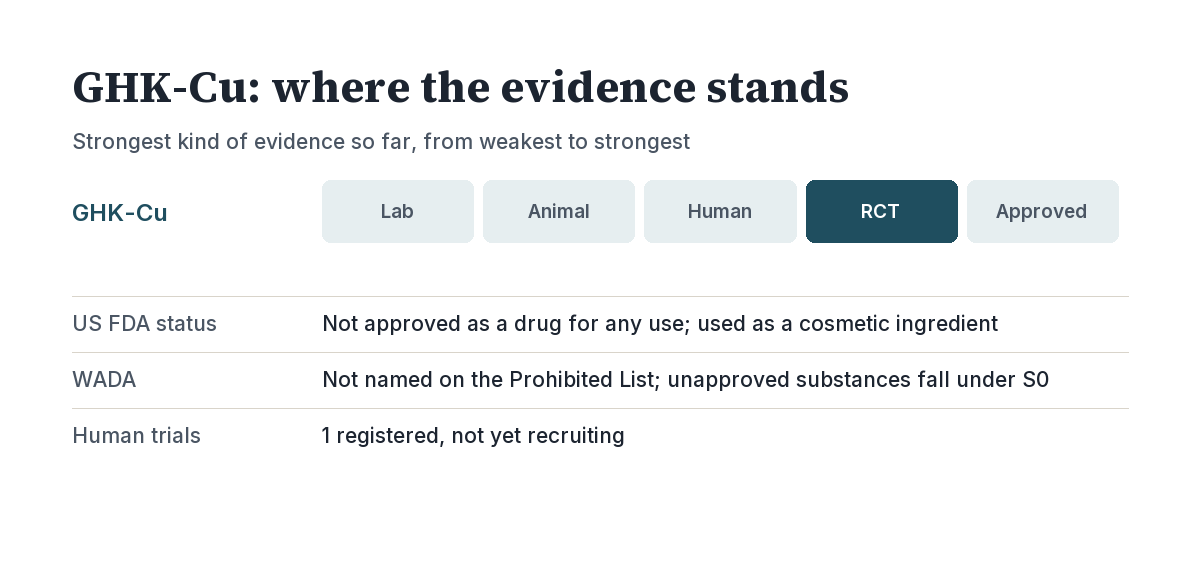
GHK-Cu, the copper peptide used in skin care, has its strongest result in wound healing: diabetic foot ulcers treated with a GHK-Cu gel closed a median 98.5% versus 60.8% with vehicle [Human RCT] (Mulder 1994). GHK-Cu is not an FDA-approved drug. It is used in skin-care products under the ingredient name copper tripeptide-1 (Patel 2024). In May 2026 the FDA placed GHK-Cu for non-injectable routes in 503A Category 1 (under evaluation), while injectable GHK-Cu left Category 2 after its nomination was withdrawn (FDA, 2026). Most findings come from cell and animal studies. The FDA states there are “limited data in humans” on its safety (FDA), and the published human studies cover topical use only (Mateescu 2026).
| Item | Status |
|---|---|
| US FDA status | Not approved as a drug for any use; used as a cosmetic ingredient |
| Compounding (503A/503B) | 503A Category 1 for non-injectable routes (May 2026); injectable nomination withdrawn from Category 2; FDA advisory committee review due before end of February 2027 (FDA) |
| WADA 2026 | Not named on the Prohibited List; unapproved substances fall under S0 (WADA); USADA lists plain GHK (non-palmitoylated tripeptide-1) as not prohibited in cosmetics (USADA) |
| Strongest evidence | Human RCT, topical gel on diabetic foot ulcers (Mulder 1994); a later RCT (n=13) found no objective benefit after laser resurfacing |
| Human trials | 1 registered, not yet recruiting: NCT07706361 |
| Injected use in people | No published human data |
| Last checked | 2026-10-18 |
Key points:
- In a 1994 randomized trial of a GHK-Cu gel in diabetic foot ulcers, median ulcer closure was 98.5% versus 60.8% with vehicle gel [Human RCT] (Mulder 1994).
- A 2006 randomized trial after CO2 laser resurfacing (n=13) found no objective difference in redness, wrinkles or skin quality [Human RCT] (Miller 2006).
- A 2026 evidence-mapping review judged the clinical evidence “sparse” and GHK-Cu “promising but unproven”.
- The FDA’s concern with injectable GHK-Cu is immunogenicity from aggregation and peptide-related impurities.
- The widely cited hair-growth study tested a different copper peptide, AHK-Cu, not GHK-Cu [Lab] (Pyo 2007).
What changed (October 2026): a new section compares topical and injected GHK-Cu, two 2026 sports medicine reviews are added, and the 2027 WADA List wording is added.
| Property | Value |
|---|---|
| Sequence | Gly-His-Lys (3 amino acids) bound to copper(II) |
| Other names | Copper tripeptide-1; glycyl-L-histidyl-L-lysine copper; the peptide alone is also listed as prezatide |
| Formula (GHK) | C14H24N6O4, 340.38 g/mol (PubChem CID 73587) |
| Formula (GHK-Cu) | C14H22CuN6O4, 401.91 g/mol (PubChem CID 165429100) |
| CAS (GHK) | 49557-75-7 |
| Routes studied | Topical (humans, animals); intraperitoneal, intra-articular and wound-chamber injection (animals only) |
| Class | Copper-binding tripeptide; naturally occurring plasma peptide |
What is GHK-Cu?
GHK was described in 1973 by Loren Pickart and Michael Thaler as a tripeptide in human serum that prolonged the survival of normal liver cells and stimulated the growth of hepatoma (liver cancer) cells in culture (Pickart and Thaler 1973). It binds copper(II) strongly, and most research uses the copper complex, GHK-Cu. A review co-written by Pickart reports that plasma GHK levels decline with age (Pickart and Margolina 2018). In the early 1990s a GHK-Cu wound gel, Iamin Gel, was tested in a randomized trial in diabetic foot ulcers (Mulder 1994). Injectable GHK-Cu was later nominated for use in pharmacy compounding, which led to the FDA’s safety review (FDA).
How does GHK-Cu work?
The proposed mechanisms come almost entirely from cell and animal work:
- Collagen synthesis: in human fibroblast cultures, GHK-Cu raised collagen production, starting between 10-12 and 10-11 M and peaking at 10-9 M [Lab] (Maquart 1988); in rat wound chambers it increased collagen and glycosaminoglycan content [Animal] (Maquart 1993).
- Tissue remodeling: GHK-Cu increased MMP-2, an enzyme that breaks down matrix during remodeling, in rat fibroblast cultures; copper ions alone reproduced this, GHK alone did not [Lab] (Siméon 2000).
- Glycosaminoglycans: GHK-Cu raised sulfated glycosaminoglycan synthesis by human fibroblasts, most at 10-9 to 10-8 M [Lab] (Wegrowski 1992).
- Antioxidant action: GHK-Cu blocked iron release from ferritin and the lipid peroxidation that follows [Lab] (Miller 1990).
- Gene expression: an analysis of the Connectivity Map database reported that GHK changed the expression of a large proportion of human genes [Lab, database analysis] (Pickart and Margolina 2018). What this means for living people has not been tested.
What the research shows
GHK-Cu’s best-supported benefit is wound repair: plantar diabetic ulcers treated with its gel closed a median 98.5% versus 60.8% with vehicle, with infections at 7% versus 34% [Human RCT] (Mulder 1994), and open wounds in rats shrank 64.5% versus 45.6% with vehicle by day 13 [Animal] (Canapp 2003). It stimulates collagen production in skin cells [Lab] (Maquart 1988), improved ligament-graft healing at 6 weeks in rats [Animal] (Fu 2015) and reduced smoke-induced emphysema in mice [Animal] (Zhang 2022). For wrinkles and other cosmetic uses, the human evidence is still sparse.
| Claim | Evidence level | Best study and result |
|---|---|---|
| Speeds diabetic foot ulcer closure (topical gel) | Human RCT (n not in abstract) | Mulder 1994: median closure 98.5% vs 60.8% vehicle; infections 7% vs 34% |
| Improves skin after laser resurfacing | Human RCT (n=13): not supported | Miller 2006: no objective difference; higher patient satisfaction (P=.04) |
| Reduces facial wrinkles | Human, small cosmetic studies | Mateescu 2026: clinical evidence “sparse” |
| Scalp flaking, acne scars | Human, open-label, multi-ingredient, no control | Patel 2024: flaking down 61.24% at day 15 (serum plus acid scrub) |
| Stimulates collagen | Lab; Animal | Maquart 1988: peak effect at 10-9 M in fibroblasts |
| Speeds open-wound healing | Animal (rats, n=24) | Canapp 2003: 64.5% area reduction vs 45.6% vehicle, 28.2% control by day 13 |
| Improves ligament graft healing | Animal (rats, n=72) | Fu 2015: less knee laxity at 6 weeks; no difference at 12 weeks |
| Protects the lungs | Animal (mice); Lab | Zhang 2022: reduced smoke-induced emphysema in mice |
| Grows hair | Lab only, different peptide | Pyo 2007: AHK-Cu, not GHK-Cu, lengthened cultured follicles |
| Reverses “aging” gene patterns | Lab (database analysis) | Pickart 2018: large-scale gene expression changes reported |
| Benefits of injected GHK-Cu | No human data | FDA: “limited data in humans” |
Wound healing
Wound healing is the only area with a controlled human trial of a clinical outcome. In the multicenter, evaluator-blinded Iamin Gel trial, all patients received debridement and pressure-relieving footwear; plantar ulcers treated with the GHK-Cu gel closed a median 98.5% versus 60.8% with vehicle, and ulcer infections were 7% versus 34% [Human RCT] (Mulder 1994). The abstract does not report the number of patients. In rats with ischemic open wounds, topical GHK-Cu reduced wound area more than vehicle and lowered TNF-alpha, MMP-2 and MMP-9 in wound tissue [Animal] (Canapp 2003). In rabbits, a topical tripeptide-copper complex left a smaller unhealed area than control at days 7, 14 and 21 [Animal] (Cangul 2006).
Skin aging and cosmetics
Most cosmetic claims trace back to studies from 1998 to 2005, such as a 12-week facial cream study in 71 women, summarized in a review co-written by GHK’s discoverer without full design details (Pickart and Margolina 2018). A randomized trial with blinded evaluators found no objective improvement in wrinkles or post-laser redness, though patients using GHK-Cu products rated their skin higher [Human RCT, n=13] (Miller 2006). Newer open-label studies test multi-ingredient products without a control group, so the effect of GHK-Cu itself cannot be separated (Patel 2025). A 2026 review concludes that the clinical evidence “does not meet contemporary active-entity quality standards”, partly because studies rarely confirm which chemical form of GHK-Cu the product contained (Mateescu 2026).
Connective tissue and ligaments
In 72 rats after anterior cruciate ligament reconstruction, GHK-Cu injected into the joint reduced knee laxity at 6 weeks, but the difference was gone by 12 weeks [Animal] (Fu 2015). Two 2026 reviews for sports medicine that included GHK-Cu found the claimed musculoskeletal benefits of such peptides unsupported by current human trials [Scoping review] (Tewari 2026) and their human safety data scarce [Narrative review] (Mendias and Awan 2026).
Lungs
In lung tissue from people with COPD, GHK reversed a gene-expression signature linked to emphysema and restored collagen remodeling in cultured lung fibroblasts [Lab] (Campbell 2012). In mice, intraperitoneal GHK-Cu reduced cigarette-smoke emphysema and inflammatory cytokines [Animal] (Zhang 2022) and reduced lung inflammation and fibrosis in a silicosis model [Animal] (Bian 2024). None of this has been tested in patients.
Hair
The study often cited for hair growth tested AHK-Cu (alanyl-histidyl-lysine copper), a related but different peptide, on cultured human hair follicles [Lab] (Pyo 2007). The 2026 review lists one hair-related human study, a split-face eyebrow study in 18 people with positive cosmetic results but no confirmation of the GHK-Cu form used [Human, n=18].
Topical vs injected GHK-Cu
Almost all human data on GHK-Cu come from products applied to the skin; no published human study has tested injected GHK-Cu. The two routes compared, as of October 2026:
| Item | Topical (skin products) | Injected |
|---|---|---|
| Human studies | Two RCTs (a wound gel; creams after laser resurfacing) plus open-label cosmetic studies | None published |
| Best result | Diabetic foot ulcer gel: median closure 98.5% vs 60.8% (Mulder 1994) | None in people |
| FDA compounding status | Category 1 under 503A, under evaluation (FDA, 2026-05-14) | Nomination withdrawn; in no category (FDA) |
| Main safety concern | Few adverse events in small studies, which cannot show safety | Immune reactions from aggregation and impurities; “limited data in humans” (FDA) |
Human studies and trials
The table lists the controlled human studies of GHK-Cu products indexed in PubMed and the trial registered on ClinicalTrials.gov. All are topical or transdermal; none tested injection.
| Study | Design, n | Status and result |
|---|---|---|
| Mulder 1994, Iamin Gel, diabetic foot ulcers | RCT, multicenter, evaluator-blinded; n not in abstract | Completed; closure 98.5% vs 60.8% vehicle |
| Miller 2006, after CO2 laser | RCT, n=13 completed | Completed; no objective benefit |
| NCT07706361, X39 patch, blood GHK and GHK-Cu levels | Placebo patch control, 100 planned | Not yet recruiting; start 2027-01 |
The patch study, sponsored by the patch maker LifeWave, measures blood levels, not a clinical outcome (NCT07706361). No completed human trial of injected GHK-Cu has been published.
Doses used in studies
| Route and amount | Species | Study |
|---|---|---|
| Topical gel, metered amount (concentration not in abstract) | Human | Mulder 1994 |
| Topical, 13-day study (concentration not in abstract) | Rat | Canapp 2003 |
| Intra-articular, 0.3 or 3 mg/mL | Rat | Fu 2015 |
| Intraperitoneal, 0.2, 2 or 20 µg/g | Mouse | Zhang 2022; Bian 2024 |
| Culture medium, 10-12 to 10-9 M | Human cells | Maquart 1988 |
No established human dose exists outside approved labels. Animal amounts do not translate directly to people, and no GHK-Cu drug label exists.
Side effects and safety
Reported adverse effects. The published human studies are small and report few adverse events. In the diabetic ulcer trial, infections were less frequent with GHK-Cu gel than with vehicle (7% vs 34%) in plantar ulcers treated immediately after debridement [Human RCT] (Mulder 1994). An open-label scar-gel study reported no local or systemic adverse effects, but it tested a multi-ingredient product without a control group [Human, open-label] (Patel 2025). The absence of reports in small studies is not evidence of safety.
Injected GHK-Cu. The FDA placed injectable GHK-Cu in Category 2 of its compounding list, stating that injectable products “may pose risk for immunogenicity due to the potential for aggregation and peptide-related impurities” and that “there are limited data in humans to inform safety-related considerations” (FDA). Immunogenicity means the immune system reacting against the product. The listing ended because the nominations were withdrawn; the FDA page still carries the safety summary. How much copper reaches the blood after injection has not been reported in any published human study.
Theoretical risks. The 1973 discovery paper reported that the tripeptide stimulated the growth of hepatoma cells in culture [Lab] (Pickart and Thaler 1973), while later gene-expression analyses were read as anti-cancer [Lab] (Pickart and Margolina 2018). Neither finding was tested in people, and the long-term effects of repeated systemic exposure are unknown. A 2026 review of injectable “biohacking” peptides names product contamination, manufacturing impurities and inaccurate doses as the main hazards of unregulated products (Moiz 2026).
Unregulated products. Injectable GHK-Cu sold outside licensed pharmacies has no FDA-checked identity, purity or sterility. A 2026 review notes that even published studies often do not verify which chemical form of GHK-Cu was delivered (Mateescu 2026).
Who should not use it. No GHK-Cu drug is approved, so no label or regulator lists contraindications. The FDA’s statement on limited human safety data applies to every group of users.
Legal and regulatory status
| Jurisdiction | Status | Source, date |
|---|---|---|
| US FDA (drug) | Not approved for any use | Checked 2026-09-30 |
| US 503A, non-injectable | Category 1 (under evaluation); not on the 503A bulks list | FDA list, updated 2026-05-14 |
| US 503A, injectable | Category 2 nomination withdrawn; in no category | FDA page, updated 2026-04-22 |
| WADA 2026 | Not named; S0 covers unapproved substances | WADA list |
| WADA 2027 (from 2027-01-01) | S0 names peptides in general; GHK-Cu is not among the examples | USADA, 2026-10-06 |
| USADA | Plain GHK in cosmetics listed as not prohibited; no GHK-Cu ruling published | USADA |
Compounding. Category 1 means the FDA “does not intend to take action against a compounder” using the substance while it is evaluated, provided the conditions of its guidance are met (FDA). It is an interim enforcement policy, not approval and not a listing. Some secondary sources say GHK-Cu was never in Category 1; the FDA’s own list says otherwise for non-injectable routes.
Dated events.
- 2026-04-22: FDA removed GHK-Cu from Category 1 after its nominations were withdrawn; injectable GHK-Cu was listed as withdrawn from Category 2 (FDA).
- 2026-05-05: one nominator said it had meant to withdraw only the injectable route; the FDA then added non-injectable GHK-Cu back to Category 1.
- Before end of February 2027: the FDA intends to consult its Pharmacy Compounding Advisory Committee on adding GHK-Cu to the 503A bulks list.
Sport. The WADA S0 class prohibits at all times any pharmacological substance that is not covered elsewhere on the list and has no current approval by a government health authority for human therapeutic use (WADA). USADA states that the list has no route-dependent statuses for peptides, so topical use of a prohibited peptide is as prohibited as injection (USADA). USADA’s summary of the 2027 List, in force from 1 January 2027, says S0 now names “peptides” in general and does not list GHK-Cu among its examples (USADA). Athletes need a ruling from their anti-doping organization for GHK-Cu specifically. The guide to WADA-banned peptides covers the prohibited classes in detail.
Related peptides
- BPC-157: another peptide studied for tissue repair, with mostly animal evidence; unlike GHK-Cu, USADA names it as prohibited under S0 (USADA).
What users report
The accounts below are unverified self-reports from people who usually bought GHK-Cu as an unregulated topical or injectable product, not clinical evidence. GHK-Cu, or copper tripeptide-1, is a small copper-binding peptide studied mainly for its effects on skin remodeling, wound healing, and hair follicle activity. On skincare boards and biohacking forums, people who post about topical GHK-Cu commonly report smoother texture, less visible fine lines, and calmer-looking skin, usually describing gradual change over several weeks to a few months rather than anything sudden. On bodybuilding and peptide forums, people who inject GHK-Cu often report thicker-feeling hair or slowed shedding, alongside injection-site redness, stinging, or soreness as a recurring complaint.
A frequent point of frustration is inconsistent results: some describe no noticeable change at all despite sticking with a product for a while, and threads often argue over whether this reflects a weak or fake batch, individual variability, or unrealistic expectations. Product quality is a constant flashpoint, with people swapping warnings about counterfeit or underdosed peptides, complaining about cost relative to benefit, and disputing which suppliers seem trustworthy. Because these products are sold outside regulated drug channels, purity and content are essentially unverified, which fuels much of the ongoing disagreement in these communities.
Frequently asked questions
Is GHK-Cu FDA approved?
No. GHK-Cu is not an FDA-approved drug for any condition. It is used as a cosmetic ingredient, and for compounding the FDA lists non-injectable GHK-Cu in Category 1, meaning under evaluation, while the injectable nomination was withdrawn from Category 2. Category 1 is an interim enforcement policy, not approval (FDA).
Is GHK-Cu safe?
Its safety has not been established. Small topical studies report few side effects, but no published human study has tested injected GHK-Cu. The FDA says injectable products may trigger immune reactions because of aggregation and impurities, and that “there are limited data in humans” on safety (FDA).
Does GHK-Cu work for skin?
The evidence is weak. Lab studies show it raises collagen in skin cells, but a randomized trial of GHK-Cu skin products after laser resurfacing found no objective improvement in wrinkles or redness in 13 patients, although patients rated their skin higher (Miller 2006). Larger controlled trials with defined products have not been published.
Is GHK-Cu banned in sports?
It is not named on the WADA Prohibited List, and USADA lists plain GHK in cosmetics as not prohibited. However, WADA’s S0 class covers any substance without government approval for human therapeutic use, and no anti-doping ruling specific to GHK-Cu has been published (USADA). Athletes need a ruling from their anti-doping body.
What is the difference between GHK and GHK-Cu?
GHK is the three-amino-acid peptide glycine-histidine-lysine; GHK-Cu is the same peptide bound to a copper ion. Most studies use the copper form, and some effects depend on the copper: in fibroblast cultures, copper ions alone reproduced GHK-Cu’s increase in the enzyme MMP-2, while GHK alone did not (Siméon 2000).
References
- US Food and Drug Administration. Bulk Drug Substances Nominated for Use in Compounding Under Section 503A (updated 2026-05-14). fda.gov/media/94155
- US Food and Drug Administration. Certain Bulk Drug Substances for Use in Compounding that May Present Significant Safety Risks (updated 2026-04-22). fda.gov
- US Food and Drug Administration. Bulk Drug Substances Used in Compounding Under Section 503A of the FD&C Act (updated 2026-05-14). fda.gov
- World Anti-Doping Agency. The Prohibited List (2026). wada-ama.org
- US Anti-Doping Agency. Peptides and Growth Factors in Cosmetics: Are They Banned? usada.org
- Mulder GD, Patt LM, Sanders L, et al. Enhanced healing of ulcers in patients with diabetes by topical treatment with glycyl-L-histidyl-L-lysine copper. Wound Repair Regen. 1994;2(4):259-269. PMID 17147644
- Miller TR, Wagner JD, Baack BR, Eisbach KJ. Effects of topical copper tripeptide complex on CO2 laser-resurfaced skin. Arch Facial Plast Surg. 2006;8(4):252-259. PMID 16847171
- Mateescu DM, et al. GHK-Cu as a bioactive metallopeptide and drug-delivery cargo. Pharmaceutics. 2026;18(9):1077. PMID 42797253
- Pickart L, Thaler MM. Tripeptide in human serum which prolongs survival of normal liver cells and stimulates growth in neoplastic liver. Nat New Biol. 1973;243(124):85-87. PMID 4349963
- Pickart L, Margolina A. Regenerative and protective actions of the GHK-Cu peptide in the light of the new gene data. Int J Mol Sci. 2018;19(7):1987. PMID 29986520
- Maquart FX, Pickart L, Laurent M, et al. Stimulation of collagen synthesis in fibroblast cultures by the tripeptide-copper complex glycyl-L-histidyl-L-lysine-Cu2+. FEBS Lett. 1988. PMID 3169264
- Maquart FX, Bellon G, Chaqour B, et al. In vivo stimulation of connective tissue accumulation by the tripeptide-copper complex glycyl-L-histidyl-L-lysine-Cu2+ in rat experimental wounds. J Clin Invest. 1993. PMID 8227353
- Siméon A, Emonard H, Hornebeck W, Maquart FX. The tripeptide-copper complex glycyl-L-histidyl-L-lysine-Cu2+ stimulates matrix metalloproteinase-2 expression by fibroblast cultures. Life Sci. 2000. PMID 11045606
- Wegrowski Y, Maquart FX, Borel JP. Stimulation of sulfated glycosaminoglycan synthesis by the tripeptide-copper complex glycyl-L-histidyl-L-lysine-Cu2+. Life Sci. 1992. PMID 1522753
- Miller DM, DeSilva D, Pickart L, Aust SD. Effects of glycyl-histidyl-lysyl chelated Cu(II) on ferritin dependent lipid peroxidation. Adv Exp Med Biol. 1990. PMID 2244543
- Canapp SO Jr, Farese JP, Schultz GS, et al. The effect of topical tripeptide-copper complex on healing of ischemic open wounds. Vet Surg. 2003. PMID 14648529
- Cangul IT, Gul NY, Topal A, Yilmaz R. Evaluation of the effects of topical tripeptide-copper complex and zinc oxide on open-wound healing in rabbits. Vet Dermatol. 2006. PMID 17083573
- Fu SC, Cheuk YC, Chiu WY, et al. Tripeptide-copper complex GHK-Cu (II) transiently improved healing outcome in a rat model of ACL reconstruction. J Orthop Res. 2015. PMID 25731775
- Pyo HK, Yoo HG, Won CH, et al. The effect of tripeptide-copper complex on human hair growth in vitro. Arch Pharm Res. 2007. PMID 17703734
- Campbell JD, McDonough JE, Zeskind JE, et al. A gene expression signature of emphysema-related lung destruction and its reversal by the tripeptide GHK. Genome Med. 2012;4(8):67. PMID 22937864
- Zhang Q, Yan L, Lu J, Zhou X. Glycyl-L-histidyl-L-lysine-Cu2+ attenuates cigarette smoke-induced pulmonary emphysema. Front Mol Biosci. 2022. PMID 35936787
- Bian Y, Deng M, Liu J, et al. The glycyl-L-histidyl-L-lysine-Cu2+ tripeptide complex attenuates lung inflammation and fibrosis in silicosis by targeting peroxiredoxin 6. Redox Biol. 2024. PMID 38879894
- Patel MN, Patel N, Merja A. Scalp treatment regimen combining a hydroxy acid-based scrub and copper tripeptide serum in seborrheic dermatitis. Cureus. 2024. PMID 39449909
- Patel MN, Patel N, Merja A. Efficacy and safety assessment of a scar gel in the treatment of skin scars. Cureus. 2025. PMID 41001334
- Moiz A, O’Keefe EL, O’Keefe JH. Dangers of injectable peptides and other unregulated “biohacking” drugs. Mo Med. 2026;123(4):337-343. PMID 42757290
- ClinicalTrials.gov. Two-Part Study of the Effects of the X39 Patch on Circulating GHK and GHK-Cu Levels in Healthy Adults. NCT07706361
- PubChem. Glycyl-L-histidyl-L-lysine, CID 73587. pubchem.ncbi.nlm.nih.gov
- PubChem. GHK-Cu, CID 165429100. pubchem.ncbi.nlm.nih.gov
- Tewari K, Liu TP, Im C, et al. Peptide supplements and their therapeutic applications in sports medicine. Am J Sports Med. 2026. PMID 42578445
- Mendias CL, Awan TM. Safety and efficacy of approved and unapproved peptide therapies for musculoskeletal injuries and athletic performance. Sports Med. 2026;56(8):1921-35. PMID 41966639
- US Anti-Doping Agency. Athlete advisory: 2027 Prohibited List. 2026-10-06. usada.org
Change log
2026-10-26: new H1; topical vs injected section and table; 2026 sports medicine reviews (Tewari 2026, Mendias and Awan 2026) and the 2027 WADA List wording added; FAQ moved out of the user-reports box; reviewed by the editorial team.
2026-10-23: links to glossary definitions added; no change to the facts.
2026-10-18: removed ClinicalTrials.gov record NCT07437586 (topical gel, phase 2), whose sponsor posts example records, from the status box, trial table, trial notes and references; registered trials now 1, not yet recruiting; reviewed by the editorial team.
2026-10-18: diabetic ulcer infection figures limited to the ulcers treated right after debridement, as in Mulder 1994; reviewed by the editorial team.
2026-10-12: Benefits section added: the most promising findings named first, each with its evidence level; opening leads with the strongest result; reviewed by the editorial team.
2026-09-30: added “What users report” (summarised public anecdote, labelled as such).
2026-09-30: first published after review by the editorial team.