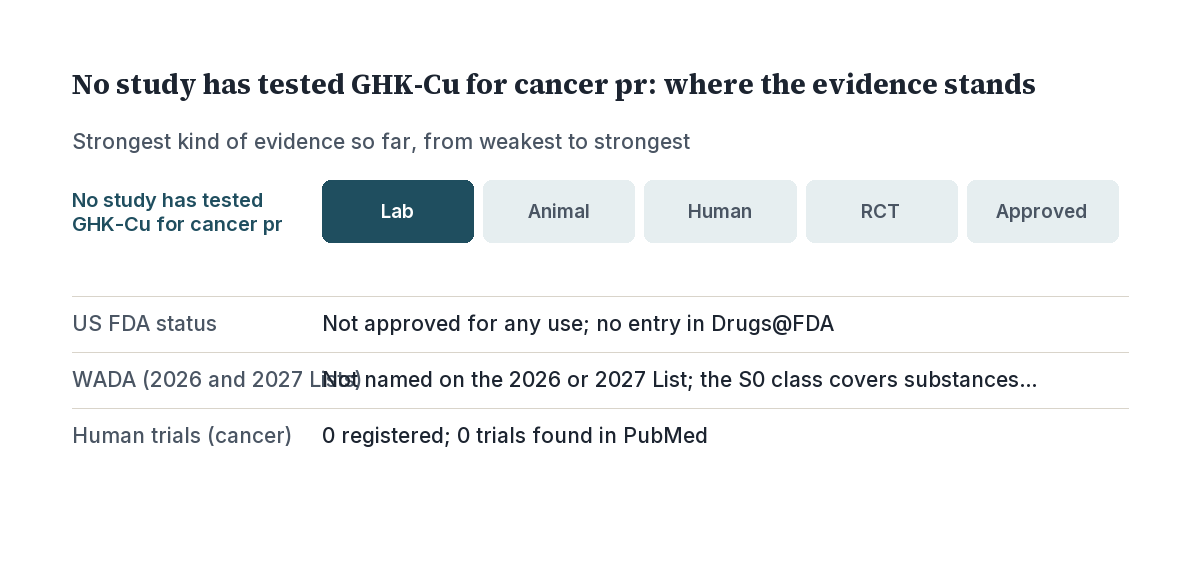
No study has tested GHK-Cu for cancer prevention or treatment in people. In cell cultures, GHK has both slowed the growth of some cancer cell lines and sped up the growth of liver tumor cells [Lab]. A gene-expression screen picked it as a possible counter to a colon cancer metastasis signature [computational]. GHK-Cu is not FDA approved for any use, and no cancer trial is registered on ClinicalTrials.gov.
The research on GHK-Cu and cancer pulls in two directions. One line of work, much of it from the scientist who discovered the peptide, describes anticancer gene and cell effects. A second, independent line shows that copper and copper-bound GHK can drive new blood-vessel growth, which tumors also rely on. Neither line has been tested in humans with cancer. The FDA notes that “there are limited data in humans to inform safety-related considerations” for injectable GHK-Cu (FDA).
| Item | Status |
|---|---|
| US FDA status | Not approved for any use; no entry in Drugs@FDA |
| Compounding (503A/503B) | Injectable: formerly in category 2, nomination withdrawn. Non-injectable: back in category 1 (“under evaluation”) as of May 14, 2026; FDA plans a PCAC review before the end of February 2027 (FDA categories list) |
| WADA (2026 and 2027 Lists) | Not named on the 2026 or 2027 List; the S0 class covers substances with no government approval for human therapeutic use (WADA 2026 List) |
| Strongest evidence (cancer) | Lab (cell lines) and one mouse tumor result reported by the developer’s group; no human data |
| Human trials (cancer) | 0 registered; 0 trials found in PubMed |
| Last checked | 2026-10-09 |
Key points:
- GHK was first described in 1973 as a blood peptide that stimulated the growth of liver tumor cells in culture.
- A 2010 colon cancer study used the Broad Institute’s Connectivity Map and found GHK could reverse a metastasis gene signature in cell-line data.
- Copper-bound GHK triggered new blood vessels in rabbit corneas, and copper itself is needed for tumor angiogenesis in animal models.
- Copper-lowering drugs, the opposite approach, have been tested in small cancer trials (n=18 and n=75).
- No GHK-Cu drug trial is registered; the registered GHK-Cu studies test a skin patch and a facial treatment, none in cancer.
What the research on GHK-Cu and cancer shows
GHK (glycyl-L-histidyl-L-lysine) is a three-amino-acid peptide found in human blood; GHK-Cu is the same peptide bound to a copper ion. Its general background, skin and wound research are covered in the GHK-Cu entry. This guide grades only the cancer-related findings. Each row names the evidence level; none of these findings shows a benefit or a harm in people.
| Claim | Evidence level | Best study and result |
|---|---|---|
| GHK stimulates liver tumor cell growth | Lab | Barra 1987: DNA synthesis in rat hepatoma cells up 50% |
| GHK slows cancer cell lines and restarts apoptosis | Lab (reported in a review; primary paper not in PubMed) | Pickart 2014: 1–10 nM, neuroblastoma, lymphoma, breast cancer cells |
| GHK reverses a colon cancer metastasis gene signature | Computational (cell-line expression data) | Hong 2010: 54-gene signature, 82 people |
| GHK-Cu plus vitamin C suppresses a mouse tumor | Animal (unpublished 1983 data, reported 2014) | Pickart 2018: sarcoma-180 in mice |
| Copper-bound GHK induces new blood vessels | Animal | Raju 1982: rabbit cornea |
| GHK-Cu raises VEGF in endothelial cells | Lab + Animal | Wang 2017: HUVEC growth up 33.1% |
| GHK-Cu prevents or treats cancer in people | No data | No trial registered or published |
Cell studies: growth slowed in some cells, stimulated in others
The peptide’s history starts with a growth signal. In 1973, Loren Pickart and Martin Thaler reported a tripeptide in human serum that “prolongs survival of normal liver cells and stimulates growth in neoplastic liver” (Pickart and Thaler 1973); a synthetic version had the same effect on hepatoma cells (Pickart 1973) [Lab]. In 1980 the same group found that GHK bound copper and iron in plasma and, at nanomolar concentrations, stimulated adhesion and growth of a tumorigenic hepatoma cell line, with copper and iron the most active metals (Pickart and Thaler 1980) [Lab]. An independent 1987 study in Morris hepatoma 7777 cells found the strongest effect at 2 ng/ml, with DNA synthesis up 50% and protein synthesis up 29%, and suggested GHK may help quiescent cells re-enter the cell cycle (Barra 1987) [Lab].
Later work points the other way. A 2014 review by Pickart’s group reports that GHK at 1 to 10 nanomolar reactivated caspases 3 and 7 (enzymes that carry out programmed cell death, or apoptosis) and inhibited the growth of human SH-SY5Y neuroblastoma, U937 histiocytic lymphoma and breast cancer cells, while it accelerated the growth of NIH-3T3 fibroblasts (Pickart 2014) [Lab]. The underlying study (Matalka 2012) appeared in a journal not indexed in PubMed, so its methods could not be checked here. The two sets of results are not necessarily in conflict: they used different cell types, and cell-culture effects often depend on concentration and conditions. Together they show that GHK can act on tumor cell growth in a dish, in either direction.
The Connectivity Map gene-expression finding
The most cited cancer result for GHK comes from a computer search, not an experiment on tumors. Hong and colleagues in Singapore profiled tissue gene expression in 82 age-, ethnicity- and tissue-matched colorectal cancer patients and healthy controls and built a 54-gene signature that predicted metastasis with an estimated accuracy of 71% (Hong 2010). They then queried the Broad Institute’s Connectivity Map, a database of how cultured cells change their gene activity after exposure to drugs and other compounds, with 70% of those genes. The search identified Gly-His-Lys and the plant alkaloid securinine as compounds that could reverse the signature, which the authors read as a possible therapeutic effect [computational].
A later review from Pickart’s group describes the database as profiles from five cancer cell lines exposed to 1,309 bioactive small molecules, and reports that GHK suppressed RNA production in 70% of the 54 genes at 1 micromolar (Pickart and Margolina 2018), whereas the original paper describes 70% as the share of the genes used to query the database. The same group reports that, in Broad Institute data, GHK changed expression of 32.1% of human genes by more than 50%, including increases in 6 of 12 caspase genes and in 47 DNA-repair genes (Pickart 2014).
These findings are hypothesis-generating. Reversing a gene-expression pattern in a cell-line database does not show that a compound shrinks tumors or prevents metastasis in an animal or a person, and no follow-up study of GHK in colorectal cancer models was found.
Animal studies
The one reported animal tumor result comes from the developer’s group. In 1983, Pickart’s team tested GHK-Cu combined with ascorbic acid (vitamin C) on sarcoma-180 tumors in mice and reported “a very strong suppression”; the results “remained unpublished until 2014” (Pickart and Margolina 2018) [Animal]. The 2014 write-up appeared in the Journal of Analytical Oncology, which is not indexed in PubMed, and the number of mice and the measured effect could not be verified.
The method was adapted from Linus Pauling’s group, which used a different copper peptide, Gly-Gly-His, with high-dose ascorbate. That complex killed Ehrlich ascites tumor cells in vitro and prolonged the life span of mice inoculated with those cells (Kimoto 1983) [Lab + Animal]. Because the copper complex and the vitamin C were given together, these results do not show what GHK-Cu does on its own.
The authors of these reviews list their affiliation as the research and development department of Skin Biology in Bellevue, Washington, and the papers state no conflict of interest (Pickart 2014). No independent laboratory has published a replication of the anticancer findings that could be found for this guide.
Copper, angiogenesis and cancer
Angiogenesis, the growth of new blood vessels, supports the development and spread of cancers, and it is unusually sensitive to the amount of available copper: copper depletion “has been shown to inhibit angiogenesis in a wide variety of cancer cell and xenograft systems”, although the reason for this sensitivity “remains unclear” (Finney 2009). In rabbit corneas, ceruloplasmin, heparin and GHK each induced new vessels only when bound to copper; the work built on earlier findings that copper-deficient rabbits could not mount an angiogenic response (Raju 1982) [Animal]. Copper ions doubled the number of human endothelial cells (the cells lining blood vessels) in culture after 48 hours (Hu 1998) [Lab]. GHK-Cu in liposomes increased endothelial cell proliferation by 33.1%, raised VEGF and FGF-2, two growth factors that drive vessel growth, and improved vessel growth in mouse burns (Wang 2017) [Lab + Animal]. Fragments of the protein SPARC that contain the GHK sequence also stimulated angiogenesis, an effect that did not depend on copper (Lane 1994) [Lab + Animal].
Copper also feeds a cancer signaling pathway: lowering copper uptake reduced BRAF V600E-driven tumor growth in mice and human cells, and copper chelators used for Wilson disease slowed tumor growth (Brady 2014) [Lab + Animal]. Too much copper can kill cells too: a 2022 study described a distinct copper-dependent form of cell death in human cells (Tsvetkov 2022) [Lab].
In people, serum copper was higher in breast cancer patients than in healthy controls in a meta-analysis of 36 studies and 5,747 women (Feng 2020) [Human observational]. A colorectal cancer meta-analysis of 26 studies found a difference that was not statistically significant (p = 0.185) and called the results inconclusive (Squitti 2024) [Human observational]. Such associations do not show that copper causes cancer.
Clinical cancer research has moved toward lowering copper, not adding it. In a phase I trial of the copper-lowering drug tetrathiomolybdate in 18 patients with metastatic cancer, five of six patients kept in the target copper range for at least 90 days had stable disease (Brewer 2000) [Human phase I]. A phase II study in 75 breast cancer patients at high risk of relapse reported 2-year event-free survival of 91% for stage II–III disease and grade 3–4 neutropenia in 3.7% (Chan 2017) [Human phase II]. Neither trial involved GHK-Cu.
Human data
There are none for cancer. A PubMed search for clinical trials of GHK, GHK-Cu or copper peptides in cancer returned no records, and ClinicalTrials.gov lists two GHK-Cu studies, none in cancer: a planned patch study (NCT07706361) and a completed facial-treatment study (NCT05932732). A 2026 systematic evidence map concluded that GHK-Cu’s clinical evidence “remains sparse” and that it “should be regarded as a promising but unproven therapeutic cargo” (Mateescu 2026). How topical or injected GHK-Cu behaves in people who have cancer, or who are at high risk of it, is unknown.
Theoretical risks and unknowns
- Growth and vessel signals: GHK stimulated hepatoma cell growth (Barra 1987) [Lab], and copper-bound GHK induced angiogenesis (Raju 1982) [Animal]. Whether this could support an existing tumor in a person has not been studied.
- Copper load: copper is needed for BRAF-driven tumor signaling in models (Brady 2014) [Lab + Animal]; a 2026 evidence map found that GHK-Cu delivery studies usually do not measure labile copper or how much free copper is released (Mateescu 2026).
- Injectable products: the FDA says compounded injectable GHK-Cu “may pose risk for immunogenicity due to the potential for aggregation and peptide-related impurities” (FDA).
- Evidence source: the anticancer reports come largely from one research group and are not independently replicated.
The lab findings in both directions are not evidence that GHK-Cu treats or causes cancer in people, and they are not evidence that it is safe for people with cancer.
Regulatory status
| Body | Status |
|---|---|
| FDA (drug approval) | No approved drug containing GHK-Cu (Drugs@FDA) |
| 503A, injectable | Formerly category 2; nomination withdrawn (FDA, page current 04/22/2026) |
| 503A, non-injectable | Removed from category 1 on April 22, 2026, then to be added back after a nominator’s May 5 clarification (FDA list, May 14, 2026) |
| FDA advisory committee | GHK-Cu on the agenda of a PCAC meeting not yet scheduled (FDA) |
| WADA | Not named in the 2026 or 2027 List (WADA 2027 List) |
Category 1 means a substance is under FDA evaluation: FDA does not intend to act against compounders using it under its interim policy until the agency decides whether to put it on the 503A bulks list (FDA 503A page). The categories are explained in the category 1 vs category 2 guide. Advisory committee recommendations are non-binding (FDA). WADA’s S0 class prohibits any substance “with no current approval by any governmental regulatory health authority for human therapeutic use” (WADA 2026 List); how that applies to GHK-Cu is covered on the WADA banned peptides page.
What users report
These are unverified self-reports from people who usually bought unregulated products, not evidence. People who post about GHK-Cu on forums and social media mostly discuss skin, hair and recovery rather than cancer. A recurring topic is whether a peptide that encourages tissue and blood-vessel growth could feed a hidden tumor, and threads often split between posters who cite the anticancer gene data as reassurance and others who point out that it comes from cell cultures and a single research group. Some posters with a personal or family history of cancer say they decided against using it, and others ask whether topical cosmetic use differs from injection. Common complaints about injected products include stinging, redness or bruising where it was applied, and doubts about product purity and labeling. Many threads end with posters noting that nobody has studied the question in people.
Frequently asked questions
Does GHK-Cu cause cancer?
There is no evidence that it does in people, and no study has looked. In cell cultures, GHK stimulated the growth of rat liver tumor cells, raising DNA synthesis by 50% (Barra 1987), while other lab reports describe growth inhibition in different cancer cell lines. Lab findings like these cannot show either risk or safety for humans.
Does GHK-Cu fight cancer?
It has not been tested as a cancer treatment in people. The anticancer claims rest on cell-culture results and a 2010 Connectivity Map analysis in which database records predicted that GHK could reverse the expression of a subset (70%) of the genes in a 54-gene colon cancer metastasis signature [computational] (Hong 2010). That is a lead for research, not evidence that it shrinks tumors.
Why does copper matter for cancer?
Copper supports angiogenesis, the blood-vessel growth tumors need, and copper-lowering drugs have been tested as cancer therapy. In a phase I trial of tetrathiomolybdate in 18 patients with metastatic cancer, five of six patients kept copper-deficient for at least 90 days had stable disease (Brewer 2000). Whether GHK-Cu changes tissue copper enough to matter is unknown.
Is GHK-Cu approved by the FDA?
No. There is no FDA-approved drug containing GHK-Cu. For compounding, the injectable form was formerly in category 2 and its nomination was withdrawn, while the non-injectable form is listed as under evaluation, with an advisory committee review planned before the end of February 2027 (FDA).
References
- U.S. Food and Drug Administration. Certain bulk drug substances for use in compounding that may present significant safety risks. 2026. FDA
- U.S. Food and Drug Administration. Bulk drug substances nominated for use in compounding under section 503A (updated May 14, 2026). FDA
- U.S. Food and Drug Administration. Bulk drug substances used in compounding under section 503A of the FD&C Act. 2026. FDA
- U.S. Food and Drug Administration. Meeting of the Pharmacy Compounding Advisory Committee (early announcement). 2026. FDA
- U.S. Food and Drug Administration. Drugs@FDA database. FDA
- World Anti-Doping Agency. Prohibited List 2026. WADA
- World Anti-Doping Agency. Prohibited List 2027. WADA
- ClinicalTrials.gov. Two-Part Study of the Effects of the X39 Patch on Circulating GHK and GHK-Cu Levels in Healthy Adults. NCT07706361. ClinicalTrials.gov
- ClinicalTrials.gov. Trial Assessing the Impact on Facial Skin Quality, Hydration, and Skin Barrier of Three (3) Hydrafacial Treatments in Adults of All Skin Types. NCT05932732. ClinicalTrials.gov
- Pickart L, Thaler MM. Tripeptide in human serum which prolongs survival of normal liver cells and stimulates growth in neoplastic liver. Nat New Biol. 1973. PubMed
- Pickart L, Thayer L, Thaler MM. A synthetic tripeptide which increases survival of normal liver cells, and stimulates growth in hepatoma cells. Biochem Biophys Res Commun. 1973. PubMed
- Pickart L, Thaler MM. Growth-modulating tripeptide (glycylhistidyllysine): association with copper and iron in plasma, and stimulation of adhesiveness and growth of hepatoma cells in culture by tripeptide-metal ion complexes. J Cell Physiol. 1980. PubMed
- Barra R. Effects of glycyl-histidyl-lysine on Morris hepatoma 7777 cells. Cytobios. 1987. PubMed
- Pickart L, Vasquez-Soltero JM, Margolina A. GHK and DNA: resetting the human genome to health. Biomed Res Int. 2014. PubMed
- Pickart L, Margolina A. Regenerative and protective actions of the GHK-Cu peptide in the light of the new gene data. Int J Mol Sci. 2018. PubMed
- Hong Y, et al. A ‘metastasis-prone’ signature for early-stage mismatch-repair proficient sporadic colorectal cancer patients and its implications for possible therapeutics. Clin Exp Metastasis. 2010. PubMed
- Kimoto E, et al. Enhancement of antitumor activity of ascorbate against Ehrlich ascites tumor cells by the copper:glycylglycylhistidine complex. Cancer Res. 1983. PubMed
- Raju KS, et al. Ceruloplasmin, copper ions, and angiogenesis. J Natl Cancer Inst. 1982. PubMed
- Lane TF, et al. SPARC is a source of copper-binding peptides that stimulate angiogenesis. J Cell Biol. 1994. PubMed
- Wang X, et al. GHK-Cu-liposomes accelerate scald wound healing in mice by promoting cell proliferation and angiogenesis. Wound Repair Regen. 2017. PubMed
- Hu GF. Copper stimulates proliferation of human endothelial cells under culture. J Cell Biochem. 1998. PubMed
- Finney L, et al. Copper and angiogenesis: unravelling a relationship key to cancer progression. Clin Exp Pharmacol Physiol. 2009. PubMed
- Brady DC, et al. Copper is required for oncogenic BRAF signalling and tumorigenesis. Nature. 2014. PubMed
- Tsvetkov P, et al. Copper induces cell death by targeting lipoylated TCA cycle proteins. Science. 2022. PubMed
- Feng Y, et al. Serum copper and zinc levels in breast cancer: a meta-analysis. J Trace Elem Med Biol. 2020. PubMed
- Squitti R, et al. Serum copper status of patients with colorectal cancer: a systematic review and meta-analysis. J Trace Elem Med Biol. 2024. PubMed
- Brewer GJ, et al. Treatment of metastatic cancer with tetrathiomolybdate, an anticopper, antiangiogenic agent: phase I study. Clin Cancer Res. 2000. PubMed
- Chan N, et al. Influencing the tumor microenvironment: a phase II study of copper depletion using tetrathiomolybdate in patients with breast cancer at high risk for recurrence. Clin Cancer Res. 2017. PubMed
- Mateescu DM, et al. GHK-Cu as a bioactive metallopeptide and drug-delivery cargo. Pharmaceutics. 2026. PubMed
Change log
2026-10-24: evidence level added to the 2010 Connectivity Map prediction (Hong 2010); reviewed by the editorial team.
2026-10-23: links to glossary definitions added; no change to the facts.
2026-10-18: removed ClinicalTrials.gov record NCT07437586 (topical gel wound trial), whose sponsor posts example records, from the key points, human data section and references; no GHK-Cu drug trial is now listed as registered; reviewed by the editorial team.
2026-10-18: 2010 Connectivity Map result worded as a prediction based on 70% of the signature genes (Hong 2010); reviewed by the editorial team.
2026-10-12: links to related entries added; no change to the facts.
2026-10-09: first published after review by the editorial team.