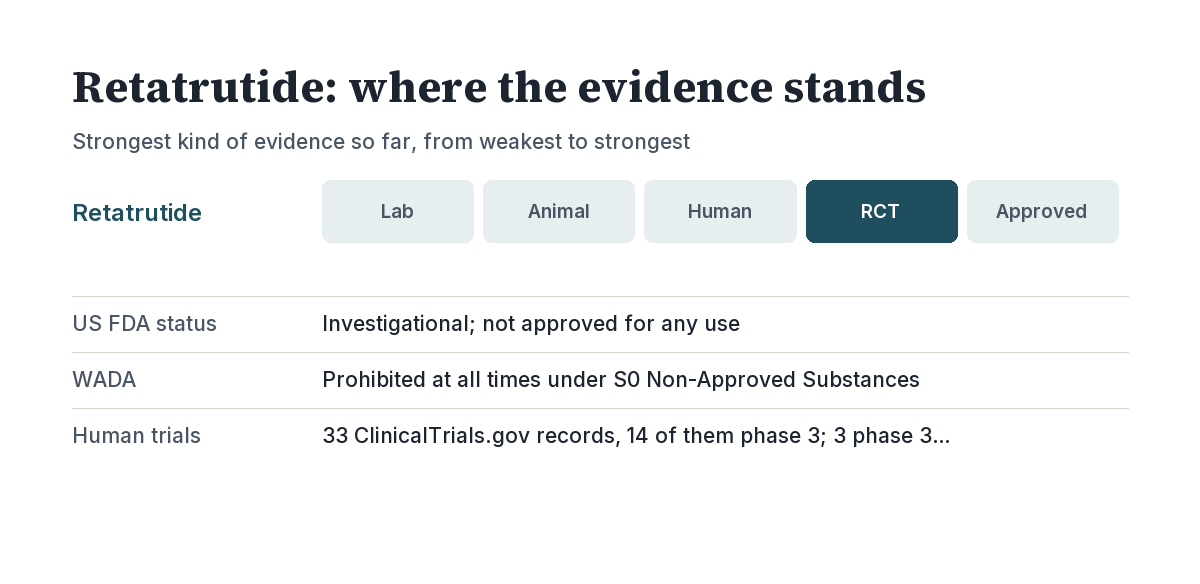
Retatrutide (LY3437943) is an investigational synthetic peptide from Eli Lilly that activates the GIP, GLP-1 and glucagon receptors at once; its strongest evidence is phase 3 randomized trials in obesity (Jastreboff 2026) and type 2 diabetes (Bellido 2026). It is not approved by the FDA or any comparable regulator (TGA). The FDA states it “cannot be used in compounding under federal law” (FDA). It cannot be obtained legally outside clinical trials or a sponsor expanded-access program. Its long-term safety and its effect on heart and kidney outcomes are not yet known.
| Item | Status |
|---|---|
| US FDA status | Investigational; not approved for any use (FDA) |
| Compounding (503A/503B) | Not eligible: “cannot be used in compounding under federal law” (FDA) |
| WADA 2026 | Prohibited at all times under S0 Non-Approved Substances (WADA) |
| Strongest evidence | Human RCT, phase 3 (n=2,339 in TRIUMPH-1) (Jastreboff 2026) |
| Human trials | 33 ClinicalTrials.gov records, 14 of them phase 3; 3 phase 3 trials published (NCT05929066, NCT05929079, NCT06354660) |
| Main risks | Nausea, vomiting, skin dysesthesia, raised heart rate; counterfeit products seized by regulators |
| Next regulatory step | Lilly plans to submit a Biologics License Application to the US FDA in the first quarter of 2027 (Lilly 8-K, 2026-08-05); no decision date announced |
| Last checked | 2026-10-24 |
Key points:
- In the 80-week TRIUMPH-1 trial in adults with obesity and without diabetes, mean weight loss was 25.0% with the 12 mg dose vs 3.9% on placebo (28.3% by the efficacy estimand, which counts people while they stayed on treatment) (Jastreboff 2026) [Human RCT, n=2,339].
- In people with type 2 diabetes, weight loss was smaller: 18.8% at 80 weeks with 12 mg vs 5.1% with placebo (Bellido 2026) [Human RCT, n=1,152].
- Abnormal skin sensations (dysesthesia) and dose-related gastrointestinal effects are the adverse effects that set it apart in trials so far.
- A product sold in Australia as retatrutide contained no retatrutide, only a high dose of undeclared semaglutide (TGA).
- The FDA has sent warning letters to sellers of compounded and “research use” retatrutide in 2025 and 2026 (FDA, 2026-08-24).
What changed (October 2026): Lilly’s company toplines for TRIUMPH-3 and TRIUMPH-4 are now in the trial table, labelled as not yet peer-reviewed, and the sleep apnea figures follow the dedicated trial paper (Grunstein 2026).
| Property | Value |
|---|---|
| Other names | LY3437943; “triple G” agonist (Coskun 2022) |
| Structure | Single synthetic peptide with non-natural residues (Aib, α-methyl-leucine) and a fatty diacid attached at lysine 17 (Li 2024) |
| Molecular formula | C221H342N46O68 (PubChem) |
| Molecular weight | About 4,731 g/mol (PubChem) |
| PubChem CID | 171934787 (sodium salt record) |
| Half-life | About 6 days in people with type 2 diabetes (Urva 2022) |
| Route studied | Subcutaneous, once weekly (Jastreboff 2023) |
| Class | GIP / GLP-1 / glucagon receptor triple agonist |
What is retatrutide?
Retatrutide was designed by Eli Lilly as one molecule that acts on three hormone receptors involved in appetite, blood sugar and energy use. The first report, in 2022, combined lab work, studies in obese mice and a single-dose phase 1 study, in which weight loss persisted up to day 43 after one dose (Coskun 2022). A phase 1b trial in type 2 diabetes followed the same year (Urva 2022), then phase 2 trials in obesity and diabetes in 2023. The phase 3 program for obesity, called TRIUMPH, enrolled more than 5,800 people across four core trials and also measures sleep apnea and knee osteoarthritis outcomes (Giblin 2026). A separate program, TRANSCEND-T2D, tests it in type 2 diabetes.
How does retatrutide work?
- GIP receptor: in cell assays, retatrutide was 8.9 times more potent than natural GIP at its receptor (Li 2024) [Lab (in vitro)].
- GLP-1 receptor: in the same assays it was less potent than natural GLP-1, by a factor of 0.4 (Li 2024) [Lab (in vitro)]. GLP-1 receptor activation is the mechanism shared with semaglutide and tirzepatide.
- Glucagon receptor: potency was 0.3 times that of natural glucagon (Li 2024) [Lab (in vitro)]; in obese mice, glucagon-receptor activity raised energy expenditure alongside reduced food intake (Coskun 2022) [Animal].
- Long action: a fatty diacid chain on lysine 17 (Li 2024) gives a half-life of about 6 days, which supports once-weekly administration (Urva 2022) [Human, phase 1b, n=72].
What the research shows
| Claim | Evidence level | Best study and result |
|---|---|---|
| Weight loss in obesity without diabetes | Human RCT (n=2,339) | Jastreboff 2026: 17.6%, 23.7%, 25.0% at 80 weeks (4, 9, 12 mg) vs 3.9% on placebo, everyone randomized |
| Weight loss in obesity with type 2 diabetes | Human RCT (n=1,152) | Bellido 2026: 11.9–18.8% vs 5.1% placebo at 80 weeks |
| Lowers HbA1c in type 2 diabetes | Human RCT (n=537) | Bajaj 2026: −1.69 to −1.94 points vs −0.81 placebo at 40 weeks |
| Reduces liver fat (MASLD) | Human RCT substudy (n=98) | Sanyal 2024: −82.4% relative liver fat at 24 weeks (12 mg) |
| Eases knee osteoarthritis pain | Human RCT (n=574, TRIUMPH-1 subgroup) | Jastreboff 2026: pain score −4.1 vs −2.5 on placebo at 80 weeks (12 mg); TRIUMPH-4 (n=445): pain score −3.7 vs −2.1 at 68 weeks (12 mg), company topline, not yet peer-reviewed (Lilly 2025) |
| Reduces sleep apnea events | Human RCT (n=243, TRIUMPH-1 subgroup) | Grunstein 2026: −31.7 vs −9.9 events per hour at 80 weeks (12 mg, TRIUMPH-1-OSA); −25.4 vs −10.3 in TRIUMPH-2-OSA (with type 2 diabetes) |
| Reduces heart or kidney events | No evidence yet | TRIUMPH-Outcomes (n=10,000) runs to 2029 |
| Raises energy expenditure | Animal | Coskun 2022: in obese mice, via the glucagon receptor |
Obesity without diabetes
In the phase 2 trial, adults with obesity, or overweight plus a weight-related condition, lost 24.2% of body weight at 48 weeks on 12 mg vs 2.1% on placebo, and 83% of the 12 mg group lost at least 15% (Jastreboff 2023) [Human RCT, n=338]. The phase 3 TRIUMPH-1 trial ran for 80 weeks. Counting everyone randomized, including people who stopped treatment (the trial’s primary analysis), mean weight loss was 17.6%, 23.7% and 25.0% for 4, 9 and 12 mg vs 3.9% on placebo; measured only while people stayed on treatment (the efficacy estimand), it was 19.0%, 25.9% and 28.3% (Jastreboff 2026; PubMed 42814954) [Human RCT, n=2,339].
Type 2 diabetes
In the phase 2 diabetes trial, HbA1c fell by up to 2.02 percentage points at 24 weeks on 12 mg, vs 0.01 on placebo and 1.41 on dulaglutide 1.5 mg (Rosenstock 2023) [Human RCT, n=281]. In TRANSCEND-T2D-1, adults managed by diet and exercise alone saw HbA1c fall by 1.69 to 1.94 points over 40 weeks, and weight by 11.5% to 15.3% vs 2.6% on placebo (Bajaj 2026) [Human RCT, n=537]. In TRIUMPH-2, which enrolled people with both obesity and type 2 diabetes, weight fell 11.9%, 16.8% and 18.8% on 4, 9 and 12 mg (Bellido 2026) [Human RCT, n=1,152]. As with other incretin drugs, weight loss was smaller in people with diabetes than in people without it.
Liver fat
A substudy of the phase 2 obesity trial enrolled participants with at least 10% liver fat. At 24 weeks, 86% of the 12 mg group had normal liver fat (below 5%), compared with 0% on placebo. The reductions tracked weight loss (Sanyal 2024) [Human RCT, n=98]. This substudy measured fat, not liver scarring. A phase 3 liver outcomes trial is recruiting (NCT07165028).
Joint pain, sleep apnea and outcomes
The TRIUMPH program measures knee osteoarthritis pain and the apnea-hypopnea index as primary endpoints in subsets of participants (Giblin 2026). In TRIUMPH-1, counting everyone randomized, the knee pain score (a 10-point scale) of 574 participants with knee osteoarthritis fell by 4.1 points on 12 mg vs 2.5 on placebo (Jastreboff 2026) [Human RCT, n=574]. In the trial’s sleep apnea arm, breathing interruptions fell by 31.7 events per hour on 12 mg vs 9.9 on placebo at 80 weeks, and by 25.4 vs 10.3 in the matching arm of TRIUMPH-2, in people who also had type 2 diabetes (Grunstein 2026) [Human RCT, n=243 and n=448].
Two more phase 3 trials have reported only as company toplines, which no journal has reviewed yet. In TRIUMPH-4 (knee osteoarthritis, 68 weeks), counting everyone randomized, weight fell 23.7% on 12 mg vs 4.6% on placebo and knee pain by 3.7 vs 2.1 points (Lilly 2025) [Human RCT, n=445]. In TRIUMPH-3 (BMI 35 or more with established heart disease, 80 weeks), weight fell 22.6% on 12 mg vs 3.2% on placebo, measured only while people stayed on treatment (the release gives no figure for everyone randomized); heart attacks, strokes and related events showed no clear difference either way (hazard ratio 0.82, 95% CI 0.55 to 1.22) (Lilly 2026) [Human RCT, n=1,949]. Whether retatrutide reduces heart attacks, strokes or kidney failure is untested until TRIUMPH-Outcomes reports.
Human studies and trials
ClinicalTrials.gov lists 33 records for retatrutide: 14 phase 1, 4 phase 2 and 14 phase 3 studies, plus one expanded-access record (ClinicalTrials.gov). The main ones:
| Trial | Phase, n, status | Result |
|---|---|---|
| NCT03841630 | Ph 1, 45, completed | Single dose; supports weekly dosing (Coskun 2022) |
| NCT04143802 | Ph 1b, 72, completed | HbA1c down up to 1.6 points; half-life about 6 days (Urva 2022) |
| NCT04881760 | Ph 2 obesity, 338, completed | −24.2% at 48 wk, 12 mg (Jastreboff 2023) |
| NCT04867785 | Ph 2 diabetes, 281, completed | HbA1c −2.02 at 24 wk (Rosenstock 2023) |
| NCT05936151 | Ph 2 kidney, 146, completed | Not yet published |
| TRIUMPH-1 | Ph 3, 2,339, completed | −25.0% vs −3.9% placebo at 80 wk, 12 mg (Jastreboff 2026) |
| TRIUMPH-2 | Ph 3, 1,152, completed | −18.8% at 80 wk, 12 mg (Bellido 2026) |
| TRIUMPH-3 | Ph 3, 1,946, completed | Obesity with heart disease: −22.6% vs −3.2% at 80 wk, 12 mg, while on treatment; company topline, no paper yet (Lilly 2026) |
| TRIUMPH-4 | Ph 3, 445, completed | Knee osteoarthritis: −23.7% vs −4.6% at 68 wk, 12 mg; company topline, no paper yet (Lilly 2025) |
| TRIUMPH-5 | Ph 3, 800, active | Head-to-head vs tirzepatide |
| TRIUMPH-6 | Ph 3, 643, active | Weight maintenance |
| TRIUMPH-7 | Ph 3, 586, active | Chronic low back pain |
| TRIUMPH-8 / TRIUMPH-9 | Ph 3, 250 / 600, active | Obesity; results due 2027–2028 |
| TRIUMPH-Outcomes | Ph 3, 10,000, active | Heart and kidney events; due 2029 |
| TRANSCEND-T2D-1 | Ph 3, 537, completed | HbA1c −1.94 at 40 wk, 12 mg (Bajaj 2026) |
| NCT06260722 | Ph 3, 1,250, active | Diabetes, vs semaglutide |
| TRANSCEND-T2D-3 | Ph 3, 320, active | Diabetes with kidney impairment |
| SYNERGY-Outcomes | Ph 3, 4,500, recruiting | Fatty liver disease; due 2030 |
| NCT07629401 | Expanded access, available | Pre-approval access via physician request |
Doses used in studies
| Route | amount | Species | Study |
|---|---|---|
| Subcutaneous, weekly | 0.5–12 mg | Human (type 2 diabetes) | Urva 2022, phase 1b |
| Subcutaneous, weekly | 1, 4, 8 or 12 mg | Human (obesity) | Jastreboff 2023, phase 2 |
| Subcutaneous, weekly | 0.5, 4, 8 or 12 mg | Human (type 2 diabetes) | Rosenstock 2023, phase 2 |
| Subcutaneous, weekly | 4, 9 or 12 mg | Human (obesity) | Jastreboff 2026, phase 3 |
| Subcutaneous, weekly | 4, 9 or 12 mg | Human (obesity and diabetes) | Bellido 2026, phase 3 |
In these trials, doses were reached in steps under medical supervision, with safety monitoring. No established human dose exists outside approved labels.
Side effects and safety
Reported adverse effects
- Gastrointestinal: nausea, diarrhea, constipation and vomiting were the most common adverse effects. They were dose-related and mostly mild to moderate (Jastreboff 2023) [Human RCT, n=338]. In TRIUMPH-1, 42.4% of people on 12 mg reported nausea vs 14.8% on placebo, and 25.3% reported vomiting vs 4.8% (Jastreboff 2026) [Human RCT, n=2,339].
- Dysesthesia (abnormal skin sensations such as tingling or skin sensitivity): 12.5% on 12 mg vs 0.9% on placebo in TRIUMPH-1 (Jastreboff 2026) [Human RCT]. This effect is not prominent with GLP-1-only drugs.
- Urinary tract infections: 8.4% on 12 mg vs 5.3% on placebo in TRIUMPH-1 (Jastreboff 2026) [Human RCT].
- Heart rate: dose-dependent increases in heart rate peaked at 24 weeks and declined after that (Jastreboff 2023) [Human RCT, n=338].
- Stopping treatment: 11.3% of the 12 mg group stopped because of adverse events vs 4.9% on placebo in TRIUMPH-1 (Jastreboff 2026). The figure was 2–5% in the 40-week TRANSCEND-T2D-1 trial (Bajaj 2026).
- Hypoglycemia: no severe hypoglycemia occurred in the phase 2 diabetes trial (Rosenstock 2023) [Human RCT, n=281].
Unknowns
No trial has yet reported how retatrutide affects heart attacks, strokes or kidney failure. That question is the purpose of TRIUMPH-Outcomes, which runs to 2029 (NCT06383390). The longest published placebo-controlled exposure is 80 weeks (Jastreboff 2026). Rare adverse effects, and effects in pregnancy, children and older adults with several illnesses, therefore remain uncharacterized.
Counterfeit and unregulated products
Outside trials, products labelled retatrutide have no quality control. In a 2026 safety alert, Australia’s TGA reported a serious adverse event: a person suffered a torn oesophagus after using a product sold as retatrutide. Laboratory testing found the product contained no retatrutide. Instead it held undeclared semaglutide at roughly eight times the level in approved semaglutide products (TGA). A 2026 case report describes a person with type 1 diabetes who developed severe vomiting, diarrhea and ketonemia of 4.3 mmol/L after using an online-sourced “retatrutide” product. A Shigella infection was also found, so the product cannot be confirmed as the cause (Branine 2026) [Human case report, n=1]. A second 2026 case report describes a woman in her mid-20s admitted to hospital with persistent nausea, vomiting and loose stools after four weekly injections of an unverified product said to contain retatrutide, given in a wellness setting by a life coach with no medical qualification; no other cause was found and her symptoms resolved within a week (Buzzi 2026) [Human case report, n=1]. The FDA warns that sellers of retatrutide falsely label their products “for research purposes” or “not for human consumption” (FDA).
Who should not use it
No approved label exists, so no regulator-defined list of contraindications exists either. The TGA advises that any retatrutide product accessed outside a clinical trial could be counterfeit and should not be used (TGA). Health Canada names retatrutide among unauthorized peptide drugs that “should all be avoided” (Health Canada).
Legal and regulatory status
| Jurisdiction | Status (checked 2026-09-30) |
|---|---|
| US FDA | Not approved; “not components of FDA-approved drugs” (FDA) |
| US compounding | Not permitted under 503A or 503B (FDA letter, 2025-09-09) |
| US pre-approval access | Sponsor expanded access listed as available (NCT07629401) |
| WADA 2026 | S0 Non-Approved Substances, prohibited at all times (WADA) |
| UK (MHRA) | Unlicensed; seized in a 2026 raid (MHRA) |
| Australia (TGA) | Unapproved; counterfeit warning (TGA) |
| Canada | Unauthorized; public advisory 2026-04-09 (Health Canada) |
Retatrutide is not named individually on the WADA list. The 2027 List, in force from 1 January 2027, names “peptides” in general in S0 (USADA). The S0 class covers any pharmacological substance with no current approval by any government health authority for human therapeutic use, including drugs in clinical development, and retatrutide fits that description (WADA).
Dated regulatory events
- 2025-09-09: an FDA warning letter to a compounder found its compounded retatrutide products were “unapproved new drugs.” The letter noted that retatrutide has no USP monograph, is not a component of an approved drug and is not on the 503B bulks list (FDA).
- 2026-04-09: Health Canada issued a public advisory listing retatrutide among unauthorized peptide drugs (Health Canada).
- 2026-05-28: the MHRA raided a site believed to be manufacturing and distributing unlicensed weight-loss medicines, including retatrutide (MHRA).
- 2026-08-24: FDA warning letters to “research peptide” sellers treated a product called “GLP-3R” (retatrutide) as an unapproved new drug marketed for human use (FDA).
- 2026-09-29: the TRIUMPH-1 and TRIUMPH-2 results were published in peer-reviewed journals (NEJM; Lancet).
- 2026-10-21: the sleep apnea results of TRIUMPH-1 and TRIUMPH-2 were published in a peer-reviewed journal (NEJM).
Related peptides
Retatrutide belongs to the GLP-1 and incretin class. Its nearest relatives are semaglutide and tirzepatide, the active ingredients of FDA-approved medicines, and the investigational agonists survodutide and mazdutide. The FDA names all of these in its warnings about unapproved and falsely labelled “research” products (FDA). None of them has an entry on this site yet.
What users report
What follows is a summary of unverified self-reports posted by people online, most of whom say they obtained retatrutide as an unregulated “research” product rather than through a supervised medical program; none of this constitutes evidence of safety or effectiveness. Retatrutide (LY3437943) is an investigational triple agonist targeting GLP-1, GIP, and glucagon receptors, still in clinical trials and not approved for human use anywhere, so anything sold to individuals outside a trial is illegal for that purpose and unregulated. People who post about using it commonly report a strong drop in appetite within the first one to two weeks, followed by steady weight loss described as faster than what they recall from other GLP-1-type products, along with noticeable fatigue, occasional nausea, and sometimes a racing or pounding heartbeat.
A recurring complaint is skin irritation or a burning, sunburn-like sensation at the injection site, along with insomnia and general exhaustion that some describe as more intense than expected. Others report no meaningful effect at all and question whether their product was genuine, since fakes, underdosed vials, and contaminated batches are widely discussed concerns in these communities. Frequent arguments center on how to judge product authenticity, whether reported effects are real or placebo, and whether trying an unapproved compound is worth the legal and health risk.
Frequently asked questions
Is retatrutide FDA approved?
No. Retatrutide is an investigational drug and is not approved by the FDA for any condition. The FDA says it is not a component of any FDA-approved drug and “cannot be used in compounding under federal law” (FDA). Legal use is limited to registered clinical trials and a sponsor expanded-access program requested by physicians.
How much weight did people lose on retatrutide in trials?
In the phase 3 TRIUMPH-1 trial in adults with obesity and without diabetes, mean weight loss at 80 weeks was 17.6%, 23.7% and 25.0% on 4, 9 and 12 mg vs 3.9% on placebo, counting everyone randomized (28.3% on 12 mg while participants stayed on treatment) (Jastreboff 2026). People with type 2 diabetes lost less, up to 18.8% in TRIUMPH-2.
What are the side effects of retatrutide?
The most common are nausea, vomiting, diarrhea and constipation, which rise with dose. In TRIUMPH-1, 12.5% of people on 12 mg reported dysesthesia, meaning abnormal skin sensations, vs 0.9% on placebo, and 11.3% stopped treatment because of adverse events (Jastreboff 2026). Heart-rate increases were also seen in phase 2.
Is “GLP-3” the same as retatrutide?
“GLP-3” is not a hormone or an official drug name. It is a label used by unregulated sellers for products claimed to be retatrutide. In an August 2026 warning letter the FDA treated a “GLP-3R” product as unapproved retatrutide (FDA). Such products may not contain retatrutide at all.
Is retatrutide banned in sport?
Yes. Retatrutide has no regulatory approval anywhere, so it falls under WADA’s S0 Non-Approved Substances class. S0 covers drugs in clinical development and is prohibited in and out of competition (WADA). Athletes in a WADA-code sport who use it risk an anti-doping rule violation.
How can I join a retatrutide trial?
Through a trial site, not a seller. ClinicalTrials.gov lists each retatrutide study with its recruitment status, eligibility criteria and site contacts, and the study team decides who can enrol. One trial recruiting as of October 2026 is the phase 3 SYNERGY-Outcomes study in fatty liver disease, which plans to randomize about 4,500 adults and has no results yet (NCT07165028) [Human RCT, ongoing].
References
- Coskun T, Urva S, Roell WC, et al. LY3437943, a novel triple glucagon, GIP, and GLP-1 receptor agonist for glycemic control and weight loss. Cell Metab. 2022;34(9):1234-1247. PubMed 35985340
- Urva S, Coskun T, Loh MT, et al. LY3437943, a novel triple GIP, GLP-1, and glucagon receptor agonist in people with type 2 diabetes: a phase 1b trial. Lancet. 2022;400(10366):1869-1881. PubMed 36354040
- Li W, Zhou Q, Cong Z, et al. Structural insights into the triple agonism at GLP-1R, GIPR and GCGR manifested by retatrutide. Cell Discov. 2024. PMC11255275
- Jastreboff AM, Kaplan LM, Frías JP, et al. Triple-hormone-receptor agonist retatrutide for obesity: a phase 2 trial. N Engl J Med. 2023;389(6):514-526. PubMed 37366315
- Rosenstock J, Frias J, Jastreboff AM, et al. Retatrutide, a GIP, GLP-1 and glucagon receptor agonist, for people with type 2 diabetes: a phase 2 trial. Lancet. 2023;402(10401):529-544. PubMed 37385280
- Sanyal AJ, Kaplan LM, Frias JP, et al. Triple hormone receptor agonist retatrutide for metabolic dysfunction-associated steatotic liver disease: a randomized phase 2a trial. Nat Med. 2024;30(7):2037-2048. PubMed 38858523
- Jastreboff AM, Kaplan LM, Davies MJ, et al., for the TRIUMPH-1 Investigators. Retatrutide, a triple hormone receptor agonist, for treatment of obesity. N Engl J Med. Published 2026-09-29. doi:10.1056/NEJMoa2604169
- Bellido V, le Roux CW, Ekinci EI, et al. Retatrutide in adults with obesity and type 2 diabetes (TRIUMPH-2): a phase 3 trial. Lancet. 2026 Sep 29. PubMed 42810372
- Bajaj HS, Welch M, Shah P, et al. Efficacy and safety of retatrutide in people with type 2 diabetes and inadequate glycaemic control with diet and exercise (TRANSCEND-T2D-1): a phase 3 trial. Lancet. 2026;407(10546):2402-2413. PubMed 42250575
- Giblin K, Kaplan LM, Somers VK, et al. Retatrutide for the treatment of obesity, obstructive sleep apnea and knee osteoarthritis: rationale and design of the TRIUMPH registrational clinical trials. Diabetes Obes Metab. 2026;28(1):83-93. PubMed 41090431
- Branine N. Online-sourced retatrutide complicating impending diabetic ketoacidosis in a patient with type 1 diabetes. Cureus. 2026;18(8):e115260. PubMed 42669023
- ClinicalTrials.gov. Studies with intervention “retatrutide” (33 records, accessed 2026-09-30). clinicaltrials.gov
- US Food and Drug Administration. FDA’s concerns with unapproved GLP-1 drugs used for weight loss (content current as of 2026-09-01). fda.gov
- US Food and Drug Administration. Warning letter, GLP-1 Solution, 2025-09-09. fda.gov
- US Food and Drug Administration. Warning letter, Peak Performance Peptides, 2026-08-24. fda.gov
- World Anti-Doping Agency. The Prohibited List (2026, in force from 1 January 2026). wada-ama.org
- Medicines and Healthcare products Regulatory Agency. Two arrested during the MHRA’s largest-ever seizure of unlicensed weight-loss medicines. 2026. gov.uk
- Therapeutic Goods Administration. TGA tests counterfeit retatrutide product following serious adverse event report. 2026. tga.gov.au
- Health Canada. Think twice before injecting peptides bought online: unauthorized products can seriously harm you. 2026-04-09. recalls-rappels.canada.ca
- PubChem. Retatrutide (sodium salt), CID 171934787. National Center for Biotechnology Information. pubchem.ncbi.nlm.nih.gov
- Grunstein RR, et al., for the TRIUMPH-1-OSA and TRIUMPH-2-OSA Investigators. Retatrutide once weekly for treatment of obstructive sleep apnea. N Engl J Med. Published 2026-10-21. PubMed 42904878
- Eli Lilly and Company. Lilly’s triple agonist, retatrutide, successful in two additional Phase 3 obesity trials, delivering significant improvements in weight and A1C (TRIUMPH-2, TRIUMPH-3). Press release, 2026-07-23. investor.lilly.com
- Eli Lilly and Company. TRIUMPH-4 topline results for retatrutide. Press release, 2025-12-11. investor.lilly.com
- US Anti-Doping Agency. Athlete advisory: 2027 Prohibited List. 2026-10-06. usada.org
Change log
2026-10-26: new H1; TRIUMPH-3 and TRIUMPH-4 company toplines added and labelled as not yet peer-reviewed; sleep apnea figures aligned with the dedicated trial paper (Grunstein 2026); 2027 WADA List wording added; FAQ moved out of the user-reports box; reviewed by the editorial team.
2026-10-26: links to related entries added; no change to the facts.
2026-10-24: sleep-apnea status-box figure corrected to the dedicated TRIUMPH-1-OSA/TRIUMPH-2-OSA NEJM paper (Grunstein 2026), replacing a misattributed citation; TRIUMPH-2-; reviewed by the editorial team.
2026-10-23: links to glossary definitions added; no change to the facts.
2026-10-19: links to related entries added; no change to the facts.
2026-10-13: headline shortened on 2026-10-12 (now “Retatrutide: benefits, evidence and legal status”); no change to the facts.
2026-10-11: A second 2026 case report of harm from an unverified ‘retatrutide’ product added; reviewed by the editorial team.
2026-10-05: evidence figure redrawn to match the status box; reviewed by the editorial team.
2026-10-04: FAQ expanded with one question readers search for (joining a trial); reviewed by the editorial team.
2026-10-04: TRIUMPH-1 results updated to the peer-reviewed NEJM paper (n=2,339; 25.0% weight loss on 12 mg counting everyone randomized, efficacy figures labelled; knee osteoarthritis and sleep apnea results added); reviewed by the editorial team.
2026-09-30: status box updated with the FDA advisory committee vote / next regulatory step (Study loop L-2).
2026-09-30: added “What users report” (summarised public anecdote, labelled as such).
2026-09-30: first published after review by the editorial team.