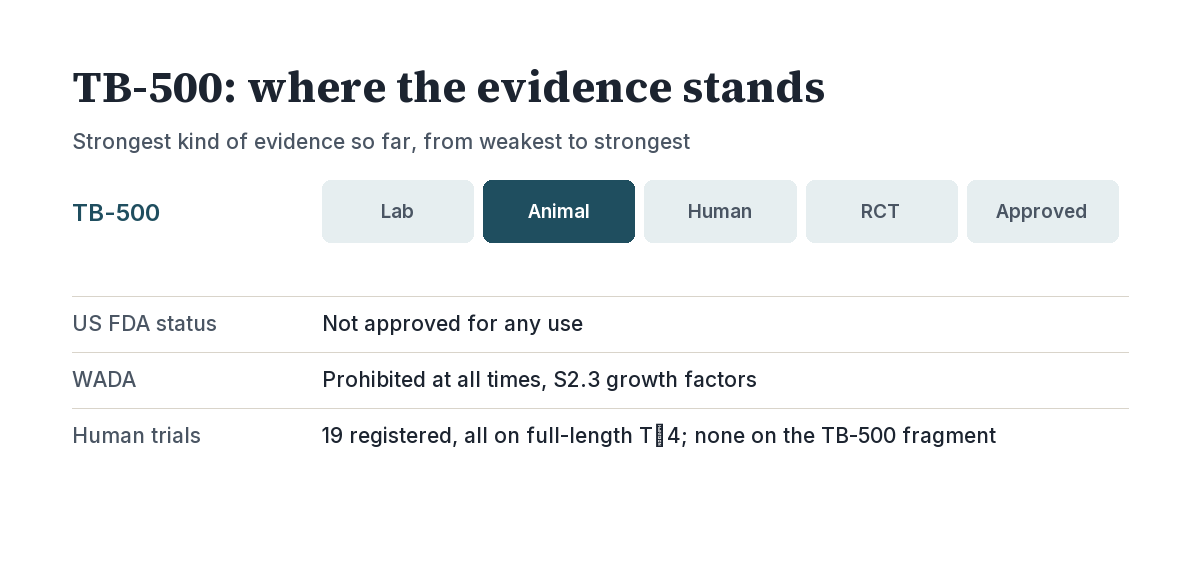
TB-500 is a synthetic peptide marketed as a form of thymosin beta-4 (Tβ4), a natural 43-amino-acid protein that binds actin. The TB-500 product that doping chemists analyzed contained a seven-amino-acid piece of Tβ4, the acetylated fragment Ac-LKKTETQ (Esposito 2012). Evidence for the fragment itself is limited to lab work, one mouse study in which a synthetic peptide containing the actin-binding domain promoted dermal wound repair in aged mice about as well as full-length Tβ4 [Animal] (Philp 2003b), and one uncontrolled 2026 report of three patients given it with BPC-157 and other drugs [Human (case series, n=3)] (Froum 2026).
Thymosin beta-4 (Tβ4), the protein TB-500 is derived from, has promising repair results: it sped wound closure in rats and reduced heart-attack damage in pigs [Animal] (Malinda 1999; Hinkel 2008). Neither TB-500 nor Tβ4 is FDA approved for any use, and FDA states it has identified no human exposure data for the fragment (FDA). Full-length Tβ4 has reached human trials as a skin gel, eye drop and intravenous drug; the largest, a 700-person dry-eye phase 3, posted primary-endpoint results similar to placebo (NCT03937882). WADA prohibits both at all times (WADA 2026 List).
| Item | Status |
|---|---|
| US FDA status | Not approved for any use (TB-500 or Tβ4) |
| Compounding (503A/503B) | Withdrawn from FDA Category 2 by the nominator; PCAC voted 2026-07-23 to recommend 503A listing; no rule issued |
| WADA 2026 | Prohibited at all times, S2.3 growth factors (“thymosin-β4 and its derivatives e.g. TB-500”) |
| Australia (TGA) | Schedule 4 (prescription-only) since 2016 |
| Strongest evidence | Animal (mice) for the TB-500 fragment Ac-LKKTETQ, plus lab work; full-length Tβ4 has human RCTs with mixed or null results |
| Human trials | 19 registered, all on full-length Tβ4; none on the TB-500 fragment |
| Last checked | 2026-10-18 |
Key points:
- Most published research concerns full-length Tβ4, not TB-500; in human cell cultures the LKKTETQ actin-binding motif was essential for Tβ4’s blood-vessel-forming activity [Lab] (Philp 2003), which is the main rationale for the fragment.
- An FDA advisory committee voted to recommend TB-500 for the 503A bulks list for wound healing; the vote is non-binding (FDA PCAC).
- Intravenous Tβ4 at 42–1,260 mg daily for 14 days caused no dose-limiting toxicity in 40 healthy volunteers [Human RCT, n=40] (Ruff 2010); no comparable data exist for TB-500.
- In mice, melanoma cells made to overproduce Tβ4 formed about four times as many lung metastases [Animal] (Cha 2003).
What changed (October 2026): a table now sets the TB-500 fragment beside full-length thymosin beta-4, two 2026 reviews of peptides in sports medicine are summarized under injury recovery, and the 2027 WADA List status is added.
| Property | Value |
|---|---|
| Length | Tβ4: 43 amino acids (Guarnera 2010). TB-500 fragment: 7 amino acids, Ac-LKKTETQ, Tβ4 residues 17–23 (Esposito 2012) |
| Molecular formula (Tβ4) | C212H350N56O78S (PubChem) |
| Molecular weight (Tβ4) | About 4,963 g/mol (PubChem) |
| PubChem CID (Tβ4) | 45382195 |
| Half-life | No single value; rose with dose after IV Tβ4 in humans (Ruff 2010) |
| Routes studied | Humans: IV, topical skin gel, eye drops. Animals: topical, intraperitoneal, coronary-vein infusion |
| Class | Beta-thymosin; actin-sequestering peptide (Safer 1991) |
What is TB-500 (thymosin beta-4)?
Thymosin beta-4 is a widespread actin-binding protein. In 1991 it was shown to be identical to “Fx”, a peptide that holds single actin molecules and stops them from assembling into filaments (Safer 1991). Wound-healing work in rats followed (Malinda 1999), and the company RegeneRx took synthetic Tβ4 into human trials as a skin gel, an eye drop and an IV drug (Guarnera 2010).
“TB-500” is a different thing: a name used on unapproved products. Doping chemists described TB-500 as a synthetic version of Tβ4’s active region and detected N-acetylated LKKTETQ and its metabolites in horses given it (Ho 2012). Products sold online claim to contain either the fragment or full-length Tβ4 (Delcourt 2025), so the name does not reliably tell which molecule is inside.
The two molecules side by side, as of October 2026:
| Item | TB-500 fragment | Full-length Tβ4 |
|---|---|---|
| Size | 7 amino acids (Ac-LKKTETQ, Tβ4 residues 17–23) | 43 amino acids |
| Human trials | None registered; one uncontrolled report of 3 patients (Froum 2026) | 19 registered: IV, skin gel and eye drops (ClinicalTrials.gov) |
| Strongest evidence | Animal (one mouse wound study) | Human RCT; dry-eye phase 3 results similar to placebo |
| US FDA | Not approved; FDA advisers voted on 2026-07-23 to recommend it for the 503A compounding list; no rule issued (FDA PCAC) | Not approved for any use |
| WADA, 2026 and 2027 | Prohibited at all times (S2) | Prohibited at all times (S2) (USADA) |
How does TB-500 work?
- Actin sequestering: Tβ4 forms a 1:1 complex with actin monomers and blocks their polymerization into filaments [Lab] (Safer 1991).
- Cell migration and new vessels: in human endothelial cells, the seven-amino-acid actin-binding motif was essential for Tβ4’s angiogenic activity, and the motif alone matched full-length Tβ4’s activity at about 50 nM [Lab] (Philp 2003).
- Cell-survival signaling: Tβ4 activated integrin-linked kinase (ILK) and Akt, enzymes that keep cells alive under stress; in mice after coronary artery ligation it improved early heart-muscle survival and heart function [Lab; Animal] (Bock-Marquette 2004).
- Anti-fibrotic breakdown product: the kidney enzymes meprin-α and prolyl oligopeptidase cut Tβ4 to release the four-amino-acid peptide Ac-SDKP [Animal] (Kumar 2016). Ac-SDKP comes from Tβ4’s first four residues, so the residue 17–23 fragment cannot supply it.
What the research shows
Thymosin beta-4’s potential benefits are in tissue repair. In rats it increased wound re-epithelialization by 42% at day 4 [Animal] (Malinda 1999), and in pigs it cut infarct size to 37% of the area at risk versus 54% [Animal, n=9 per group] (Hinkel 2008). In people, a pressure-ulcer trial healed 8 of 54 on Tβ4 versus 3 of 18 on placebo by day 84 [Human RCT, n=72, inconclusive] (NCT00382174), and a corneal trial healed 6 of 10 versus 1 of 8, short of statistical significance (p=0.0656) [Human RCT, n=18] (Sosne 2022). All of these used full-length Tβ4, not the TB-500 fragment.
The table grades each claim made for TB-500 or Tβ4 by the strongest evidence behind it. Every human row concerns full-length Tβ4.
| Claim | Evidence level | Best study and result |
|---|---|---|
| Binds actin and controls cell movement | Lab | Safer 1991: 1:1 complex with actin monomers |
| Speeds skin wound closure | Animal; Human RCT (n=73), weak | Malinda 1999, rats: re-epithelialization +42% at day 4. Guarnera 2010: about 25% of venous ulcers healed in 3 months |
| Heals pressure ulcers | Human RCT (n=72), inconclusive | NCT00382174: healed by day 84 in 8/54 on Tβ4 vs 3/18 on placebo |
| Relieves dry eye | Human RCT (n=700), not confirmed | ARISE-3: primary endpoints changed similarly in both arms |
| Heals neurotrophic keratopathy | Human RCT (n=18), trend | Sosne 2022: complete healing 6/10 vs 1/8 (p=0.0656) |
| Protects the heart after infarction | Animal (mice, pigs) | Hinkel 2008, pigs (n=9/group): infarct 37% vs 54% of area at risk |
| Reduces fibrosis | Animal | Zuo 2013, mice: Ac-SDKP consistently antifibrotic; intact Tβ4 context-dependent |
| Repairs tendons, muscle or joints in people | No human data | No musculoskeletal trial on ClinicalTrials.gov |
| TB-500 fragment works in people | No trial; one uncontrolled 3-patient report, given with other drugs | FDA: no human exposure data identified |
| May promote tumor spread (risk) | Animal; Lab | Cha 2003, mice: lung nodules 46.7 vs 10.9 |
Skin wounds
In rats with full-thickness wounds, topical or intraperitoneal Tβ4 increased re-epithelialization by 42% over saline at day 4 and by up to 61% at day 7 [Animal] (Malinda 1999). In people, a 73-patient European phase 2 trial of topical Tβ4 for venous ulcers found safety comparable to placebo; the authors wrote that a 0.03% dose “may have the potential” to speed healing, with about 25% of patients fully healed within 3 months [Human RCT, n=73] (Guarnera 2010). That wording describes a signal, not a demonstrated benefit.
Eye surface
Tβ4 eye drops (RGN-259) have the largest human dataset. A 9-patient trial in severe dry eye reported 35.1% less discomfort than vehicle at day 56 [Human RCT, n=9] (Sosne 2015, Cornea). A 72-patient phase 2 missed both primary endpoints, with some secondary endpoints positive [Human RCT, n=72] (Sosne 2015, Clin Ophthalmol). The two phase 3 trials that followed, ARISE-2 (n=601) and ARISE-3 (n=700), posted primary-endpoint results that were similar between drug and placebo (NCT02974907; NCT03937882). In neurotrophic keratopathy, a nerve-damage condition of the cornea, 6 of 10 treated patients healed completely at 4 weeks versus 1 of 8 on placebo, which did not reach statistical significance (p=0.0656) [Human RCT, n=18] (Sosne 2022).
Heart
In mice after coronary ligation, Tβ4 improved early heart-muscle survival and cardiac function [Animal] (Bock-Marquette 2004). In pigs, 15 mg of Tβ4 infused into the coronary veins cut infarct size to 37% of the area at risk versus 54% in controls [Animal, n=9 per group] (Hinkel 2008). Two Chinese phase 2 trials of recombinant Tβ4 in heart attack patients are listed as completed, but no results are posted (NCT05485818; NCT05984134).
Fibrosis
In a mouse kidney-obstruction model, Ac-SDKP had consistent antifibrotic effects, while intact Tβ4’s effects depended on the protein PAI-1 [Animal] (Zuo 2013). Because Ac-SDKP is cut from Tβ4’s opposite end, these findings do not apply to the TB-500 fragment.
Injury recovery and muscle
TB-500 is widely promoted for tendon, ligament and muscle injuries. No completed or registered musculoskeletal trial of Tβ4 or TB-500 appears on ClinicalTrials.gov, and FDA found no human exposure data for the fragment (FDA). Claims in this area rest on the cell and animal work above and on anecdotal reports.
Two 2026 reviews for sports medicine reached the same view. A scoping review of TB-500, BPC-157 and four other peptides found that about two-thirds of the publications were animal studies, mostly in rats, that the few human studies mostly lacked robust controls, and that the claimed benefits are not supported by current human trials; its authors advise against using these peptides in place of, or alongside, standard orthopedic care [Scoping review] (Tewari 2026). A narrative review of approved and unapproved peptides, TB-500 and Tβ4 among them, found favorable tissue-repair results in animals but scarce human safety data and a potential for serious harm [Narrative review] (Mendias and Awan 2026).
Human studies and trials
ClinicalTrials.gov lists 19 trials of full-length Tβ4. Its only record naming the TB-500 fragment describes itself as fictional (below), so no genuine trial of the fragment is registered.
| Trial | Population, n, status | Result |
|---|---|---|
| Ruff 2010, phase 1, IV | Healthy, 40, published | No dose-limiting toxicity or serious AEs (PubMed) |
| NCT00743769, phase 1, IV | Healthy, 0, withdrawn | None |
| NCT04555824, phase 1a, IV | Healthy, 54, completed | No serious AEs (Wang 2021) |
| NCT04555850, phase 1b, IV | Healthy, 30, completed | No accumulation, no serious AEs (Wang 2021) |
| NCT00382174, phase 2, gel | Pressure ulcers, 72, completed | Healed 8/54 vs 3/18 |
| NCT00832091, phase 2, gel | Venous ulcers, 72, completed | Signal at 0.03%; safety like placebo |
| NCT00311766, phase 2, gel | Epidermolysis bullosa, 30, terminated | Stopped: few patients, drug expired |
| NCT03578029, phase 2, gel | Epidermolysis bullosa, 4, terminated | No results posted |
| NCT00598871, phase 2, eye | Corneal wounds, 12, terminated | Terminated early |
| NCT01393132, phase 2, eye | Severe dry eye, 9, completed | 35.1% less discomfort at day 56 |
| NCT01387347, phase 2, eye | Dry eye, 72, completed | Primary endpoints missed |
| NCT02597803 ARISE-1, phase 2/3 | Dry eye, 317, completed | No results posted |
| NCT02974907 ARISE-2, phase 3 | Dry eye, 601, completed | Primary endpoints similar to placebo |
| NCT03937882 ARISE-3, phase 3 | Dry eye, 700, completed | Primary endpoints similar to placebo |
| NCT02600429 SEER-1, phase 3 | Neurotrophic keratopathy, 18, terminated | Healing 6/10 vs 1/8, p=0.0656 |
| NCT05555589 SEER-2, phase 3 | Neurotrophic keratopathy, 70 planned, listed recruiting | None yet |
| NCT01311518, phase 2, IV | Heart attack, 0, withdrawn | None |
| NCT05485818, phase 2, IV | Heart attack, 62, completed | No results posted |
| NCT05984134, phase 2, IV | Heart attack, 90, completed | No results posted |
| NCT07586865, phase 2, IV | Heart attack, 189, not yet recruiting | None yet |
The one record naming the fragment is not a real trial: its own summary calls it a “fictional study” and “an example of a ClinicalTrials.gov-style record” (NCT07487363). SEER-2’s listed completion date of May 2026 has passed while the record still shows “recruiting” (NCT05555589).
Doses used in studies
The amounts below come from published studies and trial records of full-length Tβ4. None were tested with the TB-500 fragment.
| Route and amount | Species | Study |
|---|---|---|
| IV, 42–1,260 mg single, then daily for 14 days | Human (healthy) | Ruff 2010 |
| IV recombinant, 0.05–25 μg/kg single; 0.5–5 μg/kg daily for 10 days | Human (healthy) | Wang 2021 |
| Topical gel, 0.01–0.1% w/w, daily up to 84 days | Human (pressure ulcers) | NCT00382174 |
| Eye drops, 0.1%, 6 times daily for 28 days | Human (severe dry eye) | Sosne 2015 |
| Coronary-vein infusion, 15 mg once | Pig | Hinkel 2008 |
No established human dose exists outside approved labels. No approved label for Tβ4 or TB-500 exists.
Side effects and safety
Reported adverse effects
In healthy volunteers given IV Tβ4, adverse events were infrequent and mild or moderate, with no serious events [Human RCT, n=40] (Ruff 2010); a Chinese phase 1 of recombinant Tβ4 reported the same pattern [Human RCT, n=84] (Wang 2021). In ARISE-3, instillation-site pain occurred in 23 of 350 on RGN-259 versus 16 of 349 on placebo, and reduced visual acuity in 12 versus 7, with no serious events in either arm [Human RCT, n=700] (NCT03937882). In the pressure-ulcer trial, 13 of 54 on Tβ4 and 5 of 18 on placebo had serious adverse events, mostly infections such as sepsis and osteomyelitis [Human RCT, n=72] (NCT00382174). These data cover short courses in trials; long-term human safety is unknown, and none of it applies to the fragment.
Theoretical risks
The processes Tβ4 promotes, cell migration and new blood vessel growth, are also used by tumors. In mice, melanoma cells engineered to overproduce Tβ4 migrated 2.3-fold more and formed 46.7 lung nodules versus 10.9 for controls [Animal] (Cha 2003). In human colorectal cancer samples, high Tβ4 gene expression was associated with distant metastasis [Human observational] (Wang 2004). These studies raised Tβ4 inside cancer cells; they do not show that taking the peptide causes cancer, and no study has tested that question in people. FDA also lists a risk of immune reactions (immunogenicity) from peptide aggregation and impurities in compounded fragment products (FDA).
Unregulated products
Products sold as TB-500 are not made under drug-quality oversight. FDA’s review names peptide-related impurities as a concern (FDA). In horses, a non-natural synthesis impurity was detectable in plasma after a single dose of a Tβ4 product [Animal] (Delcourt 2025), and product labels do not consistently state whether the fragment or full-length protein is inside.
Who should not use it
No regulator has issued a label, so no official contraindication list exists. Athletes subject to anti-doping rules are barred from it at all times (WADA 2026 List). The tumor findings above are the reason cancer is treated as an open safety question.
Legal and regulatory status
| Jurisdiction | Status | Source |
|---|---|---|
| US FDA | Not approved; no human exposure data for the fragment | FDA, updated 2026-04-22 |
| US compounding | Withdrawn from Category 2; not on the 503A bulks list | FDA, updated 2026-04-22 |
| US FDA advisory committee | Voted to recommend 503A listing (wound healing); non-binding | FDA PCAC, 2026-07-23 |
| WADA 2026 | Prohibited at all times, S2.3 | WADA 2026 List |
| WADA 2027 (from 2027-01-01) | Still prohibited at all times, S2 | USADA, 2026-10-06 |
| Australia | Schedule 4 and Appendix D, Item 5 | TGA, 2016 |
In the US, FDA’s Category 2 page lists “thymosin beta-4, fragment (LKKTETQ)” among substances whose nominations were withdrawn, together with FDA’s stated concerns: possible immunogenicity and no identified human exposure data (FDA). Withdrawal from Category 2 is not placement on the 503A bulks list. On 2026-07-23 the Pharmacy Compounding Advisory Committee considered TB-500 (free base) and TB-500 acetate for wound healing (FDA PCAC). Its vote in favor is advice to FDA; adding the substance to the list would take notice-and-comment rulemaking, and none has been proposed.
In sport, thymosin-β4 and its derivatives, including TB-500, were added as named examples of prohibited growth factors under S2.3 in 2018 (USADA), and the 2026 List keeps them there (WADA). In 2017 a US weightlifter received a four-year ban after admitting possession of Tβ4 and several growth hormone releasing peptides (USADA sanction). USADA’s summary of the 2027 List, in force from 1 January 2027, still lists TB-500 and thymosin-beta 4 as prohibited under S2 (USADA). The 2027 List is covered in the WADA banned peptides 2027 entry.
In Australia, the medicines scheduling delegate placed thymosin beta-4 and TB-500 in Schedule 4 (prescription-only) and Appendix D, Item 5, citing limited research and the absence of any approved form of Tβ4 anywhere (TGA).
Related peptides
- BPC-157 (Body Protection Compound 157): another tissue-repair peptide with mainly animal evidence, reviewed by the same FDA committee in July 2026.
- GHK-Cu (copper tripeptide-1): a copper-binding peptide studied in skin and wound research.
What users report
What follows are unverified self-reports from people who say they have used TB-500, most of whom bought it as an unregulated research chemical rather than a prescribed product, and none of this should be treated as evidence that it works or is safe. On forums like Reddit’s peptide communities, bodybuilding boards, and biohacking social media, people who post about TB-500 commonly report faster recovery from tendon, ligament, or muscle injuries, less joint stiffness, and a general sense of reduced inflammation, often saying they noticed changes over several weeks rather than days. Some also describe softer or fuller-feeling connective tissue and, less often, hair regrowth.
A recurring complaint is that results are inconsistent: many posters say they felt little or nothing, and this often turns into an argument about whether the product they bought was genuine, correctly represented, or effectively worthless due to poor manufacturing. Injection-site soreness, redness, and occasional flu-like fatigue or a brief head-rush after dosing are frequently mentioned as side effects, alongside frustration over the cost of maintaining regular use. Threads also debate whether reported benefits are a real drug effect or placebo, since users can’t verify purity or potency themselves.
Because TB-500 is not an FDA-approved drug and exists in a legal gray area as an unregulated research chemical, people discussing it online frequently warn each other about counterfeit or underdosed vials and disagree over which sellers can be trusted, though no one in these communities can independently confirm what is actually in the product they used.
Frequently asked questions
Is TB-500 the same as thymosin beta-4?
Not exactly. Thymosin beta-4 is a natural 43-amino-acid protein, while the TB-500 product analyzed by anti-doping chemists contained a synthetic acetylated seven-amino-acid piece of it, Ac-LKKTETQ (Esposito 2012). Some products sold as TB-500 claim to contain full-length Tβ4 instead, and nearly all human research used the full-length protein, not the fragment.
Is TB-500 FDA approved?
No. Neither TB-500 nor thymosin beta-4 is approved for any use in the US. An FDA advisory committee voted in July 2026 to recommend TB-500 for the 503A compounding list, but that vote is non-binding and no rule has been issued (FDA PCAC). FDA reports no human exposure data for the fragment (FDA).
Is TB-500 banned in sports?
Yes. WADA prohibits thymosin-β4 and its derivatives, naming TB-500 as an example, under class S2.3 growth factors, both in and out of competition (WADA 2026 List). Doping laboratories have published methods that detect the TB-500 fragment and its metabolites in horse urine and plasma (Ho 2012).
Has TB-500 been tested in humans?
Not in any trial: the only ClinicalTrials.gov record naming the TB-500 fragment describes itself as fictional (NCT07487363). A 2026 report described recovery in three dental nerve-injury patients given TB-500 with BPC-157 and other drugs, but it had no control group [Human (case series, n=3)] (Froum 2026). Full-length thymosin beta-4 has 19 registered trials, mostly for eyes and skin wounds (ClinicalTrials.gov).
Does thymosin beta-4 cause cancer?
That has not been shown in people, and no study has tested it directly. The concern comes from animal and tissue data: in mice, melanoma cells engineered to overproduce Tβ4 formed about four times as many lung metastases as controls (Cha 2003). Long-term human safety data for Tβ4 or TB-500 do not exist.
What does TB-500 help with?
Nothing has been shown in people. TB-500 is not approved for any use, there are no human data on the TB-500 fragment itself, and no trial of tendon, muscle or joint repair is registered on ClinicalTrials.gov. The human trials tested full-length thymosin beta-4 instead: its eye drops gave results similar to placebo for dry eye in two phase 3 trials, ARISE-2 (n=601) and ARISE-3 (n=700) [Human RCT] (NCT03937882), and a venous-ulcer trial showed only a weak signal [Human RCT, n=73] (Guarnera 2010). Faster wound healing and smaller heart-attack damage have been shown only in animals [Animal] (Malinda 1999; Hinkel 2008).
References
- Safer D, et al. (1991). Thymosin beta 4 and Fx, an actin-sequestering peptide, are indistinguishable. J Biol Chem. PubMed 1999398
- Malinda KM, et al. (1999). Thymosin beta4 accelerates wound healing. J Invest Dermatol. PubMed 10469335
- Philp D, et al. (2003b). Thymosin beta 4 and a synthetic peptide containing its actin-binding domain promote dermal wound repair in db/db diabetic mice and in aged mice. Wound Repair Regen. PubMed 12581423
- Philp D, et al. (2003). The actin binding site on thymosin beta4 promotes angiogenesis. FASEB J. PubMed 14500546
- Cha HJ, et al. (2003). Role of thymosin beta4 in tumor metastasis and angiogenesis. J Natl Cancer Inst. PubMed 14625258
- Bock-Marquette I, et al. (2004). Thymosin beta4 activates integrin-linked kinase and promotes cardiac cell migration, survival and cardiac repair. Nature. PubMed 15565145
- Wang WS, et al. (2004). Overexpression of the thymosin beta-4 gene is associated with increased invasion of SW480 colon carcinoma cells and the distant metastasis of human colorectal carcinoma. Oncogene. PubMed 15235586
- Hinkel R, et al. (2008). Thymosin beta4 is an essential paracrine factor of embryonic endothelial progenitor cell-mediated cardioprotection. Circulation. PubMed 18427126
- Ruff D, et al. (2010). A randomized, placebo-controlled, single and multiple dose study of intravenous thymosin beta4 in healthy volunteers. Ann N Y Acad Sci. PubMed 20536472
- Guarnera G, et al. (2010). The effect of thymosin treatment of venous ulcers. Ann N Y Acad Sci. PubMed 20536470
- Esposito S, et al. (2012). Synthesis and characterization of the N-terminal acetylated 17-23 fragment of thymosin beta 4 identified in TB-500. Drug Test Anal. PubMed 22962027
- Ho EN, et al. (2012). Doping control analysis of TB-500 in equine urine and plasma by liquid chromatography-mass spectrometry. J Chromatogr A. PubMed 23084823
- Zuo Y, et al. (2013). Thymosin β4 and its degradation product, Ac-SDKP, are novel reparative factors in renal fibrosis. Kidney Int. PubMed 23739235
- Sosne G, et al. (2015). Thymosin β4 significantly improves signs and symptoms of severe dry eye in a phase 2 randomized trial. Cornea. PubMed 25826322
- Sosne G, et al. (2015). Thymosin beta 4 ophthalmic solution for dry eye: a randomized, placebo-controlled, phase II trial using the CAE model. Clin Ophthalmol. PubMed 26056426
- Kumar N, et al. (2016). The anti-inflammatory peptide Ac-SDKP is released from thymosin-β4 by renal meprin-α and prolyl oligopeptidase. Am J Physiol Renal Physiol. PubMed 26962108
- Wang X, et al. (2021). A first-in-human, randomized, double-blind, single- and multiple-dose, phase I study of recombinant human thymosin β4 in healthy Chinese volunteers. J Cell Mol Med. PubMed 34346165
- Sosne G, et al. (2022). 0.1% RGN-259 (thymosin ß4) ophthalmic solution promotes healing and improves comfort in neurotrophic keratopathy patients in a randomized, placebo-controlled, double-masked phase III trial. Int J Mol Sci. PubMed 36613994
- Delcourt V, et al. (2025). Equine doping controls of thymosin β4: a population study and strategy for misuse detection. Drug Test Anal. PubMed 39314109
- Mendias CL, Awan TM (2026). Safety and efficacy of approved and unapproved peptide therapies for musculoskeletal injuries and athletic performance. Sports Med 56(8):1921–35. PubMed 41966639
- Tewari K, et al. (2026). Peptide supplements and their therapeutic applications in sports medicine. Am J Sports Med. PubMed 42578445
- US Food and Drug Administration. Certain bulk drug substances for use in compounding that may present significant safety risks (updated 2026-04-22). FDA
- US Food and Drug Administration. July 23–24, 2026 meeting of the Pharmacy Compounding Advisory Committee. FDA
- World Anti-Doping Agency. 2026 Prohibited List. WADA
- US Anti-Doping Agency. 2018 Prohibited List: summary of major changes. USADA
- US Anti-Doping Agency (2017). Michael Nackoul accepts doping sanction. USADA
- US Anti-Doping Agency (2026). Athlete advisory: 2027 Prohibited List. USADA
- Therapeutic Goods Administration (2016). Scheduling delegate’s final decisions, March 2016. TGA
- National Center for Biotechnology Information. PubChem compound summary, CID 45382195 (thymosin beta 4). PubChem
- ClinicalTrials.gov. Search results for thymosin beta 4 (accessed 2026-09-30). ClinicalTrials.gov
- ClinicalTrials.gov records: NCT00743769, NCT04555824, NCT04555850, NCT00382174, NCT00832091, NCT00311766, NCT03578029, NCT00598871, NCT01393132, NCT01387347.
- ClinicalTrials.gov records: NCT02597803, NCT02974907, NCT03937882, NCT02600429, NCT05555589, NCT01311518, NCT05485818, NCT05984134, NCT07586865.
Change log
2026-10-26: new H1; opening split into shorter sentences; fragment vs full-length table; 2026 sports medicine reviews (Tewari 2026, Mendias and Awan 2026) and the 2027 WADA List added; meta description count corrected to 19 trials; FAQ moved out of the user-reports box; reviewed by the editorial team.
2026-10-24: opening and evidence table now count the 2026 three-patient report in which TB-500 was given with BPC-157 and other drugs (Froum 2026), with no control group; reviewed by the editorial team.
2026-10-23: links to glossary definitions added; no change to the facts.
2026-10-18: removed ClinicalTrials.gov record NCT07487363, whose sponsor posts example records and which describes itself as fictional, from the status box, trial table and references; registered trials now 19, all on full-length thymosin beta-4 and none on the TB-500 fragment; reviewed by the editorial team.
2026-10-18: the only registry record naming TB-500 (NCT07487363) describes itself as fictional and is no longer counted as a trial; 2026 three-patient case report added; actin-binding peptide findings worded as in the Philp 2003 abstracts; reviewed by the editorial team.
2026-10-12: Benefits section added: the most promising findings named first, each with its evidence level; opening leads with the strongest result; reviewed by the editorial team.
2026-10-12: FAQ: added “What does TB-500 help with?”; reviewed by the editorial team.
2026-09-30: strongest evidence for the TB-500 fragment corrected from “lab only” to animal (mouse wound-repair study, Philp 2003b added to the references).
2026-09-30: added “What users report” (summarised public anecdote, labelled as such).
2026-09-30: first published after review by the editorial team.