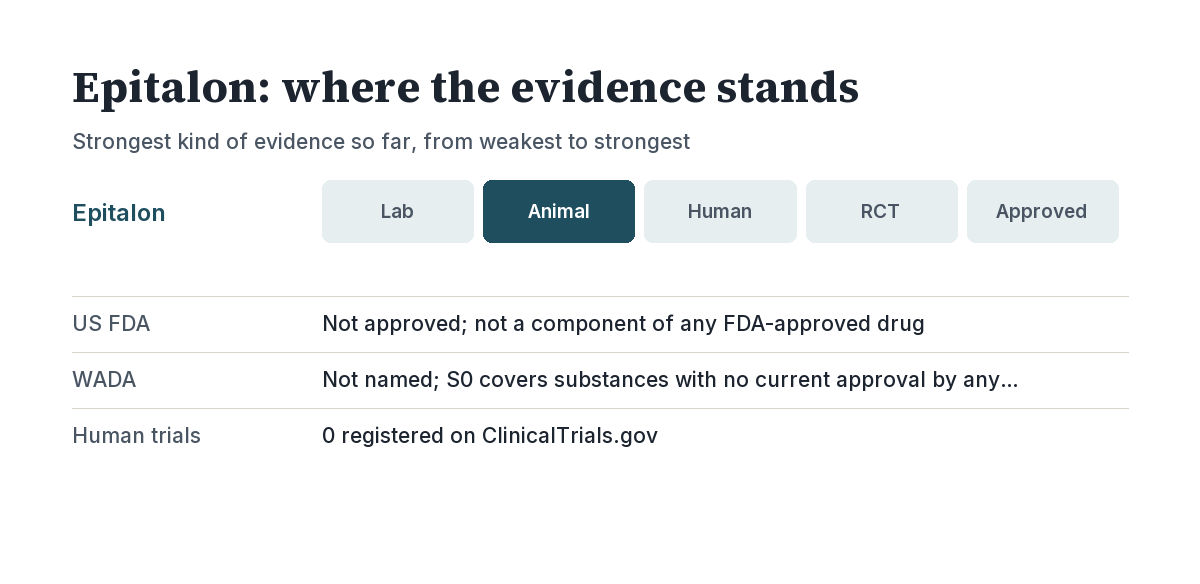
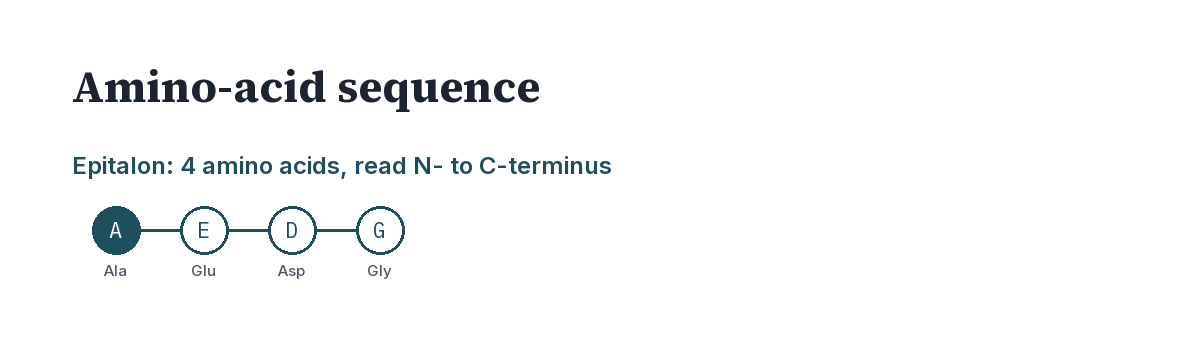
Epitalon (also spelled epithalon; Ala-Glu-Asp-Gly) is a synthetic four-amino-acid peptide modeled on epithalamin, a calf pineal gland extract. It is not approved by the FDA for any use, and its strongest evidence comes from cell and animal studies.
The research is intriguing. In human cells grown in the lab, epitalon switched on telomerase, the enzyme that rebuilds the protective caps at the ends of chromosomes [Lab] (Khavinson 2003), and in old monkeys it raised evening melatonin [Animal] (Goncharova 2001). Human data are thin: FDA’s July 2026 review found no human pharmacokinetic or safety studies, and ClinicalTrials.gov lists no registered epitalon trial.
| Item | Status |
|---|---|
| US FDA | Not approved; not a component of any FDA-approved drug (FDA briefing, 2026) |
| Compounding (503A/503B) | Withdrawn from Category 2 by its nominators (FDA, page of April 22, 2026). FDA’s Pharmacy Compounding Advisory Committee reviewed it on July 24, 2026 (FDA meeting page); FDA has posted no vote tally or minutes. The vote is advisory; FDA staff had recommended against, and no FDA rule has followed yet |
| WADA 2026 | Not named; S0 covers substances with no current approval by any government health authority (WADA 2026 List) |
| UK / EU / Australia / Canada | No approved epitalon product; none authorized by the EMA (FDA briefing) |
| Strongest evidence | Lab and animal studies, mostly from one Russian research group; one small placebo-controlled human study on a melatonin marker |
| Human trials | 0 registered on ClinicalTrials.gov |
| Last checked | 2026-10-08 |
Key points:
- Epitalon held an FDA orphan drug designation for retinitis pigmentosa from September 2, 2010 until it was withdrawn on January 6, 2016 (FDA briefing).
- An independent UK lab confirmed telomere lengthening in normal human cells in 2025, but in breast cancer cells the peptide lengthened telomeres through a separate route called ALT [Lab] (Al-Dulaimi 2025).
- FDA found no acute, repeat-dose, reproductive or two-year cancer toxicity studies of epitalon.
- FDA’s adverse-event database held no epitalon reports through December 8, 2025.
- FDA treats epitalon and epithalamin as different substances; much of the human research used the extract, not the synthetic peptide.
| Identity | Value |
|---|---|
| Sequence | Ala-Glu-Asp-Gly (4 amino acids) |
| Molecular formula | C14H22N4O9 (free base) |
| Molecular weight | 390.35 g/mol (free base); acetate salt 450.40 g/mol |
| CAS | 307297-39-8 (free base); 307297-40-1 (acetate) |
| PubChem CID | 219042 |
| Half-life | Not measured; FDA found no pharmacokinetic data in humans |
| Routes studied | Sublingual, parabulbar injection (humans); subcutaneous, intramuscular, intravenous (animals) |
| Class | Synthetic pineal peptide (“bioregulator”); studied in ageing research |
What is epitalon?
Epitalon was developed in Saint Petersburg, Russia, by researchers working under Vladimir Khavinson. It was built from the amino-acid makeup of epithalamin, a polypeptide extract of cattle pineal glands, and FDA describes it as a “synthetic analog” of that extract (FDA briefing). A 2025 review notes that the tetrapeptide was made before it was actually detected in the pineal extract, and that its structure and chemistry are still little studied (Araj 2025). Most of the published pharmacology comes from Khavinson’s group. It is sold online as an “anti-aging” peptide, and FDA found clinics promoting it as “the fountain of youth” on the strength of telomerase claims. The PubChem record lists the synonyms epithalon, epithalone and Ala-Glu-Asp-Gly.
How does epitalon work?
No receptor for epitalon has been identified. The proposed mechanisms come from lab and animal work, much of it from the developers’ group.
- Telomerase activation: in telomerase-negative human fetal fibroblasts, epitalon induced the enzyme’s catalytic subunit, its activity and longer telomeres [Lab] (Khavinson 2003).
- Telomere maintenance in other cells: an independent group saw dose-dependent telomere lengthening in normal human cells through telomerase, and through ALT in breast cancer cells [Lab] (Al-Dulaimi 2025).
- Pineal and melatonin signalling: epitalon raised evening melatonin in old rhesus monkeys [Animal] (Goncharova 2001), yet it did not trigger melatonin release from isolated rat pineal glands [Lab] (Djeridane 2003), so the route is indirect or unknown.
- Chromatin effects: in cultured lymphocytes from people aged 76–80, epitalon activated ribosomal genes and loosened tightly packed chromatin [Lab] (Khavinson 2003b).
- Antioxidant activity: in mouse egg cells, epitalon lowered reactive oxygen species and reduced cell death after 24 hours [Lab] (Yue 2022).
What the research shows
The table grades each common claim by the strongest evidence behind it, following the site’s editorial policy and methodology. Animal rows describe mice, rats, monkeys or flies, not people.
| Claim | Evidence level | Best study and result |
|---|---|---|
| Activates telomerase | Lab | Khavinson 2003: enzyme induced, telomeres longer in fetal fibroblasts |
| Lengthens telomeres (independent lab) | Lab | Al-Dulaimi 2025: dose-dependent in normal cells; via ALT in cancer cells |
| Extends cell lifespan | Lab | Khavinson 2004: 10 extra divisions beyond passage 34 |
| Changes telomeres in human blood cells | Lab, donor cells (n=11) | Khavinson 2019: longer in 5, shorter in 2 |
| Raises melatonin in old primates | Animal | Goncharova 2001: evening melatonin up over 4-fold (FDA summary) |
| Restores a melatonin marker in people | Human RCT (n=40, per FDA briefing) | Ivko 2020: urinary 6-sulfatoxymelatonin up 1.7-fold |
| Improves sleep or insomnia | No study | FDA 2026: no study of sleep outcomes found |
| Extends lifespan in mice | Animal (54 per group) | Anisimov 2003: mean unchanged; maximum +12.3% |
| Extends lifespan in flies | Animal | Khavinson 2000: +11–16% in fruit flies |
| Fewer or smaller tumors | Animal | Anisimov 2002: fewer, smaller breast tumors in HER-2/neu mice |
| Fewer chromosome aberrations | Animal | Rosenfeld 2002: down 17.9–30.1% in three mouse strains |
| Helps retinitis pigmentosa | Human, uncontrolled (n not given) | Khavinson 2002: “positive clinical effect in 90% of the cases” |
| Reduces inflammation | Lab | Avolio 2022: lower TNF and IL-6 in human monocyte cells |
Telomeres and cell ageing
Telomere work is the most cited part of the epitalon story. In the developers’ experiments, ageing fetal lung fibroblasts stopped dividing at passage 34, while epitalon-treated cells regained early-passage telomere length and reached passage 44 [Lab] (Khavinson 2004). The encouraging news for the field is that a group at Brunel University London, with no declared competing interests, reproduced telomere lengthening in normal human cells in 2025 [Lab] (Al-Dulaimi 2025). The same study found that in two breast cancer cell lines epitalon lengthened telomeres by activating ALT, a telomere-maintenance route used by some tumors. In blood cells from 11 men, telomere length rose in 5 and fell in 2 after exposure [Lab] (Khavinson 2019). No study has measured telomeres in people taking epitalon.
Lifespan and tumors in animals
In female mice injected for life, epitalon did not change average lifespan, food intake or body weight, but the longest-lived 10% lived 13.3% longer and leukemia was 6.0-fold less common [Animal] (Anisimov 2003). In a separate strain, mean survival rose 5.3% [Animal] (Anisimov 2001). In rats given a colon carcinogen, treated groups averaged 2.7 and 2.9 tumors per rat versus 4.1 in controls [Animal] (Anisimov 2002b). An Israeli-Russian team saw no metastases in treated older mice versus 3 of 9 tumor-bearing controls [Animal] (Kossoy 2006). In rats kept under standard lighting, lifespan did not change [Animal] (Vinogradova 2007). FDA reviewers noted that its three mouse cancer studies used one fixed dose, female mice only and short total exposure.
Melatonin, circadian rhythm and sleep
In old female rhesus monkeys, ten days of epitalon raised evening melatonin more than fourfold and lowered evening cortisol by about 30%, restoring the normal day-night cortisol pattern; young monkeys showed no melatonin change [Animal] (FDA briefing). In women aged 40–50 who mostly worked night shifts, a sublingual epitalon spray for 20 days raised the urinary melatonin breakdown product 6-sulfatoxymelatonin 1.7-fold from baseline, with no change on placebo, and shifted clock-gene expression [Human RCT, n=40] (Ivko 2020; design as summarized in the FDA briefing). FDA noted that the paper did not specify blinding and measured no sleep outcomes. FDA found no animal or human study of epitalon’s effect on sleep itself.
Eyes and other areas
In Campbell rats, which inherit retinal degeneration, treating both the mothers (before mating and during pregnancy) and their offspring preserved retinal structure and function about twice as long as in controls [Animal] (Khavinson 2003c). Lab studies also report anti-inflammatory effects [Lab] (Avolio 2022), and old rats showed antioxidant changes [Animal] (Kozina 2007).
Human studies and trials
There are no completed, registered clinical trials of epitalon, and a search of ClinicalTrials.gov for epitalon, epithalon and related names returns no studies. FDA’s 2026 review found three published human studies of the synthetic peptide.
| Study | Design and n | Result |
|---|---|---|
| Ivko 2020 (FDA cites as 2021) | Randomized, placebo-controlled; 75 women, 40 randomized; sublingual, 20 days (design per FDA briefing) (design per FDA briefing) | 6-sulfatoxymelatonin up 1.7-fold; no sleep or safety data reported |
| Khavinson 2021 (per FDA) | Sublingual, night-shift workers | Changes in circadian gene expression |
| Khavinson 2002 | Uncontrolled; parabulbar injection; n not stated in abstract | Retinitis pigmentosa: “positive clinical effect in 90% of the cases” |
| Korkushko 2007 | Elderly people and old monkeys; n not stated in abstract | Night melatonin rose in people with low pineal function |
| ClinicalTrials.gov | Registry search | 0 registered trials |
Longer human studies exist for epithalamin, the pineal extract, not for epitalon. In 266 older people followed for 6–8 years, mortality was reported 1.6–1.8-fold lower in the epithalamin group than in controls (Khavinson and Morozov 2003), and a randomized comparison in 39 versus 40 heart patients reported lower mortality with epithalamin added to standard care (Korkushko 2011). Both came from the same research network, and FDA does not treat epithalamin results as evidence for epitalon.
Doses used in studies
The amounts below describe what researchers gave in published studies. They are not recommendations.
| Route and amount | Species | Study |
|---|---|---|
| Subcutaneous, 1 µg per mouse (about 30–40 µg/kg), intermittent courses | Mice | Anisimov 2003 |
| Subcutaneous, 0.1 µg per animal, intermittent courses | Mice | Anisimov 2001 |
| Intramuscular, 2 µg/kg daily for 10 days | Rhesus monkeys | Goncharova 2001, per FDA |
| Intravenous, single 30 µg/kg (labelled tracer) | Pregnant rabbits | Lapina 2005 |
| Sublingual spray, 0.5 mg per day for 20 days | Humans (women 40–50) | Ivko 2021, per FDA |
| Cell culture, 50 ng/mL for 4 days | Human fetal fibroblasts | Khavinson 2003, per FDA |
No established human dose exists outside approved labels.
Side effects and safety
The safety record is mostly a record of what has not been studied. FDA’s review concluded that “there are no clinical data to support the safety” of epitalon in humans and found no human pharmacokinetic data.
- Reported adverse effects: none documented in a structured way. The placebo-controlled study reported no safety data, and one Russian abstract says the pineal preparations had “no side effects” without giving methods [Human] (Korkushko 2007). FDA’s FAERS database had no reports through December 8, 2025, and its foods and supplements complaint system had none through December 5, 2025.
- Toxicology gaps: FDA identified no acute toxicity, repeat-dose toxicity, reproductive toxicity or two-year carcinogenicity study. Two small mouse studies (4 per group) found fewer chromosome aberrations, not more, but used a single fixed dose.
- Theoretical cancer concern: FDA reasons that a substance that activates telomerase and lengthens telomeres could, with continuous long-term exposure, help cells escape senescence; longer telomeres are linked to higher cancer risk. In one of these mouse studies (Anisimov 2003), FDA calculated that the intermittent courses added up to at most about 22 weeks of exposure. The ALT activation seen in breast cancer cells adds to this open question [Lab] (Al-Dulaimi 2025).
- Immunogenicity: FDA is concerned that injected epitalon could provoke immune reactions because of aggregation and peptide-related impurities (FDA Category 2 page).
- Pregnancy: in pregnant rabbits a fluorescent-labelled dose reached fetal organs [Animal] (Lapina 2005), and no reproductive toxicology exists.
- Product quality: epitalon has no USAN name or pharmacopeia monograph; FDA found suppliers’ certificates that named one form while listing the other’s formula, and no endotoxin testing or identification of individual impurities. Several online sellers label it “research use only” (see what that label means).
Because epitalon has no approved label, no official list of contraindications exists.
Legal and regulatory status
| Jurisdiction | Status (checked 2026-10-08) |
|---|---|
| US FDA | Not approved; not in any approved drug (FDA briefing) |
| US compounding | Withdrawn from Category 2; reviewed by PCAC on July 24, 2026 after FDA staff advised against listing; vote advisory, no FDA tally posted; not added to the list |
| US orphan status | Retinitis pigmentosa designation 2010, withdrawn 2016 |
| WADA | Not named in the 2026 or 2027 List; within S0 wording (WADA 2027 List) |
| UK, EU, Canada, Australia | No approved product; none authorized by the EMA (FDA briefing) |
Compounding. Epitalon was one of the peptides placed in FDA’s Category 2 of substances that may present significant safety risks; the nominations were later withdrawn and it now sits in the “nominated but withdrawn” table (FDA Category 2 page). FDA reviewed it anyway, for insomnia only. Its staff concluded that the criteria “weigh against” listing it, citing poor characterization, no human safety data and no evidence of effectiveness (FDA briefing). The committee voted on the free base and the acetate on the morning of July 24, 2026 (FDA questions). FDA has posted no minutes or vote tally on the meeting page. The vote is advice: FDA says it will not make a final determination until the committee’s input is considered (FDA briefing), and it adds substances to the list through notice-and-comment rulemaking (FDA 503A page). FDA also no longer places substances nominated on or after January 7, 2025 into its interim categories. The two pathways are explained in 503A vs 503B compounding.
Sport. Epitalon is not named on the 2026 Prohibited List. Section S0 prohibits at all times any pharmacological substance not covered elsewhere on the List “with no current approval by any governmental regulatory health authority for human therapeutic use”. The 2027 List, in force from January 1, 2027, adds “peptides” to the S0 examples. No government approval of epitalon for human therapeutic use could be found, and FDA found none in the countries it checked, so epitalon falls within the S0 wording; see WADA banned peptides 2027.
Related peptides
- MOTS-c: a mitochondria-derived peptide studied in ageing and metabolism, reviewed at the same July 2026 committee meeting.
- GHK-Cu: a copper-binding tripeptide studied in skin ageing and wound repair, also withdrawn from Category 2.
What users report
The following summarizes unverified self-reports posted online by people who usually bought unregulated products; it is not evidence and may not reflect what those products contained. People who post about epitalon on forums, Reddit and YouTube most often describe deeper sleep and more vivid dreams, sometimes within the first few nights, and some describe a calmer mood or more energy. Many say they noticed nothing and use it for hoped-for long-term effects on ageing that they cannot feel or measure. A small number post telomere test results before and after, and others argue that consumer telomere tests are too variable to mean much. Recurring complaints include headaches, grogginess, stinging at the injection site, and doubts about what is in the bottle, since products are sold as research chemicals without independent testing. Users also debate whether the nasal and oral products work at all, whether lab findings on telomerase apply to people, and whether switching on telomerase could carry a cancer risk.
Frequently asked questions
Is epitalon FDA approved?
No. Epitalon is not approved by the FDA for any use and is not part of any approved drug. In its 2026 review for the compounding committee, FDA staff found no human safety data, no evidence of effectiveness for insomnia, and gaps in how the substance is characterized (FDA briefing).
Can pharmacies compound epitalon?
Not under a listing yet. Epitalon is not on the 503A Bulks List. FDA’s advisory committee voted on July 24, 2026 on adding it, but the vote is advisory, and FDA staff had advised against listing. FDA has issued no rule adding epitalon, and its meeting page lists no minutes or vote tally.
Does epitalon lengthen telomeres in humans?
That has not been shown. Telomere lengthening has been seen only in human cells grown in the lab, and no study has measured telomeres in people taking epitalon. In the independent 2025 study, breast cancer cells lengthened their telomeres through a different route, ALT, which leaves the cancer question open (Al-Dulaimi 2025).
Is epitalon banned in sport?
It is not named on the WADA List, but that does not make it permitted. Section S0 prohibits at all times pharmacological substances with no current government approval for human therapeutic use, and no such approval for epitalon was found. The 2027 List adds peptides to the S0 examples (WADA 2027 List).
Is epitalon the same as epithalamin?
No. Epithalamin is a peptide mixture extracted from cattle pineal glands; epitalon is one synthetic four-amino-acid peptide based on it. FDA treats them as different substances, so the longer human studies of epithalamin, including the 266-person mortality study, are not epitalon evidence (Khavinson and Morozov 2003).
References
- US Food and Drug Administration. FDA Briefing Document: Epitalon-Related Bulk Drug Substances. Pharmacy Compounding Advisory Committee, July 23–24, 2026. fda.gov/media/193345
- US Food and Drug Administration. July 23–24, 2026 Meeting of the Pharmacy Compounding Advisory Committee (meeting page). fda.gov
- US Food and Drug Administration. Pharmacy Compounding Advisory Committee, July 23–24, 2026: Questions. fda.gov/media/193711
- US Food and Drug Administration. Certain Bulk Drug Substances for Use in Compounding that May Present Significant Safety Risks (content current as of April 22, 2026). fda.gov
- US Food and Drug Administration. Bulk Drug Substances Used in Compounding Under Section 503A of the FD&C Act. fda.gov
- World Anti-Doping Agency. Prohibited List 2026. wada-ama.org
- World Anti-Doping Agency. Prohibited List 2027 (in force January 1, 2027). wada-ama.org
- ClinicalTrials.gov. Search: epitalon. clinicaltrials.gov
- PubChem. Epitalon, CID 219042. pubchem.ncbi.nlm.nih.gov
- Khavinson VKh, et al. 2003. Epithalon peptide induces telomerase activity and telomere elongation in human somatic cells. Bull Exp Biol Med. PMID 12937682
- Khavinson VKh, et al. 2004. Peptide promotes overcoming of the division limit in human somatic cell. Bull Exp Biol Med. PMID 15455129
- Al-Dulaimi S, et al. 2025. Epitalon increases telomere length in human cell lines through telomerase upregulation or ALT activity. Biogerontology. PMID 40908429
- Khavinson VK, et al. 2019. Effect of peptide AEDG on telomere length and mitotic index of PHA-stimulated human blood lymphocytes. Bull Exp Biol Med. PMID 31761987
- Goncharova ND, et al. 2001. Regulatory effect of Epithalon on production of melatonin and cortisol in old monkeys. Bull Exp Biol Med. PMID 11550036
- Djeridane Y, et al. 2003. Effect of a synthetic pineal tetrapeptide (Ala-Glu-Asp-Gly) on melatonin secretion by the pineal gland of young and old rats. J Endocrinol Invest. PMID 12809170
- Ivko OM, et al. 2020. AEDG peptide regulates human circadian rhythms genes expression during pineal gland accelerated aging. Adv Gerontol. PMID 33280326
- Khavinson VKh, et al. 2003. Peptide Epitalon activates chromatin at the old age. Neuro Endocrinol Lett. PMID 14647006
- Yue X, et al. 2022. Epitalon protects against post-ovulatory aging-related damage of mouse oocytes in vitro. Aging (Albany NY). PMID 35413689
- Anisimov VN, et al. 2003. Effect of Epitalon on biomarkers of aging, life span and spontaneous tumor incidence in female Swiss-derived SHR mice. Biogerontology. PMID 14501183
- Anisimov VN, et al. 2001. Effect of synthetic thymic and pineal peptides on biomarkers of ageing, survival and spontaneous tumour incidence in female CBA mice. Mech Ageing Dev. PMID 11163623
- Anisimov VN, et al. 2002. Inhibitory effect of the peptide epitalon on the development of spontaneous mammary tumors in HER-2/neu transgenic mice. Int J Cancer. PMID 12209581
- Anisimov VN, et al. 2002. Inhibitory effect of peptide Epitalon on colon carcinogenesis induced by 1,2-dimethylhydrazine in rats. Cancer Lett. PMID 12049808
- Kossoy G, et al. 2006. Effect of the synthetic pineal peptide epitalon on spontaneous carcinogenesis in female C3H/He mice. In Vivo. PMID 16634527
- Vinogradova IA, et al. 2007. Effect of Ala-Glu-Asp-Gly peptide on life span and development of spontaneous tumors in female rats exposed to different illumination regimes. Bull Exp Biol Med. PMID 18856211
- Khavinson VK, et al. 2000. Effect of epitalon on the lifespan increase in Drosophila melanogaster. Mech Ageing Dev. PMID 11087911
- Rosenfeld SV, et al. 2002. Effect of epithalon on the incidence of chromosome aberrations in senescence-accelerated mice. Bull Exp Biol Med. PMID 12360351
- Khavinson V, et al. 2002. Pineal-regulating tetrapeptide epitalon improves eye retina condition in retinitis pigmentosa. Neuro Endocrinol Lett. PMID 12195242
- Khavinson VKh, et al. 2003. Retinoprotective effect of Epithalon in Campbell rats of various ages. Bull Exp Biol Med. PMID 12910293
- Avolio F, et al. 2022. Peptides regulating proliferative activity and inflammatory pathways in the monocyte/macrophage THP-1 cell line. Int J Mol Sci. PMID 35408963
- Kozina LS, et al. 2007. Antioxidant properties of geroprotective peptides of the pineal gland. Arch Gerontol Geriatr. PMID 17317455
- Korkushko OV, et al. 2007. Normalizing effect of the pineal gland peptides on the daily melatonin rhythm in old monkeys and elderly people. Adv Gerontol. PMID 17969590
- Lapina EA, et al. 2005. Fluorescent microscopic study of epithalon binding in maternal and fetal rabbit tissues in health and under conditions of placental insufficiency. Bull Exp Biol Med. PMID 16224563
- Araj SK, et al. 2025. Overview of Epitalon: highly bioactive pineal tetrapeptide with promising properties. Int J Mol Sci. PMID 40141333
- Khavinson VKh, Morozov VG. 2003. Peptides of pineal gland and thymus prolong human life. Neuro Endocrinol Lett. PMID 14523363
- Korkushko OV, et al. 2011. Peptide geroprotector from the pituitary gland inhibits rapid aging of elderly people: results of 15-year follow-up. Bull Exp Biol Med. PMID 22451889
Change log
2026-10-23: links to glossary definitions added; no change to the facts.
2026-10-18: Campbell rat retina finding now says both mothers and offspring were treated (Khavinson 2003); reviewed by the editorial team.
2026-10-13: headline shortened on 2026-10-12 (now “Epitalon: benefits, evidence and legal status”); no change to the facts.
2026-10-08: first published after review by the editorial team.