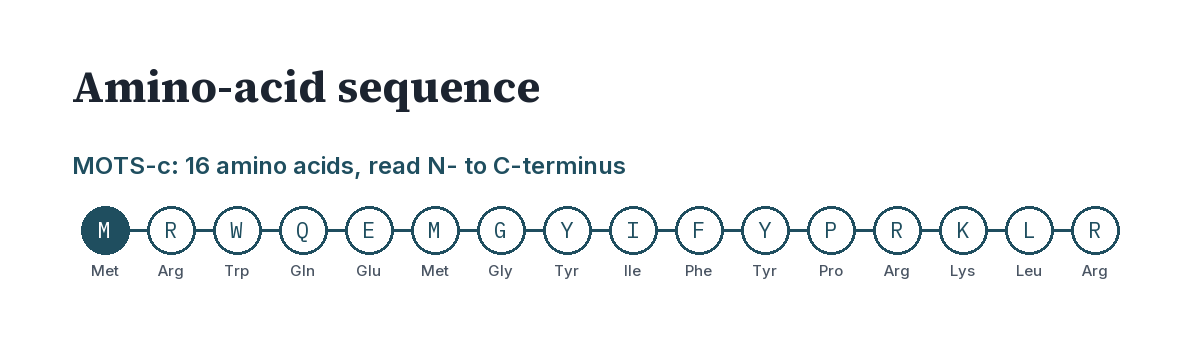
MOTS-c (mitochondrial open reading frame of the 12S rRNA type-c) is a 16-amino-acid peptide encoded in mitochondrial DNA. It has been studied mainly in mice for metabolism and exercise. It is not FDA-approved, and no peer-reviewed human efficacy trial exists (Lee et al., 2015).
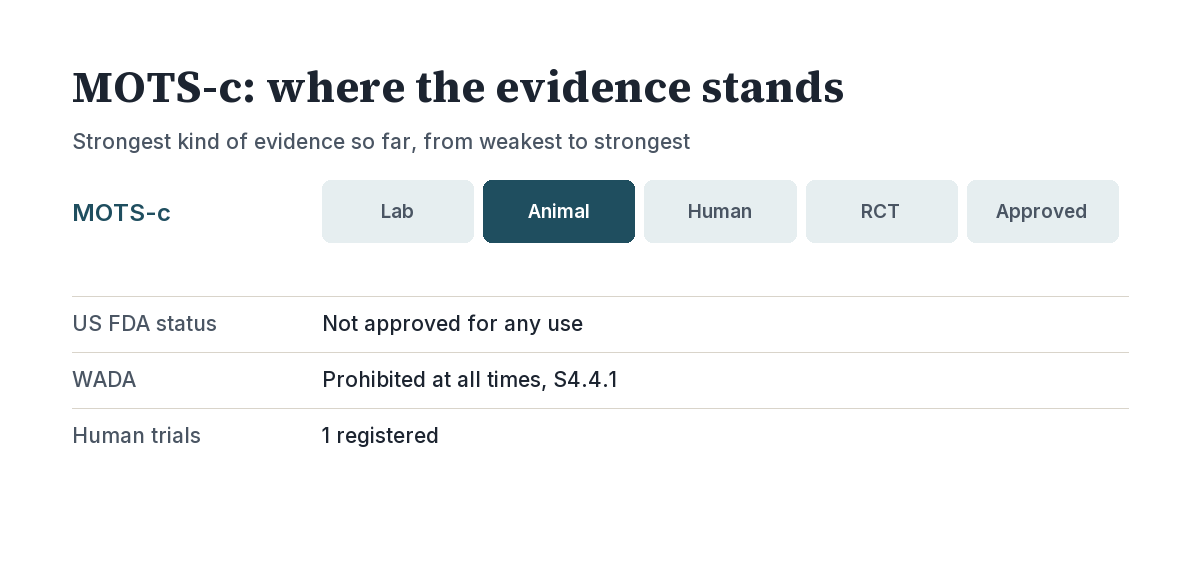
MOTS-c, a small peptide encoded in mitochondrial DNA, has shown broad metabolic benefits in mice, from preventing diet-induced obesity to about doubling running capacity in old age [Animal] (Reynolds et al., 2021). The strongest evidence is Animal. In mice, injected MOTS-c prevented diet-induced obesity and insulin resistance and improved running capacity. In humans, the only data are observational: blood and muscle levels, and one gene variant. The FDA states it “has not identified any human exposure data” on drug products containing MOTS-c (FDA, 2026). WADA prohibits it at all times in sport (USADA).
| Item | Status |
|---|---|
| US FDA status | Not approved for any use (USADA) |
| Compounding (503A/503B) | Listed by FDA as withdrawn by its nominators from Category 2; not on the 503A bulks list (FDA). The Pharmacy Compounding Advisory Committee voted 7–5 (2 abstentions) on 2026-07-23 to recommend 503A listing; advisory only, no FDA rule yet (FDA PCAC meeting; counts as reported by trade press) |
| WADA 2026 | Prohibited at all times, S4.4.1 (AMPK activators) (WADA) |
| Strongest evidence | Animal (mice); human data observational only |
| Human trials | 1 registered: NCT03998514 (analog CB4211, completed, no results posted); no registered trial of MOTS-c itself |
| Last checked | 2026-10-18 |
What changed (October 2026): FDA’s own pre-meeting review of MOTS-c is summarized in a new table, a 2026 sports-medicine review is added, and the sport section covers the 2027 WADA List.
Key points:
- MOTS-c is one of the few known peptides made from a gene inside mitochondria rather than the cell nucleus (Lee et al., 2015).
- Exercise raised MOTS-c 11.9-fold in the muscle of 10 young men [Human, observational, n=10] (Reynolds et al., 2021).
- The only completed human trial tested CB4211, a modified analog, not MOTS-c itself, and has posted no results.
- Published blood levels range from under 1 ng/mL (Cataldo et al., 2018) to over 500 ng/mL (Du et al., 2018), and a doping-control lab found ELISA and mass spectrometry results disagree (Knoop et al., 2019).
- Before an FDA advisory committee reviewed MOTS-c in July 2026, FDA’s own staff proposed not adding it to the compounding list, having found no clinical study of MOTS-c in people (FDA briefing document); the committee’s votes are advisory only.
| Property | Value |
|---|---|
| Sequence | MRWQEMGYIFYPRKLR (16 amino acids) |
| Molecular formula | C101H152N28O22S2 |
| Molecular weight | 2174.6 g/mol |
| CAS number | 1627580-64-6 |
| PubChem CID | 146675088 |
| Routes studied | Intraperitoneal (mice); subcutaneous (human trial of the analog CB4211) |
| Class | Mitochondrial-derived peptide |
What is MOTS-c?
MOTS-c was described in 2015 by a research group including Changhan Lee and Pinchas Cohen. They found a short open reading frame inside the mitochondrial 12S rRNA gene that codes for a 16-amino-acid peptide (Lee et al., 2015). It belongs to the mitochondrial-derived peptides, a small group that also includes humanin (Liu et al., 2019). The peptide circulates in human blood and is present in skeletal muscle (D’Souza et al., 2020). A variant of its gene, m.1382A>C, swaps lysine for glutamine at position 14 (K14Q). The variant is specific to Northeast Asian populations and has been studied in relation to Japanese longevity (Fuku et al., 2015).
How does MOTS-c work?
- Folate cycle and AMPK: in cells and mice, MOTS-c inhibited the folate cycle and purine synthesis. This let AICAR build up, which activates AMPK, the cell’s energy sensor [Lab + Animal] (Lee et al., 2015).
- Nuclear signaling: in HEK293 and HepG2 cells, MOTS-c moved into the nucleus within 30 minutes of glucose restriction, serum deprivation or oxidative stress. There it bound antioxidant-response genes together with NRF2. The move required AMPK [Lab] (Kim et al., 2018).
- Muscle kinase CK2: MOTS-c bound and activated the enzyme CK2 in mouse muscle, and this was linked to glucose uptake and protection against atrophy [Animal] (Kumagai et al., 2024).
- Skeletal muscle as main target: MOTS-c treatment activated AMPK in mouse skeletal muscle and improved insulin sensitivity measured by clamp studies [Animal] (Lee et al., 2015).
What the research shows
In mice, MOTS-c’s potential benefits span metabolism and ageing: it prevented weight gain and insulin resistance on a high-fat diet [Animal] (Lee et al., 2015), let 22-month-old mice run about twice as long after 2 weeks [Animal] (Reynolds et al., 2021), and reduced fatty liver disease [Animal] (Lu 2024) and bone loss [Animal] (Ming 2016). In people, exercise raises the body’s own MOTS-c, 11.9-fold in muscle [Human, observational, n=10] (Reynolds et al., 2021), one reason researchers study it as an exercise-linked signal. No controlled human trial has tested it yet. A 2026 narrative review of peptides used for injuries and athletic performance, MOTS-c among them, found favorable results in animals but scarce human safety data and a potential for serious harm [Narrative review] (Mendias and Awan 2026).
| Claim | Evidence level | Best study and result |
|---|---|---|
| Prevents diet-induced obesity and insulin resistance | Animal | Lee 2015, mice: prevented high-fat-diet weight gain and insulin resistance |
| Improves running capacity in old age | Animal | Reynolds 2021, 22-month mice: ran about 2-fold longer after 2 weeks |
| Extends lifespan | Animal (trend only) | Reynolds 2021: median lifespan +6.4%, reported as a trend |
| Exercise raises MOTS-c in people | Human, observational (n=10) | Reynolds 2021: muscle 11.9-fold, plasma 1.5-fold after exercise |
| Gene variant K14Q linked to type 2 diabetes | Human, observational (n=27,527) | Zempo 2021: higher prevalence in men, clearest in inactive men |
| Prevents bone loss | Animal | Ming 2016, ovariectomized mice: less bone loss on micro-CT |
| Protects insulin-producing cells | Animal | Kong 2021, NOD mice: prevented hyperglycemia |
| Reverses fatty liver disease | Animal | Lu 2024, mice: less steatosis and fibrosis |
| Low levels mark obesity in people | Human, observational; inconsistent | Du 2018 (n=97): lower in obese boys; Cataldo 2018 (n=20): no difference |
| Weight loss or better glucose control in people | No human data | No published controlled trial of MOTS-c |
Metabolism and body weight
The founding study reported that MOTS-c prevented weight gain and insulin resistance in mice fed a high-fat diet [Animal] (Lee et al., 2015). In ovariectomized mice, a model of menopause, 5 mg/kg a day for 12 weeks prevented obesity and insulin resistance and activated brown fat [Animal] (Lu et al., 2019). In mice with diet-induced obesity, MOTS-c lowered plasma myostatin, a signal linked to muscle wasting [Animal] (Kumagai et al., 2021). None of these results has been tested in a controlled human trial.
Exercise, muscle and ageing
In young mice, 15 mg/kg a day improved treadmill performance. In 22-month-old mice, two weeks of treatment doubled running time [Animal] (Reynolds et al., 2021). In mice treated late in life, the same study reported better grip strength and stride length. It also reported a trend toward longer median (6.4%) and maximum (7.0%) lifespan. In untrained mice, a single 15 mg/kg dose improved running time by 12% [Animal] (Hyatt et al., 2022). In people, muscle MOTS-c was about 1.5-fold higher in middle-aged and older men than in young men, while plasma levels fell with age [Human, observational] (D’Souza et al., 2020).
Genetics in people
Across three cohorts totalling 27,527 people, carriers of the K14Q variant had more type 2 diabetes. The effect was seen in men but not women, and most clearly in physically inactive men (18.5% vs 11.2%) [Human, observational] (Zempo et al., 2021). In the same paper, the K14Q form of the peptide failed to protect mice from diet-induced weight gain. In a separate cohort, the variant was more common in sprint and power athletes (6.5%) than in controls (5.1%) or endurance athletes (2.9%) [Human, observational] (Kumagai et al., 2022).
Blood levels and disease
Several studies link low circulating MOTS-c with disease. In a study of 40 people, plasma MOTS-c was lower in patients with coronary endothelial dysfunction than in controls [Human, observational, n=40] (Qin et al., 2018). A 16-week exercise program raised MOTS-c in non-Hispanic White breast cancer survivors but not in Hispanic survivors [Human RCT of exercise, n=49] (Dieli-Conwright et al., 2021). These studies measure the body’s own peptide; they do not test MOTS-c as a treatment. Measurement is also unsettled. A doping-control lab found large gaps between mass spectrometry and ELISA results [Lab] (Knoop et al., 2019). ELISA values across published studies range from under 1 ng/mL to over 500 ng/mL (Cataldo et al., 2018; Du et al., 2018).
Human studies and trials
No peer-reviewed human trial of native MOTS-c has reported results. One interventional trial is registered, of the analog CB4211; no trial of MOTS-c itself is registered.
| Trial | Design | Status and result |
|---|---|---|
| NCT03998514 (CB4211, CohBar) | Phase 1a/1b, randomized, placebo-controlled, n=88; healthy adults and obese adults with fatty liver | Completed April 2021; no results posted on ClinicalTrials.gov |
CB4211 is a modified analog of MOTS-c, so its results would not transfer directly to the native peptide. Other registered studies only measure the body’s own MOTS-c levels.
Doses used in studies
| Route and amount | Species and duration | Study |
|---|---|---|
| Intraperitoneal, 5 or 15 mg/kg/day | Young mice, 10–14 days | Reynolds 2021 |
| Intraperitoneal, 15 mg/kg/day | 22-month-old mice, 2 weeks | Reynolds 2021 |
| Intraperitoneal, 15 mg/kg, 3 times a week | Mice from 23.5 months, rest of life | Reynolds 2021 |
| Single dose, 15 mg/kg | Untrained mice | Hyatt 2022 |
| 5 mg/kg/day | Ovariectomized mice, 12 weeks | Ming 2016; Lu 2019 |
| Subcutaneous CB4211, six ascending dose levels | Humans, phase 1 (analog, not MOTS-c) | NCT03998514 |
No established human dose exists outside approved labels.
Side effects and safety
No human safety data for MOTS-c have been published. The FDA says it “lacks important information regarding any safety issues raised by MOTs-C, including whether it would cause harm if administered to humans” (FDA). The CB4211 trial listed injection-site reactions and antidrug antibodies among its outcomes, but has posted no results (NCT03998514).
- Immune reactions (theoretical, regulator-stated): the FDA says compounded MOTS-c “may pose significant risk for immunogenicity for certain routes of administration” (FDA). Its advisory-committee briefing found the substance poorly characterized and could not rule out immunogenicity from impurities and peptide aggregates (FDA briefing document, 2026).
- Reported effects (unverified): USADA lists increased heart rate or palpitations, irritation where the product was injected, insomnia, immune reactions and fever as effects users report. It notes there is “no data available on what happens with long-term use” (USADA).
- Metabolic effects (theoretical): MOTS-c acts on AMPK and glucose uptake in mice (Lee et al., 2015). Its effect on blood sugar in people taking diabetes drugs has not been studied.
- Product quality: MOTS-c is not approved as a drug, so products sold outside trials have no FDA-reviewed identity, purity or sterility standards. The FDA also flags “complexities with regard to peptide-related impurities and API characterization” (FDA).
Because there is no approved label, no regulator has defined who should not use MOTS-c. With no human exposure data identified by the FDA, groups such as pregnant or breastfeeding women, children and people with cancer or diabetes have no safety data at all.
Legal and regulatory status
| Jurisdiction | Status (checked 2026-09-30) |
|---|---|
| US FDA | Not approved for any indication (USADA) |
| US compounding | “Nominated but withdrawn” from Category 2 (FDA page updated 2026-04-22). Withdrawal is not a clearance to compound, and it is not on the 503A bulks list (FDA) |
| FDA advisory committee | Reviewed on 2026-07-23 for obesity and osteoporosis; votes are advisory and any listing requires rulemaking (FDA) |
| WADA 2026 | Prohibited at all times, S4.4.1, AMPK activators (WADA) |
FDA’s own 2026 review of MOTS-c
Before the July 2026 meeting, FDA staff reviewed the nomination against four criteria: the substance’s characterization, its safety, its effectiveness for the proposed use, and its history of use in compounding.
| Question | What FDA staff found (review dated 2026-05-11) |
|---|---|
| Use reviewed | Obesity and osteoporosis, as nominated for compounding |
| Human studies of MOTS-c | None: FDA did not identify any clinical study in which MOTS-c was given to people |
| Quality and safety | Substance poorly characterized; immune reactions from impurities and aggregates could not be ruled out |
| Staff conclusion | “Propose not adding” MOTS-c to the 503A bulks list |
| Committee vote, 2026-07-23 | For listing, as reported; counts differ between reports (7–5 with 2 abstentions, or 8–6 with 1) |
Source: FDA briefing document. The committee’s votes are advisory; as of 2026-10-27 FDA has posted no minutes and proposed no rule.
WADA named MOTS-c as an example on the 2024 Prohibited List. USADA noted that it is marketed as a weight-loss peptide “even though it is an experimental peptide not approved for human therapeutic use” (USADA, 2024). A mass-spectrometry method for detecting MOTS-c in plasma was developed for doping control (Knoop et al., 2019). The same July 2026 advisory meeting also reviewed BPC-157 and TB-500 (FDA). The wider sports picture is covered in WADA banned peptides. The 2027 List, in force from 2027-01-01, names “peptides” in general in S0; USADA’s summary of the 2027 changes does not mention MOTS-c (USADA athlete advisory). Status in the UK, EU, Australia and Canada could not be confirmed from a regulator source at the time of checking.
Related peptides
Humanin is another mitochondrial-derived peptide. Like MOTS-c, its expression was lower in the muscle of people with stage 5 chronic kidney disease than in age-matched controls [Human, observational] (Liu et al., 2019). This site does not yet have entries for other mitochondrial peptides.
What users report
The following are unverified self-reports from people who usually bought unregulated products; they are not evidence. People who post about MOTS-c on Reddit, YouTube and biohacking forums commonly describe more energy, better endurance during cardio, and easier fat loss, often while also using other compounds, which makes any single effect hard to attribute. Some say they noticed changes within a few weeks; many others report no noticeable effect at all. A recurring complaint is cost, since the peptide is described as expensive compared with other peptides sold online. Others mention stinging or redness at the site, a racing heart, trouble sleeping, or feeling flushed. Product quality is a frequent argument: posters question whether products contain the stated peptide, and some share third-party test results that disagree with each other. Threads also debate whether mouse data on exercise capacity mean anything for people, and whether the WADA ban reflects real performance effects or just its mechanism class.
Frequently asked questions
Is MOTS-c FDA approved?
No. MOTS-c is not approved by the FDA for any use, in humans or in compounded medicines. The FDA lists it as withdrawn by its nominators from the Category 2 compounding list, which is not a clearance to compound, and it is not on the 503A bulks list. The agency says it has found no human exposure data for MOTS-c drug products (FDA).
Is MOTS-c banned in sport?
Yes. WADA prohibits MOTS-c at all times, in and out of competition, under section S4.4.1 as an activator of AMP-activated protein kinase (AMPK). It became a named example on the list in 2024. USADA describes it as an experimental peptide that is not approved for human use (USADA).
Does MOTS-c help with weight loss?
There is no human evidence that it does. Weight findings come from mice: MOTS-c prevented high-fat-diet obesity and insulin resistance in the founding 2015 study. No trial of MOTS-c itself is registered on ClinicalTrials.gov.
Does the body make MOTS-c naturally?
Yes. MOTS-c is encoded in mitochondrial DNA and is found in human blood and muscle. Exercise raises it: in 10 young men, muscle MOTS-c rose 11.9-fold after a bout of exercise and plasma levels rose about 1.5-fold before returning to baseline within four hours (Reynolds et al., 2021).
Is MOTS-c a GLP-1?
No. MOTS-c is a 16-amino-acid peptide encoded in mitochondrial DNA, not a GLP-1 receptor agonist like semaglutide. Its proposed mechanism is different: in cells and mice, it inhibited the folate cycle and purine synthesis, which led to activation of AMPK, the cell’s energy sensor (Lee et al., 2015) [Lab + Animal]. Unlike approved GLP-1 drugs, it has no human trial results for weight loss.
Is MOTS-c good for muscle growth?
There is no human evidence that it builds muscle. The findings come from mice: MOTS-c bound and activated the muscle enzyme CK2, and treatment prevented skeletal muscle atrophy and raised muscle glucose uptake (Kumagai et al., 2024) [Animal]. Preventing wasting in mice is not the same as building muscle in people, and no published human trial has measured muscle mass or strength.
References
- Lee C, Zeng J, Drew BG, et al. (2015). The mitochondrial-derived peptide MOTS-c promotes metabolic homeostasis and reduces obesity and insulin resistance. Cell Metabolism. PMID 25738459
- Kim KH, Son JM, Benayoun BA, Lee C (2018). The mitochondrial-encoded peptide MOTS-c translocates to the nucleus to regulate nuclear gene expression in response to metabolic stress. Cell Metabolism. PMID 29983246
- Reynolds JC, Lai RW, Woodhead JST, et al. (2021). MOTS-c is an exercise-induced mitochondrial-encoded regulator of age-dependent physical decline and muscle homeostasis. Nature Communications. PMID 33473109
- Zempo H, Kim SJ, Fuku N, et al. (2021). A pro-diabetogenic mtDNA polymorphism in the mitochondrial-derived peptide, MOTS-c. Aging. PMID 33468709
- Kumagai H, Natsume T, Kim SJ, et al. (2022). The MOTS-c K14Q polymorphism in the mtDNA is associated with muscle fiber composition and muscular performance. Biochim Biophys Acta Gen Subj. PMID 34728329
- Kumagai H, Kim SJ, Miller B, et al. (2024). MOTS-c modulates skeletal muscle function by directly binding and activating CK2. iScience. PMID 39559755
- Kumagai H, Coelho AR, Wan J, et al. (2021). MOTS-c reduces myostatin and muscle atrophy signaling. Am J Physiol Endocrinol Metab. PMID 33554779
- Hyatt JK, et al. (2022). MOTS-c increases in skeletal muscle following long-term physical activity and improves acute exercise performance after a single dose. Physiological Reports. PMID 35808870
- Ming W, Lu G, Xin S, et al. (2016). Mitochondria related peptide MOTS-c suppresses ovariectomy-induced bone loss via AMPK activation. Biochem Biophys Res Commun. PMID 27237975
- Lu H, Wei M, Zhai Y, et al. (2019). MOTS-c peptide regulates adipose homeostasis to prevent ovariectomy-induced metabolic dysfunction. J Mol Med. PMID 30725119
- Kong BS, Min SH, Lee C, Cho YM (2021). Mitochondrial-encoded MOTS-c prevents pancreatic islet destruction in autoimmune diabetes. Cell Reports. PMID 34320351
- Lu H, Fan L, Zhang W, et al. (2024). The mitochondrial genome-encoded peptide MOTS-c interacts with Bcl-2 to alleviate nonalcoholic steatohepatitis progression. Cell Reports. PMID 38206815
- Du C, Zhang C, Wu W, et al. (2018). Circulating MOTS-c levels are decreased in obese male children and adolescents and associated with insulin resistance. Pediatric Diabetes. PMID 29691953
- Cataldo LR, Fernández-Verdejo R, Santos JL, Galgani JE (2018). Plasma MOTS-c levels are associated with insulin sensitivity in lean but not in obese individuals. J Investig Med. PMID 29593067
- Knoop A, Thomas A, Thevis M (2019). Development of a mass spectrometry based detection method for the mitochondrion-derived peptide MOTS-c in plasma samples for doping control purposes. Rapid Commun Mass Spectrom. PMID 30394592
- D’Souza RF, Woodhead JST, Hedges CP, et al. (2020). Increased expression of the mitochondrial derived peptide, MOTS-c, in skeletal muscle of healthy aging men is associated with myofiber composition. Aging. PMID 32182209
- Qin Q, Delrio S, Wan J, et al. (2018). Downregulation of circulating MOTS-c levels in patients with coronary endothelial dysfunction. Int J Cardiol. PMID 29242099
- Dieli-Conwright CM, Sami N, Norris MK, et al. (2021). Effect of aerobic and resistance exercise on the mitochondrial peptide MOTS-c in Hispanic and Non-Hispanic White breast cancer survivors. Scientific Reports. PMID 34413391
- Fuku N, Pareja-Galeano H, Zempo H, et al. (2015). The mitochondrial-derived peptide MOTS-c: a player in exceptional longevity? Aging Cell. PMID 26289118
- Liu C, Gidlund EK, Witasp A, et al. (2019). Reduced skeletal muscle expression of mitochondrial-derived peptides humanin and MOTS-C and Nrf2 in chronic kidney disease. Am J Physiol Renal Physiol. PMID 31432706
- ClinicalTrials.gov. NCT03998514: A Phase 1a/1b Study of CB4211 in Healthy Non-obese Subjects and Subjects With Nonalcoholic Fatty Liver Disease. NCT03998514
- US FDA (updated 2026-04-22). Certain Bulk Drug Substances for Use in Compounding that May Present Significant Safety Risks. fda.gov
- US FDA (2026). July 23–24, 2026: Meeting of the Pharmacy Compounding Advisory Committee. fda.gov
- US FDA (2026). FDA Briefing Document for MOTS-c-Related Bulk Drug Substances, Pharmacy Compounding Advisory Committee. fda.gov
- World Anti-Doping Agency (2025). 2026 Prohibited List. wada-ama.org
- USADA. What is the MOTS-c peptide? usada.org
- USADA (2024). Explanation of Key Changes on the 2024 WADA Prohibited List. usada.org
- PubChem. MOTS-c, CID 146675088. National Library of Medicine. pubchem.ncbi.nlm.nih.gov
- US FDA. FDA briefing document: MOTS-c, Pharmacy Compounding Advisory Committee, July 23–24, 2026 (review memo 2026-05-11). fda.gov
- Mendias CL, Awan TM (2026). Safety and efficacy of approved and unapproved peptide therapies for musculoskeletal injuries and athletic performance. Sports Med. doi:10.1007/s40279-026-02437-0
- USADA. Athlete advisory: 2027 Prohibited List (2026-10-06). usada.org
Change log
2026-10-27: FDA’s pre-meeting review of MOTS-c summarized in a table; 2026 narrative review added; 2027 WADA List added; own page title; reviewed by the editorial team.
2026-10-23: links to glossary definitions added; no change to the facts.
2026-10-18: removed ClinicalTrials.gov record NCT07505745 (phase 2a), whose sponsor posts example records, from the status box, trial table, trial notes, FAQ and references; registered trials now 1 (the analog CB4211), with no registered trial of MOTS-c itself; reviewed by the editorial team.
2026-10-13: Status box: the compounding committee’s 7–5 vote to recommend 503A listing moved into the Status column, where readers look for it; reviewed by the editorial team.
2026-10-12: Benefits section added: the most promising findings named first, each with its evidence level; opening leads with the strongest result; reviewed by the editorial team.
2026-10-04: FAQ expanded with two questions readers search for (GLP-1, muscle growth); reviewed by the editorial team.
2026-09-30: status box updated with the FDA advisory committee vote / next regulatory step (Study loop L-2).
2026-09-30: first published after review by the editorial team.