CagriSema is an investigational once-weekly injection that combines cagrilintide, a long-acting amylin analogue, with semaglutide, a GLP-1 receptor agonist; its strongest evidence is phase 3 randomized trials, including two pivotal trials in about 4,600 adults. It is not FDA-approved: Novo Nordisk filed a New Drug Application on 18 December 2025 for chronic weight management, and the company expects an FDA decision by late 2026 (Novo Nordisk, 2025; Novo Nordisk, 2026). Until a decision, it is obtainable legally only inside clinical trials. Gastrointestinal side effects are common, and long-term cardiovascular outcome data are still pending.
| Item | Status |
|---|---|
| US FDA | Not approved. NDA for weight management filed 2025-12-18; decision expected late 2026 (Novo Nordisk) |
| Compounding (503A/503B) | Not allowed: FDA states cagrilintide “cannot be used in compounding under federal law” (FDA) |
| WADA 2026 | Semaglutide is not prohibited (USADA). Cagrilintide is not named; as an unapproved drug in clinical development it appears to fall under S0 (non-approved substances, prohibited at all times) on our reading of the List, not a published WADA ruling (WADA) |
| EU | Not approved (Novo Nordisk) |
| Strongest evidence | Human RCT, phase 3 (REDEFINE 1, n=3,417) |
| Human trials | 35 registered studies with cagrilintide plus semaglutide; cardiovascular outcomes trial NCT05669755 still running |
| Next regulatory step | FDA decision on the weight-management NDA anticipated by late 2026; no type 2 diabetes filing announced (Novo Nordisk) |
| Last checked | 2026-10-24 |
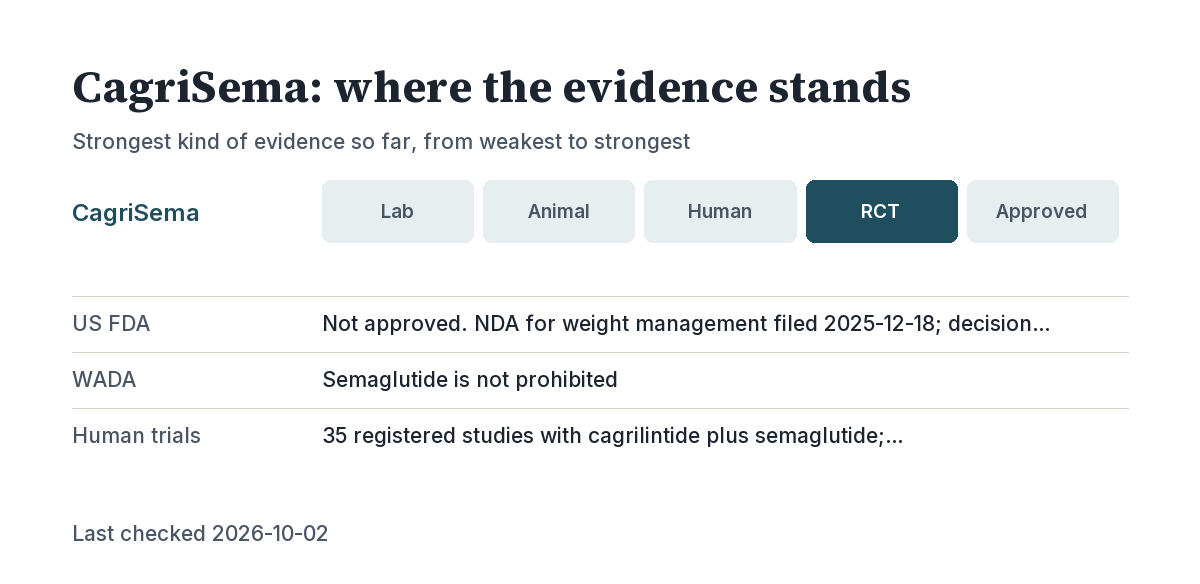
What changed (October 2026): REIMAGINE 5, the first trial in which CagriSema beat tirzepatide on weight (at lower doses, in type 2 diabetes), Novo’s September 2026 abstracts and its latest statement on FDA timing are added, and the sport row covers the 2027 WADA List.
Key points:
- In REDEFINE 1, adults without diabetes lost 20.4% of body weight at 68 weeks on CagriSema versus 3.0% on placebo, counting everyone regardless of whether they stayed on treatment [Human RCT, n=3,417] (Garvey 2025).
- In adults with type 2 diabetes, weight loss was smaller: 13.7% versus 3.4% [Human RCT, n=1,206] (Davies 2025).
- Gastrointestinal adverse events affected 79.6% of REDEFINE 1 participants on CagriSema versus 39.9% on placebo; nausea affected 55% (Novo Nordisk, 2025).
- In an open-label 84-week trial against tirzepatide 15 mg, CagriSema did not meet its non-inferiority endpoint for weight loss (Novo Nordisk, 2026).
- Products sold online as “cagrilintide” are unapproved; FDA warns that such drugs have not been found safe and effective for any condition (FDA).
| Property | Value |
|---|---|
| Components | Cagrilintide 2.4 mg + semaglutide 2.4 mg, fixed-dose combination (Novo Nordisk) |
| Cagrilintide | Lipidated 37-residue amylin analogue; C194H312N54O59S2; MW 4,409; CAS 1415456-99-3; PubChem CID 171397054 |
| Semaglutide | GLP-1 analogue; C187H291N45O59; MW 4,114; CAS 910463-68-2; PubChem CID 56843331 |
| Half-life | Cagrilintide 159–195 h; semaglutide 145–165 h (Enebo 2021) |
| Route studied | Subcutaneous, once weekly; single-use dual-chamber pen (Gulisano 2026) |
| Developer | Novo Nordisk |
| Class | Amylin analogue + GLP-1 receptor agonist (incretin-based) |
What is CagriSema?
CagriSema is Novo Nordisk’s name for a fixed-dose pairing of two peptides. Semaglutide is already approved as Wegovy for chronic weight management (Wegovy label). Cagrilintide is new: Novo Nordisk chemists designed it as a stable, lipidated, long-acting version of amylin, a pancreatic hormone that clumps into amyloid fibrils in its natural form (Kruse 2021). The earlier amylin drug pramlintide needs three injections a day because of its short half-life. An early phase 1b trial paired cagrilintide with semaglutide between 2018 and 2019 (Enebo 2021). Phase 3 work then split into REDEFINE (obesity) and REIMAGINE (type 2 diabetes). If approved, it would be the first injectable combination of a GLP-1 receptor agonist and an amylin analogue (Novo Nordisk, 2025). CagriSema is not the same as zenagamtide (amycretin), a separate Novo Nordisk drug in which one peptide activates both GLP-1 and amylin receptors; subcutaneous amycretin was tested in a randomized phase 1b/2a trial in adults with overweight or obesity (Dahl 2025) [Human RCT, n=125]. In a phase 2 trial of zenagamtide in 262 adults with type 2 diabetes, presented in June 2026, HbA1c fell by up to 1.71 percentage points and body weight by up to 14.6% at week 36 on the highest dose (40 mg), against 0.14 points and 2.1% on placebo, as reported by the sponsor [Human RCT, n=262, sponsor report] (Novo Nordisk, 2026).
How does CagriSema work?
- GLP-1 receptor (semaglutide): semaglutide shares 94% of its sequence with human GLP-1 and activates the GLP-1 receptor, a regulator of appetite and calorie intake found in brain areas that control eating [Approved label] (Wegovy label).
- Amylin and calcitonin receptors (cagrilintide): cryo-electron microscopy shows cagrilintide binding the three amylin receptors (AMY1R, AMY2R, AMY3R) and the calcitonin receptor in an amylin-like way, with distinct receptor dynamics [Lab (in vitro)] (Cao 2025).
- Eating less: the developer describes the two molecules as reducing hunger and increasing fullness so that people eat fewer calories [Human RCT program, sponsor summary] (Novo Nordisk, 2026).
- Energy expenditure: in rats, CagriSema produced 12% weight loss with a 39% fall in food intake, while food restriction alone needed a 51% cut to match the weight; the authors attribute about one-third of the effect to blunted metabolic adaptation [Animal] (Jacobsen 2025).
- Long action: both components have half-lives of roughly six to eight days, and cagrilintide did not change semaglutide exposure [Human, phase 1b, n=95 exposed] (Enebo 2021).
What the research shows
The table grades each claim by its best evidence. All of the trials below were funded by Novo Nordisk. For what each evidence level means, see the site’s editorial policy and methodology.
| Claim | Evidence level | Best study and result |
|---|---|---|
| Reduces body weight in adults without diabetes | Human RCT (n=3,417) | Garvey 2025: −20.4% vs −3.0% at 68 weeks |
| Combination beats each component alone | Human RCT (n=3,417) | Busetto 2026: −22.7% vs −16.1% (semaglutide) vs −11.8% (cagrilintide), on-treatment estimate |
| Reduces weight in type 2 diabetes | Human RCT (n=1,206) | Davies 2025: −13.7% vs −3.4% |
| Lowers HbA1c more than semaglutide alone | Human RCT (n=2,713) | Buse 2026: −1.91 vs −1.75 points, difference −0.16 |
| Lowers blood pressure | Human RCT, secondary analysis (n=3,417) | Verma 2026: systolic −10.9 vs −2.8 mm Hg |
| Reduces heart attacks, strokes or deaths | No data yet | REDEFINE 3: outcomes trial, n=7,101, running |
| Preserves energy expenditure | Animal (rats) | Jacobsen 2025: about one-third of weight loss |
Weight loss in obesity
REDEFINE 1 randomized 3,417 adults with a BMI of 30 or more, or 27 or more with a weight-related condition, to CagriSema, semaglutide, cagrilintide or placebo for 68 weeks. Counting all participants, mean weight fell 20.4% with CagriSema and 3.0% with placebo, a difference of 17.3 percentage points [Human RCT, n=3,417] (Garvey 2025). An analysis that assumes everyone kept taking the drug gave 22.7%, against 16.1% for semaglutide alone and 11.8% for cagrilintide alone (Busetto 2026). In that post hoc analysis, 30.3% of CagriSema users reached both a BMI under 27 and a waist-to-height ratio under 0.53, versus 3.3% on placebo. In Japan and Taiwan, REDEFINE 5 found −18.4% with CagriSema versus −11.9% with semaglutide [Human RCT, n=331] (Yamauchi 2026).
Type 2 diabetes
Weight loss was smaller in adults with type 2 diabetes: −13.7% versus −3.4% in REDEFINE 2, with 73.5% reaching an HbA1c of 6.5% or less versus 15.9% on placebo [Human RCT, n=1,206] (Davies 2025). In REIMAGINE 2, CagriSema lowered HbA1c by 1.91 points against 1.75 for semaglutide 2.4 mg, a small but statistically significant gap [Human RCT, n=2,713] (Buse 2026). Added to basal insulin, HbA1c fell 2.33 points versus 0.66 with placebo, with no severe hypoglycemia reported [Human RCT, n=274] (Rosenstock 2026). Novo Nordisk has said it will discuss a diabetes filing with regulators after REIMAGINE 1 and REDEFINE 3 (Novo Nordisk, 2026).
Blood pressure and cardiometabolic markers
In REDEFINE 1, systolic blood pressure fell 10.9 mm Hg on CagriSema and 2.8 mm Hg on placebo, and 39.6% of those on blood-pressure drugs reduced or stopped them, versus 18.8% on placebo [Human RCT, secondary analysis] (Verma 2026). Whether these marker changes translate into fewer heart attacks or strokes is the question REDEFINE 3 is designed to answer.
Human studies and trials
A ClinicalTrials.gov search on 2 October 2026 returned 35 registered studies that give cagrilintide with semaglutide, almost all sponsored by Novo Nordisk. The main ones:
| Trial | Design and n | Status and result |
|---|---|---|
| Phase 1b (Enebo 2021) | 20 weeks, n=96, all on semaglutide 2.4 mg | Completed; 17.1% vs 9.8% weight loss (cagrilintide 2.4 mg vs placebo, both with semaglutide) |
| Phase 2, type 2 diabetes (Frias 2023) | 32 weeks, n=92 | Completed; weight −15.6% vs −5.1% (semaglutide) |
| REDEFINE 1 (NCT05567796) | Phase 3, 68 weeks, n=3,417 | Primary results published 2025; −20.4% vs −3.0% |
| REDEFINE 2 (NCT05394519) | Phase 3, type 2 diabetes, n=1,206 | Completed; −13.7% vs −3.4% |
| REDEFINE 3 (NCT05669755) | Phase 3, cardiovascular outcomes, n=7,101 | Active, not recruiting; primary completion 2027 |
| REDEFINE 4 (NCT06131437) | Phase 3, open-label vs tirzepatide 15 mg, n=809 | Completed; non-inferiority not met (headline) |
| REDEFINE 5 (NCT05813925) | Phase 3, East Asia, n=331 | Completed; −18.4% vs −11.9% (semaglutide) |
| REIMAGINE 1 (NCT06323174) | Phase 3, early type 2 diabetes, n=189 | Completed; HbA1c −1.8 vs −0.1 points |
| REIMAGINE 2 (NCT06065540) | Phase 3, type 2 diabetes, n=2,713 | Completed; HbA1c −1.91 vs −1.75 (semaglutide) |
| REIMAGINE 3 (NCT06323161) | Phase 3, add-on to basal insulin, n=274 | Completed; HbA1c −2.33 vs −0.66 |
| REIMAGINE 5 (NCT06534411) | Phase 3 vs tirzepatide, type 2 diabetes, n=1,023 | Completed; weight −12.4% vs −9.1% (tirzepatide 5 mg) at 60 weeks, company headline (Novo Nordisk) |
| Weight maintenance (NCT07011667) | Phase 3, n=609 | Active, not recruiting; primary completion 2027 |
| Children and adolescents (NCT07253285) | Phase 3, n=460 | Recruiting; primary completion 2030 |
In REDEFINE 4, people adhering to treatment lost 23.0% on CagriSema and 25.5% on tirzepatide 15 mg over 84 weeks; counting everyone, the figures were 20.2% and 23.6% (Novo Nordisk, 2026). These are company headline results; the trial was open-label and has not yet been published in a journal. In February 2026 the company said it planned to start a higher-dose phase 3 trial in the second half of 2026 and expected REDEFINE 11 data in the first half of 2027.
REIMAGINE 5 went the other way. In adults with type 2 diabetes on metformin, an SGLT2 inhibitor or both, CagriSema 1.0 mg/1.0 mg was superior to tirzepatide 5 mg on weight at 60 weeks, 12.4% versus 9.1% on the efficacy estimand, and non-inferior on HbA1c, which fell 1.71 versus 1.67 points; Novo called it well tolerated (Novo Nordisk, 2026-09-21). These are lower doses of both drugs and company headline results, not yet peer reviewed. At the EASD meeting Novo then presented three abstracts: a 52-week brain-imaging study with weight 22.4% lower than placebo and less self-reported “food noise”, an MRI sub-study of REIMAGINE 1 showing less fat in the abdomen, liver and pancreas than placebo at 40 weeks, and a post hoc REIMAGINE 2 analysis its authors call “preliminary reassurance regarding bone changes”; the release gives no sample sizes or safety data for these (Novo Nordisk, 2026-09-30).
Doses used in studies
| Route and amount | Population (species) | Study |
|---|---|---|
| Subcutaneous, weekly; cagrilintide 0.16–4.5 mg with semaglutide 2.4 mg | Human, adults with overweight or obesity | Enebo 2021 |
| Subcutaneous, weekly; 2.4 mg + 2.4 mg | Human, adults with obesity, with or without type 2 diabetes | Garvey 2025; Davies 2025 |
| Subcutaneous, weekly; 1.0 mg + 1.0 mg | Human, adults with type 2 diabetes | Aroda 2026; Rosenstock 2026 |
No established human dose exists outside approved labels. The dose submitted to FDA is 2.4 mg of each component (Novo Nordisk, 2025); no CagriSema label exists until FDA rules.
Side effects and safety
Gastrointestinal effects are the main burden. In REDEFINE 1, gastrointestinal adverse events affected 79.6% on CagriSema versus 39.9% on placebo, including nausea (55% vs 12.6%), constipation (30.7% vs 11.6%) and vomiting (26.1% vs 4.1%) [Human RCT, n=3,417] (Novo Nordisk, 2025). The trial report describes these as mainly transient and mild to moderate (Garvey 2025). Stopping treatment because of adverse events was 5.9% versus 3.5% in REDEFINE 1 and 8.4% versus 3% in REDEFINE 2. A meta-analysis of four trials found gastrointestinal events about one-third more frequent than with semaglutide or placebo (risk ratio 1.32) and called for longer-term data [Meta-analysis, n=4,419] (Gadelmawla 2026).
Risks carried by the semaglutide component. The approved Wegovy label has a boxed warning: semaglutide causes thyroid C-cell tumors in rodents, human relevance is unknown, and it must not be used by people with a personal or family history of medullary thyroid carcinoma or MEN 2 [Approved label] (Wegovy label). The same label warns of acute pancreatitis, gallbladder disease, hypoglycemia with insulin or insulin secretagogues, kidney injury from volume depletion, diabetic retinopathy complications, a raised heart rate and pulmonary aspiration under anesthesia, and advises stopping at least two months before a planned pregnancy. How these warnings will read on a CagriSema label is unknown until FDA acts.
Open questions for the amylin component. A 2026 Lancet viewpoint hypothesizes that amylin-type drugs could activate the renin-angiotensin system and offset some cardiorenal benefit, while noting the large blood-pressure falls seen in phase 3 [Theoretical, no human outcome data] (Muskiet 2026). Long-term safety beyond 68–84 weeks, and cardiovascular outcomes, depend on REDEFINE 3.
Unregulated products. FDA states cagrilintide is not a component of any approved drug and has not been found safe and effective for any condition; it has warned sellers of GLP-1 drugs falsely labeled “for research purposes”, calling such products of unknown quality and potentially harmful (FDA). Self-assembled mixtures carry none of the quality controls of the trial product.
Legal and regulatory status
| Jurisdiction | Status | Source |
|---|---|---|
| US FDA | Investigational; NDA filed 2025-12-18; decision expected late 2026 | Novo Nordisk, Feb 2026 |
| US compounding | Cagrilintide cannot be compounded under federal law | FDA, current 2026-10-01 |
| EU | Not approved | Novo Nordisk, Dec 2025 |
| WADA 2027 (from 2027-01-01) | Semaglutide named on the Monitoring Program: tested for, not prohibited. S0 names “peptides” in general | USADA athlete advisory |
| WADA (sport) | Semaglutide not prohibited; unapproved cagrilintide appears to fall under S0, prohibited at all times (our reading; not named on the List) | USADA; WADA 2026 List |
WADA’s S0 class covers any pharmacological substance with no current approval by any government health authority for human therapeutic use, naming drugs under clinical development as an example (WADA). UK Anti-Doping notes that not every prohibited substance is named on the List and that athletes are strictly liable for anything found in their system (UKAD). An approval would change the S0 reasoning, so the status needs rechecking on Global DRO or with a national anti-doping agency at that point. USADA reports that WADA is monitoring GLP-1 drugs to decide whether to prohibit them in future. For other peptides on the List, see WADA banned peptides 2027.
Related peptides
- Semaglutide: the approved GLP-1 receptor agonist inside CagriSema, sold for weight management as Wegovy.
- Cagrilintide: the amylin analogue; on its own it produced 6.0–10.8% weight loss over 26 weeks in a phase 2 trial [Human RCT, n=706 on cagrilintide] (Lau 2021).
- Retatrutide: a different investigational incretin drug, acting on GLP-1, GIP and glucagon receptors; see Retatrutide (LY3437943).
What users report
What follows are unverified self-reports from people posting online, many of whom used unregulated products rather than the trial drug; it is not evidence. Most public posts come from two groups: people who say they took part in a REDEFINE or REIMAGINE trial, and people who say they combined grey-market cagrilintide with semaglutide on their own. The effect described most often is a stronger and steadier loss of appetite than with semaglutide alone, with some saying constant thoughts about food faded within the first weeks. The most common complaints are nausea, constipation, fatigue and burping, often said to be worst in the first weeks of treatment. Trial participants frequently guess whether they received the active drug from their side effects, and some report regaining weight after their trial ended. A recurring argument is whether the amylin component adds enough to justify a second peptide, an argument that sharpened after the head-to-head trial with tirzepatide missed its goal. Posters who used unregulated products also complain about inconsistent effects from one batch to the next, and others reply that those products may not contain what the label says.
Frequently asked questions
Is CagriSema FDA approved?
No. CagriSema remains an investigational drug in the United States. Novo Nordisk submitted a New Drug Application for chronic weight management on 18 December 2025, and in September 2026 the company said a decision is expected in Q4 2026. Until then it is available legally only to people enrolled in clinical trials (Novo Nordisk, 2026).
How much weight did people lose on CagriSema in trials?
In REDEFINE 1, adults without diabetes lost an average of 20.4% of body weight over 68 weeks, compared with 3.0% on placebo, counting everyone who was randomized. Adults with type 2 diabetes in REDEFINE 2 lost 13.7% versus 3.4%. Results are averages: individual responses varied widely (Garvey 2025).
How is CagriSema different from Wegovy?
Wegovy contains only semaglutide, an approved GLP-1 receptor agonist. CagriSema adds cagrilintide, an amylin analogue, in the same weekly injection. In REDEFINE 1, the on-treatment estimate was 22.7% weight loss with the combination versus 16.1% with semaglutide 2.4 mg alone, at the cost of more gastrointestinal side effects (Busetto 2026). A pooled meta-analysis of five trials (n=4,746) did not find a statistically significant overall rise in gastrointestinal adverse events (RR 1.09, 95% CI 0.97–1.21), but injection-site reactions were about three times as common (RR 3.14, 95% CI 1.42–6.96) (Rasool 2026).
What are the most common side effects of CagriSema?
Gastrointestinal effects dominate. In REDEFINE 1, 55% of people on CagriSema reported nausea, 30.7% constipation and 26.1% vomiting, versus 12.6%, 11.6% and 4.1% on placebo. Most cases were mild to moderate and eased over time, but 5.9% stopped treatment because of adverse events (Novo Nordisk, 2025).
Can a pharmacy compound CagriSema?
No. FDA states that cagrilintide cannot be used in compounding under federal law, is not a component of any FDA-approved drug and has not been found safe and effective for any condition. Products sold online as cagrilintide are therefore unapproved drugs of unknown quality, whatever their label claims (FDA).
Is CagriSema banned in sport?
Semaglutide alone is not prohibited, but cagrilintide has no regulatory approval anywhere. WADA’s S0 class bans any substance without current approval for human therapeutic use, including drugs in clinical development, at all times. While cagrilintide stays unapproved, an athlete using CagriSema outside a sanctioned trial risks a violation (WADA).
References
- Novo Nordisk. Novo Nordisk files for FDA approval of CagriSema. Press release, 18 December 2025. novonordisk.com
- Novo Nordisk. CagriSema demonstrated 23% weight loss in an open-label head-to-head REDEFINE 4 trial; the primary endpoint was not achieved. Company announcement, 23 February 2026. novonordisk.com
- Novo Nordisk. CagriSema demonstrated superior HbA1c reduction and weight loss in the REIMAGINE 2 trial. Company announcement, 2 February 2026. novonordisk.com
- Garvey WT, Blüher M, Osorto Contreras CK, et al. Coadministered cagrilintide and semaglutide in adults with overweight or obesity. N Engl J Med. 2025;393:635–647. PubMed 40544433
- Davies MJ, Bajaj HS, Broholm C, et al. Cagrilintide–semaglutide in adults with overweight or obesity and type 2 diabetes. N Engl J Med. 2025;393:648–659. PubMed 40544432
- Busetto L, Contreras CO, Christensen MH, et al. Efficacy of CagriSema for reaching anthropometric treatment targets and cardiometabolic outcomes: a post hoc analysis of REDEFINE 1. Diabetes Obes Metab. 2026;28:9317–9325. PMC13538786
- Verma S, Böttcher M, Brown P, et al. CagriSema reduces blood pressure in adults with overweight or obesity: REDEFINE 1. Hypertension. 2026;83:e26055. PubMed 41328546
- Frias JP, Deenadayalan S, Erichsen L, et al. Co-administered once-weekly cagrilintide 2.4 mg with semaglutide 2.4 mg in type 2 diabetes: a phase 2 trial. Lancet. 2023;402:720–730. PubMed 37364590
- Enebo LB, Berthelsen KK, Kankam M, et al. Concomitant administration of multiple doses of cagrilintide with semaglutide 2.4 mg for weight management: a phase 1b trial. Lancet. 2021;397:1736–1748. PubMed 33894838
- Aroda VR, Buzzetti R, Dalskov SM, et al. CagriSema in adults with type 2 diabetes inadequately controlled on diet and exercise (REIMAGINE 1). Lancet Diabetes Endocrinol. 2026;14:649–661. PubMed 42251860
- Buse JB, Bajaj HS, Dalskov SM, et al. CagriSema versus semaglutide or cagrilintide in people with type 2 diabetes (REIMAGINE 2). Lancet Diabetes Endocrinol. 2026;14:662–677. PubMed 42251859
- Rosenstock J, Billings LK, Gajria R, et al. CagriSema as an add-on to basal insulin in adults with type 2 diabetes (REIMAGINE 3). Lancet. 2026;408:38–51. PubMed 42251856
- Yamauchi T, Becker NP, Hagemann CA, et al. Cagrilintide and semaglutide versus semaglutide in Japan and Taiwan (REDEFINE 5). Lancet Diabetes Endocrinol. 2026;14:450–462. PubMed 42009015
- Gadelmawla AF, Hammad N, Atta K, et al. CagriSema versus semaglutide monotherapy or placebo for obesity: systematic review and meta-analysis. Am J Cardiol. 2026;267:28–37. PubMed 41759565
- Kruse T, Hansen JL, Dahl K, et al. Development of cagrilintide, a long-acting amylin analogue. J Med Chem. 2021;64:11183–11194. PubMed 34288673
- Cao J, Belousoff MJ, Johnson RM, et al. Structural and dynamic features of cagrilintide binding to calcitonin and amylin receptors. Nat Commun. 2025;16:3389. PubMed 40204768
- Jacobsen JM, Halling JF, Blom I, et al. CagriSema drives weight loss in rats by reducing energy intake and preserving energy expenditure. Nat Metab. 2025;7:1322–1329. PubMed 40629149
- Muskiet MHA, Nardone M, Rensen PCN, et al. Amylin and the renin-angiotensin system: risk or opportunity in amylin-based therapy? Lancet. 2026. PubMed 41207308
- Lau DCW, Erichsen L, Francisco AM, et al. Once-weekly cagrilintide for weight management: a dose-finding phase 2 trial. Lancet. 2021;398:2160–2172. PubMed 34798060
- Gulisano W, Ter-Borch G, Brown P, et al. Usability of the CagriSema dual-chamber pen. J Diabetes Sci Technol. 2026. PubMed 42366647
- US FDA. FDA’s concerns with unapproved GLP-1 drugs used for weight loss. Content current as of 1 October 2026. fda.gov
- Novo Nordisk. Wegovy (semaglutide) prescribing information. DailyMed, June 2026. dailymed.nlm.nih.gov
- World Anti-Doping Agency. The 2026 Prohibited List, S0 Non-approved substances. wada-ama.org
- USADA. Weight loss drugs: what athletes need to know about GLP-1s. usada.org
- UK Anti-Doping. What’s banned in sport: the Prohibited List. ukad.org.uk
- PubChem. Cagrilintide (CID 171397054) and semaglutide (CID 56843331). pubchem.ncbi.nlm.nih.gov
- ClinicalTrials.gov records NCT05567796, NCT05394519, NCT05669755, NCT06131437, NCT05813925, NCT06323174, NCT06065540, NCT06323161, NCT06534411, NCT07011667, NCT07253285. clinicaltrials.gov
- Novo Nordisk. CagriSema delivers superior weight loss versus tirzepatide in REIMAGINE 5. Company announcement, 21 September 2026. novonordisk.com
- Novo Nordisk. CagriSema reduces food noise and shows benefits in organ and bone health (EASD 2026). Press release, 30 September 2026. globenewswire.com
- USADA. Athlete advisory: 2027 Prohibited List (2026-10-06). usada.org
Change log
2026-10-27: REIMAGINE 5 headline result (vs tirzepatide 5 mg) and Novo’s September 2026 abstracts and FDA timing added; 2027 WADA row added; own page title; reviewed by the editorial team.
2026-10-24: added a pooled five-trial safety analysis (gastrointestinal and injection-site reactions) next to the REDEFINE 1 result; reviewed by the editorial team.
2026-10-23: links to glossary definitions added; no change to the facts.
2026-10-13: headline shortened on 2026-10-12 (now “CagriSema (cagrilintide + semaglutide): benefits, evidence and legal status”); no change to the facts.
2026-10-11: Amycretin’s new name (zenagamtide) and its June 2026 phase 2 result in type 2 diabetes added; reviewed by the editorial team.
2026-10-04: One sentence added on whether CagriSema is the same as amycretin; reviewed by the editorial team.
2026-10-02: first published after review by the editorial team.