A lyophilized peptide is a peptide that has been freeze-dried: frozen, then held under vacuum so the ice turns straight into vapor, leaving a dry powder or “cake” (FDA inspection guide). The word names a physical form, not an approval or a quality grade. Some FDA-approved peptide drugs are lyophilized, such as tesamorelin (Egrifta WR) (FDA label), while unapproved peptides sold as powders stay unapproved. The evidence behind the term is pharmaceutical science, mostly lab work.
| Item | Status |
|---|---|
| What the term means | Freeze-dried: water removed by freezing, then sublimation and desorption under vacuum (FDA) |
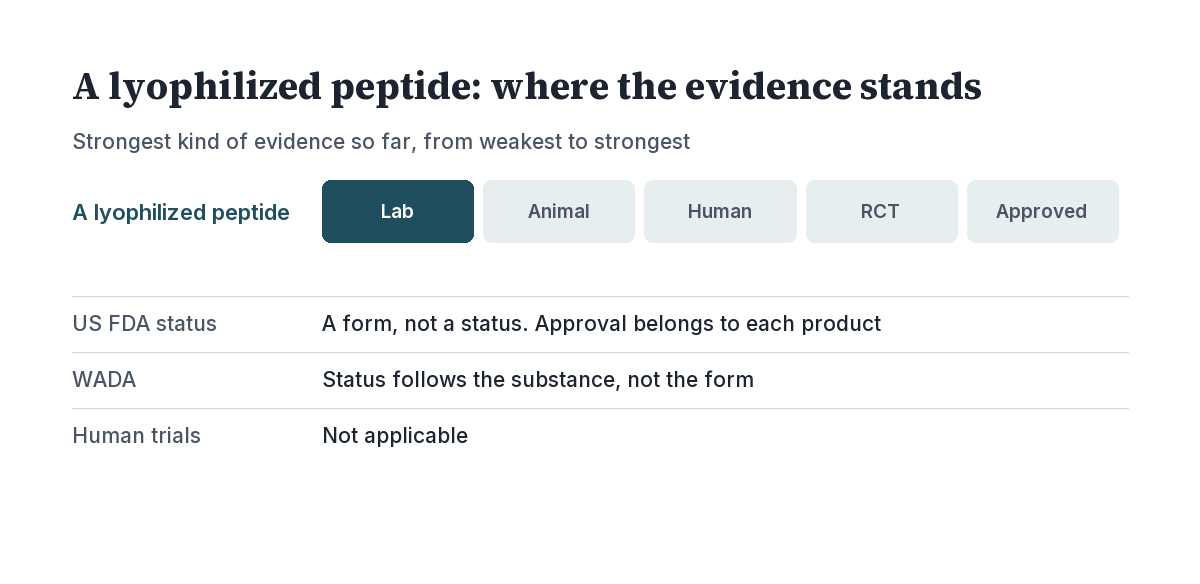
| US FDA status | A form, not a status. Approval belongs to each product: Egrifta WR is approved as a lyophilized powder (label); BPC-157 powder has no FDA approval as of 2026-10-11 |
| Compounding (503A/503B) | Form does not change a substance’s category. GHRP-2 is still in Category 2; BPC-157 and injectable GHK-Cu were withdrawn by nominators, with no new category assigned (FDA page dated 2026-04-22) |
| WADA 2026 | Status follows the substance, not the form: BPC-157 is prohibited under S0, non-approved substances (USADA) |
| Strongest evidence | Lab (in vitro) studies and pharmaceutical reviews on peptide stability in solids |
| Human trials | Not applicable: the term names a manufacturing process. Approved lyophilized drugs were tested in their own trials |
| Last checked | 2026-10-11 |
Key points:
- Freeze-drying is the most common way to make solid protein drugs, but freezing and drying stresses can themselves damage proteins (Wang 2000).
- A dry peptide still degrades slowly; in a lab study, more water meant faster deamidation (Lai 1999).
- Freeze-drying a peptide purified with trifluoroacetic acid (TFA) leaves a peptide–TFA salt, and TFA can make up to 35% of its weight (Erckes 2025).
- “Non-lyophilized” means the peptide comes already in solution, as in the approved glucagon product Gvoke (FDA label).
- A Belgian study of ten falsified peptide drugs from suspected illegal internet pharmacies found purity of 5–75% for cysteine-containing peptides, plus arsenic and lead contamination (Janvier 2018).
What does lyophilized mean?
Lyophilization is the technical name for freeze-drying. FDA’s inspection guide defines it as “a process in which water is removed from a product after it is frozen and placed under a vacuum, allowing the ice to change directly from solid to vapor without passing through a liquid phase” (FDA, Lyophilization of Parenteral). That jump from solid to vapor is called sublimation.
The same FDA guide splits the process into three linked stages:
- Freezing: the peptide solution is frozen, so most of the water becomes ice.
- Primary drying (sublimation): under vacuum, the ice turns straight into vapor and is removed.
- Secondary drying (desorption): water still bound to the solid is driven off, leaving a low residual moisture that manufacturers set limits for.
What is left is a porous solid, often called a “cake”. If drying goes wrong, the cake can collapse. FDA describes “meltback” as “a form of cake collapse … caused by the change from the solid to liquid state”, meaning sublimation was incomplete. Process design rests on measured thermal limits of the frozen product, such as its collapse temperature and glass transition (Tg′), together with shelf temperature and chamber pressure (Tang and Pikal 2004). A glass transition is the temperature at which a rigid, glassy solid starts to soften.
So when a peptide label says “lyophilized”, it tells the reader how water was taken out of the product. On its own, it says nothing about what the peptide is, how pure it is or whether it is approved.
Why are peptides lyophilized?
The main reason is stability. FDA notes that many parenteral drugs (drugs given by routes other than the gut), including antibiotics and biopharmaceuticals, are unstable in solution, which is why they are made as lyophilized products (FDA). Wang’s review of solid protein drugs calls lyophilization “the most commonly used method for preparing solid protein pharmaceuticals” (Wang 2000).
In water, peptides and proteins break down through chemical reactions such as deamidation (loss of an amide group, often at asparagine), oxidation and cleavage of the peptide backbone, and through physical changes such as aggregation (Manning 2010). Taking most of the water out slows many of these reactions.
Drying does not stop them completely. A review of solid-state stability lists deamidation, peptide bond cleavage, oxidation, the Maillard reaction, beta-elimination and aggregation as reactions that still occur in dry peptide and protein drugs, driven by temperature, moisture, excipients and whether the solid is amorphous or crystalline (Lai and Topp 1999) [Lab]. In a lab study of an asparagine-containing six-amino-acid peptide held in polymer solids, “the rate of Asn-hexapeptide deamidation increases with increasing water content or water activity” (Lai et al. 1999) [Lab]. FDA’s guide likewise treats residual moisture as a major quality concern for lyophilized products.
The process carries its own risks. Wang notes that lyophilization “generates both freezing and drying stresses, which can denature proteins to various degrees”, and the review covers excipients (inactive ingredients) that protect the molecule during freezing and drying. The approved tesamorelin powder, for example, contains mannitol and hydroxypropyl betadex as inactive ingredients (Egrifta WR label).
What is actually in a lyophilized peptide powder?
A powder labeled with a peptide’s name is not pure peptide by weight. The table below grades each claim by its evidence level.
| Claim | Evidence level | Best source and result |
|---|---|---|
| Freeze-drying is used because many drugs are unstable in solution | Regulator guidance | FDA guide: antibiotics and biopharmaceuticals named |
| Dry peptides still degrade, faster with more water | Lab (in vitro) | Lai 1999: deamidation rose with water content |
| The process can damage the molecule | Review | Wang 2000: freezing and drying stresses can denature proteins |
| Synthetic peptide powders carry counter-ions | Lab (in vitro) | Erckes 2025: TFA about 25%, up to 35% of salt weight |
| Measured peptide content depends on the method | Lab (analytical) | Vemuri 2005: four methods compared for thymalfasin |
| Illegal online peptide drugs vary widely in content | Lab analysis of products | Janvier 2018: 10 products, purity 5–75%, arsenic and lead found |
Counter-ions. A counter-ion is the oppositely charged ion that pairs with a charged peptide to form a salt. Solid-phase peptide synthesis (SPPS) and its purification “strongly rely on trifluoroacetic acid (TFA) as a cleavage agent and ion-pairing reagent”, and freeze-drying the purified solution “results in the formation of a peptide—TFA salt” (Erckes et al. 2025) [Lab]. In that study the expected TFA share of the test peptides’ salt weight was about 25%, and the authors cite TFA reaching up to 35% of total weight. They also note that residual TFA has been shown to change cell growth, increase cell and liver toxicity and boost antibody responses in experiments [Lab]. Tesamorelin in Egrifta WR, by comparison, is an acetate salt (FDA label). A review of counter-ions in peptide drugs describes how the choice of salt affects a peptide’s structure, physical properties and formulation (Sikora 2020).
Water and excipients. Secondary drying leaves a small amount of residual moisture, for which FDA expects specifications at release and over the product’s shelf life (FDA). Added stabilizers, such as mannitol in the tesamorelin product, add further weight.
Peptide content. Because of salts, water and excipients, the net peptide content of a powder is lower than its total weight, and measuring it is not trivial. An analytical study of lyophilized thymalfasin (thymosin alpha-1) compared elemental analysis, amino acid analysis, HPLC and the Kjeldahl method and found that results depend “highly upon the particular peptide compound and methodology used”; elemental (CHN) analysis was the most precise, at under 2% variation (Vemuri 2005) [Lab].
What does non-lyophilized mean?
“Non-lyophilized” describes a peptide product that is not freeze-dried, usually one supplied already dissolved in liquid. Both forms exist among approved drugs. Gvoke, first approved in 2019, is glucagon for severe hypoglycemia supplied as a ready-to-use solution (Gvoke label). Egrifta WR, by contrast, supplies tesamorelin, a 44-amino-acid growth hormone-releasing factor analog, as a lyophilized powder (Egrifta WR label).
Neither form is better in general. A ready-to-use liquid removes a preparation step, but it needs a formulation that keeps the peptide intact in water, where the degradation reactions described above run fastest (Manning 2010). For an approved drug, FDA reviews the form the company submits. For an unapproved product, neither a powder nor a liquid has gone through that review.
Does “lyophilized” mean pharmaceutical grade or safe?
No. Freeze-drying is open to licensed and unlicensed manufacturers alike. A study of seized pharmaceutical preparations found Selank and Semax, peptides it described as “freely available either as lyophilized powder for injection purposes or are present in nasal sprays” (Vanhee 2020).
When Belgian researchers tested the ten falsified peptide drugs most often found on their market, bought from three suspected illegal internet pharmacies, they found “high variation in amount of drugs per unit and a low purity (ranging between 5% and 75% for cysteine containing peptides)”, plus arsenic and lead, with multiple samples at up to ten times the ICH toxicity limit for parenteral drugs (Janvier 2018) [Lab analysis of products].
FDA has also acted on “research use only” peptide sellers. Its warning letter of 2026-08-24 to one seller named products including tesamorelin, semaglutide and retatrutide sold as “GLP-3R”, and stated that despite “research use only” and “not for human consumption” labels, the seller’s website showed the products were intended as drugs for human use (FDA warning letter). The letter adds that injectable products “bypass some of the body’s key defenses against toxins and microorganisms that can lead to serious and life-threatening conditions.” Retatrutide is an investigational drug that cannot be obtained legally outside clinical trials; its status is covered in the retatrutide FDA approval timeline. What the label wording means legally is explained in research use only peptides: what the label means.
Legal and regulatory status of lyophilized peptides
Regulators classify the substance and the product, not the drying method. The table shows what decides status, as of 2026-10-11.
| Body | What decides status | Example |
|---|---|---|
| US FDA (approval) | Each product, in its approved form | Egrifta WR approved as lyophilized powder (label); Gvoke approved as solution (label) |
| US FDA (compounding) | The bulk drug substance | GHRP-2, GHRP-6, kisspeptin-10 still in Category 2 (FDA, 2026-04-22) |
| US FDA (enforcement) | Intended use, shown by labeling and marketing | “Research use only” labels did not prevent a 2026-08-24 warning letter (FDA) |
| WADA / USADA | The substance and its approval status | BPC-157 prohibited under S0 (USADA) |
On compounding, the FDA page lists BPC-157 and “GHK-Cu (for injectable routes of administration)” among substances “previously in Category 2 – withdrawn by nominators” (FDA). Withdrawal is not a move to Category 1; the difference is set out in Category 1 vs Category 2 peptides and FDA’s 503A lists.
In sport, USADA describes S0 non-approved substances as those “not approved by any government regulatory authority” and “not approved for human use”, and names BPC-157 as an example (USADA). A freeze-dried powder of a prohibited peptide is the same prohibited substance. The full list by class is in WADA banned peptides: which peptides are prohibited in sport.
What users report
What follows are unverified self-reports from people who usually bought unregulated products; they are not evidence. People who post on forums, Reddit and YouTube about peptides commonly treat “lyophilized” as a sign of quality, and a recurring argument is whether that is justified, since the term only describes drying. Many posts discuss what the powder should look like: a firm white cake is often described as normal, while a collapsed, sticky or shrunken cake prompts worry that the product was damaged or poorly made. Some people post third-party lab results showing less peptide than the label claims, or a different substance, and complain about inconsistent results between batches. Others say they noticed no effect and wonder whether the powder had degraded. A smaller group raises the trifluoroacetate question and argues over whether acetate salts are preferable.
Frequently asked questions
What do lyophilized peptides do?
Freeze-drying itself does nothing in the body; it only removes water so the peptide breaks down more slowly before use. Any effect comes from the peptide, and its evidence is separate. FDA states that many parenteral drugs are made lyophilized because they are unstable in solution (FDA).
How long does a lyophilized peptide last?
There is no single shelf life. An approved product’s expiry comes from stability testing of that exact formulation, and FDA expects moisture limits to be set for it. Dry peptides still degrade: a review lists deamidation, oxidation and aggregation in solids, driven by temperature and moisture (Lai and Topp 1999). Unapproved powders have no FDA-reviewed labeling.
What does GHK-Cu lyophilized mean?
It means the copper peptide GHK-Cu is supplied as a freeze-dried powder; it is the same molecule, not a different version. The form does not change its status: FDA lists GHK-Cu for injectable routes as withdrawn from Category 2 by nominators, noting limited human data on safety (FDA).
Is a lyophilized peptide the same as an FDA-approved peptide?
No. Lyophilization is a manufacturing step used by approved and unapproved products alike. Egrifta WR is an FDA-approved lyophilized peptide, while falsified peptide powders in one Belgian study were of low and variable purity (Janvier 2018).
References
- US Food and Drug Administration. Lyophilization of Parenteral (7/93), Guide to Inspections. Content current 2014-11-11. fda.gov
- Wang W. Lyophilization and development of solid protein pharmaceuticals. Int J Pharm. 2000;203(1-2):1-60. PubMed 10967427
- Manning MC, Chou DK, Murphy BM, Payne RW, Katayama DS. Stability of protein pharmaceuticals: an update. Pharm Res. 2010;27(4):544-75. PubMed 20143256
- Lai MC, Topp EM. Solid-state chemical stability of proteins and peptides. J Pharm Sci. 1999;88(5):489-500. PubMed 10229638
- Lai MC, Hageman MJ, Schowen RL, Borchardt RT, Topp EM. Chemical stability of peptides in polymers. 1. Effect of water on peptide deamidation in poly(vinyl alcohol) and poly(vinyl pyrrolidone) matrixes. J Pharm Sci. 1999;88(10):1073-80. PubMed 10514358
- Tang X, Pikal MJ. Design of freeze-drying processes for pharmaceuticals: practical advice. Pharm Res. 2004;21(2):191-200. PubMed 15032301
- Erckes V, Streuli A, Chamera Rendueles L, Krämer SD, Steuer C. Towards a consensus for the analysis and exchange of TFA as a counterion in synthetic peptides and its influence on membrane permeation. Pharmaceuticals (Basel). 2025;18(8):1163. PMC12389442
- Sikora K, Jaśkiewicz M, Neubauer D, Migoń D, Kamysz W. The role of counter-ions in peptides: an overview. Pharmaceuticals (Basel). 2020;13(12):442. PMC7761850
- Vemuri S. Comparison of assays for determination of peptide content for lyophilized thymalfasin. J Pept Res. 2005;65(4):433-9. PubMed 15813890
- US Food and Drug Administration. EGRIFTA WR (tesamorelin) prescribing information, 2025. accessdata.fda.gov
- US Food and Drug Administration. GVOKE (glucagon injection) prescribing information, 2019. accessdata.fda.gov
- Janvier S, Cheyns K, Canfyn M, Goscinny S, De Spiegeleer B, Vanhee C, Deconinck E. Impurity profiling of the most frequently encountered falsified polypeptide drugs on the Belgian market. Talanta. 2018;188:795-807. PubMed 30029448
- Vanhee C, Francotte A, Janvier S, Deconinck E. The occurrence of putative cognitive enhancing research peptides in seized pharmaceutical preparations. Drug Test Anal. 2020;12(3):371-381. PubMed 31667971
- US Food and Drug Administration. Warning letter to Peak Performance Peptides, 2026-08-24. fda.gov
- US Food and Drug Administration. Certain bulk drug substances for use in compounding that may present significant safety risks (Category 2). Content current 2026-04-22. fda.gov
- USADA. #AskUSADA: What is a non-approved substance and why are they prohibited? usada.org
Change log
2026-10-23: links to glossary definitions added; no change to the facts.
2026-10-19: links to related entries added; no change to the facts.
2026-10-14: links to related entries added; no change to the facts.
2026-10-12: links to related entries added; no change to the facts.
2026-10-11: first published after review by the editorial team.