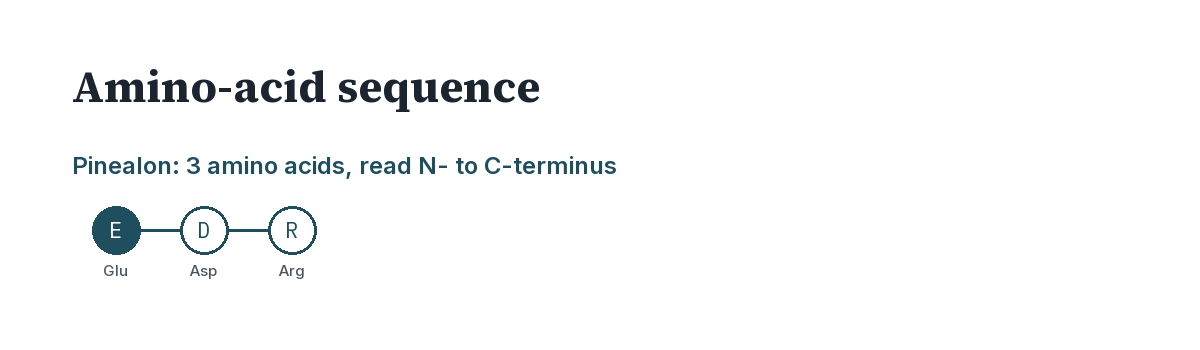
Pinealon is a synthetic three-amino-acid peptide (Glu-Asp-Arg, or EDR) from Vladimir Khavinson’s bioregulator group in St. Petersburg, studied mainly in cells and rodents for brain protection; its strongest evidence is small uncontrolled human reports.
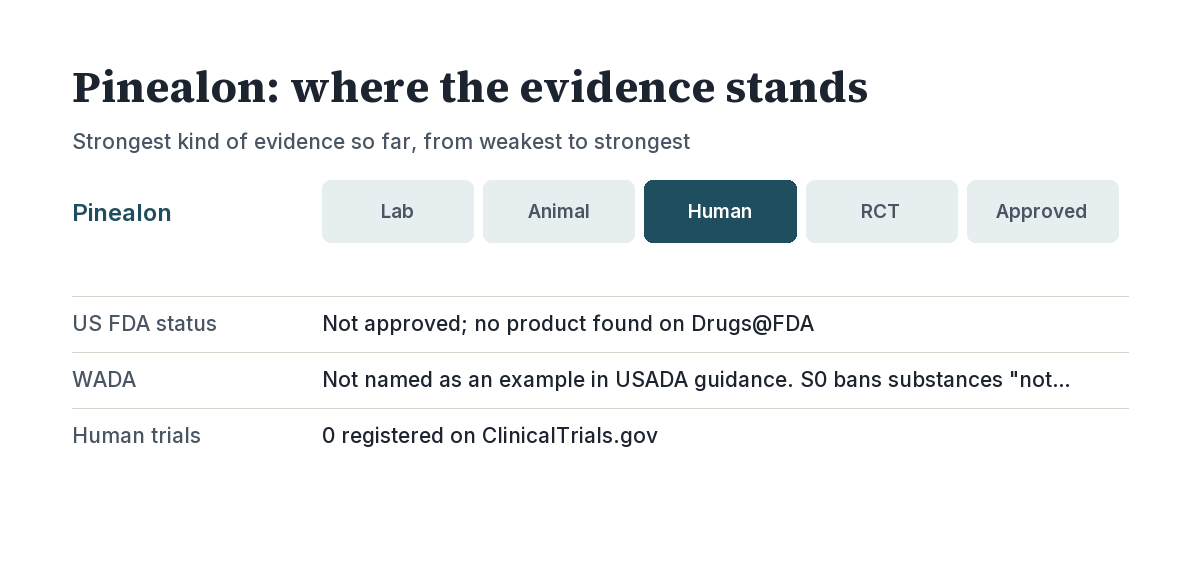
Its most promising result comes from rats: when pregnant rats with high homocysteine received pinealon, the share of dying cerebellar neurons in their offspring under oxidative stress fell from 17.7% to 7.0%, and the pups learned a water maze faster (Arutjunyan 2012) [Animal]. Pinealon has no FDA approval, no trial registered on ClinicalTrials.gov, and no published randomized human trial (all searched 2026-10-15).
| Item | Status |
|---|---|
| US FDA status | Not approved; no product found on Drugs@FDA (searched 2026-10-15). No approval step announced as of that date. |
| Compounding (503A/503B) | Not on the 503A bulks list; not named on FDA’s Category 2 page (current as of 2026-04-22). Not on the agenda of FDA’s July 2026 compounding committee; no review scheduled. |
| WADA | Not named as an example in USADA guidance. S0 bans substances “not approved by any government regulatory authority” (USADA). The 2027 List (in force 2027-01-01) adds named peptide examples to S0, not pinealon; USADA warns unnamed peptides “may still be prohibited” (USADA 2027). |
| Strongest evidence | Human, uncontrolled (n=32), plus rat, mouse and cell studies |
| Human trials | 0 registered on ClinicalTrials.gov (searched 2026-10-15); 3 small Russian human reports |
| Last checked | 2026-10-15 |
Key points:
- All 17 studies cited on this page come from Russian research teams, and 8 list Vladimir Khavinson as an author.
- In a mouse model of Alzheimer’s disease, EDR restored dendritic spine density to normal levels (+11%, p = 0.039) [Animal].
- In neurons made from the skin cells of three women aged 61–68, EDR lengthened dendrites by 46% [Lab].
- A 32-adult report, with no placebo group described, also noted a drop in blood stem-cell markers.
- No published study measures how much pinealon reaches the blood or brain after it is swallowed (PubMed, searched 2026-10-15).
| Property | Value |
|---|---|
| Sequence | Glu-Asp-Arg (EDR), 3 amino acids |
| Molecular formula | C15H26N6O8 |
| Molecular weight | 418.40 g/mol |
| PubChem CID | 10273502 |
| Routes studied | Intraperitoneal (rats, mice); oral capsule (humans); cell culture |
| Class | Synthetic short peptide (“peptide bioregulator”) |
What is pinealon?
Pinealon is one of a family of short synthetic peptides that Vladimir Khavinson and colleagues call “bioregulators”, a term the group uses for short peptides they propose act on gene activity in specific tissues. The family includes epitalon (Ala-Glu-Asp-Gly) and testagen; a 2011 cell study tested all three side by side and described pinealon as Glu-Asp-Arg (Fedoreyeva 2011). Despite its name, pinealon has been studied mostly in neurons and brain cortex cells rather than the pineal gland. In cultured rat pineal tissue, only epitalon raised the pinealocyte signaling marker CGRP; Glu-Asp-Arg did not (Khavinson 2011, pineal culture) [Lab]. Recent work from the same network refers to it as the “EDR peptide” and studies it as a candidate for Alzheimer’s disease (Ilina 2024).
How does pinealon work?
- Antioxidant protection: in cultured rat cerebellar neurons, neutrophils and PC12 cells, pinealon limited the build-up of reactive oxygen species in a dose-dependent way and reduced necrotic cell death (Khavinson 2011) [Lab].
- Effects beyond antioxidant action: the same study found the antioxidant effect leveled off at lower concentrations, while changes to the cell cycle and ERK 1/2 signaling continued at higher ones, which the authors read as a sign of direct action on the genome [Lab].
- DNA binding: fluorescence-labeled pinealon entered the nucleus of human HeLa cells, and in separate DNA-binding tests it appeared to bind preferentially to CAG-containing sequences (Fedoreyeva 2011) [Lab]; a physics group at Saint Petersburg State University found EDR can partly enter the major groove of DNA and contact guanine atoms (Silanteva 2019) [Lab].
- Gene regulation (hypothesis): computer modeling predicted EDR binding sites in the promoter regions of genes including CASP3, APOE, SOD2 and GAP43 (Khavinson 2021) [Lab, modeling]; a review from the group proposes it binds histones or RNA to change protein synthesis (Khavinson 2020). This has not been tested in people.
- Serotonin: Glu-Asp-Arg raised serotonin expression in aging cultures of brain cortex cells (Khavinson 2014) [Lab].
Benefits of pinealon: what the research shows
The most promising potential benefit of pinealon is protection of nerve cells under stress. In rat pups exposed to high homocysteine before birth, pinealon given to their mothers cut necrotic cerebellar neurons from 17.7% to 7.0% under oxidative challenge [Animal]. In an Alzheimer’s mouse model, EDR brought dendritic spine density back to normal [Animal], and in aging human-derived neurons it increased dendrite length by 46% [Lab].
| Claim | Evidence level | Best study and result |
|---|---|---|
| Protects neurons from oxidative stress | Lab; Animal | Arutjunyan 2012, rats, 6 litters/group: necrotic cells 17.7% vs 7.0%; ROS 158.7 vs 108.6 units |
| Improves learning and memory | Animal | Arutjunyan 2012, 23 pups/group: maze search 170 s vs 137 s; Mendzheritskiĭ 2013, young and old rats |
| Counters Alzheimer’s-type synapse loss | Animal | Khavinson 2021, 5xFAD mice: spine density +11% (p = 0.039) |
| Supports aging human neurons | Lab (3 donors) | Kraskovskaya 2024: dendrite length +46% (p = 0.033); DNA damage −23% (p = 0.057, not significant) |
| Resistance to low oxygen | Animal | Kozina 2008: strongest effect of four peptides in hypobaric hypoxia |
| Slows “biological age” in people | Human, uncontrolled (n=32) | Meshchaninov 2015: improved nervous-system measures; vesugen outperformed pinealon |
| Work-stress resilience | Human, observational | Bashkireva 2012, truck drivers: better psychoemotional indices with pinealon plus vesugen |
| Sleep or melatonin | No study found | No PubMed record tests pinealon on sleep (searched 2026-10-15) |
Brain protection and memory
The neuroprotection data come from several rodent models, all from the same research network. In the homocysteine study, pinealon was given to pregnant Wistar rats at 10 µg/kg, and both cell survival and maze learning improved in their offspring (Arutjunyan 2012) [Animal]. In old rats under acute hypoxia, the authors suggested pinealon brought neuroinflammatory markers (IL-6, TNF) back toward reference levels (Mendzheritskiĭ 2014) [Animal]. In a learning test, pinealon helped both young and old rats more than the comparator peptide preparation Cortexin (Mendzheritskiĭ 2013) [Animal]. Results were not uniformly positive: in old rats with blocked carotid arteries, pinealon improved survival but reduced exploratory, motivational and motor behavior (Mendzheritskiĭ 2011) [Animal].
Alzheimer’s disease models
In 5xFAD mice, which carry human Alzheimer’s mutations, two months of daily EDR restored spine density at 5 months of age to that of healthy control mice (p = 0.509 versus controls) and reduced thin spines by 10% (Khavinson 2021) [Animal]. Some measures of synaptic strengthening narrowly missed significance (p = 0.057). In induced neurons from older women, EDR increased primary dendrites by 28% (p = 0.0208); its effect on oxidative DNA damage did not reach statistical significance (Kraskovskaya 2024) [Lab].
Ageing and work capacity in people
The human reports come from Russian occupational and gerontology research and appear in the journal Advances in Gerontology. They describe improvements in “biological age” scores and stress measures, but none of their abstracts describes randomization or a placebo group, so they cannot separate the peptide’s effect from expectation or chance. They are listed in the next section.
Human studies and trials
No trial of pinealon is registered on ClinicalTrials.gov (searched 2026-10-15). The published human data are three small reports:
- Meshchaninov 2015: 32 adults aged 41–83 with several chronic diseases and organic brain syndrome received the peptides pinealon and vesugen. The authors reported improved central nervous system activity, but also pro-oxidant activity and a fall in CD34+ blood stem-cell markers; vesugen showed the clearer effect. No control group is described in the abstract.
- Nazimko 2012: locomotive crew workers took pinealon capsules for two weeks; the authors reported better biological-age and adaptation scores. The abstract gives no sample size or control group.
- Bashkireva 2012: compared 150 male truck drivers with 150 metal workers and reported that pinealon combined with vesugen improved psychoemotional indices (p < 0.001–0.05). The two peptides were given together, so pinealon’s own effect cannot be isolated.
No completed randomized, placebo-controlled trial of pinealon was found on PubMed or ClinicalTrials.gov as of 2026-10-15.
Doses used in studies
| Route and amount | Species | Study |
|---|---|---|
| Intraperitoneal, 10 µg/kg | Pregnant rats | Arutjunyan 2012 |
| Intraperitoneal, 400 µg/kg daily for 2 months | Mice (5xFAD) | Khavinson 2021 |
| Cell culture, 10 µg/mL | Human induced neurons | Kraskovskaya 2024 |
| Oral capsule, 100 µg twice a day for two weeks | Humans (workers) | Nazimko 2012 |
No established human dose exists outside approved labels.
Side effects and safety
No serious adverse events are described in the abstracts reviewed for this page, but the safety record is thin. A report in 32 adults given the peptides pinealon and vesugen noted pro-oxidant activity and a “significant inhibition of hemopoiesis”, meaning lower markers of blood-forming stem cells, without saying which peptide was responsible (Meshchaninov 2015) [Human, uncontrolled]. The same authors found no change in chromatin condensation, which they read as no harm at the nuclear level. In old rats, pinealon reduced motor and exploratory behavior after carotid occlusion and moderately raised activity of caspase-3, an enzyme involved in cell death (Mendzheritskiĭ 2011) [Animal].
Theoretical risks follow from the proposed mechanism. If EDR binds DNA and changes gene expression, as the Khavinson group proposes (Khavinson 2020), its long-term effects on gene activity are unstudied; no long-term toxicology or cancer study was found on PubMed (searched 2026-10-15).
Because no pinealon product is FDA-approved (Drugs@FDA, searched 2026-10-15), no product sold in the US has had its identity, purity, sterility or strength reviewed by FDA; our page on what the “research use only” label means explains the legal position of such products. With no label, no regulator has defined who should not use it, and there are no published data in pregnancy, breastfeeding, children or people taking other medicines.
Anyone who suspects a side effect from pinealon or any other drug or product can report it to the FDA through MedWatch.
What users report
What follows are unverified self-reports from people who usually bought unregulated products; they are not evidence. People who post about pinealon on forums and social media most often describe clearer thinking, better focus, and changes in dreams or sleep. Some say they noticed a difference within days, while a common complaint is that nothing noticeable happened at all. It is frequently discussed together with epitalon and other bioregulators, which makes it hard for posters to say which product did what. Other recurring complaints are cost and doubt about whether a product contains what its label says, since buyers have no way to check purity. A long-running argument is whether a peptide this small survives digestion when swallowed, with some posters convinced oral forms work and others dismissing them. A second debate is how much weight to give research that comes almost entirely from one Russian group and has rarely been repeated elsewhere.
Legal and regulatory status
| Jurisdiction | Status (checked 2026-10-15) |
|---|---|
| US FDA | Not approved; no product on Drugs@FDA |
| 503A bulks list | Not listed (21 CFR 216.23) |
| FDA categories 1–3 | Not named (Category 2 page, 2026-04-22) |
| FDA advisory committee | Not on the July 2026 agenda |
| WADA 2026 List | Not named as an example; S0 covers non-approved substances (USADA) |
| WADA 2027 List | Not named; unnamed peptides “may still be prohibited” (USADA) |
| Clinical trials | None registered (ClinicalTrials.gov) |
FDA’s 503A page says the agency “does not intend to place bulk drug substances nominated on or after January 7, 2025, into these categories” (FDA, 503A bulks), so a new nomination of pinealon would not receive an interim category. Our explainer on what FDA’s Category 1 and Category 2 compounding lists mean covers how that system works. Unlike its sibling epitalon, which was reviewed for insomnia, pinealon was not on the agenda when FDA’s Pharmacy Compounding Advisory Committee met on 2026-07-23/24 (FDA meeting page). For athletes, the 2027 List keeps the S0 class; our page on which peptides WADA prohibits in 2027 lists the named examples. We found no UK, EU or Australian regulator page naming pinealon, so no status is given for those jurisdictions.
Related peptides
- Epitalon (Ala-Glu-Asp-Gly): the best-known Khavinson bioregulator, a separate four-amino-acid peptide studied for the pineal gland and ageing.
- Semax: a Russian-developed neuropeptide studied for stroke and cognition.
- DSIP (delta sleep-inducing peptide): the peptide most often searched alongside pinealon for sleep.
- GHK-Cu (copper tripeptide-1): another three-amino-acid peptide studied in ageing, mainly of skin.
Frequently asked questions
Is pinealon FDA approved?
No. Pinealon is not an FDA-approved drug, and no pinealon product appears on Drugs@FDA as of 2026-10-15. It is also not on the 503A bulks list in 21 CFR 216.23, the list of bulk substances pharmacies may compound from, and no FDA review of it was scheduled as of that date.
Is pinealon safe?
Its safety in people is unknown. A Russian report in 32 adults, with no placebo group described, noted pro-oxidant activity and lower blood stem-cell markers (Meshchaninov 2015). No long-term toxicology study was found on PubMed as of 2026-10-15, and products sold outside approval have had no FDA quality review.
Are pinealon and epitalon the same?
No. They are different peptides from the same Russian research group. Pinealon is a tripeptide, Glu-Asp-Arg, while epitalon is a tetrapeptide, Ala-Glu-Asp-Gly. In rat pineal tissue culture, only epitalon raised the pinealocyte marker CGRP, while Glu-Asp-Arg did not (Khavinson 2011), despite pinealon’s name.
Is pinealon orally bioavailable?
This has not been measured. No pharmacokinetic study of pinealon in animals or people was found on PubMed as of 2026-10-15. One Russian study gave workers pinealon by capsule for two weeks and reported better biological-age scores (Nazimko 2012), but it did not report blood or brain levels.
Is pinealon a bioregulator?
Yes, in the sense its developers use. “Peptide bioregulator” is the Khavinson group’s term for short peptides they propose regulate gene activity. Lab work shows labeled pinealon entering cell nuclei and binding DNA (Fedoreyeva 2011), but gene regulation by pinealon has not been shown in people.
References
- Khavinson V, Ribakova Y, Kulebiakin K, et al. (2011). Pinealon increases cell viability by suppression of free radical levels and activating proliferative processes. Rejuvenation Research. PubMed 21978084
- Arutjunyan A, Kozina L, Stvolinskiy S, et al. (2012). Pinealon protects the rat offspring from prenatal hyperhomocysteinemia. International Journal of Clinical and Experimental Medicine. PMC3342713
- Khavinson V, Ilina A, Kraskovskaya N, et al. (2021). Neuroprotective effects of tripeptides-epigenetic regulators in mouse model of Alzheimer’s disease. Pharmaceuticals (Basel). PubMed 34071923
- Kraskovskaya N, Linkova N, Sakhenberg E, et al. (2024). Short peptides protect fibroblast-derived induced neurons from age-related changes. International Journal of Molecular Sciences. PubMed 39518916
- Khavinson V, Linkova N, Kozhevnikova E, Trofimova S. (2020). EDR peptide: possible mechanism of gene expression and protein synthesis regulation involved in the pathogenesis of Alzheimer’s disease. Molecules. PubMed 33396470
- Fedoreyeva LI, Kireev II, Khavinson VKh, Vanyushin BF. (2011). Penetration of short fluorescence-labeled peptides into the nucleus in HeLa cells. Biochemistry (Moscow). PubMed 22117547
- Silanteva IA, Komolkin AV, Morozova EA, et al. (2019). Role of mono- and divalent ions in peptide Glu-Asp-Arg-DNA interaction. Journal of Physical Chemistry B. PubMed 30762356
- Khavinson VKh, Lin’kova NS, Tarnovskaya SI, et al. (2014). Short peptides stimulate serotonin expression in cells of brain cortex. Bulletin of Experimental Biology and Medicine. PubMed 24909721
- Khavinson VKh, Linkova NS, Chalisova NI, et al. (2011). Effect of short peptides on expression of signaling molecules in organotypic pineal cell culture. Bulletin of Experimental Biology and Medicine. PubMed 22803060
- Kozina LS. (2008). Investigation of antihypoxic properties of short peptides. Advances in Gerontology. PubMed 18546825
- Mendzheritskiĭ AM, Karantysh GV, Ivonina KO. (2011). Effects of introduction of short peptides before carotid artery occlusion on behaviour and caspase-3 activity in the brain of old rats. Advances in Gerontology. PubMed 21809624
- Mendzheritski AM, Karantysh GV, Abramchuk VA, Ryzhak GA. (2013). Effect of peptide geroprotectors on the navigation system learning and caspase-3 in brain structures in rats of different age. Advances in Gerontology. PubMed 28976148
- Mendzheritskiĭ AM, Karantysh GV, Ryzhak GA, Dem’ianenko SV. (2014). Regulation of content of cytokines in blood serum and of caspase-3 activity in brains of old rats in model of sharp hypoxic hypoxia with Cortexin and Pinealon. Advances in Gerontology. PubMed 25051764
- Ilina AR, Popovich IG, Ryzhak GA, Khavinson VK. (2024). Prospects for use of short peptides in pharmacotherapeutic correction of Alzheimer’s disease. Advances in Gerontology. PubMed 38944767
- Meshchaninov VN, Tkachenko EL, Zharkov SV, et al. (2015). Effect of synthetic peptides on aging of patients with chronic polymorbidity and organic brain syndrome of the central nervous system in remission. Advances in Gerontology. PubMed 26390612
- Nazimko VA, Morgul’ EV, Petrova OA, et al. (2012). Analysis of some parameters of biological age and adaptation possibilities of workers of locomotive brigades. Advances in Gerontology. PubMed 22708445
- Bashkireva AS, Artamonova VG. (2012). The peptide correction of neurotic disorders among professional truck-drivers. Advances in Gerontology. PubMed 23734521
- National Center for Biotechnology Information. PubChem Compound CID 10273502 (pinealon). PubChem
- ClinicalTrials.gov. Search results for “pinealon” (searched 2026-10-15). ClinicalTrials.gov
- US FDA. Drugs@FDA database (searched 2026-10-15). Drugs@FDA
- US FDA. Certain bulk drug substances for use in compounding that may present significant safety risks (content current as of 2026-04-22). FDA
- US FDA. Bulk drug substances used in compounding under section 503A of the FD&C Act (content current as of 2026-05-14). FDA
- US FDA. July 23–24, 2026 meeting of the Pharmacy Compounding Advisory Committee. FDA
- Electronic Code of Federal Regulations. 21 CFR 216.23, Bulk drug substances that can be used to compound drug products in accordance with section 503A. eCFR
- USADA. #AskUSADA: What is a non-approved substance and why are they prohibited? USADA
- USADA. Athlete advisory: what’s new on the 2027 WADA Prohibited List. USADA
Change log
2026-10-23: links to glossary definitions added; no change to the facts.
2026-10-19: links to related entries added; no change to the facts.
2026-10-18: 5xFAD mouse spine result: dosing window corrected to two months of daily EDR before testing at 5 months (Khavinson 2021); reviewed by the editorial team.
2026-10-15: first published after review by the editorial team.