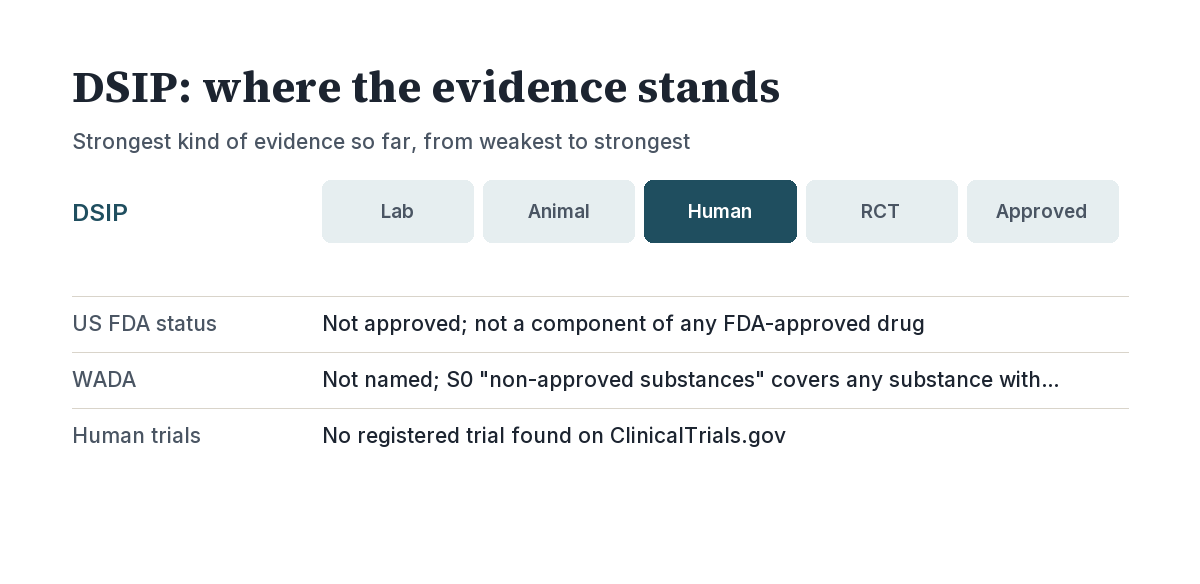
DSIP (delta sleep-inducing peptide, international name emideltide) is a nine-amino-acid peptide first isolated from rabbits in 1977 and studied as a sleep and withdrawal treatment. It is not FDA approved, and its strongest evidence is a handful of small intravenous human studies from 1981–1998 with mixed results. On 2026-07-24 the FDA’s compounding advisory committee voted against adding it to the 503A Bulks List, the only one of the seven peptides on the two-day agenda to get a “no” vote, according to trade-press reports of the meeting.
| Item | Status |
|---|---|
| US FDA status | Not approved; not a component of any FDA-approved drug (FDA briefing, 2026) |
| Compounding (503A/503B) | Withdrawn from Category 2 by nominators (FDA page, current 2026-04-22). FDA staff recommended against 503A listing; PCAC voted 6–7 (1 abstention) against on 2026-07-24 (FDA meeting page; counts as reported by trade press). Advisory; not on the 503A Bulks List |
| WADA 2026 | Not named; S0 “non-approved substances” covers any substance with no current approval by any health authority (WADA 2026 List) |
| Strongest evidence | Small human studies (n=6 to n=16 in sleep studies), IV only; FDA calls the insomnia data “inconclusive and at best preliminary” |
| Human trials | No registered trial found on ClinicalTrials.gov (searched 2026-10-06); published studies date from 1981 to 2009 |
| Last checked | 2026-10-10 |
What changed (October 2026): the sport section and the legal table now cover the 2027 WADA List, which names “peptides” in general in S0 from 2027-01-01.
Key points:
- The first human study, in six healthy volunteers, recorded 59% more sleep in the 130 minutes after an IV infusion than after placebo.
- Two later double-blind placebo-controlled insomnia studies (n=16 and n=6) found weak or no clinically meaningful benefit.
- DSIP breaks down within minutes in blood; FDA cites a human plasma half-life of 8 minutes (FDA briefing, 2026).
- No human safety data exist for the subcutaneous route that compounders proposed, according to FDA’s 2026 review.
- FDA’s adverse-event database held zero reports for emideltide when searched through March 3, 2024.
| Property | Value |
|---|---|
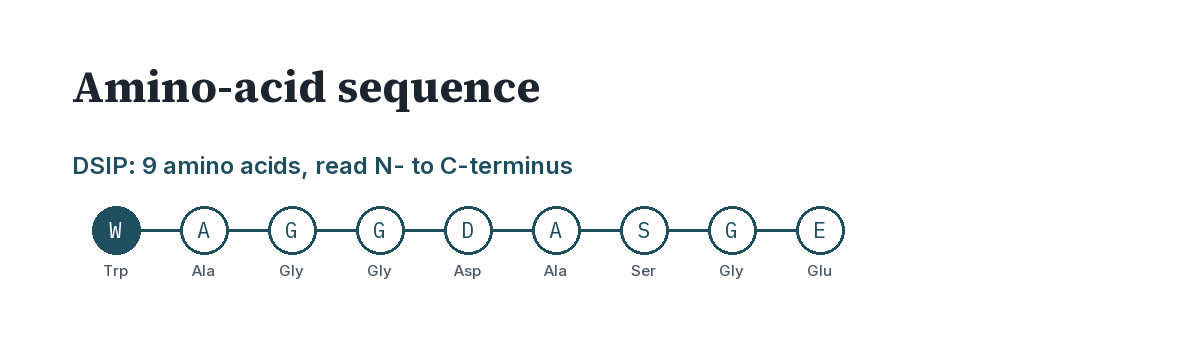
| Sequence | Trp-Ala-Gly-Gly-Asp-Ala-Ser-Gly-Glu (9 amino acids) |
| Molecular formula | C35H48N10O15 |
| Molecular weight | 848.8 g/mol (acetate salt 908.8) |
| CAS number | 62568-57-4 |
| UNII | YN28Z5YZ73 |
| PubChem CID | 68816 |
| Half-life | About 8 minutes in human plasma; 5–10 minutes in human serum in vitro |
| Routes studied in humans | Intravenous (studies cited here) |
| Class | Neuropeptide; studied for sleep, stress and withdrawal |
What is DSIP?
A Swiss group led by Schoenenberger and Monnier isolated DSIP from rabbits and in 1977 reported that the synthetic nonapeptide, infused into the brain ventricles of rabbits, specifically enhanced delta-wave and spindle EEG patterns, the electrical signature of deep sleep [Animal] (Schoenenberger and Monnier 1977, 58 rabbits). Human studies followed from 1981. “Emideltide” is the WHO international name; FDA notes that it is not a US Adopted Name and that products sold under the common name have included different salts and derivatives (FDA briefing, 2026). Decades on, the biology is still unsettled: a 2006 review called the hypothesis of DSIP as a sleep factor “extremely poorly documented and still weak”, partly because no gene, precursor protein or receptor for it has been found (Kovalzon and Strekalova 2006).
How does DSIP work?
No receptor has been identified, so the proposed mechanisms rest on indirect evidence:
- Deep-sleep EEG changes: brain infusion in rabbits enhanced delta and spindle activity [Animal] (Schoenenberger and Monnier 1977), but FDA’s review lists rat and cat studies with conflicting results, including one that found no delta increase (FDA briefing, 2026).
- Opioid-system involvement: in rats, DSIP given into the brain increased both REM and non-REM sleep, and the opioid blocker naloxone abolished the effect [Animal] (Young and Key 1984).
- Enkephalin release: in rat brain nerve-ending preparations, DSIP at 10⁻¹⁰–10⁻⁹ M triggered calcium-dependent release of Met-enkephalin, an endogenous opioid, in several brain regions but not the striatum [Lab] (Nakamura 1991).
- Stress-hormone effects: in 11 healthy men, one IV dose lowered ACTH-like immunoreactivity for at least 3 hours while cortisol was unchanged [Human RCT, n=11] (Bjartell 1989); a later study found ACTH and cortisol responses “almost identical” with DSIP and placebo [Human, healthy men] (Späth-Schwalbe 1995).
- Rapid breakdown: peptidases in blood degrade DSIP quickly, which the authors examined as a possible cause of its variable effects [Lab] (Graf 1987).
What the research shows
| Claim | Evidence level | Best study and result |
|---|---|---|
| Increases sleep in healthy people | Human, crossover, n=6 | Schneider-Helmert 1981: median sleep +59% in the 130 min after infusion vs placebo |
| Improves chronic insomnia | Human RCTs, n=6 and n=16; mixed | Bes 1992: effects weak, “not likely to be of major therapeutic benefit” |
| Eases opioid or alcohol withdrawal | Human, open, uncontrolled, n=107 | Dick 1984: signs resolved or improved in 97% (opiate) and 87% (alcohol), staff-rated |
| Helps narcolepsy | Case report, n=1 | FDA review of Schneider-Helmert 1984: sleep attacks 6 → 3 in treatment weeks |
| Reduces chronic pain | Human, uncontrolled pilot, n=7 | Larbig 1984: pain lower in 6 of 7 |
| Deepens anesthesia | Human RCT, n=24 | Pomfrett 2009: the reverse; delta rhythm fell and anesthesia lightened |
| Fewer tumors, longer life | Animal, mice, n=54 per group | Popovich 2003: tumor incidence 2.6-fold lower; mean lifespan unchanged |
| Aids stroke recovery | Animal, rats | Tukhovskaya 2021: faster motor recovery; infarct size not significantly smaller |
Sleep and insomnia
The early results were encouraging. In the first human study, six healthy volunteers given a slow IV infusion in the morning reported “sleep pressure” and slept 59% longer (median) over the next 130 minutes than after placebo, without measurable sedation [Human, n=6] (Schneider-Helmert 1981). In six middle-aged people with chronic insomnia, the same group reported longer and less interrupted sleep, with a slight arousing effect in the first hour [Human RCT crossover, n=6] (Schneider-Helmert and Schoenenberger 1981). In a seven-night study of 14 insomniacs, sleep efficiency and daytime alertness reached the levels of normal controls [Human, n=14] (Schneider-Helmert 1987); FDA’s review reports that mean time to fall asleep fell from 58.4 to 27.6 minutes and total sleep rose from 313 to 385 minutes, but notes the study had no placebo arm and compared patients with external healthy controls (FDA briefing, 2026). An open study reported normalized sleep in six of seven patients with severe insomnia for 3–7 months of follow-up [Human, open, n=7] (Kaeser 1984).
Groups outside the original laboratory found less. A double-blind parallel-group study in 16 insomniacs concluded that short-term DSIP “is not likely to be of major therapeutic benefit” [Human RCT, n=16] (Bes 1992), and a double-blind crossover study found no significant differences from baseline or placebo nights, calling the improvement “of little clinical significance” [Human RCT crossover, n=6] (Monti 1987). FDA’s 2026 review judged the insomnia evidence “inconclusive and at best preliminary”.
Opioid and alcohol withdrawal
The withdrawal research is the most clinically intriguing strand. In Geneva, IV DSIP was given to 107 inpatients in alcohol (n=47) or opiate (n=60) withdrawal; staff rated symptoms as resolved or markedly improved in 97% of opiate and 87% of alcohol patients, with anxiety slower to settle [Human, open, uncontrolled, n=107] (Dick 1984). An earlier report from the same team found a benefit in 48 of 49 evaluable patients, but 27% of those enrolled were lost or unsuitable for evaluation [Human, open, n=67] (Dick 1983). In a 1998 open trial of opioid detoxification, FDA’s review reports that mean withdrawal scores fell from 34.4 to 17.8 after the first injection, yet only two of seven patients completed the planned course [Human, open, n=7] (Backmund 1998). In rats in alcohol withdrawal, DSIP was reported to regulate the disturbed sleep [Animal] (Viglinskaia 1990). None of these human studies had a comparison group.
Cancer and lifespan
For the common “DSIP and cancer” question, the only tumor data come from mice. Female mice injected monthly with Deltaran, a Russian preparation of DSIP mixed with glycine, had 2.6-fold fewer spontaneous tumors and a 24.1% longer maximum lifespan, while mean lifespan did not change [Animal, n=54 per group] (Popovich 2003). FDA cautions that glycine itself has reported anti-tumor properties and that the study was not designed to test whether DSIP can cause cancer.
DSIP, melatonin and other sleep peptides
DSIP and melatonin are often compared. In rats, an injection of DSIP at 15 nmol/kg briefly delayed the night-time rise of melatonin in the pineal gland, an effect gone by later time points [Animal] (Oaknin 1986). No study found here tested DSIP against melatonin, epitalon or Selank in people. FDA’s panel reviewed epitalon for insomnia at the same session (FDA meeting page); separate entries for Selank and Semax are listed under Related peptides below.
Human studies and trials
No registered trial of DSIP or emideltide was found on ClinicalTrials.gov (searched 2026-10-06 under “emideltide”, “DSIP” and “delta sleep-inducing peptide”). Most of the published human work predates trial registration, and the human studies cited here gave DSIP intravenously. FDA counted doses of 25–150 nmol/kg given intravenously to 209 people for 1 to 15 days across these studies (FDA briefing, 2026).
| Study | Design and n | Result |
|---|---|---|
| Schneider-Helmert 1981 | DB crossover, healthy, n=6 | Sleep +59% (median) vs placebo; well tolerated |
| Schneider-Helmert 1981 | DB crossover, insomnia, n=6 | Longer, less interrupted sleep |
| Schneider-Helmert 1987 | 7 nights, insomnia, n=14 | Sleep reached normal-control levels; external controls |
| Monti 1987 | DB PC crossover, insomnia, n=6 | No significant difference vs placebo |
| Bes 1992 | DB PC parallel, insomnia, n=16 | Weak effects; no major benefit |
| Kaeser 1984 | Open, severe insomnia, n=7 | Sleep normalized in 6 of 7 |
| Dick 1984 | Open, withdrawal, n=107 | Improved in 97% (opiate), 87% (alcohol) |
| Backmund 1998 | Open, opioid detox, n=7 | 2 of 7 completed the course |
| Larbig 1984 | Open pilot, chronic pain, n=7 | Pain lower in 6 of 7 |
| Pomfrett 2009 | Randomized, anesthesia, n=24 | Lighter anesthesia, higher heart rate |
| Giusti 1993 | Healthy women, n=8 | No effect on growth hormone or prolactin |
Doses used in studies
| Route and amount | Species | Study |
|---|---|---|
| IV, 25 nmol/kg, once or on consecutive nights | Human, n=6 to n=16 | Schneider-Helmert 1981; Bes 1992 |
| IV, 25 nmol/kg, repeated | Human, n=107 | Dick 1984 |
| IV, 35 nmol/kg, repeated | Human, n=7 | FDA review of Backmund 1998 |
| IV, 25, 50 or 100 nmol/kg | Human, n=24 | Pomfrett 2009 |
| Intranasal, 120 µg/kg | Rat | Tukhovskaya 2021 |
| Subcutaneous, about 100 µg/kg (with glycine) | Mouse | Popovich 2003 |
No established human dose exists outside approved labels. FDA found no human data at all for the subcutaneous route that compounders nominated (FDA briefing, 2026).
Side effects and safety
Reported effects. In the small sleep studies, IV DSIP was described as well tolerated, with no psychological, physiological or biochemical side effects in the first healthy-volunteer study [Human, n=6] (Schneider-Helmert 1981). In the withdrawal studies FDA counted nine patients with minor transient effects (sweating, headache, nausea, vertigo) and three with serious reactions, two of them low blood pressure at the first injection, out of 107 [Human, open, n=107] (FDA briefing, 2026). FDA notes these effects overlap with withdrawal symptoms themselves. In patients under anesthesia, DSIP raised heart rate and lowered heart-rate variability [Human RCT, n=24] (Pomfrett 2009). FDA’s adverse-event database returned zero reports through March 3, 2024.
Theoretical risks named by FDA. Because DSIP appears to act through the body’s opioid system, FDA reasons it “could have reinforcing properties” and found no studies of its abuse potential. A nine-amino-acid peptide injected under the skin may provoke an immune response, a risk FDA says aggregation and impurities can amplify. Drugs that block the enzyme degrading DSIP, such as captopril, could raise its levels. FDA identified no repeat-dose, reproductive or two-year cancer toxicity studies.
Product quality. FDA reports that injection and intranasal emideltide products are sold in the US through clinics, medical spas and online retailers, and that products sold under the name have included different salts and molecules. Its Category 2 entry states that the agency “lacks sufficient information to know whether the drug would cause harm if administered to humans” (FDA Category 2 page). The general risks of unregulated vials are covered in our page on research use only peptides.
Who regulators exclude. There is no label, so there are no labelled contraindications. FDA points out that approved treatments with established efficacy exist for insomnia, narcolepsy and opioid withdrawal, and that none of the clinical guidelines it checked mentions emideltide.
What users report
These are unverified self-reports from people who usually bought unregulated products, not evidence. People who post about DSIP on forums and social media most often describe it as a sleep aid, and the accounts split sharply: some say they fall asleep more easily or wake feeling clearer, while a large share say they noticed nothing at all. Several describe unusually vivid dreams, and some report grogginess the next morning or, the opposite, feeling wired. A recurring complaint is inconsistency, with the same person describing a good first night followed by no effect. Nasal sprays draw particular skepticism, with posters questioning whether a fragile peptide survives in a spray bottle. Product quality is a frequent argument, since buyers cannot confirm what a vial contains, and cost comes up as a reason people stop. Many threads compare DSIP with melatonin or with other “sleep peptides” and conclude that the experience is hard to separate from placebo.
Legal and regulatory status
| Jurisdiction | Status | Source |
|---|---|---|
| US FDA | Not approved; no approved drug contains it | FDA briefing |
| US 503A Bulks List | Not listed (21 CFR 216.23, checked 2026-10-06) | eCFR |
| US interim categories | Withdrawn from Category 2 by nominators | FDA |
| WADA 2026 | Not named; S0 applies to substances with no approval by any health authority | WADA |
| WADA 2027 | Not named; S0 names “peptides” in general from 2027-01-01, with the same approval test | USADA athlete advisory |
The July 2026 vote. FDA’s Pharmacy Compounding Advisory Committee took two votes on emideltide on the morning of 2026-07-24, one for the free base and one for the acetate salt (FDA meeting questions), after FDA staff had proposed “not adding emideltide (free base) or emideltide acetate to the 503A Bulks List” (FDA briefing, 2026). FDA has posted no minutes or vote tally on its meeting page (checked 2026-10-06). Law-firm and trade-press reports put the committee vote at 6–7 with one abstention against listing, while the other six peptides reviewed over the two days (BPC-157, KPV, TB-500, MOTS-c, epitalon and Semax) received favorable votes. The committee’s votes are advisory; the full background is in our explainer on the FDA PCAC peptide vote.
Compounding categories. Emideltide sits in FDA’s “nominated but withdrawn” table, which is not the same as Category 1; FDA also states it does not intend to place substances nominated on or after January 7, 2025, into the interim categories (FDA 503A bulks page). Our Category 1 vs Category 2 guide explains the difference.
Sport. DSIP does not appear by name on the 2026 Prohibited List. The S0 class prohibits at all times “any pharmacological substance” not covered elsewhere and “with no current approval by any governmental regulatory health authority for human therapeutic use” (WADA 2026 List). It has no FDA approval; this review did not establish its status with every national regulator, which is the test S0 applies. On the 2027 List, in force from 2027-01-01, S0 also names “peptides” in general; DSIP is a peptide, and the same approval test still applies (USADA athlete advisory). See our overview of WADA-prohibited peptides.
Related peptides
- Selank (TP-7): another short neuro peptide often discussed alongside DSIP; its entry covers its own evidence and status.
- Semax: a neuro peptide that the same advisory committee reviewed on 2026-07-24 (FDA meeting page).
- MOTS-c: reviewed by the same committee on 2026-07-23.
Frequently asked questions
Is DSIP FDA approved?
No. DSIP, or emideltide, is not approved by the FDA for any use, and FDA’s 2026 review states that it is not a component of any approved drug. On 2026-07-24 FDA’s compounding advisory committee voted 6–7 against adding it to the 503A Bulks List, as reported by trade press; FDA staff had recommended against listing (FDA briefing).
Is DSIP safe?
Its safety has not been established. Small IV studies in insomnia reported few side effects, but in withdrawal patients FDA counted transient headache, nausea and vertigo and two cases of low blood pressure among 107 people. FDA found no human data for injection under the skin and no long-term toxicity studies (FDA Category 2 page).
Is DSIP good for sleep?
The evidence is mixed. The original Swiss group reported faster sleep onset and longer sleep in small studies, but independent double-blind trials of 16 and 6 insomniacs found weak or clinically insignificant effects. The larger of these, Bes 1992, concluded that short-term DSIP “is not likely to be of major therapeutic benefit” [Human RCT, n=16] (Bes 1992).
Is DSIP nasal spray effective?
No human study of intranasal DSIP for sleep was found in PubMed or ClinicalTrials.gov searches on 2026-10-06. The human sleep studies used IV infusions, and DSIP breaks down in blood within minutes. Among the studies cited here, the intranasal data come from rats after stroke, where it sped motor recovery [Animal] (Tukhovskaya 2021).
Is DSIP a peptide?
Yes. DSIP is a nonapeptide, a chain of nine amino acids with the sequence Trp-Ala-Gly-Gly-Asp-Ala-Ser-Gly-Glu and a molecular weight of about 849. It was isolated from rabbits and named for its ability to boost the delta waves of deep sleep on EEG recordings [Animal] (Schoenenberger and Monnier 1977).
References
- US Food and Drug Administration. July 23–24, 2026: Meeting of the Pharmacy Compounding Advisory Committee. fda.gov
- US Food and Drug Administration. FDA Briefing Document for Emideltide-Related Bulk Drug Substances, PCAC July 23–24, 2026. fda.gov
- US Food and Drug Administration. PCAC July 23–24, 2026: Questions. fda.gov
- US Food and Drug Administration. Certain bulk drug substances for use in compounding that may present significant safety risks (Category 2). fda.gov
- US Food and Drug Administration. Bulk drug substances used in compounding under section 503A of the FD&C Act. fda.gov
- 21 CFR 216.23. Bulk drug substances that can be used to compound drug products in accordance with section 503A. ecfr.gov
- World Anti-Doping Agency. 2026 Prohibited List. wada-ama.org
- ClinicalTrials.gov. Search: emideltide. clinicaltrials.gov
- PubChem. Emideltide, CID 68816. pubchem.ncbi.nlm.nih.gov
- Schoenenberger GA, Monnier M. 1977. Characterization of a delta-electroencephalogram (-sleep)-inducing peptide. Proc Natl Acad Sci USA. PubMed
- Schneider-Helmert D, et al. 1981. Acute and delayed effects of DSIP on human sleep behavior. Int J Clin Pharmacol Ther Toxicol. PubMed
- Schneider-Helmert D, Schoenenberger GA. 1981. The influence of synthetic DSIP on disturbed human sleep. Experientia. PubMed
- Schneider-Helmert D. 1987. Effects of delta-sleep-inducing peptide on 24-hour sleep-wake behaviour in severe chronic insomnia. Eur Neurol. PubMed
- Bes F, et al. 1992. Effects of delta sleep-inducing peptide on sleep of chronic insomniac patients. A double-blind study. Neuropsychobiology. PubMed
- Monti JM, et al. 1987. Study of delta sleep-inducing peptide efficacy in improving sleep on short-term administration to chronic insomniacs. Int J Clin Pharmacol Res. PubMed
- Kaeser HE. 1984. A clinical trial with DSIP. Eur Neurol. PubMed
- Dick P, et al. 1984. DSIP in the treatment of withdrawal syndromes from alcohol and opiates. Eur Neurol. PubMed
- Dick P, Grandjean ME, Tissot R. 1983. Successful treatment of withdrawal symptoms with delta sleep-inducing peptide. Neuropsychobiology. PubMed
- Backmund M, et al. 1998. Opioid detoxification with delta sleep-inducing peptide: results of an open clinical trial. J Clin Psychopharmacol. PubMed
- Larbig W, et al. 1984. Therapeutic effects of DSIP in patients with chronic, pronounced pain episodes. Eur Neurol. PubMed
- Pomfrett CJ, et al. 2009. Delta sleep-inducing peptide alters bispectral index, the electroencephalogram and heart rate variability when used as an adjunct to isoflurane anaesthesia. Eur J Anaesthesiol. PubMed
- Bjartell A, et al. 1989. Reduction of immunoreactive ACTH in plasma following intravenous injection of DSIP in man. Psychoneuroendocrinology. PubMed
- Späth-Schwalbe E, et al. 1995. Delta-sleep-inducing peptide does not affect CRH and meal-induced ACTH and cortisol secretion. Psychoneuroendocrinology. PubMed
- Giusti M, et al. 1993. Delta sleep-inducing peptide administration does not influence growth hormone and prolactin secretion in normal women. Psychoneuroendocrinology. PubMed
- Kovalzon VM, Strekalova TV. 2006. Delta sleep-inducing peptide (DSIP): a still unresolved riddle. J Neurochem. PubMed
- Nakamura A, et al. 1991. Characterization of delta-sleep-inducing peptide-evoked release of Met-enkephalin from brain synaptosomes in rats. J Neurochem. PubMed
- Young AM, Key BJ. 1984. Antagonism of the effect of delta sleep-inducing peptide by naloxone in the rat. Neuropharmacology. PubMed
- Graf MV, Saegesser B, Schoenenberger GA. 1987. Degradation and aggregation of DSIP and two analogs in plasma and serum. Peptides. PubMed
- Popovich IG, et al. 2003. Effect of delta-sleep inducing peptide-containing preparation Deltaran on biomarkers of aging, life span and spontaneous tumor incidence in female SHR mice. Mech Ageing Dev. PubMed
- Oaknin S, et al. 1986. Influence of delta-sleep inducing peptide on melatonin synthesis in the rat pineal gland. Neurosci Lett. PubMed
- Tukhovskaya EA, et al. 2021. Delta sleep-inducing peptide recovers motor function in SD rats after focal stroke. Molecules. PubMed
- Viglinskaia IV, et al. 1990. Effects of delta sleep-inducing peptide on electrophysiological parameters of sleep during alcohol withdrawal in rats. Biull Eksp Biol Med. PubMed
- USADA. Athlete advisory: 2027 Prohibited List (2026-10-06). usada.org
Change log
2026-10-27: 2027 WADA List added to the sport section and the legal table; own page title; reviewed by the editorial team.
2026-10-23: links to glossary definitions added; no change to the facts.
2026-10-19: links to related entries added; no change to the facts.
2026-10-14: links to related entries added; no change to the facts.
2026-10-12: links to related entries added; no change to the facts.
2026-10-10: first published after review by the editorial team.