PT-141, now called bremelanotide, is a synthetic cyclic seven-amino-acid peptide modeled on alpha-melanocyte-stimulating hormone (α-MSH) that the FDA approved on June 21, 2019 as Vyleesi, for one narrow use: acquired, generalized hypoactive sexual desire disorder (HSDD) in premenopausal women.
Its strongest evidence is two phase 3 randomized controlled trials (RECONNECT) in 1,267 women, which found statistically significant gains over placebo in desire scores (0.35 points on a 1.2–6 scale) and in distress about low desire [Human RCT, n=1,267] (Kingsberg 2019). The approved label also shows the limits: no difference from placebo in the number of satisfying sexual events, nausea in 40% of users, and a transient rise in blood pressure after every dose (Vyleesi label). Products sold online as “PT-141” are not Vyleesi; in August 2026 the FDA named one seller’s “PT-141” as an unapproved new drug.
| Item | Status |
|---|---|
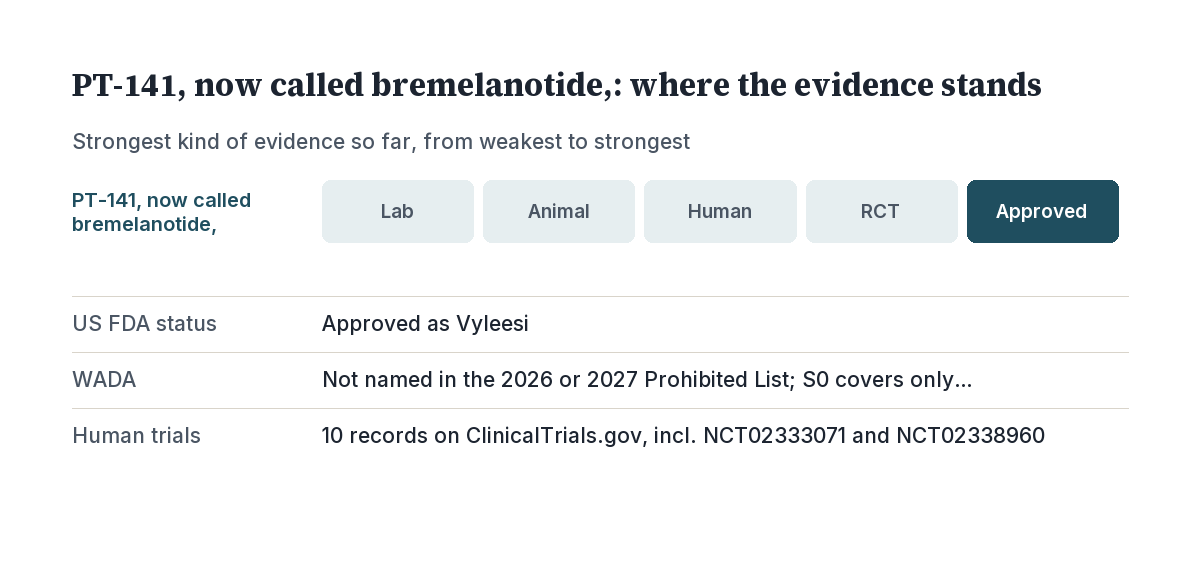
| US FDA status | Approved as Vyleesi (NDA 210557, June 21, 2019), prescription only, for acquired, generalized HSDD in premenopausal women; not for men, postmenopausal women or sexual performance (label) |
| Compounding (503A/503B) | Not on FDA’s Category 1 or 2 lists; as a component of an FDA-approved drug it meets one 503A bulk-substance criterion (FDA 503A); “research use” PT-141 was named as an unapproved new drug in an August 2026 FDA warning letter |
| WADA 2026 | Not named in the 2026 or 2027 Prohibited List; S0 covers only substances without any regulatory approval (WADA 2026 List) |
| Strongest evidence | Approved label; Human RCT (two phase 3 trials, n=1,267) |
| Human trials | 10 records on ClinicalTrials.gov, incl. NCT02333071 and NCT02338960 |
| EU | No marketing authorization in EMA’s medicines data (EMA) |
| Last checked | 2026-10-06 |
Key points:
- The label states that “the mechanism by which VYLEESI improves HSDD in women is unknown”; the drug activates several melanocortin receptors, mainly MC1R and MC4R at therapeutic doses.
- In the phase 3 trials, 18% of women on bremelanotide stopped because of adverse reactions, against 2% on placebo.
- Focal darkening of the skin, gums or breasts affected 1% of trial users, but 38% of people given daily doses for 8 days.
- Independent reanalyses judged the benefit small and questioned the outcome measures; the sponsor-side authors disputed those reanalyses.
- The approval covers women only; studies in men with erectile dysfunction never led to an approval.
Identity
| Property | Value |
|---|---|
| Names | Bremelanotide; PT-141; Vyleesi (brand) |
| Sequence | Ac-Nle-cyclo-(Asp-His-D-Phe-Arg-Trp-Lys-OH), a cyclic heptapeptide (label) |
| Molecular formula | C50H68N14O10 (free base) |
| Molecular weight | 1025.2 g/mol (free base) |
| CAS | 189691-06-3 (PubChem CID 9941379) |
| Half-life | About 2.7 hours after subcutaneous use (range 1.9–4.0) (label) |
| Routes studied | Subcutaneous (approved); intranasal (earlier trials) |
| Class | Melanocortin receptor agonist |
What is PT-141 (bremelanotide)?
PT-141 was the development code used by Palatin Technologies, whose scientists described it in 2003 as a synthetic α-MSH analogue that acts at the MC3R and MC4R melanocortin receptors and caused erections in rats and nonhuman primates [Animal] (Molinoff 2003). Early human work tested it for erectile dysfunction, first as a nasal spray. Development then turned to women. Palatin sponsored the phase 3 trials and licensed North American rights to AMAG Pharmaceuticals, which filed the New Drug Application (Dhillon 2019). The FDA approved it in 2019 as a new molecular entity; the application is now held by Cosette Pharmaceuticals (Drugs@FDA).
How does PT-141 work?
- Receptor binding: bremelanotide activates melanocortin receptors nonselectively, in the order MC1R, MC4R, MC3R, MC5R, MC2R; at therapeutic doses MC1R and MC4R matter most [Approved label] (Vyleesi label).
- Brain desire circuits: in female rats it increased solicitation behavior without changing lordosis or pacing [Animal] (Pfaus 2004), and the effect followed infusion into the medial preoptic area of the hypothalamus but not the ventromedial hypothalamus [Animal] (Pfaus 2007). A review proposes dopamine release in that area as the link [review of animal data] (Pfaus 2022).
- Not a reward-circuit drug: in female Syrian hamsters it did not enhance sexual reward, and the authors concluded it does not act on the ventral tegmental area–nucleus accumbens reward pathway [Animal] (Borland 2025).
- Human brain imaging: in 31 women with HSDD, a single dose raised self-rated desire for up to 24 hours and changed brain responses to erotic images on functional MRI [Human RCT, crossover, n=31] (Thurston 2022).
- Skin pigment: MC1R sits on melanocytes, and activating it increases pigmentation, which explains the hyperpigmentation side effect [Approved label].
Despite this work, the label itself says the mechanism by which the drug improves HSDD is unknown.
What the research shows
| Claim | Evidence level | Best study and result |
|---|---|---|
| Raises sexual desire in premenopausal women with HSDD | Human RCT (n=1,267) | Kingsberg 2019: FSFI desire +0.35 vs placebo (integrated, scale 1.2–6) |
| Reduces distress about low desire | Human RCT (n=1,267) | Kingsberg 2019: FSDS-DAO item 13 −0.33 vs placebo (scale 0–4) |
| Increases satisfying sexual events | Human RCT: not shown in phase 3 | Label: no significant difference (p=0.76; p=0.70) |
| Benefit persists over a year | Human, open-label (n=684) | Simon 2019: improvements sustained; 272 completed, no control group |
| Improves arousal scores | Systematic review and meta-analysis | Toledo 2026: improved FSFI total, desire and arousal |
| Treats erectile dysfunction | Human RCT, small; key trial under expression of concern | Rosen 2004: erectile response at 4 and 6 mg; not approved |
| Reduces body weight | Human phase 1 RCT (short) | Spana 2022: −1.3 kg vs placebo over 16 days |
| Acts through brain MC4R | Animal; Human RCT (imaging, n=31) | Thurston 2022: desire up for up to 24 h; fMRI changes |
| Enhances sexual reward | Animal: not shown | Borland 2025: no effect in hamsters |
Low sexual desire in women
The RECONNECT program ran two identical 24-week trials from 2015 to 2016. Women injected 1.75 mg or placebo as needed; 96.6% of participants were enrolled at US sites and their mean age was 39. Both trials met their two primary endpoints, with desire gains of 0.30 and 0.42 points over placebo and distress reductions of 0.37 and 0.29 points [Human RCT, n=1,267] (Kingsberg 2019). The FDA label reports mean desire-score changes of 0.5 and 0.6 on bremelanotide against 0.2 on placebo, and a mean distress change of −0.7 against −0.4 in both studies (Vyleesi label). Dropout was uneven: 40% versus 13% (Study 1) and 39% versus 25% (Study 2) left the double-blind period early. Prespecified subgroup analyses found benefits across age, weight and testosterone groups, with few exceptions [Human RCT, n=1,202] (Simon 2022).
The dispute over effect size
An independent reanalysis found that 72.72% of the protocol-listed outcomes were not reported in the main paper, that adverse-event dropout was far higher on the drug (odds ratio 11.98) and that participants were more likely to complete the trial and continue into the extension on placebo (Spielmans 2021). The trial authors published a rebuttal titled “Failure of a Meta-analysis” (Kingsberg 2021). A second analysis reported that 8 of 11 registered efficacy outcomes had gone unpublished and that their effect sizes ranged from nil to small (Spielmans 2024). A drug bulletin review concluded that bremelanotide produced no additional enjoyable sexual experiences in trials and called for the approval to be reconsidered (Mintzes 2021).
Men and erectile dysfunction
In healthy men, subcutaneous doses above 1.0 mg produced erections measured by RigiScan, and men with a poor response to sildenafil responded at 4 and 6 mg [Human, small controlled studies] (Rosen 2004). A nasal form worked at doses above 7 mg, with the first erection after about 30 minutes (Diamond 2004), and a low nasal dose added to 25 mg sildenafil beat sildenafil alone in 19 men (Diamond 2005). The largest male trial (342 men) now carries a journal expression of concern (J Urol 2023). The label states that Vyleesi is not indicated in men.
Weight and other uses
Because MC4R also controls appetite, Palatin tested bremelanotide in obese premenopausal women: over 16 days, weight fell 1.3 kg more than on placebo and intake fell by about 400 kcal a day [Human phase 1 RCT, n=30 on drug in Study A] (Spana 2022). Those trials used several doses a day, far beyond the approved pattern, and were run by the company. A combination trial with tirzepatide and a small diabetic kidney disease study are registered, without published results so far.
Human studies and trials
A search of ClinicalTrials.gov on October 3, 2026 returned 10 registered bremelanotide studies. The sponsor’s safety review counted 3,500 subjects in 43 completed studies across phases 1 to 3 (Clayton 2022).
| Trial | Phase, n, status | Population and result |
|---|---|---|
| NCT00425256 | Phase 2; completed 2007 | Women with arousal disorder; no results posted |
| NCT01382719 | Phase 2b; efficacy n=327; completed 2012 | Premenopausal women; pooled 1.25/1.75 mg improved satisfying events (+0.7 vs +0.2/month) (Clayton 2016) |
| NCT02333071 | Phase 3; n=723; completed 2017 | RECONNECT 301; met both primary endpoints |
| NCT02338960 | Phase 3; n=714; completed 2017 | RECONNECT 302; met both primary endpoints |
| NCT03973047 | Phase 1; n=228; completed 2019 | Healthy women; ondansetron did not reduce nausea |
| NCT04179734 | Phase 4; n=40; completed 2020 | HSDD brain imaging; desire up for up to 24 h (Thurston 2022) |
| NCT04943068 | Phase 3; n=193; completed 2023 | Bridging trial (Kwang Dong); no results posted |
| NCT05709444 | Phase 2; n=16; completed 2024 | Diabetic kidney disease; no results posted |
| NCT06565611 | Phase 2; n=108; active, not recruiting | With tirzepatide for obesity; no results posted |
| NCT06867835 | Phase 4; n=10; completed 2025 | Breast-milk levels in lactating women; no results posted |
Two other published studies need caution. A 2008 trial in women with arousal disorder was retracted after its author did not supply the original data (retraction notice), and a 2008 trial in 342 men with erectile dysfunction is under an expression of concern (Safarinejad 2008). An early crossover study in 18 women with arousal disorder found more reports of moderate or high desire after a single nasal dose, but no significant change in measured vaginal blood flow (Diamond 2006).
Doses used in studies
The amounts below are given for scientific context only and are not recommendations.
| Route and amount | Population | Study |
|---|---|---|
| Subcutaneous, 1.75 mg as needed | Premenopausal women with HSDD (phase 3) | Kingsberg 2019 |
| Subcutaneous, 0.75, 1.25 or 1.75 mg | Premenopausal women (phase 2b) | Clayton 2016 |
| Subcutaneous, 0.3–10 mg single doses | Healthy men | Rosen 2004 |
| Intranasal, 20 mg single dose | Women with arousal disorder | Diamond 2006 |
| Intranasal, 20 mg with or without alcohol | 24 healthy adults | Clayton 2017 |
| Subcutaneous, 2.5 mg and 2.0 mg daily pairs | Obese women (phase 1) | Spana 2022 |
The approved label dose is 1.75 mg by subcutaneous autoinjector at least 45 minutes before anticipated sexual activity, with no more than one dose in 24 hours and more than 8 doses a month not recommended; the label also says to stop after 8 weeks if there is no improvement (Vyleesi label). No established human dose exists outside approved labels.
Side effects and safety
The label’s adverse-reaction table compares 627 women on bremelanotide with 620 on placebo in the phase 3 trials [Approved label] (Vyleesi label).
| Adverse reaction | Bremelanotide vs placebo |
|---|---|
| Nausea | 40.0% vs 1.3% |
| Flushing | 20.3% vs 0.3% |
| Injection site reactions | 13.2% vs 8.4% |
| Headache | 11.3% vs 1.9% |
| Vomiting | 4.8% vs 0.2% |
| Stopped due to adverse reactions | 18% vs 2% |
- Nausea: 21% had it after the first dose and about 3% after later doses; it began within an hour and lasted about two hours; 13% needed anti-nausea medicine, and 8% left the trials because of it. Ondansetron taken beforehand did not prevent it in 228 healthy women [Approved label].
- Blood pressure: systolic pressure rose by up to 6 mmHg and diastolic by 3 mmHg, peaking 2 to 4 hours after a dose, with heart rate falling by up to 5 beats per minute; values usually returned to baseline within 12 hours [Approved label]. An ambulatory monitoring trial in 397 women found rises of about 3 mmHg at 1.75 mg [Human RCT, n=397] (White 2017).
- Hyperpigmentation: focal darkening of the face, gums or breasts in 1% of trial users, 38% after 8 daily doses and a further 14% after 8 more; it was more likely with darker skin, and resolution was not confirmed in all patients [Approved label].
- Liver: one case of acute hepatitis, with liver enzymes over 40 times the upper limit, occurred in the open-label extension; a role for the drug could not be excluded [Approved label, single case].
- Interactions: it may slow stomach emptying and lower absorption of oral drugs, and may significantly reduce exposure to oral naltrexone, so the label says to avoid that combination [Approved label].
Who should not use it, per the label: people with uncontrolled high blood pressure or known cardiovascular disease (contraindicated); it is not recommended for those at high cardiovascular risk. Women who could become pregnant are advised to use effective contraception, because fetal harm occurred in dogs at 16 times human exposure. The sponsor’s program-wide review reported no deaths and mostly mild-to-moderate events (Clayton 2022).
Unregulated “PT-141”: vials sold online as PT-141 are not the approved autoinjector and have no FDA quality oversight. In August 2026 the FDA told one online seller that its “PT-141” was an unapproved new drug, citing the seller’s own descriptions of effects on sexual arousal as evidence of intended human use (FDA warning letter). Italian forensic chemists identified bremelanotide and melanotan II in 8 unknown samples seized by police with anabolic steroids for the bodybuilding black market (Mestria 2021).
Legal and regulatory status
| Jurisdiction | Status (checked October 3, 2026) |
|---|---|
| US FDA | Approved June 21, 2019 as Vyleesi, NDA 210557, prescription only (Drugs@FDA) |
| US compounding | Components of FDA-approved drugs meet one 503A bulk criterion (FDA 503A); other 503A conditions still apply |
| US “research” sales | “PT-141” named as an unapproved new drug, August 24, 2026 (FDA) |
| WADA 2026 | Not named (2026 List) |
| WADA 2027 | Not named; in effect January 1, 2027 (2027 List) |
| EU | No marketing authorization in EMA’s medicines data (EMA) |
The approval is narrow. The label limits use to premenopausal women whose low desire is acquired, generalized and not explained by another medical or psychiatric condition, relationship problems or a medicine, and it states that the drug is not indicated to enhance sexual performance (Vyleesi label). The August 2026 warning letter also covered retatrutide sold as “GLP-3R” (FDA); see our retatrutide entry.
For athletes, WADA’s S0 class bans substances with no current approval by any government health regulator; bremelanotide has US approval and is not named anywhere in the 2026 List (WADA). That does not settle the status of an unlabeled product of unknown content, and anti-doping bodies decide individual cases. Our overview of which peptides WADA prohibits in 2027 covers the classes in detail.
Related peptides
Bremelanotide belongs to the melanocortin class of α-MSH analogues. Its closest relative in the unregulated market is melanotan II, a tanning peptide that forensic chemists describe as not legally marketed and that turned up alongside bremelanotide in the same seized samples (Mestria 2021). Other peptides with pages here include BPC-157, an unapproved peptide often sold by the same “research” sellers.
What users report
The following summarizes unverified self-reports from people who usually bought unregulated products; it is not evidence and may not reflect what those products contained. People who post about PT-141 on forums, Reddit and YouTube most often describe a stronger interest in sex and, among men, firmer or easier erections, usually noticed within an hour or a few hours. Many say the effect is inconsistent from one use to the next, and some report no effect at all. The most common complaint is nausea, sometimes with vomiting, followed by facial flushing, headache and a feeling of warmth. A recurring worry is skin darkening, with posts about new freckles or darker moles, and some people describe a spike in blood pressure or a racing feeling. Users argue about whether the “research” vials they bought contained the labeled peptide, whether the effect is mostly placebo, and whether it is worth the side effects compared with prescription options. Some women who used the approved autoinjector post similar accounts of nausea after the first use that eased later.
Frequently asked questions
Is PT-141 the same as Vyleesi?
Same molecule, different product. PT-141 was the development code for bremelanotide, which the FDA approved in 2019 as Vyleesi, a prescription autoinjector for premenopausal women with acquired, generalized HSDD. Vials sold online as “PT-141” are not Vyleesi; in August 2026 the FDA called one seller’s PT-141 an unapproved new drug (FDA warning letter).
Is bremelanotide FDA approved for men?
No. The Vyleesi label states that it is not indicated for HSDD in men or in postmenopausal women, and not to enhance sexual performance. Small studies in men with erectile dysfunction found erections at 4 and 6 mg under the skin, but that work never led to an approval (Rosen 2004).
How well does bremelanotide work?
Modestly. In the two phase 3 trials, desire scores rose 0.35 points more than on placebo on a 1.2–6 scale, and distress fell 0.33 points more on a 0–4 scale (Kingsberg 2019). The number of satisfying sexual events did not differ from placebo, and independent reanalyses judged the benefit small.
What are the main side effects of PT-141?
Nausea is the most common, affecting 40% of women in the phase 3 trials, followed by flushing (20.3%), injection site reactions (13.2%) and headache (11.3%). Blood pressure rises briefly after each dose, and skin darkening occurred in 1% of trial users, more often with daily use (Vyleesi label).
Is PT-141 banned by WADA?
It is not named in the WADA 2026 or 2027 Prohibited List. The S0 class covers substances with no approval from any government health regulator, and bremelanotide has US approval (WADA 2026 List). Unlabeled products of unknown content remain a risk for tested athletes.
References
- Cosette Pharmaceuticals. Vyleesi (bremelanotide injection) prescribing information, rev. 03/2024. DailyMed. DailyMed
- US FDA. Drugs@FDA: NDA 210557, Vyleesi. Drugs@FDA
- US FDA. Warning letter, MARCS-CMS 735127, August 24, 2026. fda.gov
- US FDA. Bulk drug substances used in compounding under section 503A of the FD&C Act. fda.gov
- WADA. 2026 Prohibited List. wada-ama.org
- WADA. 2027 Prohibited List. wada-ama.org
- European Medicines Agency. Download medicine data. ema.europa.eu
- ClinicalTrials.gov. Search: bremelanotide. clinicaltrials.gov
- PubChem. Bremelanotide, CID 9941379. PubChem
- Kingsberg SA, et al. 2019. Bremelanotide for the treatment of hypoactive sexual desire disorder: two randomized phase 3 trials. Obstet Gynecol. PMID 31599840
- Simon JA, et al. 2019. Long-term safety and efficacy of bremelanotide for hypoactive sexual desire disorder. Obstet Gynecol. PMID 31599847
- Clayton AH, et al. 2022. Safety profile of bremelanotide across the clinical development program. J Womens Health. PMID 35147466
- Clayton AH, et al. 2016. Bremelanotide for female sexual dysfunctions in premenopausal women: a dose-finding trial. Womens Health (Lond). PMID 27181790
- Simon JA, et al. 2022. Prespecified and integrated subgroup analyses from the RECONNECT phase 3 studies. J Womens Health. PMID 35230162
- Spielmans GI. 2021. Re-analyzing phase III bremelanotide trials for “hypoactive sexual desire disorder” in women. J Sex Res. PMID 33678061
- Kingsberg SA, et al. 2021. Failure of a meta-analysis: a commentary on Glen Spielmans’s re-analysis. J Sex Res. PMID 33835907
- Spielmans GI, Ellefson EM. 2024. Small effects, questionable outcomes: bremelanotide for hypoactive sexual desire disorder. J Sex Res. PMID 36809187
- Mintzes B, et al. 2021. Bremelanotide and flibanserin for low sexual desire in women: the fallacy of regulatory precedent. Drug Ther Bull. PMID 34642243
- Toledo RG, et al. 2026. Female sexual desire, arousal, and orgasmic dysfunctions: a systematic review and meta-analysis. J Minim Invasive Gynecol. PMID 40543759
- Thurston L, et al. 2022. Melanocortin 4 receptor agonism enhances sexual brain processing in women with HSDD. J Clin Invest. PMID 36189794
- Diamond LE, et al. 2006. An effect on the subjective sexual response in premenopausal women with sexual arousal disorder by bremelanotide. J Sex Med. PMID 16839319
- Rosen RC, et al. 2004. Subcutaneously administered PT-141 in healthy men and patients with inadequate response to Viagra. Int J Impot Res. PMID 14999221
- Diamond LE, et al. 2004. Intranasal PT-141 in healthy males and patients with erectile dysfunction. Int J Impot Res. PMID 14963471
- Diamond LE, et al. 2005. Co-administration of low doses of intranasal PT-141 and sildenafil. Urology. PMID 15833522
- Safarinejad MR, Hosseini SY. 2008. Salvage of sildenafil failures with bremelanotide. J Urol. PMID 18206919
- Expression of concern: Salvage of sildenafil failures with bremelanotide. 2023. J Urol. PMID 36626345
- Safarinejad MR. 2008 (retracted). Bremelanotide in female subjects with arousal disorder. J Sex Med. PMID 18179455
- White WB, et al. 2017. Ambulatory blood pressure monitoring to assess bremelanotide. J Hypertens. PMID 27977473
- Clayton AH, et al. 2017. Bremelanotide coadministered with ethanol in healthy participants. Clin Ther. PMID 28189361
- Spana C, et al. 2022. Effect of bremelanotide on body weight of obese women. Diabetes Obes Metab. PMID 35170192
- Molinoff PB, et al. 2003. PT-141: a melanocortin agonist for the treatment of sexual dysfunction. Ann N Y Acad Sci. PMID 12851303
- Pfaus JG, et al. 2004. Selective facilitation of sexual solicitation in the female rat by a melanocortin receptor agonist. PNAS. PMID 15226502
- Pfaus J, et al. 2007. Bremelanotide: an overview of preclinical CNS effects on female sexual function. J Sex Med. PMID 17958619
- Pfaus JG, et al. 2022. The neurobiology of bremelanotide for HSDD in premenopausal women. CNS Spectr. PMID 33455598
- Borland JM, et al. 2025. Female Syrian hamster analyses of bremelanotide. Neuropharmacology. PMID 39793696
- Dhillon S, Keam SJ. 2019. Bremelanotide: first approval. Drugs. PMID 31429064
- Mestria S, et al. 2021. LC-HRMS characterization of melanotan II and bremelanotide sold on the black market. Drug Test Anal. PMID 33245851
Change log
2026-10-23: links to glossary definitions added; no change to the facts.
2026-10-13: links corrected (a link inside a citation or on a generic word removed); no change to the facts.
2026-10-12: links to related entries added; no change to the facts.
2026-10-06: first published after review by the editorial team.