Teriparatide is a 34-amino-acid peptide copy of the active part of human parathyroid hormone (PTH), and it is an FDA-approved bone-building drug sold as Forteo, Bonsity and generic teriparatide. Its strongest result: in a randomized trial of 1,637 postmenopausal women with prior spine fractures, new vertebral fractures fell from 14% on placebo to 5% on 20 micrograms a day (Neer 2001). It is approved for osteoporosis at high fracture risk; rat studies raised a bone-cancer signal that large human surveillance studies have not confirmed.
| Item | Status |
|---|---|
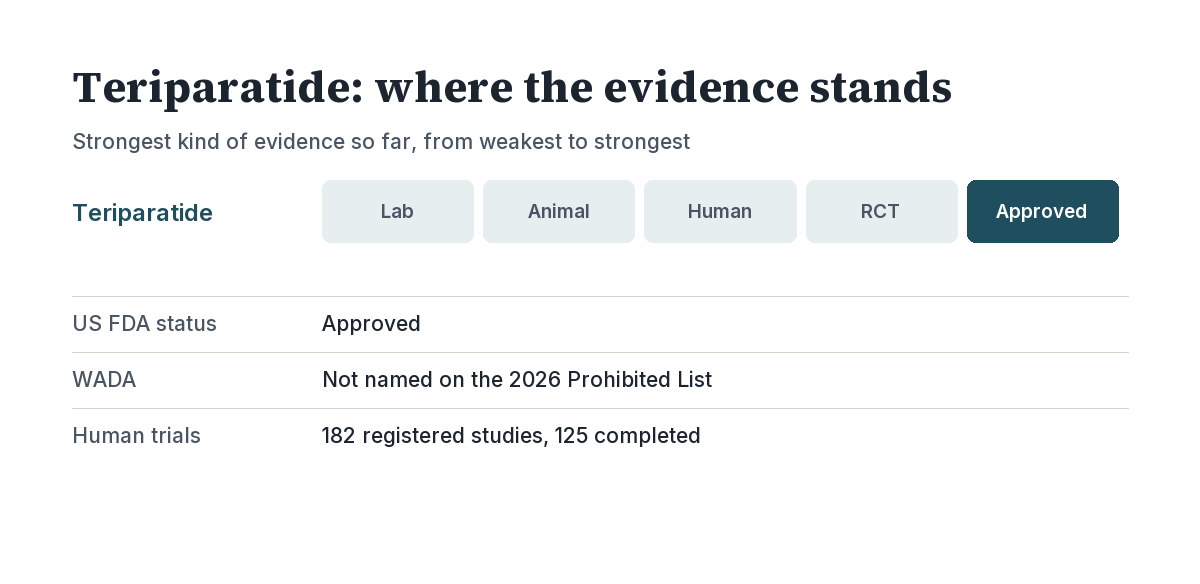
| US FDA status | Approved: Forteo (Lilly) since 2002-11-26 (Drugs@FDA, Forteo); Bonsity since 2019-10-04 (Drugs@FDA, Bonsity); first generics (Teva, Apotex) 2023-11-16 (FDA first generics 2023). Indication: osteoporosis at high fracture risk in postmenopausal women, men, and glucocorticoid users (Forteo label) |
| Compounding (503A/503B) | Not on the 503A bulks list and not in FDA’s Categories 1–3 (checked 2026-10-14); as a component of approved drugs it does not need that list (FDA 503A page). A compounded copy is not an FDA-approved product |
| WADA 2026 | Not named on the 2026 Prohibited List (text searched 2026-10-14); S0 covers only substances with no regulatory approval, and teriparatide is approved (WADA 2026 List) |
| WADA 2027 | No change found: not named on the 2027 List, in force 2027-01-01 (WADA 2027 List). S2 lists are “including, but not limited to”, so the List alone does not settle every case |
| Strongest evidence | Approved label, backed by Human RCTs with fracture endpoints (n=1,637; n=1,360) |
| Human trials | 182 registered studies, 125 completed (ClinicalTrials.gov, searched 2026-10-14), e.g. NCT01709110 |
| Last checked | 2026-10-15 (status sources re-verified 2026-10-14) |
Key points:
- It is an anabolic drug: it stimulates new bone formation, while denosumab (Prolia) slows bone resorption.
- In a head-to-head trial in severe osteoporosis, it cut new spine fractures to 5.4% versus 12.0% on risedronate over 24 months [Human RCT].
- The US label dropped its osteosarcoma boxed warning in 2020; the EU summary still describes one two-year course per lifetime.
- Common label side effects are joint pain, pain and nausea; a short drop in blood pressure and raised blood calcium can occur after doses.
- It is not a GLP-1 drug, not a bisphosphonate and has no weight-loss indication.
| Identity | Detail |
|---|---|
| Other names | rhPTH(1-34), PTH 1-34; brands Forteo, Bonsity (US), Forsteo (EU) |
| Length | 34 amino acids, identical to the first 34 of the 84-amino-acid human hormone (Forteo label) |
| Molecular formula | C181H291N55O51S2 |
| Molecular weight | 4,117.8 Da (label) |
| CAS / PubChem | 52232-67-4 / CID 16133850 |
| Made by | Recombinant DNA technology in E. coli (Forteo) |
| Half-life | About 1 hour after subcutaneous injection; bioavailability about 95% (label) |
| Routes studied | Subcutaneous injection |
| Class | Parathyroid hormone analog; bone anabolic agent |
What is teriparatide?
Teriparatide is the N-terminal fragment of parathyroid hormone, the hormone that is “the primary regulator of calcium and phosphate metabolism in bone and kidney” (Forteo label). The label lists the ingredient’s initial US approval as 1987, and Lilly’s Forteo, the osteoporosis drug, was approved on 2002-11-26 (Drugs@FDA data). The European Commission authorized the same drug as Forsteo on 10 June 2003 (EMA). FDA approved the first generic versions, from Teva and Apotex, on 16 November 2023 (FDA). So “teriparatide” is the ingredient and Forteo is the original brand.
How does teriparatide work?
- Receptor: teriparatide binds PTH’s cell-surface receptors with the same affinity as the first 34 amino acids of natural PTH and has the same actions on bone and kidney [Approved label] (Forteo label).
- Pattern matters: once-daily doses stimulate new bone formation by favoring bone-building osteoblasts over bone-resorbing osteoclasts, while a continuous excess of PTH, as in hyperparathyroidism, can harm the skeleton [Approved label].
- Short exposure: blood levels peak about 30 minutes after a 20-microgram injection and become unmeasurable within 3 hours [Approved label].
- Bone quality in animals: in monkeys, teriparatide improved trabecular microarchitecture and increased bone mass and strength [Animal].
- A different class from antiresorptives: denosumab (Prolia), by contrast, is an antibody that blocks RANKL, a protein osteoclasts need (Prolia label).
Benefits of teriparatide: what the research shows
The main benefit of teriparatide is fewer fractures: it cut new spine fractures by 65% relative to placebo in its pivotal trial [Human RCT, n=1,637] (Forteo label). It also beat two standard oral drugs on spine fractures in head-to-head trials, risedronate in severe postmenopausal osteoporosis and alendronate in steroid-induced osteoporosis [Human RCT]. Smaller trials point to faster healing of some bone defects, a promising but less certain finding.
| Claim | Evidence level | Best study and result |
|---|---|---|
| Fewer spine fractures vs placebo | Human RCT (n=1,637) | Neer 2001: 14% placebo vs 5% (20 µg), RR 0.35 |
| Fewer non-spine fractures vs placebo | Human RCT (n=1,637) | Neer 2001: 6% vs 3%, RR 0.47 |
| Fewer spine fractures vs risedronate | Human RCT (n=1,360) | Kendler 2018: 5.4% vs 12.0%, RR 0.44 |
| Fewer spine fractures vs alendronate on steroids | Human RCT (n=428) | Saag 2007: 0.6% vs 6.1% |
| Higher spine density in men | Human RCT (n=437) | Orwoll 2003: +5.9% (20 µg) |
| Hip fractures reduced | Not shown | EMA: reduction “not hip fractures” |
| Faster wrist-fracture healing | Human RCT (n=102), mixed | Aspenberg 2010: primary aim not met |
| Jaw bone regrowth in gum disease | Human RCT (n=40) | Bashutski 2010: 29% vs 3% bone gain |
Postmenopausal osteoporosis
In the pivotal trial, women took 20 or 40 micrograms or placebo and were followed for a median of 21 months; both doses lowered vertebral and non-vertebral fractures, and spine density rose 9 and 13 percentage points more than placebo [Human RCT, n=1,637] (Neer 2001). The 40-microgram dose raised density more but had similar fracture effects and more side effects. The VERO trial then compared it directly with risedronate in women with severe osteoporosis and prior spine fractures: clinical fractures were 4.8% versus 9.8%, while non-vertebral fractures (4.0% vs 6.1%) did not differ significantly [Human RCT, n=1,360] (Kendler 2018).
Men and glucocorticoid-induced osteoporosis
In 437 men, spine density rose 5.9% on 20 micrograms over a median 11 months [Human RCT] (Orwoll 2003); the US label approves it to increase bone mass in men, not on a fracture endpoint. In people on long-term steroids, spine density rose 7.2% versus 3.4% on alendronate over 18 months [Human RCT, n=428] (Saag 2007).
Fracture healing and dental bone
In 102 women with wrist fractures, the 40-microgram dose did not shorten healing, the primary aim; a post hoc finding of faster healing on 20 micrograms (7.4 vs 9.1 weeks) was flagged by the authors as needing caution [Human RCT] (Aspenberg 2010). In 40 patients having gum surgery, six weeks of teriparatide gave more jaw bone regrowth at one year [Human RCT] (Bashutski 2010). Neither use is an approved indication.
Teriparatide vs abaloparatide, romosozumab and denosumab
Abaloparatide (Tymlos) is a different molecule, an analog of PTH-related peptide with 41% homology to PTH(1-34) (Tymlos label). In the ACTIVE trial, both drugs cut spine fractures versus placebo, and high blood calcium was less common on abaloparatide (3.4% vs 6.4%) [Human RCT, n=2,463] (Miller 2016). Romosozumab (Evenity), a sclerostin antibody, raised hip density 2.6% versus −0.6% for teriparatide in women switching from bisphosphonates [Human RCT, n=436] (Langdahl 2017). Teriparatide plus denosumab raised hip density more than either alone at 12 months (4.9% vs 0.7% and 2.5%) [Human RCT, n=94] (Tsai 2013). Order matters too: hip density rose 6.6% when women moved from teriparatide to denosumab but only 2.8% the other way round (Leder 2015).
Human studies and trials
Teriparatide has a large human evidence base: ClinicalTrials.gov lists 182 registered studies, 125 of them completed and 17 recruiting or active (ClinicalTrials.gov, searched 2026-10-14). The trials most relevant to its approved uses:
| Trial | Design and n | Result |
|---|---|---|
| Neer 2001 (pre-registry) | Placebo-controlled, n=1,637 | Spine fractures RR 0.35 |
| Orwoll 2003, men | Placebo-controlled, n=437 | Spine density +5.9%; stopped early for the rat finding |
| NCT00051558 | Phase 3 vs alendronate, n=428 | Spine density 7.2% vs 3.4% |
| NCT01709110 (VERO) | Phase 4 vs risedronate, n=1,360 | Spine fractures 5.4% vs 12.0% |
| NCT01343004 (ACTIVE) | Phase 3, n=2,463 | Teriparatide arm: hypercalcemia 6.4% |
| NCT01796301 | Phase 3 vs romosozumab, n=436 | Hip density −0.6% vs +2.6% |
| NCT00926380 (DATA) | Phase 2 vs denosumab or both, n=94 | Combination best for hip density |
| NCT00277706 | Gum surgery, n=40 | Bone gain 29% vs 3% |
Doses used in studies
| Route and amount | Species | Study |
|---|---|---|
| Subcutaneous, 20 µg once daily (approved label dose) | Human | Forteo label |
| Subcutaneous, 20 or 40 µg daily, median 21 months of follow-up | Human | Neer 2001 |
| Subcutaneous, 20 or 40 µg daily, 8 weeks | Human | Aspenberg 2010 |
| Subcutaneous, 20 µg daily, 6 weeks | Human | Bashutski 2010 |
| Subcutaneous, 5, 30 or 75 µg/kg/day, 24 months | Rat | Forteo label, section 13.1 |
No established human dose exists outside approved labels. The only established dose is the label dose for the labelled osteoporosis indications.
Side effects and safety
The label lists arthralgia, pain and nausea as the most common adverse reactions (over 10%) [Approved label] (Forteo label). In the pooled trials, nausea (8.5% vs 6.7%), dizziness (8.0% vs 5.4%) and leg cramps (2.6% vs 1.3%) were more frequent than on placebo, while serious adverse events were 16% versus 19%.
- Blood calcium: transient high calcium 4 to 6 hours after a dose occurred in 11% of women and 6% of men, against 2% and 0% on placebo; the label says to avoid it in hypercalcemic disorders such as primary hyperparathyroidism [Approved label].
- Low blood pressure on standing: seen in 5% of healthy volunteers, usually within 4 hours of early doses [Approved label].
- Allergic reactions: anaphylaxis and angioedema have been reported, and severe hypersensitivity is a contraindication [Approved label].
- Other label warnings: calciphylaxis and skin calcification, kidney stones, and digoxin toxicity through raised calcium [Approved label].
- Who should avoid it per the label: children and young adults with open growth plates, Paget’s disease, bone metastases or skeletal cancers, and prior skeletal radiation; breastfeeding is not recommended [Approved label].
The osteosarcoma question
In rats given lifelong daily injections at 3 to 60 times human exposure, osteosarcoma appeared at every dose and reached 40% to 50% at the highest [Animal] (Forteo label, section 13.1). A later rat study found no bone tumors when a low dose was started in adult rats, even for up to 70% of the life span [Animal] (Vahle 2004). In people, a 15-year US surveillance study found three osteosarcoma patients with prior teriparatide use against 4.17 expected [Human observational] (Gilsenan 2021), and a Medicare study of 153,316 users found no cases [Human observational] (Gilsenan 2020). On this evidence the US label removed its boxed warning in 2020 and revised the two-year limit (Krege 2022). The label still notes limited data beyond two years of use.
Teriparatide sold outside the approved prescription products is not an FDA-approved drug, so FDA has not checked its content or purity.
Anyone who suspects a side effect from teriparatide or any other drug or product can report it to the FDA through MedWatch.
Legal and regulatory status
| Jurisdiction | Status (checked 2026-10-14) |
|---|---|
| US FDA | Approved Rx: Forteo (2002), Bonsity (2019), generics (2023 onward) |
| US duration | Over 2 years per lifetime “only … if a patient remains at or has returned to having a high risk for fracture” |
| US biologic? | No: FDA defines a protein as over 40 amino acids (21 CFR 600.3); teriparatide has 34 and is approved as a drug |
| Compounding | Not on the 503A bulks list or in FDA’s Categories 1–3; approved-drug component |
| EU (EMA) | Forsteo authorized since 2003; “one two-year course” per lifetime |
| WADA | Not named on the 2026 or 2027 List; approved, so not S0 |
The US and EU now differ on duration: the US label allows use beyond two years for patients who remain at high fracture risk (Forteo label), while the EMA summary says “only one two-year course” should be given in a lifetime (EMA). For athletes, the WADA 2026 List does not name parathyroid hormone or teriparatide, and its S0 class applies only to substances with no current regulatory approval (WADA 2026 List). The 2027 List, which adds “peptides” as an S0 example, still limits S0 to unapproved substances (WADA 2027 List). Because the S2 growth-factor class ends with an open “other growth factors” clause, the list alone does not settle every case; the peptides WADA does name are collected in WADA banned peptides 2027.
Related peptides
Teriparatide’s closest relatives are drugs rather than research peptides: abaloparatide (Tymlos), a PTH-related-peptide analog approved in 2017 (Tymlos label), and palopegteriparatide (Yorvipath), a prodrug that releases PTH(1-34) continuously and is approved for adult hypoparathyroidism (Yorvipath label). For how peptides differ from proteins in law, see what peptides are and how they are classed, and for other compounds, the peptide legal status tracker.
What users report
What follows are unverified self-reports from people posting online, not evidence; unlike most peptides covered here, many of these posters describe a prescribed, approved drug, while others describe unregulated “research” products. People who post about teriparatide on patient forums and social media most often describe it as the drug they were offered after a fracture or a very low bone-density result. Common complaints are nausea, dizziness or light-headedness soon after early doses, leg cramps, joint aches and tiredness, and some describe these fading over the first weeks. Many discuss the daily injections as the main burden, and a recurring theme is waiting for a follow-up density scan to see whether it worked, with mixed reports of large gains, small gains or none. Insurance approval and cost come up often. People argue about whether to choose teriparatide, abaloparatide or romosozumab, about what to take afterwards, and about how worried to be over the old rat cancer warning. Some bodybuilding posters ask about it for joints or tendons, a use with no approved indication.
Frequently asked questions
Is teriparatide the same as Forteo?
Yes. Teriparatide is the active ingredient and Forteo is Eli Lilly’s original brand, approved in 2002. Bonsity and several generic teriparatide injections carry the same ingredient and the same osteoporosis indications; FDA approved the first generics, from Teva and Apotex, on 16 November 2023 (FDA).
Is teriparatide a bisphosphonate or a GLP-1?
Neither. Teriparatide is a parathyroid hormone analog that stimulates new bone formation, while bisphosphonates such as alendronate and GLP-1 drugs such as semaglutide belong to other drug classes. It has no weight-loss indication: every approved use is osteoporosis at high fracture risk, in women, men or people on long-term steroids (Forteo label).
Is teriparatide a peptide or a biologic?
It is a peptide of 34 amino acids. US rules define a protein, and so a biologic of that kind, as a chain of more than 40 amino acids, so teriparatide is approved and regulated as a drug, and generic versions have been approved as ordinary generic drugs (ANDAs) (21 CFR 600.3).
Why is teriparatide limited to two years?
The limit came from rat studies in which lifelong daily dosing caused osteosarcoma. Human surveillance has not found an increased risk, so in 2020 the US label dropped its boxed warning and now allows longer use for patients still at high fracture risk, though data beyond two years are limited (Krege 2022). The EU summary still advises one two-year course.
Is teriparatide safe?
It is an approved drug with a known safety profile rather than a risk-free one. Joint pain, pain and nausea are the most common label reactions, and transient high blood calcium, dizziness on standing and allergic reactions are listed warnings. In the Medicare study of 153,316 users, no osteosarcoma cases were found (Gilsenan 2020).
Is teriparatide the same as Prolia?
No. Prolia is denosumab, an antibody that blocks RANKL and slows bone resorption, while teriparatide stimulates new bone formation. In the DATA trial, combining them raised hip density more than either drug alone, and switching from denosumab to teriparatide gave smaller hip gains than the reverse order (Leder 2015).
References
- Neer RM, et al. 2001. Effect of parathyroid hormone (1-34) on fractures and bone mineral density in postmenopausal women with osteoporosis. N Engl J Med. PubMed 11346808
- Orwoll ES, et al. 2003. The effect of teriparatide therapy on bone density in men with osteoporosis. J Bone Miner Res. PubMed 12510800
- Saag KG, et al. 2007. Teriparatide or alendronate in glucocorticoid-induced osteoporosis. N Engl J Med. PubMed 18003959
- Kendler DL, et al. 2018. Effects of teriparatide and risedronate on new fractures in post-menopausal women with severe osteoporosis (VERO). Lancet. PubMed 29129436
- Miller PD, et al. 2016. Effect of abaloparatide vs placebo on new vertebral fractures in postmenopausal women with osteoporosis (ACTIVE). JAMA. PubMed 27533157
- Langdahl BL, et al. 2017. Romosozumab versus teriparatide in postmenopausal women transitioning from oral bisphosphonate therapy. Lancet. PubMed 28755782
- Tsai JN, et al. 2013. Teriparatide and denosumab, alone or combined (DATA). Lancet. PubMed 23683600
- Leder BZ, et al. 2015. Denosumab and teriparatide transitions in postmenopausal osteoporosis (DATA-Switch). Lancet. PubMed 26144908
- Aspenberg P, et al. 2010. Teriparatide for acceleration of fracture repair in humans. J Bone Miner Res. PubMed 19594305
- Bashutski JD, et al. 2010. Teriparatide and osseous regeneration in the oral cavity. N Engl J Med. PubMed 20950166
- Vahle JL, et al. 2004. Bone neoplasms in F344 rats given teriparatide are dependent on duration of treatment and dose. Toxicol Pathol. PubMed 15204966
- Gilsenan A, et al. 2021. Teriparatide did not increase adult osteosarcoma incidence in a 15-year US postmarketing surveillance study. J Bone Miner Res. PubMed 32990990
- Gilsenan A, et al. 2020. Assessing the incidence of osteosarcoma among teriparatide users based on Medicare Part D and US state cancer registry data. Pharmacoepidemiol Drug Saf. PubMed 32894794
- Krege JH, et al. 2022. Teriparatide and osteosarcoma risk: history, science, elimination of boxed warning, and other label updates. JBMR Plus. PubMed 36111201
- US FDA. Forteo (teriparatide) injection, prescribing information, revised 08/2026 (DailyMed). DailyMed
- US FDA. Tymlos (abaloparatide) injection, prescribing information (DailyMed). DailyMed
- US FDA. Prolia (denosumab) injection, prescribing information (DailyMed). DailyMed
- US FDA. Yorvipath (palopegteriparatide) injection, prescribing information (DailyMed). DailyMed
- US FDA. Drugs@FDA application data, Forteo NDA 021318, via openFDA (queried 2026-10-14). api.fda.gov
- US FDA. Drugs@FDA application data, Bonsity NDA 211939, via openFDA (queried 2026-10-14). api.fda.gov
- US FDA. 2023 First Generic Drug Approvals. FDA
- US FDA. Bulk drug substances used in compounding under section 503A of the FD&C Act (content current 2026-05-14). FDA
- US FDA. Bulk drug substances nominated for use in compounding under section 503A: categories 1–3 (updated May 14, 2026). FDA
- Electronic Code of Federal Regulations. 21 CFR 216.23, bulk drug substances that can be used to compound under section 503A. eCFR
- Electronic Code of Federal Regulations. 21 CFR 600.3, definitions (protein). eCFR
- European Medicines Agency. Forsteo (teriparatide), EPAR overview. EMA
- World Anti-Doping Agency. 2026 Prohibited List. WADA
- World Anti-Doping Agency. 2027 Prohibited List, in force 1 January 2027. WADA
- ClinicalTrials.gov. Search for teriparatide interventions (searched 2026-10-14). ClinicalTrials.gov
- PubChem. Teriparatide, CID 16133850. PubChem
Change log
2026-10-23: links to glossary definitions added; no change to the facts.
2026-10-15: first published after review by the editorial team.