Peptides are short chains of amino acids joined by peptide (amide) bonds. The US Food and Drug Administration treats chains of 40 or fewer amino acids as peptides and longer ones as proteins (FDA). More than 80 peptide drugs have reached the market (Muttenthaler 2021), backed by approved labels and human RCTs. Most peptides sold online as “research” products are not FDA-approved, and their evidence is mostly animal or lab data. Peptides are not steroids.
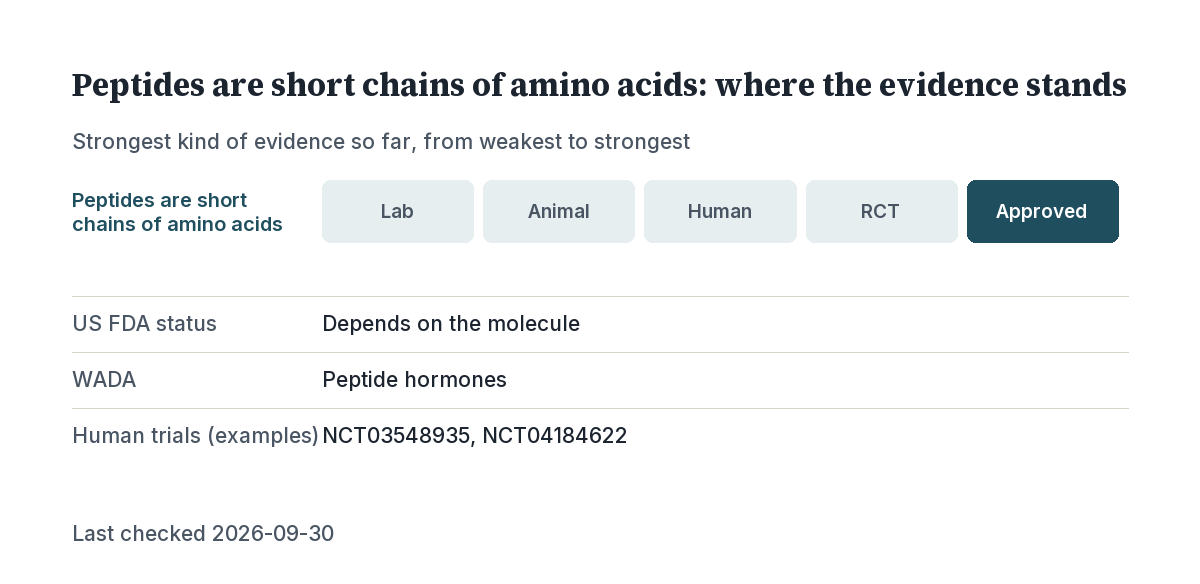
| Item | Status |
|---|---|
| Definition | Amino acids linked by amide bonds (IUPAC-IUB) |
| Peptide vs protein (US) | 40 or fewer amino acids = peptide; more than 40 = protein (FDA) |
| US FDA status | Depends on the molecule: semaglutide (label) and bremelanotide (label) are approved; BPC-157 is not (USADA) |
| Compounding (503A/503B) | 16 peptides “withdrawn by nominators” from Category 2; kisspeptin-10, GHRP-2, GHRP-6 and ipamorelin still in Category 2 (FDA, updated 2026-04-22) |
| WADA 2026 | Peptide hormones: S2; non-approved peptides such as BPC-157: S0; prohibited at all times (USADA) |
| Strongest evidence | Approved labels and phase 3 RCTs for approved peptide drugs; mostly animal and lab data for unapproved ones |
| Human trials (examples) | NCT03548935, NCT04184622 (phase 3, completed); BPC-157: 1 clinical study among 36 (Vasireddi 2025) |
| Steroids? | No: steroids are made from cholesterol, peptides from amino acids (Miller 2011) |
| Last checked | 2026-09-30 |
Key points:
- Chemists put the peptide–protein boundary at “more than about 50 residues”; the FDA’s 40 is a regulatory line, not a chemical one (IUPAC-IUB 1984).
- Insulin, with 51 amino acids in two chains, has been regulated in the US as a biologic, not a peptide drug, since March 23, 2020 (Federal Register 2020).
- Peptides are poorly absorbed by mouth: even with an absorption enhancer, oral semaglutide reaches about 0.4% to 1% bioavailability (Approved label).
- In a 23-trial meta-analysis, collagen peptide supplements showed no skin effect in trials without industry funding (Myung 2025).
- In August 2026 the FDA found that “research use only” labels did not stop peptide products from being unapproved drugs (FDA warning letter).
What changed (October 2026): a table of common peptides by US legal class is added, with the 503A and 503B compounding lists kept apart; the reported outcome of the July 2026 advisory votes and the 2027 WADA List change for peptides are added; FDA’s pages were re-checked on 2026-10-26.
What are peptides?
A peptide is “any compound produced by amide formation between a carboxyl group of one amino acid and an amino group of another”, and those amide links “may be called peptide bonds”, according to the international nomenclature rules for biochemistry (IUPAC-IUB 1984). Each amino acid in the chain is called a residue. By convention the sequence is written from the N-terminal residue (the end with a free amino group) on the left to the C-terminal residue (the end with a free carboxyl group) on the right. The same rules say peptides with “fewer than about 10–20 residues” may be called oligopeptides, longer ones polypeptides, and that polypeptides of defined sequence with “more than about 50 residues are usually known as proteins”. They also note that authors differ on where the protein label begins.
The body makes many peptides as signaling molecules. Insulin is the best-known example: in 1922, Banting, Best and colleagues reported the first use of pancreatic extracts to treat people with diabetes (Banting 1922), and in 1955 Sanger’s group described the disulphide bonds that link insulin’s chains (Ryle 1955). Glucagon-like peptide-1 (GLP-1), a gut hormone, is the template for semaglutide, which the FDA label describes as a GLP-1 analogue with 94% sequence homology to the human hormone (Rybelsus label).
Peptides also come from other species. In 1992, researchers isolated exendin-4 from the venom of the Gila monster (Heloderma suspectum) and showed that it acts on receptors in pancreatic tissue [Lab] (Eng 1992). A 2021 review in Nature Reviews Drug Discovery lists human hormones, rational chemical design and natural sources such as venoms as the main routes to peptide drugs (Muttenthaler 2021).
In the laboratory, peptides are made by chemical synthesis or by biological (recombinant) methods (Wang 2022). The chemical route traces back to 1963, when Merrifield built a four-residue peptide on a solid resin support, the method now called solid-phase peptide synthesis (Merrifield 1963).
Peptides vs proteins: what is the difference?
Chemically, peptides and proteins are the same kind of molecule, amino-acid chains, and the difference is mainly size. International nomenclature usage reserves the word protein for defined chains of more than about 50 residues and admits that the boundary is partly a matter of convention (IUPAC-IUB 1984). In US law the line is sharper, because it decides which approval pathway a medicine follows.
| Feature | Peptide | Protein |
|---|---|---|
| IUPAC usage | Up to about 50 residues | More than about 50 residues |
| FDA definition | 40 or fewer amino acids | More than 40 amino acids |
| US pathway | Drug (new drug application) | Biologic (license) since 2020-03-23 |
| Examples | Semaglutide, bremelanotide | Insulin, human growth hormone |
The FDA’s 2020 final rule defines a protein as “any alpha amino acid polymer with a specific, defined sequence that is greater than 40 amino acids in size”. When two or more chains are joined as they are in nature, their amino acids are counted together. Under that rule insulin, with chains of 21 and 30 amino acids, counts as a 51-amino-acid protein (Federal Register 2020).
On March 23, 2020, approved applications for protein products that had historically been approved as drugs, including insulins, human growth hormone and pancreatic enzymes, were “deemed to be” biologics licenses. The FDA states that this change “does not affect ‘peptides’ (i.e., polymers composed of 40 or fewer amino acids)”, which stay regulated as drugs (FDA). The practical result: a molecule called a “peptide” in popular usage, such as human growth hormone, is not always a peptide in regulatory terms.
How are peptides classified?
No single official classification exists. Researchers and regulators group peptides in at least five overlapping ways: by length, origin, biological target, chemical structure and regulatory status. This site groups its entries by target and mechanism.
| Basis | Classes | Examples |
|---|---|---|
| Length | Dipeptide, tripeptide, oligopeptide, polypeptide | KPV (3 residues); bremelanotide (7) |
| Origin | Human hormones, venom-derived, synthetic analogues | Insulin; exendin-4; semaglutide |
| Target | Incretin, melanocortin, GH secretagogue, others | Tirzepatide; bremelanotide; ipamorelin |
| Structure | Linear, cyclic, lipidated | Cyclic: bremelanotide; fatty-acid chain: tirzepatide |
| Regulatory | Approved drug, compounded, unapproved | Vyleesi; Category 2 list; “research” products |
By length: the IUPAC-IUB terms di-, tri-, oligo- and polypeptide describe residue counts, with no hard cut-offs below the protein range. The KPV tripeptide is three residues long; the FDA label describes bremelanotide as a synthetic cyclic heptapeptide, seven residues (Vyleesi label).
By target: incretin peptides act on GLP-1, GIP and related receptors; melanocortin peptides act on melanocortin receptors; growth hormone secretagogues act on the growth hormone axis. Other groups covered on this site include copper-binding peptides such as GHK-Cu, mitochondria-derived peptides such as MOTS-c, and tissue-repair peptides such as BPC-157 and TB-500; each entry grades its own evidence.
By structure: chemists modify natural sequences to slow their breakdown and extend their action. Wang and colleagues describe design and delivery strategies that “overcome the inherent drawbacks of peptides” (Wang 2022). Tirzepatide, for example, carries two non-coded amino acids and a fatty-acid side chain that binds albumin (Mounjaro label).
By regulatory status: the same word “peptide” covers approved prescription drugs, substances nominated for pharmacy compounding, cosmetic ingredients and unapproved products sold online. For compounding, the FDA sorts nominated bulk substances into categories, one of which is reserved for substances with “significant safety risks”, and several peptides appear in it (FDA 503A categories).
Common peptides by US legal class, as of October 2026:
| Legal class | What it means | Examples |
|---|---|---|
| FDA-approved drug | Prescription use for the labeled condition | Semaglutide, tirzepatide, bremelanotide, tesamorelin |
| Investigational | Trials or expanded access only; cannot be compounded under federal law | Retatrutide (FDA) |
| 503A Category 1 | FDA does not intend to act against compounding with it, under conditions; not an approval | GHK-Cu (non-injectable), glutathione (FDA list) |
| 503A Category 2 | Significant safety risks identified; outside that policy | Kisspeptin-10 |
| 503B Category 2 | The same, for outsourcing facilities | GHRP-2, GHRP-6, ipamorelin acetate (FDA) |
| In no category | Nominations withdrawn; unapproved drugs | BPC-157, TB-500, CJC-1295 |
| Cosmetic ingredient | Used in skin products, not sold as a drug | Copper tripeptide-1, palmitoyl pentapeptide-4 |
Are peptides steroids?
No. Steroid hormones are made in the body from cholesterol through a chain of enzyme steps called steroidogenesis (Miller and Auchus 2011). Peptides are chains of amino acids. The two groups differ in chemistry, in how they are regulated and in how anti-doping rules classify them. They are often mentioned together because both are misused as performance-enhancing drugs: an Endocrine Society scientific statement reviews anabolic steroids and peptide hormones side by side and links performance-enhancing drug use to cardiovascular, psychiatric, hepatic, endocrine and other disorders [Human observational] (Pope 2014).
| Feature | Peptides | Anabolic steroids |
|---|---|---|
| Built from | Amino acids | Cholesterol |
| US legal class | Drug, biologic or unapproved product | Schedule III controlled substances |
| WADA class | S2 (peptide hormones) or S0 (non-approved) | S1 (anabolic agents) |
In the US, anabolic steroids are Schedule III controlled substances under the Controlled Substances Act, and the Drug Enforcement Administration adds new steroids to that schedule by rule (DEA 2009). In sport, anabolic steroids such as boldenone sit in WADA class S1, anabolic agents, prohibited at all times (USADA). Peptide hormones and growth factors sit in a separate class, S2, and experimental peptides without any government approval, such as BPC-157, fall under S0 (USADA).
How do peptides work in the body?
- Receptor binding: many peptide drugs work as receptor agonists. Semaglutide is a GLP-1 receptor agonist [Approved label] (Rybelsus label); bremelanotide activates several melanocortin receptor subtypes [Approved label] (Vyleesi label).
- Engineered half-life: modified peptides are built to last. The labeled elimination half-life is about one week for semaglutide (Rybelsus label) and about five days for tirzepatide [Approved label] (Mounjaro label).
- Poor oral absorption: oral semaglutide needs the absorption enhancer salcaprozate sodium (SNAC), is absorbed mainly in the stomach and still reaches only about 0.4% to 1% bioavailability [Approved label] (Rybelsus label).
- Multiple targets: newer peptides are built to act on more than one receptor. Retatrutide, an investigational triple-hormone-receptor agonist, acts on GIP, GLP-1 and glucagon receptors; its first phase 3 results are in the tables below [Human RCT, phase 3] (Jastreboff 2026).
What do peptides do? Benefits the research shows
As medicines, peptides deliver some of the largest benefits in modern drug trials. Once-weekly semaglutide reduced body weight by 14.9% versus 2.4% with placebo over 68 weeks [Human RCT, n=1,961] (Wilding 2021), tirzepatide by up to 20.9% versus 3.1% over 72 weeks [Human RCT, n=2,539] (Jastreboff 2022), and the investigational drug retatrutide by 25.0% on its highest dose versus 3.9% over 80 weeks in phase 3 [Human RCT, n=2,339] (Jastreboff 2026). Bremelanotide is approved to treat low sexual desire in women [Approved label] (Vyleesi label). For research peptides sold online, most benefits have so far been shown in animals.
“Peptides” is too broad a word for a single verdict. The strength of the evidence depends entirely on the molecule. The table grades common claims made about peptides as a group.
| Claim | Evidence level | Best study and result |
|---|---|---|
| A GLP-1 peptide reduces body weight | Human RCT (n=1,961) | Wilding 2021: −14.9% vs −2.4% placebo at 68 weeks |
| A GIP/GLP-1 peptide reduces body weight | Human RCT (n=2,539) | Jastreboff 2022: up to −20.9% vs −3.1% at 72 weeks |
| Retatrutide reduces body weight | Human RCT, phase 3 (n=2,339) | Jastreboff 2026 (TRIUMPH-1): −25.0% on 12 mg vs −3.9% placebo at 80 weeks; not approved |
| Bremelanotide treats low sexual desire in women | Approved label | Vyleesi label: approved for acquired, generalized HSDD |
| Collagen peptides reverse skin aging | Human RCT meta-analysis (23 RCTs) | Myung 2025: no effect in non-industry or high-quality trials |
| BPC-157 heals tendons and muscle | Animal (35 of 36 studies) | Vasireddi 2025: one retrospective human study |
| Peptides work well as pills | Approved label (against) | Rybelsus label: 0.4–1% oral bioavailability |
| Venom peptides act on mammalian receptors | Lab (in vitro) | Eng 1992: exendin-4 acts on pancreatic tissue receptors |
Approved metabolic peptides. The strongest peptide evidence comes from large phase 3 trials of GLP-1-based drugs. In STEP 1, once-weekly semaglutide reduced body weight by 14.9% versus 2.4% with placebo over 68 weeks, and 86.4% of participants lost at least 5% of body weight versus 31.5% on placebo [Human RCT, n=1,961] (Wilding 2021). In SURMOUNT-1, tirzepatide reduced body weight by 15.0% to 20.9% across three dose groups versus 3.1% with placebo over 72 weeks [Human RCT, n=2,539] (Jastreboff 2022).
Supplements and cosmetics. Oral collagen peptides are among the most widely sold peptide products. A 2025 meta-analysis of 23 randomized trials found improvements in skin hydration, elasticity and wrinkles when all trials were pooled. Trials without pharmaceutical-company funding showed no effect, nor did high-quality trials, and the authors concluded there is “no clinical evidence to support the use of collagen supplements to prevent or treat skin aging” [Human RCT meta-analysis] (Myung 2025).
Unapproved peptides sold online. For the peptides most discussed online, the evidence is mostly preclinical. A 2025 systematic review of BPC-157 in orthopaedic sports medicine found 36 studies, of which 35 were preclinical and 1 was a retrospective clinical study [Animal] (Vasireddi 2025). A 2026 narrative review describes the peptides promoted in online “biohacking” spaces as “experimental or weakly evidenced” (Hailu 2026).
Human studies and trials
The three completed trials below underpin the best-known modern peptide results. Each was confirmed as completed on ClinicalTrials.gov on 2026-09-30.
| Trial | Phase, n, status | Result |
|---|---|---|
| STEP 1, semaglutide (NCT03548935) | Phase 3, n=1,961, completed | −14.9% vs −2.4% weight at 68 weeks |
| SURMOUNT-1, tirzepatide (NCT04184622) | Phase 3, n=2,539, completed | Up to −20.9% vs −3.1% at 72 weeks |
| TRIUMPH-1, retatrutide (NCT05929066) | Phase 3, n=2,339 randomized, completed | −25.0% (12 mg) vs −3.9% at 80 weeks |
Retatrutide remains investigational and is not approved for any use; the FDA states that it cannot be used in compounding under federal law (FDA). Its entry is at retatrutide (LY3437943). For BPC-157, one of the most discussed “research” peptides, the systematic review above found a single retrospective human study and no controlled trial (Vasireddi 2025).
Side effects and safety
Approved peptide drugs. Gastrointestinal effects dominate. Nausea and diarrhea were the most common adverse events with semaglutide in STEP 1 [Human RCT, n=1,961] (Wilding 2021), and gastrointestinal events with tirzepatide occurred mainly while the dose was being increased [Human RCT, n=2,539] (Jastreboff 2022). Tirzepatide carries a boxed warning because it caused thyroid C-cell tumors in rats; whether it does so in humans is unknown [Approved label] (Mounjaro label). Semaglutide carries a similar boxed warning based on rodent data, and semaglutide tablets are contraindicated in people with a personal or family history of medullary thyroid carcinoma or multiple endocrine neoplasia type 2 [Approved label] (Rybelsus label). With bremelanotide, nausea affected 40% of treated patients in trials [Approved label] (Vyleesi label).
Immunogenicity and impurities. Immunogenicity means the risk that the immune system reacts to a substance. Explaining why BPC-157 was placed in Category 2, the FDA wrote that compounded BPC-157 “may pose risk for immunogenicity for certain routes of administration and may have complexities with regard to peptide-related impurities and active pharmaceutical ingredient (API) characterization” (FDA).
Unregulated and compounded products. As of May 2026, the FDA had received nearly 1,000 adverse event reports for compounded semaglutide and more than 730 for compounded tirzepatide, and it reports hospitalizations linked to administration and calculation errors (FDA). Australia’s regulator warns that for unapproved peptide products it is unknown how they are manufactured, whether they are sterile, what side effects they may cause and what they actually contain (TGA). A 2026 review frames the core risk as “products of uncertain identity, purity, potency, sterility, and safety” (Hailu 2026).
Who should not use them. For approved peptide drugs, the label lists contraindications, such as the thyroid-cancer history noted above. Competitive athletes face anti-doping sanctions: USADA states that topical use of a prohibited peptide or growth factor is as prohibited as any other route (USADA).
Legal and regulatory status
There is no single legal status for “peptides”. Each molecule has its own, and status also depends on where a product is sold and how it is labeled. The table summarizes the rules that apply to the category as a whole, checked on 2026-09-30; the compounding and sport rows were re-checked on 2026-10-26.
| Jurisdiction | Rule or status | Source |
|---|---|---|
| US FDA | 40 or fewer amino acids: drug; more than 40: biologic | FDA |
| US compounding | 16 peptides withdrawn from Category 2; 4 remain: kisspeptin-10 (503A), GHRP-2, GHRP-6 and ipamorelin (503B) | FDA, 2026-04-22 |
| US advisory review | 7 peptides reviewed for the 503A bulks list, 2026-07-23/24; no proposed rule by 2026-10-26 | FDA PCAC |
| US “research use only” | Warning letters 2026-08-24: labels did not change drug status | FDA |
| WADA 2026 | S2 peptide hormones; S0 non-approved; S1 steroids | USADA |
| WADA 2027 | From 2027-01-01, S0 names peptides in general | USADA |
| UK | MHRA seized unlicensed weight-loss drugs and peptide products, 2026-05-28 | MHRA |
| Australia | Unapproved peptides not assessed by the TGA; advertising likely unlawful | TGA |
Compounding categories. For pharmacy compounding under section 503A, the FDA sorts nominated bulk substances into three interim categories. Category 1 substances “may be eligible for inclusion on the 503A bulks list”; Category 2 substances also may be eligible, “however, FDA has identified significant safety risks”; Category 3 substances were nominated with insufficient information. The agency does not intend to categorize substances nominated on or after January 7, 2025 (FDA).
The 2026 Category 2 changes. The FDA’s Category 2 page, updated 2026-04-22, lists 16 substances as “previously in Category 2 – withdrawn by nominators”, including BPC-157, TB-500, GHK-Cu, KPV, MOTS-c, CJC-1295, Melanotan II, semax, selank, epitalon and thymosin alpha-1. Kisspeptin-10 remains in Category 2 for 503A compounding, and growth hormone releasing peptide-2, growth hormone releasing peptide-6 and ipamorelin acetate remain in Category 2 for 503B outsourcing facilities (FDA). Withdrawal from Category 2 is not an FDA approval, and the FDA lists these peptides as withdrawn, not as Category 1.
Advisory committee review. On July 23–24, 2026, the FDA’s Pharmacy Compounding Advisory Committee reviewed BPC-157 (for ulcerative colitis), KPV, TB-500, MOTS-c, emideltide (DSIP), semax and epitalon for possible inclusion on the 503A bulks list (FDA). Advisory committees advise the FDA; the meeting did not itself add any substance to the list. Trade press reported votes in favor of six of the seven, all but emideltide; when checked on 2026-10-26, FDA had posted no minutes and the Federal Register showed no proposed rule.
“Research use only” products. In warning letters dated August 24, 2026, the FDA found that website content showed products labeled “research use only” and “not for human consumption” were “intended to be drugs for human use”. The products named in one letter included semaglutide, retatrutide, SS-31, PT-141 and tesamorelin (FDA warning letter).
Sport. The 2026 WADA Prohibited List keeps peptide hormones and growth factors in S2 and added pegmolesatide as a new S2 example; athletes are “strictly liable” for what is in their systems (USADA). BPC-157 is prohibited under S0, non-approved substances (USADA). Most cosmetic peptides, such as palmitoyl pentapeptide-4 and non-palmitoylated GHK, are permitted (USADA). From 1 January 2027, the S0 class names “peptides” in general as prohibited non-approved substances (USADA). A peptide-by-peptide list is at WADA banned peptides.
UK and Australia. On May 28, 2026, the UK Medicines and Healthcare products Regulatory Agency (MHRA) seized about 12,000 doses of unlicensed weight-loss medicines, including retatrutide and tirzepatide, together with peptide products (MHRA). Australia’s Therapeutic Goods Administration states that unapproved peptide products have not been assessed for safety, quality or effectiveness, and that promoting them through social media or influencers is likely to breach advertising law (TGA).
What users report
What follows summarizes unverified self-reports from people who usually bought unregulated products; it is not evidence. People who post about peptides on Reddit, X, YouTube and bodybuilding or biohacking boards most often describe using them for fat loss, recovery from tendon and joint injuries, skin and hair appearance, sleep and focus. Posts about GLP-1-type products commonly describe reduced appetite within the first weeks, along with nausea and constipation. Posts about repair peptides such as BPC-157 and TB-500 are more mixed: some posters credit them with faster recovery, while others say they noticed no difference and that the injury would have healed anyway. Recurring complaints include redness or pain where the product was applied, headaches, flushing, water retention, cost and uncertainty about what a product actually contains. Product quality is a constant argument: posters dispute purity claims, share conflicting third-party test results and warn about underfilled or mislabeled products. Many threads also debate whether the effects are real or placebo, and whether animal studies say anything about people.
Frequently asked questions
Are peptides the same as proteins?
No, though both are amino-acid chains. The difference is size. Chemists usually call defined chains of more than about 50 residues proteins, while US regulators draw the line at 40: the FDA treats “polymers composed of 40 or fewer amino acids” as peptides regulated as drugs, and longer chains as proteins regulated as biologics (FDA).
Are peptides steroids?
No. Peptides are built from amino acids, while steroid hormones are made from cholesterol (Miller 2011). They are regulated differently too: anabolic steroids are Schedule III controlled substances in the US and sit in WADA class S1, while peptide hormones sit in class S2. Both groups are misused for performance enhancement.
Are peptides FDA approved?
Some are. More than 80 peptide drugs have reached the market worldwide, for conditions including diabetes, cancer and osteoporosis (Muttenthaler 2021). Many peptides sold online, including BPC-157 and TB-500, have no FDA approval for any use, and a “research use only” label does not change that. Approval always applies to a specific product and indication.
Do peptides work when taken by mouth?
Mostly poorly. The approved oral semaglutide tablet shows how hard oral delivery is: even with the absorption enhancer SNAC, only about 0.4% to 1% of the drug reaches the bloodstream (Rybelsus label). Collagen peptide supplements have not shown convincing skin benefits in independent, high-quality trials.
Are peptides banned in sport?
Many are. WADA prohibits peptide hormones and growth factors at all times under class S2, and experimental peptides without government approval, such as BPC-157, under S0 (USADA). USADA says topical use of a prohibited peptide counts the same as other routes, though most ordinary cosmetic peptides are permitted. From 2027, S0 names peptides in general (USADA).
References
- IUPAC-IUB Joint Commission on Biochemical Nomenclature. 1984. Nomenclature and symbolism for amino acids and peptides. Recommendations 1983. Biochemical Journal. PubMed 6743224
- US Food and Drug Administration. “Deemed to be a License” Provision of the BPCI Act. FDA
- US Food and Drug Administration. 2020. Definition of the Term “Biological Product”, final rule. Federal Register, February 21, 2020. Federal Register
- Muttenthaler M, King GF, Adams DJ, Alewood PF. 2021. Trends in peptide drug discovery. Nature Reviews Drug Discovery 20:309–325. PubMed 33536635
- Wang L, Wang N, Zhang W, et al. 2022. Therapeutic peptides: current applications and future directions. Signal Transduction and Targeted Therapy 7:48. PMC8844085
- Banting FG, Best CH, Collip JB, Campbell WR, Fletcher AA. 1922. Pancreatic extracts in the treatment of diabetes mellitus. Canadian Medical Association Journal. PMC1524425
- Ryle AP, Sanger F, Smith LF, Kitai R. 1955. The disulphide bonds of insulin. Biochemical Journal 60:541. PMC1216151
- Merrifield RB. 1963. Solid phase peptide synthesis. I. The synthesis of a tetrapeptide. Journal of the American Chemical Society. DOI
- Eng J, Kleinman WA, Singh L, Singh G, Raufman JP. 1992. Isolation and characterization of exendin-4, an exendin-3 analogue, from Heloderma suspectum venom. Journal of Biological Chemistry. PubMed 1313797
- Rybelsus (semaglutide) tablets, prescribing information, 2026. FDA. FDA label
- Mounjaro (tirzepatide), prescribing information, 2022. FDA. FDA label
- Vyleesi (bremelanotide), prescribing information, 2019. FDA. FDA label
- Wilding JPH, et al. 2021. Once-weekly semaglutide in adults with overweight or obesity. New England Journal of Medicine. PubMed 33567185
- Jastreboff AM, et al. 2022. Tirzepatide once weekly for the treatment of obesity. New England Journal of Medicine. PubMed 35658024
- Jastreboff AM, Kaplan LM, Frías JP, et al. 2023. Triple-hormone-receptor agonist retatrutide for obesity: a phase 2 trial. New England Journal of Medicine. PubMed 37366315
- ClinicalTrials.gov. STEP 1 (NCT03548935), SURMOUNT-1 (NCT04184622), retatrutide phase 2 (NCT04881760).
- Myung SK, Park Y. 2025. Effects of collagen supplements on skin aging: a systematic review and meta-analysis of randomized controlled trials. American Journal of Medicine. PubMed 40324552
- Vasireddi N, et al. 2025. Emerging use of BPC-157 in orthopaedic sports medicine: a systematic review. HSS Journal. PubMed 40756949
- Hailu KT, et al. 2026. Unregulated peptide use in the age of biohacking: digital promotion, gray-market access, and emerging public health risks. Cureus. PubMed 42437212
- Pope HG Jr, Wood RI, Rogol A, Nyberg F, Bowers L, Bhasin S. 2014. Adverse health consequences of performance-enhancing drugs: an Endocrine Society scientific statement. Endocrine Reviews 35(3). PubMed 24423981
- Miller WL, Auchus RJ. 2011. The molecular biology, biochemistry, and physiology of human steroidogenesis and its disorders. Endocrine Reviews. PubMed 21051590
- Drug Enforcement Administration. 2009. Classification of three steroids as schedule III anabolic steroids under the Controlled Substances Act, final rule. Federal Register. PubMed 20169675
- US Food and Drug Administration. Certain bulk drug substances for use in compounding that may present significant safety risks (updated 2026-04-22). FDA
- US Food and Drug Administration. Bulk drug substances used in compounding under section 503A (updated 2026-05-14). FDA
- US Food and Drug Administration. July 23–24, 2026 meeting of the Pharmacy Compounding Advisory Committee. FDA
- US Food and Drug Administration. FDA’s concerns with unapproved GLP-1 drugs used for weight loss. FDA
- US Food and Drug Administration. Warning letter to Peak Performance Peptides, 2026-08-24. FDA
- USADA. BPC-157: peptide prohibited under S0. USADA
- USADA. Peptides and growth factors in cosmetics: are they banned? USADA
- USADA. What’s new on the 2026 WADA Prohibited List? USADA
- USADA. 5 things athletes should know about boldenone. USADA
- Medicines and Healthcare products Regulatory Agency. 2026-05-29. Two arrested during the MHRA’s largest-ever seizure of unlicensed weight-loss medicines. GOV.UK
- Therapeutic Goods Administration. Understanding your responsibilities when importing, compounding and supplying unapproved peptide products. TGA
- USADA. Athlete advisory: 2027 Prohibited List. 2026-10-06. USADA
Change log
2026-10-26: table of common peptides by US legal class added (503A and 503B kept apart); reported July 2026 committee outcome and the 2027 WADA List change for peptides added; compounding and sport rows re-checked; a repeated trial figure trimmed; reviewed by the editorial team.
2026-10-26: links to related entries added; no change to the facts.
2026-10-23: links to glossary definitions added; no change to the facts.
2026-10-19: links to related entries added; no change to the facts.
2026-10-14: links to related entries added; no change to the facts.
2026-10-12: Section renamed “What do peptides do? Benefits the research shows” and opened with the benefits shown in approved-drug trials; reviewed by the editorial team.
2026-10-12: links to related entries added; no change to the facts.
2026-10-11: Retatrutide’s first phase 3 result (TRIUMPH-1, 80 weeks) replaces the phase 2 figures; reviewed by the editorial team.
2026-10-06: links to related entries were added on 2026-10-05; no change to the facts.
2026-09-30: first published after review by the editorial team.