CJC-1295 is a synthetic 29-amino-acid analog of growth hormone-releasing hormone (GHRH) that makes the pituitary release more growth hormone; its original form carries a “DAC” albumin-binding tag that makes one dose last about a week. It is not approved by the FDA for any use, and FDA’s compounding advisers voted against allowing pharmacies to compound it. The strongest evidence is small phase 1 studies in healthy adults, where it raised growth hormone and IGF-1 for days (Teichman 2006). The only patient trial was stopped early, no efficacy data exist, and it is prohibited in sport at all times.
| Item | Status |
|---|---|
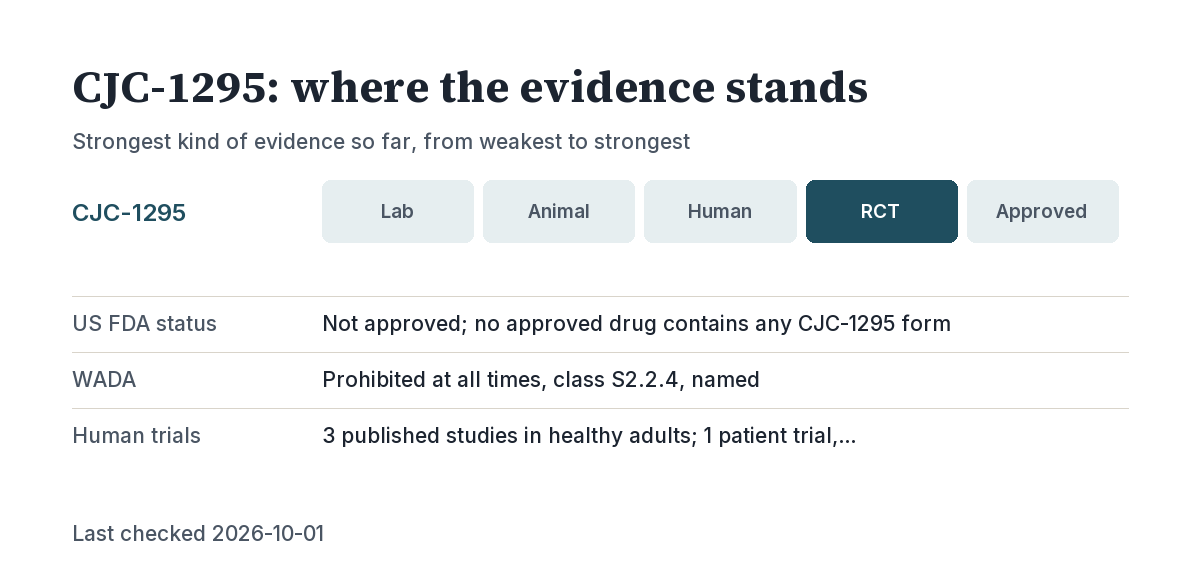
| US FDA status | Not approved; no approved drug contains any CJC-1295 form (FDA review, 2024) |
| Compounding (503A/503B) | FDA’s advisory committee voted 13–0 (free base and DAC forms) and 12–1 (acetate) on 2024-12-04 against the 503A list (minutes); advisory, no final rule yet. Listed by FDA with safety risks; not on the July 2026 agenda |
| WADA 2026 | Prohibited at all times, class S2.2.4, named (2026 List); still named in the 2027 List |
| Strongest evidence | Human RCT, phase 1 (n=42 and n=24, healthy adults): hormone levels only |
| Human trials | 3 published studies in healthy adults; 1 patient trial, NCT00267527, terminated 2006, no results |
| Main risks | Injection-site reactions, flushing, headache, faster heart rate; long-term and cancer data absent |
| Last checked | 2026-10-01 |
Key points:
- “CJC-1295” names two different molecules: the DAC version studied in people, and a version without DAC, also called Mod GRF 1-29 (Dominikowski 2026), for which FDA reviewers found no pharmacology studies at all.
- In healthy adults, a single dose raised mean growth hormone 2- to 10-fold for 6 days or more, with an estimated half-life of 5.8–8.1 days.
- A participant in the HIV trial died of a heart attack two hours after a dose; the attending physician attributed it to underlying coronary disease, and the trial was stopped.
- FDA reviewers flagged injection-site necrosis in rats and dogs and DNA-damage signals in mouse pituitary cells.
- FDA used CJC-1295 in July 2026 as its example of “multiple forms” sold under one name.
What changed (October 2026): a table now compares the forms with and without DAC, including how FDA’s advisers voted on each; the IGF-1 figure in the evidence table now reads 1.5- to 3-fold, as in the trial paper; two 2026 sports medicine reviews are added; and rulemaking was re-checked on 2026-10-26.
| Property | Value |
|---|---|
| Sequence (core) | Tyr-D-Ala-Asp-Ala-Ile-Phe-Thr-Gln-Ser-Tyr-Arg-Lys-Val-Leu-Ala-Gln-Leu-Ser-Ala-Arg-Lys-Leu-Leu-Gln-Asp-Ile-Leu-Ser-Arg-NH2 (FDA review) |
| Changes vs GHRH(1-29) | Substitutions at positions 2, 8, 15 and 27 |
| DAC form | Adds a lysine carrying a maleimidopropionyl group at the C-terminus |
| Formula, weight (DAC) | C165H269N47O46; 3,647.95 g/mol |
| Formula, weight (no DAC) | C152H252N44O42; 3,367.95 g/mol |
| CAS | 446262-90-4 (DAC); 446036-97-1 (no DAC) |
| PubChem CID | 91971820 (DAC); 56841945 (no DAC) |
| Half-life | 5.8–8.1 days (DAC, healthy adults); no human data without DAC |
| Route studied | Subcutaneous injection |
| Class | GHRH analog (growth hormone secretagogue) |
What is CJC-1295?
CJC-1295 was developed by the Montreal company ConjuChem, whose scientists described it in 2005 as the best of three albumin-linked versions of human GHRH(1-29), the shortest fragment of the natural hormone with full activity (Jetté 2005). The company’s “Drug Affinity Complex” (DAC) is a reactive group that attaches the peptide to albumin in the blood so it circulates far longer than natural GHRH. Phase 1 studies followed in 2006, then a phase 2 trial in HIV-associated belly fat that was terminated. Today the name is used loosely: FDA reviewers counted at least five distinct substances and nine names in circulation, and they treat the versions with and without DAC as different active moieties that are not interchangeable (FDA briefing document).
How does CJC-1295 work?
- GHRH receptor activation: like natural GHRH, CJC-1295 stimulates GHRH receptors on pituitary somatotroph cells, which release growth hormone; in rats it produced a 4-fold larger growth hormone response over 2 hours than GHRH(1-29) [Animal] (Jetté 2005).
- Albumin binding (DAC): after injection in rats, CJC-1295 was found bound to serum albumin within 15 minutes and stayed in plasma beyond 72 hours [Animal] (Jetté 2005).
- Enzyme resistance: albumin-bound CJC-1295 resisted breakdown by the enzyme DPP-IV, which rapidly inactivates natural GHRH [Lab (in vitro)] (Jetté 2005).
- IGF-1 as the downstream signal: the extra growth hormone drives the liver to make IGF-1 (insulin-like growth factor 1), which rose 1.5- to 3-fold for 9–11 days after one dose [Human RCT, phase 1] (Teichman 2006).
- Pulses preserved: growth hormone kept its normal pulsing pattern while the low “trough” levels between pulses rose 7.5-fold [Human, uncontrolled, n=12] (Ionescu 2006).
What the research shows
CJC-1295’s demonstrated effect is a long-lasting rise in the body’s own growth hormone: in phase 1 trials one injection raised mean growth hormone 2- to 10-fold for 6 days or more and IGF-1 1.5- to 3-fold for 9–11 days [Human RCT, phase 1, n=42 and n=24] (Teichman 2006), while natural growth hormone pulses were preserved [Human, n=12] (Ionescu 2006). In mice lacking growth hormone-releasing hormone, dosing every 24 hours restored normal weight and length, while dosing every 48 or 72 hours did not fully normalize growth [Animal] (Alba 2006). Whether these hormone changes bring muscle, fat-loss, sleep or recovery benefits has not been tested in people.
Every row below carries its evidence level, using the labels described in the PeptideWikis editorial policy.
| Claim | Evidence level | Best study and result |
|---|---|---|
| Raises growth hormone for days | Human RCT, phase 1 (n=42) | Teichman 2006: mean GH up 2- to 10-fold for 6 days or more |
| Raises IGF-1 | Human RCT, phase 1 (n=42 and n=24) | Teichman 2006: 1.5- to 3-fold for 9–11 days; above baseline up to 28 days with repeat doses |
| Keeps natural GH pulses | Human, uncontrolled (n=12) | Ionescu 2006: pulse frequency unchanged; mean GH +46%, IGF-1 +44% |
| Changes blood protein markers | Human, uncontrolled (n=11) | Sackmann-Sala 2009: 5 serum protein spots changed |
| Restores growth in GHRH-deficient animals | Animal (knockout mice) | Alba 2006: normal weight and length with dosing every 24 h |
| Reduces visceral fat in HIV | No results | NCT00267527: terminated, unpublished |
| Builds muscle, burns fat, improves sleep or recovery | No human data | Dominikowski 2026: no peer-reviewed support |
| Any effect of CJC-1295 without DAC | No human or animal pharmacology | FDA 2024: no studies identified |
Growth hormone and IGF-1
The clearest and most encouraging finding is pharmacological: CJC-1295 does what it was designed to do. In two randomized, placebo-controlled, double-blind trials in healthy adults aged 21–61, one injection produced dose-dependent rises in growth hormone and IGF-1 that lasted about a week, and repeat doses had a cumulative effect, keeping IGF-1 above baseline for up to 28 days [Human RCT, phase 1] (Teichman 2006). FDA’s reading of the same paper notes that IGF-1 exceeded the age- and sex-adjusted normal range only at the highest dose tested (FDA briefing document). A follow-up in 12 healthy young men found that growth hormone kept its pulsing rhythm, which researchers consider important for many of the hormone’s effects [Human, uncontrolled, n=12] (Ionescu 2006). FDA’s summary adds that IGF-1 stayed within the normal range in every subject.
Growth in animals
In mice born without the GHRH gene, CJC-1295 given every 24 hours for 5 weeks produced normal body weight, body length and bone length, and increased pituitary growth hormone production; dosing every 48 or 72 hours worked less well [Animal] (Alba 2006). The authors pointed to childhood growth hormone deficiency as a possible use, but no study in children has been published.
Body composition, ageing and performance
No published human study has measured fat loss, muscle gain, strength, sleep, skin or recovery with CJC-1295. A 2026 review of growth hormone-axis peptides placed the DAC form in an evidence tier of “phase I PK/PD studies in healthy adults; no controlled efficacy data”, and the non-DAC form in the lowest tier, with no peer-reviewed human studies (Dominikowski 2026). The same review notes that combining CJC-1295 with ipamorelin is driven by anecdotal rationale, with little controlled evidence of synergy.
Two 2026 reviews for sports medicine reached the same view. A scoping review of CJC-1295 and five other peptides found the claimed benefits unsupported by current human trials and advised against using them in place of, or alongside, standard orthopedic care [Scoping review] (Tewari 2026). A narrative review of approved and unapproved peptides, CJC-1295 among them, found favorable results in animals but scarce human safety data [Narrative review] (Mendias and Awan 2026).
With DAC versus without DAC
Almost all of the evidence above concerns the DAC version made by ConjuChem. FDA reviewers found no studies establishing whether CJC-1295 without DAC is pharmacologically active, and warned that the DAC version’s profile “cannot be extrapolated” to it (FDA briefing document, 2024). The non-DAC peptide is still expected to act on GHRH receptors because it shares the modified GHRH(1-29) core, but its half-life and effects in people have not been measured.
The two forms side by side, as of October 2026:
| Item | With DAC | Without DAC (Mod GRF 1-29) |
|---|---|---|
| Added part | A lysine with a group that binds albumin in the blood | None |
| Half-life in people | 5.8–8.1 days (Teichman 2006) | Never measured |
| Studies | Rats, mice and 3 published studies in healthy adults | No pharmacology studies found (FDA 2024) |
| FDA advisers’ vote on the 503A list, 2024-12-04 | 0 yes, 13 no for each of the three DAC forms | 0 yes, 13 no (free base); 1 yes, 12 no (acetate) (minutes) |
| WADA, 2026 and 2027 | Prohibited at all times, S2.2.4 | Prohibited at all times, S2.2.4, as a GHRH analog |
Human studies and trials
| Study | Design and n | Result |
|---|---|---|
| Teichman 2006, study 1 | RCT, single ascending doses; 35 drug, 7 placebo | GH and IGF-1 rose for 6–11 days; no serious reactions |
| Teichman 2006, study 2 | RCT, 2–3 doses; 24 adults | Cumulative IGF-1 rise to day 28 |
| Ionescu 2006 | Single dose, no placebo; 12 men | Pulses kept; trough GH ×7.5 |
| Sackmann-Sala 2009 | Subset of Ionescu; 11 men | Serum protein marker changes |
| NCT00267527 | Phase 2 RCT, HIV visceral fat; 120 listed | Terminated (2005-12 to 2006-09); no results posted |
This is the full human record found in PubMed and ClinicalTrials.gov searches for this entry: three published studies, all in healthy adults, and one terminated patient trial. FDA counted 63 healthy adults exposed across the published studies, 87% of them men and 73% given a single dose (FDA briefing document). The phase 2 trial, sponsored by ConjuChem, randomized people with HIV-associated abdominal fat to low dose, high dose or placebo for 12 weeks (NCT00267527). Reports summarized by FDA describe 192 enrolled participants and one death from a heart attack about two hours after an 11th dose; the trial was stopped and its data were never published. A 2016 qualitative study of 23 online forum threads, not a clinical study, found that women discussing CJC-1295 sought weight loss, muscle, younger-looking skin, better sleep and injury healing [Qualitative, forum analysis] (Van Hout 2016).
Doses used in studies
| Route and amount | Species | Study |
|---|---|---|
| Subcutaneous, single, 30–250 µg/kg (4 dose groups) | Healthy adults | Teichman 2006 |
| Subcutaneous, 20–60 µg/kg, 2–3 doses over 14 days | Healthy adults | Teichman 2006 (via FDA review) |
| Subcutaneous, single, 60 or 90 µg/kg | Healthy men | Ionescu 2006 |
| Subcutaneous, single, 1 µmol/kg | Rats | Jetté 2005 |
| 2 µg per mouse every 24, 48 or 72 h for 5 weeks | GHRH-knockout mice | Alba 2006 |
No established human dose exists outside approved labels. CJC-1295 has no approved label, and no dose of the non-DAC form has been tested in any published study.
Side effects and safety
Reported in human studies
In the first Teichman trial, 33 of 35 people given CJC-1295 (94%) reported an adverse event, against 2 of 7 on placebo, according to FDA’s summary of the paper (FDA briefing document). Injection-site reactions such as redness, hardening, pain or itching affected about 70%, a transient hive-like rash about 30%, headache 63% (14% on placebo), and flushing, warmth and transient low blood pressure 30%; most effects were more common at the two highest doses [Human RCT, phase 1]. In the multiple-dose trial, flushing within 30 minutes of injection occurred in 40% after low doses and 100% after high doses, and one person had transient leg muscle contractions and loss of coordination. A dose-dependent rise in heart rate was reported in the Ionescu study [Human, n=12]. The study authors reported no serious adverse reactions and no consistent changes in blood glucose, liver tests or ECGs (Teichman 2006). FDA lists “increased heart rate and systemic vasodilatory reaction” as serious adverse events on its compounding safety-risk page.
The terminated HIV trial
The one death linked in time to CJC-1295 occurred in the phase 2 trial: chest discomfort two hours after a dose, an ECG showing a heart attack, and death about an hour later. The attending physician’s most likely explanation was undiagnosed coronary artery disease with plaque rupture; FDA notes that no further safety data from the trial are available. Causation was never established.
Animal and lab findings
FDA reviewers summarized toxicity studies, published as abstracts only, in which repeated injections caused injection-site hemorrhage, inflammation and necrosis in rats and dogs, plus small drops in red blood cell counts [Animal]. In a Cedars-Sinai study, a long-acting GHRH analog increased DNA damage markers in mouse pituitary cells in culture and in living mice [Animal; Lab (in vitro)] (Ben-Shlomo 2020); FDA identifies that analog as CJC-1295 DAC. No 2-year cancer studies exist, and mice engineered to overproduce GHRH develop pituitary enlargement and tumors, so FDA states that pituitary overgrowth with long-term use “cannot be ruled out” [theoretical, based on animal data].
Theoretical risks
Because CJC-1295 works by raising growth hormone and IGF-1, FDA found no data suggesting it would avoid the risks listed on approved growth hormone labels, including glucose intolerance and diabetes, fluid retention, raised pressure inside the skull and a possible increase in tumor risk [theoretical, by mechanism]. FDA also raised immunogenicity: CJC-1295 is 86% identical to the body’s own GHRH, so antibodies against it could in principle cross-react with the natural hormone. No safety data exist for children, pregnancy or anyone with heart disease, and no published study has followed anyone for longer than seven weeks.
Product identity and contamination
Unregulated products add a separate layer of risk. In 2009 the Norwegian doping laboratory analyzed an unknown preparation submitted by police or customs and identified a 29-amino-acid peptide consistent with one marketed as “CJC-1295” (Henninge 2010). FDA’s review found that a certificate of analysis submitted for “CJC-1295 acetate” lacked tests for aggregates and endotoxins, and at its July 2026 meeting FDA cited CJC-1295 as an example of different molecules sold under the same name (FDA presentation). For more on how such products are labeled, see what “research use only” means.
What users report
What follows are unverified self-reports from people who usually bought unregulated products, not evidence that CJC-1295 works or is harmless. People who post about CJC-1295 on forums, video channels and social media most often describe deeper sleep, vivid dreams, faster recovery from training, gradual fat loss and better skin, usually saying any change took several weeks to notice. The most common complaint is a warm, red flush of the face soon after an injection, sometimes with a racing heart or light-headedness. Others mention water retention, tingling or numb hands, increased hunger, tiredness and redness or lumps where they injected. A large share say they felt nothing at all. Product quality is a recurring worry, with posters unsure whether a vial labeled “CJC-1295” contains the DAC form, the non-DAC form or something else. The longest-running argument is whether the long-acting DAC version or the short-acting non-DAC version is “better”, and whether pairing it with ipamorelin adds anything, a question no controlled study has answered.
Legal and regulatory status
| Jurisdiction | Status |
|---|---|
| US, FDA | Not approved; not a component of any approved drug (FDA 2024) |
| US, 503A compounding | Not on the 503A bulks list; PCAC voted against listing 2024-12-04 (minutes); final FDA rule pending |
| US, FDA category page | Nominations withdrawn; safety concerns still listed (page updated 2026-04-22) |
| US, enforcement | Named in a 2020 FDA warning letter to a compounder |
| Sport, WADA 2026 | Prohibited at all times, S2.2.4 (2026 List) |
| Sport, WADA 2027 | Still named, S2.2.4, from 2027-01-01 (2027 List) |
The December 2024 vote. Two nominators, one of them Wells Pharmacy Network, put CJC-1295 forward for the 503A bulks list, the list of ingredients pharmacies may compound without an approved drug, and later withdrew. FDA evaluated five CJC-1295 substances for growth hormone deficiency on its own initiative and proposed that none be listed, citing poor chemical characterization, nonclinical safety signals and no effectiveness data (FDA briefing document). On 2024-12-04 the Pharmacy Compounding Advisory Committee agreed: 0 yes and 13 no for CJC-1295 free base and each DAC form, and 1 yes and 12 no for CJC-1295 acetate (PCAC minutes). The vote is advisory; the next step is FDA rulemaking, and no rule had been proposed or published in the Federal Register as of 2026-10-26. CJC-1295 was not among the seven peptides reviewed at the July 2026 meeting. How the two compounding pathways differ is explained in 503A vs 503B peptides.
In 2020 FDA warned a compounder that drugs made from CJC-1295 do not qualify for the 503A exemptions because the ingredient has no USP monograph, is not part of an approved drug and is not on the 503A list (Tailor Made Compounding letter).
Sport. WADA names CJC-1295 under S2.2.4, growth hormone releasing factors, prohibited in and out of competition (WADA 2026 List). Anti-doping laboratories have published a validated method for human plasma that detects CJC-1295 (Knoop 2016). UK, EU and Australian status could not be confirmed on a regulator page for this edition.
Related peptides
- Tesamorelin: a 44-amino-acid GHRH analog approved in 2010 as Egrifta for excess abdominal fat in adults with HIV (FDA approval letter, 2010).
- Sermorelin: GHRH(1-29) itself, once approved as Geref for children with growth hormone deficiency; the approvals were withdrawn effective 2009-06-18, and FDA determined this was not for safety or effectiveness reasons (Dominikowski 2026).
- Ipamorelin: a ghrelin-receptor agonist that raises growth hormone by a different route, often discussed alongside CJC-1295; WADA lists it in the same class, S2.2.4.
Frequently asked questions
Is CJC-1295 FDA approved?
No. CJC-1295 is not approved for any use in the United States, and no approved drug contains it. FDA also proposed keeping every form off the list of ingredients pharmacies may compound, and its advisory committee agreed in December 2024 by votes of 13–0 and 12–1 (PCAC minutes). Products sold online are unapproved drugs.
What is the difference between CJC-1295 with and without DAC?
The DAC version carries an extra lysine with a reactive group that binds albumin, giving a half-life of 5.8–8.1 days in healthy adults. The version without DAC, often called Mod GRF 1-29, lacks that tag. FDA treats them as different active moieties and found no published pharmacology studies of the non-DAC form (FDA review).
Is CJC-1295 banned in sports?
Yes. WADA names CJC-1295 in class S2.2.4, growth hormone releasing factors, which is prohibited at all times, in and out of competition (WADA 2026 List). It remains on the 2027 List. Doping laboratories have published a validated method for detecting it in blood plasma.
What are the side effects of CJC-1295?
In small trials in healthy adults, the most common effects were injection-site reactions in about 70% of participants, headache, diarrhea, and flushing with warmth and low blood pressure, more often at higher doses. FDA lists increased heart rate and systemic vasodilatory reaction as serious adverse events (FDA). Long-term effects, including on cancer risk and blood sugar, have never been studied.
How long does CJC-1295 stay in the body?
For the DAC version, the estimated half-life in healthy adults was 5.8–8.1 days, and growth hormone stayed raised for 6 days or more after one injection (Teichman 2006). No human study has measured the half-life of CJC-1295 without DAC, so figures quoted online for that form are not backed by published data.
Is CJC-1295 a steroid?
No. CJC-1295 is a peptide, a modified 29-amino-acid fragment of growth hormone-releasing hormone, not an anabolic steroid. It acts on the pituitary: in randomized, placebo-controlled trials in healthy adults, a single injection raised mean growth hormone 2- to 10-fold for 6 days or more (Teichman 2006) [Human RCT]. No study shows muscle or fat effects, and WADA bans it under its growth hormone class.
References
- Teichman SL, Neale A, Lawrence B, et al. (2006). Prolonged stimulation of growth hormone (GH) and insulin-like growth factor I secretion by CJC-1295, a long-acting analog of GH-releasing hormone, in healthy adults. J Clin Endocrinol Metab 91(3):799–805. PubMed 16352683
- Ionescu M, Frohman LA (2006). Pulsatile secretion of growth hormone (GH) persists during continuous stimulation by CJC-1295, a long-acting GH-releasing hormone analog. J Clin Endocrinol Metab 91(12):4792–7. PubMed 17018654
- Jetté L, Léger R, Thibaudeau K, et al. (2005). Human growth hormone-releasing factor (hGRF)1-29-albumin bioconjugates activate the GRF receptor on the anterior pituitary in rats: identification of CJC-1295 as a long-lasting GRF analog. Endocrinology 146(7):3052–8. PubMed 15817669
- Alba M, Fintini D, Sagazio A, et al. (2006). Once-daily administration of CJC-1295, a long-acting GHRH analog, normalizes growth in the GHRH knockout mouse. Am J Physiol Endocrinol Metab 291(6):E1290–4. PubMed 16822960
- Sackmann-Sala L, Ding J, Frohman LA, Kopchick JJ (2009). Activation of the GH/IGF-1 axis by CJC-1295, a long-acting GHRH analog, results in serum protein profile changes in normal adult subjects. Growth Horm IGF Res 19(6):471–7. PubMed 19386527
- Ben-Shlomo A, Deng N, Ding E, et al. (2020). DNA damage and growth hormone hypersecretion in pituitary somatotroph adenomas. J Clin Invest 130(11):5738–55. PubMed 32673291
- Henninge J, Pepaj M, Hullstein I, Hemmersbach P (2010). Identification of CJC-1295, a growth-hormone-releasing peptide, in an unknown pharmaceutical preparation. Drug Test Anal 2(11-12):647–50. PubMed 21204297
- Knoop A, Thomas A, Fichant E, et al. (2016). Qualitative identification of growth hormone-releasing hormones in human plasma by means of immunoaffinity purification and LC-HRMS/MS. Anal Bioanal Chem 408(12):3145–53. PubMed 26879649
- Van Hout MC, Hearne E (2016). Netnography of female use of the synthetic growth hormone CJC-1295: pulses and potions. Subst Use Misuse 51(1):73–84. PubMed 26771670
- Dominikowski A, Rękoś Z, Olejarz M, et al. (2026). The emerging landscape of performance-enhancing peptides modulating GH-IGF1 axis. Front Endocrinol 17:1822475. PubMed 42395176
- Tewari K, Liu TP, Im C, et al. (2026). Peptide supplements and their therapeutic applications in sports medicine. Am J Sports Med. PubMed 42578445
- Mendias CL, Awan TM (2026). Safety and efficacy of approved and unapproved peptide therapies for musculoskeletal injuries and athletic performance. Sports Med 56(8):1921–35. PubMed 41966639
- ConjuChem. A study to evaluate CJC 1295 in HIV patients with visceral obesity (phase 2, terminated). ClinicalTrials.gov. NCT00267527
- US FDA (2024). FDA briefing document: CJC-1295-related bulk drug substances, Pharmacy Compounding Advisory Committee, December 4, 2024. fda.gov/media/183819
- US FDA (2025). Final summary minutes of the Pharmacy Compounding Advisory Committee meeting, December 4, 2024. fda.gov/media/185642
- US FDA. Certain bulk drug substances for use in compounding that may present significant safety risks (updated 2026-04-22). fda.gov
- US FDA (2026). FDA introductory remarks, Pharmacy Compounding Advisory Committee, July 23, 2026. fda.gov/media/193773
- US FDA. July 23–24, 2026 meeting of the Pharmacy Compounding Advisory Committee. fda.gov
- US FDA (2020). Warning letter to Tailor Made Compounding LLC, 594743, April 1, 2020. fda.gov
- US FDA (2010). Approval letter, Egrifta (tesamorelin), NDA 022505. accessdata.fda.gov
- World Anti-Doping Agency. The 2026 Prohibited List. wada-ama.org
- World Anti-Doping Agency. The 2027 Prohibited List (in force 2027-01-01). wada-ama.org
- PubChem. CJC-1295, CID 91971820; CID 56841945. pubchem.ncbi.nlm.nih.gov
Change log
2026-10-26: new H1; with and without DAC compared in one table, with each form’s FDA advisory vote; evidence table IGF-1 figure corrected to 1.5- to 3-fold, as in Teichman 2006; 2026 sports medicine reviews added; rulemaking re-checked; reviewed by the editorial team.
2026-10-24: mouse growth result narrowed to the every-24-hour schedule, as in Alba 2006; less frequent dosing did not fully normalize growth; reviewed by the editorial team.
2026-10-23: links to glossary definitions added; no change to the facts.
2026-10-18: IGF-1 rise after one dose corrected to 1.5- to 3-fold, as reported in Teichman 2006; reviewed by the editorial team.
2026-10-12: Benefits section added: the most promising findings named first, each with its evidence level; reviewed by the editorial team.
2026-10-12: links to related entries added; no change to the facts.
2026-10-04: FAQ expanded with one question readers search for (whether it is a steroid); reviewed by the editorial team.
2026-10-01: first published after review by the editorial team.