Sermorelin is a synthetic 29-amino-acid copy of the active start of human growth hormone-releasing hormone (GHRH) that signals the pituitary to release growth hormone; its strongest evidence is a former FDA approval, Geref, for children with growth hormone deficiency.
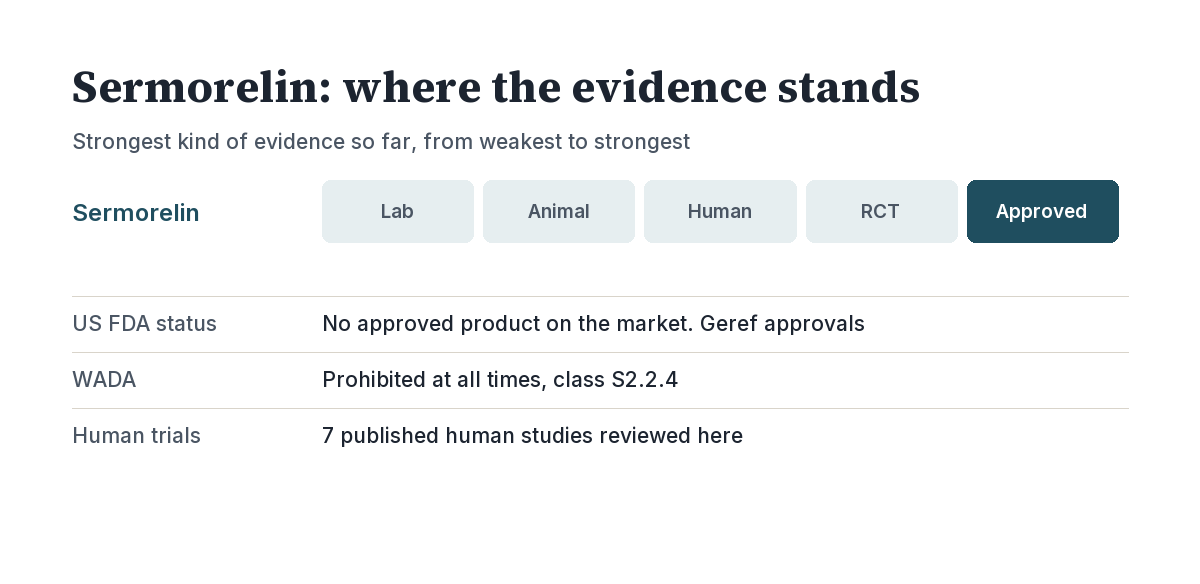
Sermorelin’s best-documented benefit is faster growth in children with growth hormone deficiency: in a study of 110 children, height velocity rose from 4.1 to 8.0 cm a year at 6 months [Human, n=86 analysed] (Thorner, 1996). Is sermorelin FDA approved? Not today: no FDA-approved sermorelin product is marketed in the US as of 2026-10-06. Geref was approved in 1990 as a diagnostic test and in 1997 as a treatment, was discontinued in 2008, and FDA determined in 2013 that it was not withdrawn for reasons of safety or effectiveness. Sermorelin is prohibited in sport at all times. The human evidence comes from small trials, most of them from the 1990s.
| Item | Status |
|---|---|
| US FDA status | No approved product on the market. Geref approvals (NDA 020443, NDA 19-863) withdrawn effective 2009-06-18; FDA found in 2013 this was not for safety or effectiveness reasons. Next step: none announced |
| Compounding (503A/503B) | Not on FDA’s 503A Category 2 list (page current 2026-04-22). FDA’s 503B list (updated 2025-03-21) places sermorelin acetate in Category 1, “under evaluation”; no final decision found |
| WADA 2026 | Prohibited at all times, class S2.2.4 (GHRH analogues), named on the 2026 Prohibited List |
| Strongest evidence | Approved label (former, Geref, pediatric GH deficiency); small human RCTs |
| Human trials | 7 published human studies reviewed here (treated n=10 to 110; one used a close analogue); no registered trial naming sermorelin as the intervention on ClinicalTrials.gov (searched 2026-10-06) |
| Last checked | 2026-10-06 |
Key points:
- Sermorelin’s sequence matches the first 29 residues of human GHRH; its molecular weight is 3357.9 (PubChem).
- In a study that enrolled 110 GH-deficient children (86 analysed for efficacy), height velocity rose from 4.1 to 8.0 cm/year after 6 months, though growth hormone itself worked better in a head-to-head trial.
- In older men, two weeks of the higher sermorelin dose brought GH and IGF-1 up to young-adult levels, but a 6-week study found no change in muscle or fat mass.
- FDA’s recall database lists 92 recall entries whose product description includes sermorelin, and most of those reviewed were for lack of sterility assurance.
- Unlike ipamorelin, sermorelin is not on FDA’s compounding Category 2 “significant safety risks” list.
Identity
| Property | Value |
|---|---|
| Sequence (29 aa, C-terminal amide) | YADAIFTNSYRKVLGQLSARKLLQDIMSR-NH2 (residues 1–29 of human GHRH, per the Egrifta WR label sequence) |
| Molecular formula | C149H246N44O42S |
| Molecular weight | 3357.9 |
| CAS number | 86168-78-7 |
| PubChem CID | 16132413 |
| Other names | Geref, GHRH(1-29)NH2, GRF(1-29)NH2, sermorelin acetate |
| Routes studied | Intravenous (diagnostic test), subcutaneous |
| Class | GHRH analogue (growth hormone secretagogue) |
What is sermorelin?
Sermorelin is a laboratory-made peptide, not a steroid. A 1999 drug review called it “the shortest synthetic peptide with full biological activity of GHRH” (Prakash and Goa, 1999). EMD Serono held the US approvals for Geref in two forms: a 0.05 mg product approved on 1990-12-28 for testing whether the pituitary can secrete growth hormone, and 0.5 mg and 1.0 mg products approved on 1997-09-26 for children with idiopathic growth hormone deficiency and growth failure (FDA, 2013). The company told FDA in July and December 2008 that both were being discontinued. After a 2012 citizen petition, FDA reviewed its records and postmarketing data and concluded that neither product was withdrawn for safety or effectiveness reasons, which allows generic applications that refer to Geref.
How does sermorelin work?
- Pituitary GHRH receptor: GHRH acts on pituitary somatotroph cells “to stimulate the synthesis and pulsatile release of endogenous growth hormone” [Approved label, for the class] (Egrifta WR label, 2025); sermorelin given into a vein or under the skin “specifically” stimulates growth hormone secretion [Human] (Prakash and Goa, 1999).
- Bigger pulses, same rhythm: in 11 men aged 64–76, nightly sermorelin raised growth hormone peak size (P < .05) without changing how often pulses occurred [Human, n=11] (Vittone, 1997).
- IGF-1 downstream: some growth hormone effects run through insulin-like growth factor 1 (IGF-1) made in the liver [Approved label, for the class]; in older men, the higher sermorelin dose raised IGF-1 (P < 0.005) over 14 days [Human, n=10] (Corpas, 1992).
- Needs a working pituitary: because it acts upstream, Geref Diagnostic was approved for “evaluating the ability of the somatotroph of the pituitary gland to secrete growth hormone” [Approved label, former] (FDA, 2013).
Benefits of Sermorelin: what the research shows
Sermorelin’s clearest benefit is growth: in children with growth hormone deficiency it roughly doubled height velocity, from 4.1 to 8.0 cm a year at 6 months [Human, n=86 analysed] (Thorner, 1996), the use for which it was approved as Geref until 2008. It also served as a diagnostic test of the pituitary’s growth hormone reserve [Approved label, former] (Prakash and Goa, 1999). In older men, 14 days of sermorelin brought growth hormone and IGF-1 up to young-adult levels [Human, n=10, no placebo] (Corpas, 1992), and in a small randomized trial of a sermorelin analogue, men gained lean mass and insulin sensitivity over 5 months, and immune-cell responsiveness rose [Human RCT, n=19] (Khorram, 1997).
| Claim | Evidence level | Best study and result |
|---|---|---|
| Speeds growth in GH-deficient children | Approved label (former); Human, n=110 | Thorner, 1996: height velocity 4.1 → 8.0 cm/yr at 6 months, 7.2 at 12 months |
| Works as well as growth hormone in children | Human RCT, n=60 | Not shown. Chen, 1993: 9.2 and 9.3 vs 14.6 cm/yr with GH (p < 0.01) |
| Tests pituitary GH reserve | Approved label (former) | Prakash, 1999: a rapid and relatively specific diagnostic test |
| Raises GH and IGF-1 in older men | Human, n=10 (no placebo) | Corpas, 1992: GH and IGF-1 reached young-adult levels in 14 days |
| Builds muscle or cuts fat in older adults | Human, n=11 (no placebo) | Not shown. Vittone, 1997: no DEXA change; 2 of 6 strength tests improved |
| Lean mass and insulin sensitivity in older adults | Human RCT, n=19 (sermorelin analogue) | Khorram, 1997: gains in men only over 5 months |
| Boosts immune markers | Human RCT, n=19 (sermorelin analogue) | Khorram, 1997: higher B and T cell responsiveness |
| Raises IGF-1 in men on testosterone | Human (retrospective), n=14 | Sigalos, 2017: 159.5 → 239.0 ng/mL, combined with GHRP-2 and GHRP-6 |
| Weight loss, anti-aging, better sleep | No trial found | No registered sermorelin trial for these uses on ClinicalTrials.gov (searched 2026-10-06); in the small older-adult study above, weight and DEXA fat did not change |
Growth in children. This is where sermorelin’s evidence is strongest. In a multicenter study of 110 previously untreated prepubertal children, of whom 86 were eligible for efficacy analysis, nightly sermorelin under the skin raised mean height velocity from 4.1 to 8.0 cm/year at 6 months and 7.2 cm/year at 12 months, and 74% were good responders at 6 months [Human, n=86 analysed] (Thorner, 1996). A review of the data found the effect held for 12 months and, in a few children, 36 months, but the recommended once-daily regimen was never compared directly with daily somatropin, the growth hormone drug; gains on the regimens that were compared (continuous infusion or three divided daily doses) were smaller (Prakash and Goa, 1999). In a randomized trial of 60 children, growth hormone produced 14.6 cm/year against 9.2 and 9.3 cm/year on two sermorelin doses [Human RCT, n=60] (Chen, 1993).
Older adults. Research in the 1990s tested whether sermorelin could reverse the fall in growth hormone that comes with age. In 10 men averaging 68 years, two weeks of the higher dose raised 24-hour GH and IGF-1 until they no longer differed from those of young men [Human, n=10] (Corpas, 1992). Those hormone gains did not clearly turn into body changes: in 11 men given sermorelin nightly for 6 weeks, two of six strength measures and one endurance test improved, but weight, DEXA muscle and fat, glucose and lipids did not change [Human, n=11] (Vittone, 1997). Neither study had a placebo group.
The 5-month analogue trial. A placebo-controlled trial in 19 older men and women used a close analogue, [Nle27]GHRH(1-29)NH2, in which norleucine replaces methionine at position 27. IGF-1 rose within two weeks, skin thickness increased, and men gained lean mass and insulin sensitivity while women did not [Human RCT, n=19] (Khorram, 1997). In the same group, GH rose 107% in men and 70% in women and several immune-cell markers increased, with no adverse effects reported [Human RCT, n=19] (Khorram, 1997). These results are encouraging, but the molecule differs from sermorelin and the trial was small.
Men on testosterone. A retrospective review of medical records covered 105 men on testosterone who were prescribed sermorelin together with GHRP-2 and GHRP-6; in the 14 who met strict inclusion criteria, mean IGF-1 rose from 159.5 to 239.0 ng/mL (p < .0001) [Human, retrospective, n=14] (Sigalos, 2017). Because three peptides were combined, the study cannot isolate sermorelin’s share, and it measured no body-composition outcome.
Human studies and trials
| Study | Design, n | Result |
|---|---|---|
| Thorner 1996 | Multicenter, open, 12 months; n=110 children | Height velocity 4.1 → 7.2 cm/yr at 12 months |
| Neyzi 1993 | Randomized vs GH, 6 months; n=43 children | Gain of ≥2 cm/yr in all but two; higher dose comparable to GH |
| Chen 1993 | Randomized vs GH, 6 months; n=60 children | GH group grew faster (p < 0.01) |
| Corpas 1992 | Two doses, 14 days each; n=10 old men treated, 9 young men as reference | GH and IGF-1 rose to young-adult levels |
| Vittone 1997 | Uncontrolled, 6 weeks; n=11 men | More nocturnal GH; no DEXA change |
| Khorram 1997 | Placebo-controlled RCT, 5 months; n=19 (analogue) | IGF-1 up; lean mass and insulin sensitivity up in men |
| Sigalos 2017 | Retrospective review; n=14 men | IGF-1 159.5 → 239.0 ng/mL (with GHRPs) |
A ClinicalTrials.gov search for the intervention “sermorelin” on 2026-10-06 returned 27 records, but none names sermorelin or Geref as the intervention; the matches are tesamorelin trials, GHRH stimulation tests and other GHRH products (ClinicalTrials.gov). No sermorelin trial registered there was recruiting on that date.
Doses used in studies
| Route | Amount studied | Population and study |
|---|---|---|
| Intravenous, single dose | 1 µg/kg (diagnostic test) | Humans; Prakash 1999 |
| Subcutaneous | 30 µg/kg once daily, 12 months | Children, n=110; Thorner 1996 |
| Subcutaneous | 30 or 60 µg/kg/day in three doses, 6 months | Children, n=43; Neyzi 1993 |
| Subcutaneous | 0.5 mg or 1 mg twice daily, 14 days | Older men, n=10; Corpas 1992 |
| Subcutaneous | 2 mg nightly, 6 weeks | Older men, n=11; Vittone 1997 |
No established human dose exists outside approved labels. Sermorelin has no current US label, and Drugs@FDA does not hold the Geref label.
Side effects and safety
Reported in trials. In the pediatric studies, single and repeated doses were “well tolerated”, and transient facial flushing and pain at the administration site were the most common adverse events [Human] (Prakash and Goa, 1999). The 110-child study found no adverse changes in blood chemistry or hormones over a year [Human, n=110] (Thorner, 1996). In older men, two weeks did not affect fasting glucose, blood pressure or blood counts [Human, n=10] (Corpas, 1992), and the six-week study observed no meaningful adverse effects [Human, n=11] (Vittone, 1997). At the higher pediatric dose, GHRH immunoreactivity built up in the blood over time, without a link to GH levels [Human, n=43] (Neyzi, 1993). FDA’s 2013 review, which included postmarketing adverse-event data, found that Geref was not withdrawn for safety reasons (FDA, 2013). The trials were short and small, so long-term risks in adults are unknown.
Theoretical risks from raising growth hormone. Sermorelin’s effects run through growth hormone and IGF-1, so the warnings on the label of tesamorelin, an approved GHRH analogue, are a reasonable guide to what could happen with sermorelin, though they come from a different drug. That label lists fluid retention (swelling, joint pain, carpal tunnel syndrome), glucose intolerance (HbA1c of 6.5% or more in 5% vs 1% on placebo), hypersensitivity reactions in 4%, and IGF-1 rises whose long-term effects “are unknown” [Approved label, tesamorelin] (Egrifta WR label, 2025). USADA lists swelling, joint and nerve pain, insulin resistance, high blood pressure and heart enlargement as risks of excess growth hormone (USADA). How growth-hormone peptides relate to cancer risk is covered in our page on whether peptides cause cancer.
Product quality. “Compounded drugs are not FDA-approved,” and FDA does not check their safety, effectiveness or quality before sale (FDA). FDA’s enforcement database returned 92 recall entries whose product description includes sermorelin (searched 2026-10-06); the entries reviewed were Class II recalls of compounded products, mostly for “lack of assurance of sterility”, plus one for sub-potency and one after skin abscess reactions (openFDA). Sermorelin also appears in the unregulated market: FDA named “SERMORELIN” among products a “research use only” seller offered in a 2024-12-10 warning letter, and European investigators identified sermorelin among falsified injectable medicines seized in 2014 (Venhuis, 2016). Our page on what the “research use only” label means explains why that label does not make a product legal for people.
Who should not use it. No current label states contraindications for sermorelin. The tesamorelin label contraindicates that GHRH analogue in people with a disrupted hypothalamic-pituitary axis, active cancer, known hypersensitivity, or pregnancy [Approved label, tesamorelin].
Legal and regulatory status
| Jurisdiction | Status (checked 2026-10-06) |
|---|---|
| US FDA | No approved product marketed; Geref approvals withdrawn 2009-06-18, not for safety or effectiveness (FDA 2013) |
| US 503A pharmacies | Not on FDA’s Category 2 list (page current 2026-04-22) |
| US 503B outsourcing | Category 1, “under evaluation”; marked as a component of an FDA-approved drug (list updated 2025-03-21) |
| US “research use only” sales | Treated by FDA as unapproved new drugs (warning letter 2024-12-10) |
| WADA (sport) | Prohibited at all times, S2.2.4 (2026 List) |
Dated events: Geref Diagnostic approved 1990-12-28; Geref approved 1997-09-26; discontinuation notices 2008-07-11 and 2008-12-02; approvals withdrawn effective 2009-06-18; FDA’s “not withdrawn for safety or effectiveness” determination published 2013-03-04 (FDA). That determination allows FDA to approve a generic that refers to Geref if all other requirements are met. On compounding, sermorelin sits apart from many peptides discussed today: it is not on FDA’s Category 2 page (current 2026-04-22), and FDA’s 503B list marks it as a component of an FDA-approved drug. Our guide to what FDA’s Category 1 and Category 2 compounding lists mean explains those categories. For athletes, USADA states that a therapeutic use exemption for sermorelin is “highly unlikely” to be approved, because alternative treatments exist (USADA); our list of WADA-banned peptides covers the rest of the class. UK, EU and Australian status could not be confirmed from a regulator page for this entry.
Related peptides
Three class siblings have their own entries here. They are often searched alongside sermorelin, but they are different molecules with different status.
| Peptide | What it is | US status |
|---|---|---|
| Tesamorelin | Full 44-amino-acid GHRH plus a hexenoyl group | Approved (Egrifta) for excess abdominal fat in HIV lipodystrophy |
| CJC-1295 | GHRH analogue | Not approved; withdrawn from Category 2 by nominators |
| Ipamorelin | Growth hormone secretagogue, not a GHRH analogue | Not approved; Category 2 for 503B |
Tesamorelin’s indication and structure come from its FDA label, which rests on two randomized, placebo-controlled trials of 412 and 404 patients; the CJC-1295 and ipamorelin compounding entries come from FDA’s Category 2 page. WADA names sermorelin, tesamorelin and CJC-1295 together as GHRH analogues in class S2.2.4.
What users report
What follows is a summary of unverified self-reports from people who usually bought unregulated or compounded products; it is not evidence. People who post about sermorelin on forums, Reddit and YouTube most often describe deeper sleep and more vivid dreams in the first weeks, followed by claims of better recovery, skin and energy over several months. Many say they noticed little or nothing, and a recurring argument is whether sermorelin is too weak compared with newer GHRH analogues or with growth hormone itself. Common complaints include redness or itching where the shot was given, flushing, headaches, water retention and tingling hands. Cost is a frequent complaint, and posters argue about whether products from “research” sellers contain what the label says. Others debate whether lab tests showing a higher IGF-1 mean anything for how they look or feel. Posters who took it alongside other peptides often admit they cannot tell which product caused which effect.
Frequently asked questions
Is sermorelin FDA approved?
Not currently. FDA approved sermorelin as Geref in 1990 for testing pituitary function and in 1997 for children with idiopathic growth hormone deficiency, but the maker discontinued both in 2008 and the approvals were withdrawn effective 2009-06-18. FDA concluded in 2013 that Geref was not withdrawn for safety or effectiveness reasons (FDA, 2013).
Is sermorelin a peptide or a steroid?
Sermorelin is a peptide, not a steroid. It is a chain of 29 amino acids matching the start of human growth hormone-releasing hormone, with the formula C149H246N44O42S and a molecular weight of 3357.9 (PubChem). Rather than supplying a hormone directly, it signals the pituitary gland to release more of the body’s own growth hormone.
Is sermorelin safe?
In short pediatric trials it was well tolerated, with facial flushing and local pain the most common effects (Prakash and Goa, 1999), and the adult studies were small and lasted weeks to months, so long-term safety in adults is unknown. Products sold today are compounded or unregulated, and FDA’s recall database lists 92 recall entries whose product description includes sermorelin, most of those reviewed over sterility assurance.
What are the downsides of sermorelin?
The main downsides are thin modern evidence, effects smaller than growth hormone, and product-quality risk. In a randomized trial, children grew faster on growth hormone than on sermorelin (Chen, 1993). Raising growth hormone may also cause fluid retention and higher blood sugar, as seen with tesamorelin.
Why is sermorelin banned?
Sermorelin has no FDA-approved product on the US market, and it is banned in sport. WADA prohibits it at all times as a growth hormone releasing factor in class S2.2.4, and USADA says a therapeutic use exemption is “highly unlikely” because alternative treatments exist (USADA). Its US approval ended in 2009 after the maker discontinued it.
How is sermorelin different from tesamorelin and ipamorelin?
Tesamorelin is a modified full-length 44-amino-acid GHRH and is FDA-approved as Egrifta for excess abdominal fat in HIV lipodystrophy (Egrifta WR label). Ipamorelin is not a GHRH analogue; WADA lists it as a growth hormone secretagogue, and it is unapproved. Sermorelin is the shorter 29-amino-acid GHRH fragment, formerly approved as Geref.
References
- Food and Drug Administration. 2013. Determination that GEREF (sermorelin acetate) injection products were not withdrawn from sale for reasons of safety or effectiveness. Federal Register, 2013-03-04, FR Doc. 2013-04827. govinfo.gov
- Food and Drug Administration. Drugs@FDA: GEREF, NDA 020443. Accessed 2026-10-06. accessdata.fda.gov
- Food and Drug Administration. Certain bulk drug substances for use in compounding that may present significant safety risks. Content current as of 2026-04-22. fda.gov
- Food and Drug Administration. Bulk drug substances nominated for use in compounding under section 503B of the FD&C Act. Updated 2025-03-21. fda.gov
- Food and Drug Administration. Compounding and the FDA: questions and answers. Content current as of 2025-09-16. fda.gov
- Food and Drug Administration. Warning letter to Xcel Research LLC, 2024-12-10. fda.gov
- Food and Drug Administration. openFDA drug enforcement reports, query “sermorelin”. Searched 2026-10-06. api.fda.gov
- World Anti-Doping Agency. 2026 Prohibited List. In force 2026-01-01. wada-ama.org
- US Anti-Doping Agency. What should athletes know about sermorelin? usada.org
- National Center for Biotechnology Information. PubChem compound summary: sermorelin, CID 16132413. pubchem.ncbi.nlm.nih.gov
- Prakash A, Goa KL. 1999. Sermorelin: a review of its use in the diagnosis and treatment of children with idiopathic growth hormone deficiency. BioDrugs 12(2):139-157. PubMed 18031173
- Thorner M, Rochiccioli P, Colle M, et al. 1996. Once daily subcutaneous growth hormone-releasing hormone therapy accelerates growth in growth hormone-deficient children during the first year of therapy. J Clin Endocrinol Metab. PubMed 8772599
- Neyzi O, Yordam N, Ocal G, et al. 1993. Growth response to growth hormone-releasing hormone(1-29)-NH2 compared with growth hormone. Acta Paediatr Suppl 388:16-21. PubMed 8329826
- Chen RG, Shen YN, Yei J, et al. 1993. A comparative study of growth hormone (GH) and GH-releasing hormone(1-29)-NH2 for stimulation of growth in children with GH deficiency. Acta Paediatr Suppl 388:32-35. PubMed 8329830
- Corpas E, Harman SM, Piñeyro MA, Roberson R, Blackman MR. 1992. Growth hormone (GH)-releasing hormone-(1-29) twice daily reverses the decreased GH and insulin-like growth factor-I levels in old men. J Clin Endocrinol Metab 75(2):530-535. PubMed 1379256
- Vittone J, Blackman MR, Busby-Whitehead J, et al. 1997. Effects of single nightly injections of growth hormone-releasing hormone (GHRH 1-29) in healthy elderly men. Metabolism 46(1):89-96. PubMed 9005976
- Khorram O, Laughlin GA, Yen SS. 1997. Endocrine and metabolic effects of long-term administration of [Nle27]growth hormone-releasing hormone-(1-29)-NH2 in age-advanced men and women. J Clin Endocrinol Metab. PubMed 9141536
- Khorram O, Yeung M, Vu L, Yen SS. 1997. Effects of [norleucine27]growth hormone-releasing hormone (GHRH) (1-29)-NH2 administration on the immune system of aging men and women. J Clin Endocrinol Metab. PubMed 9360512
- Sigalos JT, Pastuszak AW, Allison A, et al. 2017. Growth hormone secretagogue treatment in hypogonadal men raises serum insulin-like growth factor-1 levels. Am J Mens Health 11(6):1752-1757. PubMed 28830317
- Venhuis BJ, Keizers PH, Klausmann R, Hegger I. 2016. Operation Resistance: a snapshot of falsified antibiotics and biopharmaceutical injectables in Europe. Drug Test Anal 8(3-4):398-401. PubMed 26456392
- Theratechnologies Inc. EGRIFTA WR (tesamorelin) prescribing information, revised 3/2025. FDA. accessdata.fda.gov
- ClinicalTrials.gov. Search results for intervention “sermorelin”. Searched 2026-10-06. clinicaltrials.gov
Change log
2026-10-23: links to glossary definitions added; no change to the facts.
2026-10-18: sermorelin vs somatropin comparison limited to the regimens the review compared (Prakash and Goa 1999); reviewed by the editorial team.
2026-10-12: Benefits section added: the most promising findings named first, each with its evidence level; opening leads with the strongest result; reviewed by the editorial team.
2026-10-12: links to related entries added; no change to the facts.
2026-10-06: first published after review by the editorial team.