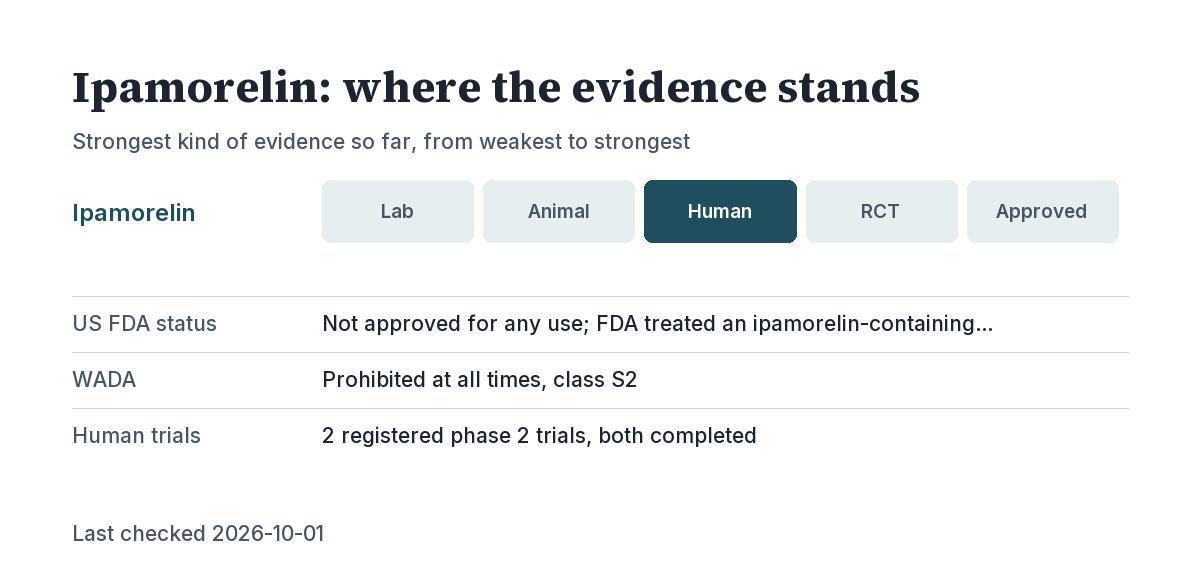
Ipamorelin is a synthetic five-amino-acid peptide (a pentapeptide) that copies the action of ghrelin to make the pituitary gland release growth hormone, developed by Novo Nordisk in the 1990s as the first selective growth hormone secretagogue (Raun et al., 1998). It is not approved by the FDA for any use. Its strongest evidence is human: a dose-ranging study in healthy men showed a clean, short growth hormone pulse (Gobburu et al., 1999), and two phase 2 trials tested it after bowel surgery, where the published one found it well tolerated but no faster recovery than placebo (Beck et al., 2014). FDA lists it as a compounding substance with significant safety risks, and WADA prohibits it at all times.
| Item | Status |
|---|---|
| US FDA status | Not approved for any use; FDA treated an ipamorelin-containing product as an unapproved new drug in an August 2026 warning letter |
| Compounding (503A/503B) | 503B: Category 2 (significant safety risks) since 2023-09-29, still listed on FDA’s page (updated 2026-04-22). FDA also lists it as “nominated but withdrawn”; it is not on the 503A bulks list. No advisory-committee review announced |
| WADA 2026 | Prohibited at all times, class S2 (named under growth hormone secretagogues), non-Specified (WADA Prohibited List) |
| Strongest evidence | Human: growth hormone release (phase 1, healthy men); no benefit over placebo for post-surgical ileus (phase 2 RCT, n=114) |
| Human trials | 2 registered phase 2 trials, both completed: NCT00672074 (published) and NCT01280344 (no results posted); no phase 3 |
| Last checked | 2026-10-01 |
What changed (October 2026): the October 2024 FDA advisory committee vote on ipamorelin (0–12 against compounding listing, from FDA’s minutes) and a dated table of its regulatory events are added, and the sport sections cover the 2027 WADA List.
Key points:
- In pigs, ipamorelin raised growth hormone without raising ACTH or cortisol, even at doses over 200 times the effective dose, which set it apart from GHRP-2 and GHRP-6 (Animal).
- In healthy men its half-life was about 2 hours, and each dose produced a single growth hormone peak at about 40 minutes (Human, phase 1).
- Bone, muscle and gut findings come from rats and other animals; no trial has tested muscle gain, fat loss or anti-ageing effects in people.
- FDA’s compounding page cites serious adverse events, including death, reported when ipamorelin was given intravenously in gut-motility research (FDA).
- Anti-doping laboratories have published urine tests for ipamorelin and its breakdown products (Semenistaya 2015).
| Identity | Detail |
|---|---|
| Sequence | Aib-His-D-2-Nal-D-Phe-Lys-NH2 (5 residues) (Raun 1998) |
| Molecular formula | C38H49N9O5 (PubChem) |
| Molecular weight | 711.9 g/mol |
| CAS number | 170851-70-4 |
| PubChem CID | 9831659 |
| Code name | NNC 26-0161 (Johansen 1998) |
| Half-life | About 2 hours, intravenous, healthy men (Gobburu 1999) |
| Routes studied | Intravenous (humans, animals); subcutaneous (animals); nasal (rats, one human metabolism study) |
| Class | Ghrelin-receptor agonist; growth hormone secretagogue |
What is ipamorelin?
Ipamorelin came out of a Novo Nordisk chemistry programme that derived it from the older growth hormone-releasing peptide GHRP-1 by removing that peptide’s central Ala-Trp pair, leaving five building blocks that include non-natural residues such as Aib and D-2-naphthylalanine (Raun et al., 1998). The company’s researchers then tested it in rats for bone growth and for protecting muscle and bone against steroid damage. Helsinn Therapeutics later sponsored the two registered human trials for postoperative ileus, the temporary stalling of the gut after abdominal surgery (NCT00672074). No phase 3 trial followed, and ipamorelin has not been approved by the FDA. Today it circulates mainly as an unregulated injectable sold with “research use only” labels, a practice FDA rejected in a 2026 warning letter (see what the research use only label means).
How does ipamorelin work?
- Ghrelin-receptor agonist: ipamorelin acts on the growth hormone secretagogue receptor, the receptor for the hunger hormone ghrelin; in antagonist tests it worked through this GHRP-type receptor rather than the GHRH receptor (Lab and Animal; Raun 1998).
- Pulse-like growth hormone release: in healthy men each infusion produced one growth hormone episode peaking at 0.67 hours and falling back to negligible levels, with half-maximal stimulation at a blood level of 214 nmol/L (Human, phase 1; Gobburu 1999).
- Selectivity: in conscious pigs it did not change FSH, LH, prolactin or TSH, and unlike GHRP-2 and GHRP-6 it did not raise ACTH or cortisol (Animal).
- Gut motility: in rats after abdominal surgery it reversed the loss of stomach-muscle contraction, an effect linked to ghrelin receptors on cholinergic nerves (Animal and tissue; Greenwood-Van Meerveld 2012).
- Pancreas: in pancreatic tissue from normal and diabetic rats it increased insulin release through calcium-channel and adrenergic pathways (Lab; Adeghate 2004).
What the research shows
| Claim | Evidence level | Best study and result |
|---|---|---|
| Raises growth hormone in people | Human (phase 1, 8 men per dose level) | Gobburu 1999: GH rose at all 5 dose levels; peak at 0.67 h |
| Releases GH without cortisol | Animal (pigs) | Raun 1998: no ACTH or cortisol rise above GHRH levels |
| Speeds recovery after bowel surgery | Human RCT (n=114): not shown | Beck 2014: first meal 25.3 h vs 32.6 h placebo, p=0.15 |
| Restores gut transit after surgery | Animal (rats) | Venkova 2009: faster first bowel movement |
| Speeds stomach emptying after surgery | Animal (rats) | Greenwood-Van Meerveld 2012: 52% vs 78% of meal left |
| Increases bone growth | Animal (rats) | Johansen 1999: tibial growth 42 to 52 µm/day |
| Increases bone mineral content | Animal (rats, n=7) | Svensson 2000: larger bones; density unchanged |
| Offsets steroid-induced muscle and bone loss | Animal (rats) | Andersen 2001: bone formation 4-fold vs steroid alone |
| Limits steroid-driven protein breakdown | Animal (rats) | Aagaard 2009: urea synthesis 20% lower |
| Reduces body fat | Animal (mice): opposite found | Lall 2001: body fat and food intake rose |
| Limits chemotherapy weight loss | Animal (ferrets) | Lu 2024: about 24% less weight loss; no effect on vomiting |
| Builds muscle, burns fat or slows ageing in people | No human data | No trial has tested these outcomes |
Growth hormone release
The most solid finding is that ipamorelin reliably triggers growth hormone release. In the original Novo Nordisk work it matched GHRP-6 in potency in rat pituitary cells and in anaesthetised rats, and in conscious pigs it released growth hormone without raising ACTH or cortisol even at more than 200 times the effective dose (Animal; Raun 1998). In people, a dose-escalation study gave intravenous infusions to healthy men at five dose levels, eight men per level; drug levels rose in proportion to dose, and every level produced a growth hormone pulse (Human, phase 1; Gobburu 1999). That study measured hormone levels, not any health outcome.
Gut motility and postoperative ileus
Ghrelin speeds the gut, which made ipamorelin a candidate for postoperative ileus. In rats after abdominal surgery, a single intravenous dose shortened the time to the first bowel movement, and repeated dosing over two days increased stool output, food intake and weight gain (Animal; Venkova 2009). A second rat study found faster stomach emptying (Animal; Greenwood-Van Meerveld 2012). The human test did not confirm it: in a double-blind trial of 114 bowel-resection patients, median time to a tolerated solid meal was 25.3 hours on ipamorelin and 32.6 hours on placebo, a difference that was not statistically significant (Human RCT, n=114; Beck 2014).
Bone and muscle
The bone data are consistently positive, but all come from rats. Over 15 days, ipamorelin increased tibial growth rate in a dose-dependent way without changing total IGF-1 (Animal; Johansen 1999). Over 12 weeks it increased bone mineral content, but because bones grew larger rather than denser, volumetric density did not change (Animal; Svensson 2000). In rats given the steroid methylprednisolone for three months, adding ipamorelin increased calf-muscle strength and quadrupled periosteal bone formation compared with the steroid alone (Animal; Andersen 2001). These results are encouraging for steroid-related wasting, a use never tested in people.
Body fat and appetite
Ipamorelin is often described as fat-burning, but the one dedicated study points the other way. In mice it increased fat-pad weight, and secretagogue treatment raised food intake and leptin, by a mechanism independent of growth hormone (Animal; Lall 2001). In ferrets given the chemotherapy drug cisplatin, it reduced weight loss by about 24% in the delayed phase without reducing vomiting (Animal; Lu 2024).
Human studies and trials
Only a handful of human studies of ipamorelin exist, and none tested body composition, ageing, sleep or athletic performance.
| Study | Design and n | Status and result |
|---|---|---|
| Gobburu 1999 | Phase 1 dose escalation; healthy men, 8 per dose level | Published; dose-proportional kinetics, half-life about 2 h, GH pulse at every dose |
| NCT00672074 | Phase 2 RCT, ileus after bowel resection; 117 enrolled | Completed 2009; no significant benefit; well tolerated (Beck 2014) |
| NCT01280344 | Phase 2 dose-finding RCT, GI recovery after bowel resection; 320 enrolled | Completed 2014; no results posted on the registry |
| Semenistaya 2015 | Nasal dose in 1 volunteer, for doping tests | Metabolites traced in urine; not a treatment study |
Both registered trials were sponsored by Helsinn Therapeutics. The larger, 320-patient study (NCT01280344) tested three intravenous dose arms against placebo and finished in May 2014, but its registry entry has no posted results and we found no journal publication of it. An observational study of combat veterans, begun in 2022 and registered in 2026, lists ipamorelin as one ingredient of a hormone-supplementation programme alongside testosterone and other agents, so it cannot isolate ipamorelin’s effect [Human (observational, n=52)] (NCT07717866).
Doses used in studies
| Route and amount | Species | Study |
|---|---|---|
| IV infusion, 4.21 to 140.45 nmol/kg over 15 minutes, single dose | Healthy men | Gobburu 1999 |
| IV infusion, 0.03 mg/kg twice daily for up to 7 days | Adults after bowel surgery | Beck 2014 |
| IV, 0.03 or 0.06 mg/kg arms | Adults after bowel surgery | NCT01280344 |
| SC, 18 to 450 µg/day for 15 days | Rats | Johansen 1999 |
| SC pump, 0.5 mg/kg/day for 12 weeks | Rats | Svensson 2000 |
| IV, 0.01 to 1 mg/kg | Rats | Venkova 2009 |
No established human dose exists outside approved labels. Ipamorelin has no approved label, and the human amounts above were given intravenously in clinical research settings.
Side effects and safety
Reported in trials. In the published phase 2 trial, treatment-emergent adverse events were common in both groups, 87.5% on ipamorelin and 94.8% on placebo, and the authors judged the drug well tolerated over up to 7 days after surgery (Human RCT, n=114; Beck 2014). FDA, reviewing the literature for compounding, states that “a study published in literature identified serious adverse events including death when ipamorelin was administered intravenously for improving gastric motility” (FDA Category 2 list). The trial abstract does not say whether any death was linked to the drug. No long-term human safety data exist (Dominikowski 2026 review).
Signals from animal and lab work. In mice, ipamorelin raised relative body fat (Animal; Lall 2001). After 15 days of treatment in rats, the pituitary’s growth hormone response to a test dose of ipamorelin was marginally reduced, a possible sign of tolerance (Animal; Johansen 1999). In rat pancreatic tissue it stimulated insulin release, so effects on blood sugar control are plausible but untested in people (Lab; Adeghate 2004).
Theoretical risks. Because ipamorelin works by raising growth hormone and, downstream, IGF-1, reviewers flag the class’s possible effects on glucose, fluid retention and cell growth; for the cancer-related concern they find no direct evidence in clinical studies, and the risk remains theoretical (Dominikowski 2026). FDA adds that compounded ipamorelin may trigger immune reactions through aggregation or peptide impurities, and that its unnatural amino acids make the peptide harder to characterise.
Product quality. Products sold outside regulated supply have no verified content. Anti-doping chemists analysing black-market growth products identified Gly-ipamorelin, a modified version with an extra glycine that is not the compound tested in the studies above (Krug 2018). In August 2026 FDA warned an online seller of a “tesamorelin ipamorelin blend” that its research-only labelling did not stop the product being an unapproved new drug (FDA warning letter).
Who it is not for. There is no approved label, so no regulator has defined contraindications. FDA states it lacks sufficient information to know whether ipamorelin would cause harm by other injectable routes, and competitive athletes face an anti-doping violation under WADA’s S2 class.
What users report
What follows are unverified self-reports, mostly from people who bought unregulated products, and they are not evidence that ipamorelin works or is harmless. People who post about ipamorelin on forums, bodybuilding boards and social media most often say it improved their sleep, sometimes with vivid dreams, and that recovery from training felt easier. Some describe better skin or a gradual change in body composition, and many say the sleep effect came early while any physique change, if they saw one, took months. Common complaints include a brief head rush or flushing, headaches, water retention, tingling or numb hands, more hunger than expected, redness at the injection spot and tiredness. A large share report no noticeable effect at all. Recurring arguments concern whether products are underdosed or mislabelled, whether ipamorelin does anything on its own compared with other secretagogues, and whether blood tests showing raised IGF-1 mean anything for health. Cost and the lack of any medical supervision are frequent complaints, and several posters note that a positive change could also come from better sleep habits or training.
Legal and regulatory status
| Jurisdiction | Status | Source |
|---|---|---|
| US FDA | Not approved; ipamorelin product treated as an unapproved new drug (letter dated 2026-08-24) | FDA warning letter |
| US 503B compounding | Category 2 since 2023-09-29; still listed (page updated 2026-04-22) | FDA Category 2 list |
| US 503A compounding | Listed by FDA as nominated but withdrawn; not on the 503A bulks list | FDA 503A page |
| WADA (2026 list) | Prohibited at all times; S2, named as a GH secretagogue | WADA |
FDA placed ipamorelin acetate in Category 2 of its 503B interim policy on 2023-09-29, citing immunogenicity risk, the complexity of its unnatural amino acids and the serious adverse events in intravenous gut-motility research (FDA). Category 2 means FDA identified significant safety risks and would consider enforcement action against compounders who use the substance (FDA 503A policy). FDA’s page also lists ipamorelin acetate under “nominated but withdrawn”, with a note that it still appears in the Category 2 table because of the 503B interim policy; unlike BPC-157, which left Category 2 entirely, ipamorelin remains in Category 2 for 503B outsourcing facilities. A withdrawn nomination is not an approval, and it does not put ipamorelin on the 503A bulks list; the two pathways are explained in 503A vs 503B peptides. Ipamorelin was not among the seven peptides FDA’s Pharmacy Compounding Advisory Committee reviewed on 2026-07-23/24 (FDA meeting page), and FDA has announced no next step for it.
FDA advisory vote, October 2024. FDA’s Pharmacy Compounding Advisory Committee reviewed ipamorelin for growth hormone deficiency and postoperative ileus on 2024-10-29. FDA proposed not adding it to the 503A bulks list, and members voted 0 for inclusion, 12 against and 1 abstention, for the free base and for the acetate alike. The majority cited a lack of information supporting safety and effectiveness for either use (FDA final summary minutes, approved 2025-01-15). The vote is advisory, but it is the committee’s only vote on ipamorelin.
| Date | Regulatory event | Source |
|---|---|---|
| 2023-09-29 | Ipamorelin acetate placed in Category 2 (significant safety risks) for 503B compounding | FDA Category 2 list |
| 2024-10-29 | Advisory committee votes 0–12 (1 abstention) against 503A listing, both forms | FDA minutes |
| 2026-04-22 (page date) | FDA’s page lists a 503A nomination as withdrawn; the 503B Category 2 entry stays | FDA Category 2 list |
| 2027-01-01 | 2027 WADA List in force; USADA’s examples keep ipamorelin under S2 | USADA athlete advisory |
For athletes, the 2026 WADA Prohibited List names ipamorelin under S2 growth hormone secretagogues, prohibited in and out of competition and classed as non-Specified (WADA). Laboratories have validated urine methods that detect ipamorelin and its metabolites (Semenistaya 2015). The 2027 List, in force from 2027-01-01, keeps it prohibited: USADA’s 2027 examples name ipamorelin under S2 (USADA athlete advisory). UK, EU and Australian status are not covered here because we could not verify them on the regulators’ own pages for this entry.
Related peptides
Ipamorelin belongs to the ghrelin-mimetic branch of the growth hormone secretagogues, alongside GHRP-2, GHRP-6 and hexarelin; in the original pig study GHRP-2 and GHRP-6 raised ACTH and cortisol where ipamorelin did not (Raun 1998). The other branch copies GHRH, the hypothalamic releasing hormone: CJC-1295, sermorelin and tesamorelin, all listed with ipamorelin in WADA class S2. For a peptide whose compounding status moved differently in 2026, see BPC-157.
Frequently asked questions
Is ipamorelin FDA approved?
No. Ipamorelin is not approved by the FDA for any condition, and no phase 3 trial has been registered. FDA keeps ipamorelin acetate in Category 2 for 503B compounding because of significant safety risks, and in August 2026 it treated a product containing ipamorelin as an unapproved new drug in a warning letter (FDA).
Is ipamorelin banned in sports?
Yes. The 2026 WADA Prohibited List names ipamorelin in class S2 among growth hormone secretagogues, prohibited both in and out of competition and classed as non-Specified. Anti-doping laboratories have published validated urine methods that identify ipamorelin and its breakdown products, so its use carries a real risk of an anti-doping violation (WADA). The 2027 List keeps it in S2.
Does ipamorelin raise cortisol or increase appetite?
In pigs it did not raise ACTH or cortisol, even at doses over 200 times the effective dose, which is what made it notable among growth hormone-releasing peptides. Appetite is less clear: a mouse study found that ipamorelin increased food intake and body fat through a mechanism separate from growth hormone (Lall 2001).
What are the side effects of ipamorelin?
In the one published trial, adverse events were frequent but no more common than on placebo, 87.5% versus 94.8%, over up to 7 days after surgery. FDA cites serious adverse events, including death, in intravenous gut research, and no long-term human safety data exist. Unregulated products add contamination and mislabelling risk (Beck 2014).
Did ipamorelin work in human trials?
It did what it was designed to do hormonally: healthy men showed a growth hormone pulse at every dose tested. Its only clinical target, faster gut recovery after bowel surgery, was not met; the 114-patient trial found no significant difference from placebo, and the larger follow-up trial never posted results (NCT01280344).
Can compounding pharmacies make ipamorelin?
Not under FDA’s interim policies as they stand. Ipamorelin acetate has been in Category 2 for 503B outsourcing facilities since 2023-09-29, meaning FDA would consider enforcement, and FDA lists a separate nomination as withdrawn, without the peptide being added to the 503A bulks list. An FDA advisory committee voted 0–12 against 503A listing in October 2024 (FDA).
References
- Raun K, Hansen BS, Johansen NL, et al. Ipamorelin, the first selective growth hormone secretagogue. Eur J Endocrinol. 1998;139(5):552-61. PubMed 9849822
- Gobburu JV, Agersø H, Jusko WJ, Ynddal L. Pharmacokinetic-pharmacodynamic modeling of ipamorelin, a growth hormone releasing peptide, in human volunteers. Pharm Res. 1999;16(9):1412-6. PubMed 10496658
- Beck DE, Sweeney WB, McCarter MD; Ipamorelin 201 Study Group. Prospective, randomized, controlled, proof-of-concept study of the ghrelin mimetic ipamorelin for the management of postoperative ileus in bowel resection patients. Int J Colorectal Dis. 2014;29(12):1527-34. PubMed 25331030
- Helsinn Therapeutics. Safety and Efficacy of Ipamorelin for Management of Post-Operative Ileus. ClinicalTrials.gov. NCT00672074
- Helsinn Therapeutics. Safety and Efficacy of Ipamorelin Compared to Placebo for the Recovery of Gastrointestinal Function. ClinicalTrials.gov. NCT01280344
- Axial Therapeutic Research. Trifecta Research Study (observational). ClinicalTrials.gov. NCT07717866
- Johansen PB, Nowak J, Skjaerbaek C, et al. Ipamorelin, a new growth-hormone-releasing peptide, induces longitudinal bone growth in rats. Growth Horm IGF Res. 1999;9(2):106-13. PubMed 10373343
- Svensson J, Lall S, Dickson SL, et al. The GH secretagogues ipamorelin and GH-releasing peptide-6 increase bone mineral content in adult female rats. J Endocrinol. 2000;165(3):569-77. PubMed 10828840
- Andersen NB, Malmlöf K, Johansen PB, et al. The growth hormone secretagogue ipamorelin counteracts glucocorticoid-induced decrease in bone formation of adult rats. Growth Horm IGF Res. 2001;11(5):266-72. PubMed 11735244
- Aagaard NK, Grøfte T, Greisen J, et al. Growth hormone and growth hormone secretagogue effects on nitrogen balance and urea synthesis in steroid treated rats. Growth Horm IGF Res. 2009;19(5):426-31. PubMed 19231263
- Venkova K, Mann W, Nelson R, Greenwood-Van Meerveld B. Efficacy of ipamorelin, a novel ghrelin mimetic, in a rodent model of postoperative ileus. J Pharmacol Exp Ther. 2009;329(3):1110-6. PubMed 19289567
- Greenwood-Van Meerveld B, Tyler K, Mohammadi E, Pietra C. Efficacy of ipamorelin, a ghrelin mimetic, on gastric dysmotility in a rodent model of postoperative ileus. J Exp Pharmacol. 2012;4:149-55. PubMed 27186127
- Lall S, Tung LY, Ohlsson C, et al. Growth hormone (GH)-independent stimulation of adiposity by GH secretagogues. Biochem Biophys Res Commun. 2001;280(1):132-8. PubMed 11162489
- Lu Z, Ngan MP, Liu JYH, et al. The growth hormone secretagogue receptor 1a agonists, anamorelin and ipamorelin, inhibit cisplatin-induced weight loss in ferrets. Physiol Behav. 2024;284:114644. PubMed 39043357
- Adeghate E, Ponery AS. Mechanism of ipamorelin-evoked insulin release from the pancreas of normal and diabetic rats. Neuro Endocrinol Lett. 2004;25(6):403-6. PubMed 15665799
- Johansen PB, Hansen KT, Andersen JV, Johansen NL. Pharmacokinetic evaluation of ipamorelin and other peptidyl growth hormone secretagogues with emphasis on nasal absorption. Xenobiotica. 1998;28(11):1083-92. PubMed 9879640
- Semenistaya E, Zvereva I, Thomas A, et al. Determination of growth hormone releasing peptides metabolites in human urine after nasal administration of GHRP-1, GHRP-2, GHRP-6, Hexarelin, and Ipamorelin. Drug Test Anal. 2015;7(10):919-25. PubMed 25869809
- Krug O, Thomas A, Malerød-Fjeld H, et al. Analysis of new growth promoting black market products. Growth Horm IGF Res. 2018;41:1-6. PubMed 29864719
- Dominikowski A, Rękoś Z, Olejarz M, et al. The emerging landscape of performance-enhancing peptides modulating GH-IGF1 axis. Front Endocrinol. 2026;17:1822475. doi:10.3389/fendo.2026.1822475
- US Food and Drug Administration. Certain bulk drug substances for use in compounding that may present significant safety risks (content current as of 2026-04-22). fda.gov
- US Food and Drug Administration. Bulk drug substances used in compounding under section 503A of the FD&C Act. fda.gov
- US Food and Drug Administration. Warning letter 733652, dated 2026-08-24 (ipamorelin-containing blend). fda.gov
- World Anti-Doping Agency. The 2026 Prohibited List, class S2 (in force 2026-01-01). wada-ama.org
- PubChem. Ipamorelin, CID 9831659. National Library of Medicine. pubchem.ncbi.nlm.nih.gov
- US FDA. Final summary minutes of the Pharmacy Compounding Advisory Committee meeting, October 29, 2024 (approved 2025-01-15). fda.gov
- USADA. Athlete advisory: 2027 Prohibited List (2026-10-06). usada.org
Change log
2026-10-27: October 2024 FDA advisory committee vote added from FDA’s minutes, with a dated table of regulatory events; 2027 WADA List added; own page title; reviewed by the editorial team.
2026-10-24: evidence level and size (observational, 52 participants) added to the veterans study (NCT07717866); reviewed by the editorial team.
2026-10-23: links to glossary definitions added; no change to the facts.
2026-10-19: links to related entries added; no change to the facts.
2026-10-18: veterans study dated correctly: it began in 2022 and was registered in 2026 (NCT07717866); reviewed by the editorial team.
2026-10-12: links to related entries added; no change to the facts.
2026-10-04: first change-log line corrected to state the editorial review; reviewed by the editorial team.
2026-10-01: first published after review by the editorial team; how entries are researched, graded and checked is set out in our editorial policy.