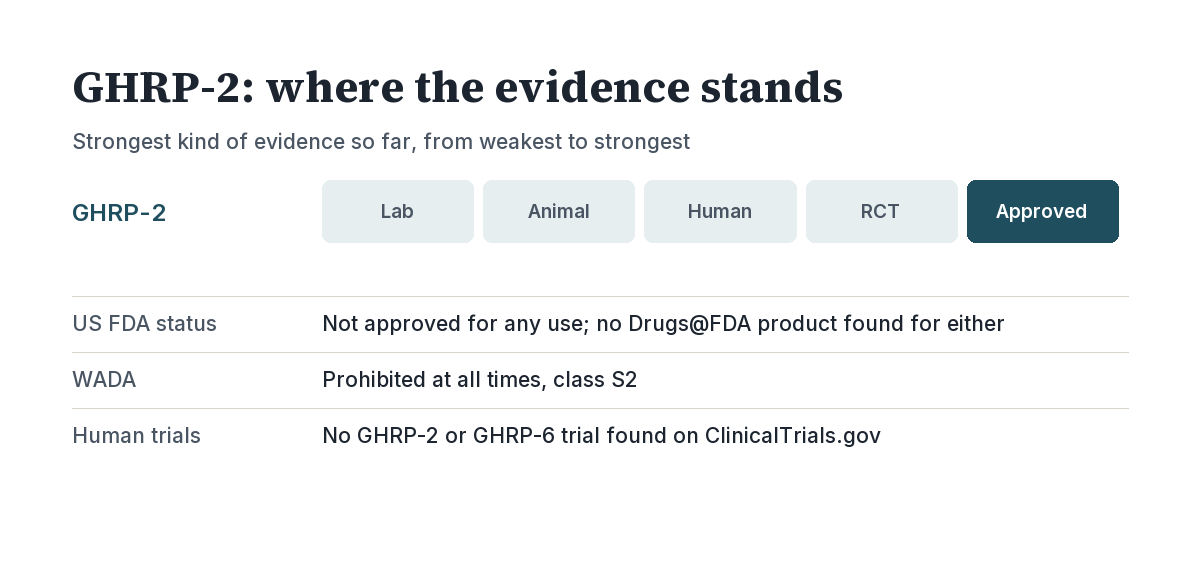
GHRP-2 (pralmorelin) and GHRP-6 are synthetic six-amino-acid growth hormone-releasing peptides that act on the ghrelin receptor. Neither is FDA approved; GHRP-2 is approved in Japan only as a one-time diagnostic test, and both are banned in sport. The strongest evidence comes from small human studies showing that each raises growth hormone within an hour and that GHRP-2 increases appetite. We found no trial of either for muscle gain or fat loss in healthy adults (PubMed and ClinicalTrials.gov, searched 2026-10-10).
| Item | Status |
|---|---|
| US FDA status | Not approved for any use; no Drugs@FDA product found for either (searched 2026-10-10) |
| Compounding (503A/503B) | Both on FDA Category 2 for 503B since 2023-09-29; still listed on the page version dated 2026-04-22; no change announced |
| WADA 2026 | Prohibited at all times, class S2 (GH-releasing peptides); GHRPs also named for the 2027 list, in force 2027-01-01 |
| Outside the US | Japan: GHRP-2 approved as GHRP Kaken 100, a diagnostic for growth hormone deficiency (on sale since February 2005) |
| Strongest evidence | Approved diagnostic label (Japan); human diagnostic studies (GHRP-2, n=135; GHRP-6 with GHRH, n=250) |
| Human trials | No GHRP-2 or GHRP-6 trial found on ClinicalTrials.gov (searched 2026-10-10); one published phase 3 stroke trial of GHRP-6 plus EGF (n=188) |
| Last checked | 2026-10-10 |
Key points:
- GHRP-6 was described in 1984 (Bowers 1984), 12 years before its receptor was cloned (Howard 1996) and 15 years before ghrelin, the body’s own hormone for that receptor, was found (Kojima 1999).
- Both peptides also raise cortisol in people, and FDA lists effects on cortisol and blood sugar among its safety concerns (Arvat 1997; Frieboes 1995).
- In a 2026 phase 3 stroke trial, GHRP-6 combined with epidermal growth factor missed its main goal but showed a signal in a small severe-stroke subgroup (Hernández-Bernal 2026).
- Anti-doping chemists have found GHRP-2 in tablets sold as a supplement (Thomas 2010) and altered “Gly-” versions of both peptides in seized products (Gajda 2019).
| Property | GHRP-2 | GHRP-6 |
|---|---|
| Other names | Pralmorelin, KP-102 | growth hormone-releasing hexapeptide |
| Sequence | D-Ala-D-2-Nal-Ala-Trp-D-Phe-Lys-NH2 | His-D-Trp-Ala-Trp-D-Phe-Lys-NH2 |
| Formula | C45H55N9O6 | C46H56N12O6 |
| Molecular weight | 818.0 | 873.0 g/mol |
| CAS | 158861-67-7 (GHRP-2) |
| PubChem CID | 6918245 | 4345065 |
| Half-life | GHRP-6: about 2.5 h after an IV dose (n=9) |
| Routes studied | Intravenous, subcutaneous, intranasal, oral (Ghigo 1997) |
| Class | Growth hormone secretagogue (ghrelin receptor agonist) |
What are GHRP-2 and GHRP-6?
GHRP-6 came first. In 1984 Cyril Bowers and colleagues reported a “new synthetic hexapeptide”, His-D-Trp-Ala-Trp-D-Phe-Lys-NH2, that released growth hormone (GH) “without concomitant release of LH, FSH, TSH, or PRL” in lab and animal tests (Bowers 1984; Momany 1984). GHRP-2 is a later, modified hexapeptide from a series developed by Polygen in Germany and Tulane University in the US; Kaken acquired the rights and developed it in Japan as KP-102 under the name pralmorelin (Drugs R D 2004). Its injectable form, Kaken Pharmaceutical’s GHRP Kaken 100, has been sold in Japan since February 2005 to diagnose GH deficiency (PMDA). We found no approval anywhere for GHRP-6 as of 2026-10-10.
How do GHRP-2 and GHRP-6 work?
- Ghrelin receptor: both act on the growth hormone secretagogue receptor, a G protein-coupled receptor in the pituitary and hypothalamus that was cloned in 1996 and shown to be the target of these drugs [Lab] (Howard 1996). Its natural ligand, ghrelin, is a 28-amino-acid stomach hormone identified in 1999 [Lab] (Kojima 1999).
- GH pulse: a single intravenous dose of GHRP-2 drives peak GH within 60 minutes in adults [Human, n=135] (Chihara 2007).
- Synergy with GHRH: given with growth hormone-releasing hormone (GHRH), GHRP-6 produced mean GH peaks of 59.2 µg/L in healthy adults [Human, n=250] (Popovic 2000); in critical illness, GHRH plus GHRP-2 raised IGF-1 by a further 40% (P=0.04) [Human, n=26] (Van den Berghe 1997).
- Other pituitary hormones: in people, the ACTH/cortisol-releasing activity of GHRP-2 was “similar to that of hCRH” [Human, n=6] (Arvat 1997); in pigs, both GHRP-2 and GHRP-6 raised ACTH and cortisol while ipamorelin did not [Animal] (Raun 1998).
- Appetite: like ghrelin, GHRP-2 increased how much healthy men ate at a meal [Human, saline-controlled, n=7] (Laferrère 2005).
What the research shows
Research on these two peptides runs from 1984 to 2026. Most of it measures hormone responses over hours rather than health outcomes over months, and it was done in patients or volunteers under medical supervision.
| Claim | Evidence level | Best study and result |
|---|---|---|
| GHRP-2 identifies GH deficiency | Approved label (Japan); Human (n=135) | Chihara 2007: peak GH 1.36 vs 84.6 µg/l, P<0.001 |
| GHRP-6 with GHRH identifies GH deficiency | Human (n=250) | Popovic 2000: peaks 4.1 vs 59.2 µg/L, p<0.001 |
| Raises IGF-1 in critical illness | Human (n=26) | Van den Berghe 1997: +61% in 24 h, P=0.02 |
| Shifts metabolism toward anabolism in critical illness (with TRH) | Human, placebo-controlled (n=14) | Van den Berghe 1999: osteocalcin +19% vs −6% |
| Increases food intake | Human, saline-controlled (n=7; n=19) | Laferrère 2005: 35.9% more eaten, p=0.008 |
| Speeds growth in GH-deficient children | Human (n=6, uncontrolled) | Mericq 1998: growth velocity higher; IGF-1 did not rise |
| Raises IGF-1 in men on testosterone | Human observational (n=14) | Sigalos 2017: 159.5 to 239.0 ng/mL, p<.0001 |
| Improves stroke recovery (GHRP-6 + EGF) | Human RCT, open-label (n=188) | Hernández-Bernal 2026: no overall difference |
| Protects the heart after infarction | Animal (pigs) | Berlanga 2007: infarct mass −78%, P<0.01 |
| Builds muscle or cuts fat in healthy adults | No trial found | PubMed and ClinicalTrials.gov searched 2026-10-10 |
Diagnosing growth hormone deficiency
This is the best-established use. In the Japanese KP-102 study, 58 adults with GH deficiency reached a mean peak of 1.36 µg/l after 100 µg of intravenous GHRP-2, against 84.6 µg/l in 77 healthy people, and the test showed “favourable reproducibility” (Chihara 2007). The authors present it as a safer alternative to the insulin tolerance test. A GHRP-2 test has also been studied for secondary adrenal failure, where a cortisol cut-off gave 89.7% sensitivity and 88.9% specificity (Arimura 2016). For GHRP-6, a Lancet study of 250 adults found that the GHRH plus GHRP-6 test separated patients from controls, and the GH peaks “did not result in any side-effects” (Popovic 2000).
Critical illness
Intensive-care studies tested GHRP-2 infusions in patients whose GH secretion is blunted during prolonged illness. In a study of 26 critically ill patients, GHRP-2 infusion raised IGF-1 by 61% within 24 hours without changing cortisol (Van den Berghe 1997). Combined with thyrotropin-releasing hormone (TRH) for five days, it restored pulsatile GH and TSH and produced “a shift toward anabolic metabolism” against placebo in 14 patients (Van den Berghe 1999). These were short mechanistic studies, not outcome trials, and FDA’s safety summary for GHRP-2 lists “death of critically ill study subjects” among reported events (FDA).
Appetite and body weight
GHRP-2 reproduces ghrelin’s hunger signal. In a study of 7 lean men, GHRP-2 led them to eat 35.9% more at a buffet meal than on saline (Laferrère 2005); a follow-up in 19 lean and obese adults found dose-related rises of 10.2% and 33.5% (Laferrère 2006). In 10 children taking GHRP-2 by mouth for 12 months, 7 reported a marked increase in appetite, but the change in BMI did not reach statistical significance (Mericq 2003). We found no comparable controlled human appetite study for GHRP-6 (PubMed, searched 2026-10-10).
Growth, muscle and body composition
In 6 GH-deficient children, eight months of daily GHRP-2 raised overnight GH and growth velocity, yet IGF-1 and IGFBP-3 did not rise, and the authors concluded that longer-acting forms would be needed (Mericq 1998). The only adult data close to the uses people search for come from a retrospective chart review: 14 men on testosterone who were prescribed GHRP-2, GHRP-6 and sermorelin saw IGF-1 rise from 159.5 to 239.0 ng/mL (Sigalos 2017). That study had no control group and did not report muscle or strength outcomes.
Tissue protection
GHRP-6 has also been studied for organ protection. In pigs with an induced heart attack, GHRP-6 reduced infarct mass by 78% and infarct thickness by 50% compared with saline (Berlanga 2007). In people, the closest test is the COURAGE-2 stroke trial described below.
Human studies and trials
A ClinicalTrials.gov search on 2026-10-10 for GHRP-2, GHRP-6 and pralmorelin returned no registered trial; a broader “GHRP” search returned no record testing either peptide. The human evidence sits in published studies instead, most from the 1990s and 2000s.
| Study | Design and n | Result |
|---|---|---|
| COURAGE-2, 2026 (GHRP-6 + EGF, stroke) | Phase 3, randomized, open-label; n=188 | No overall difference; severe-stroke subgroup (n=27) mRS 2.6 vs 4.7, p=0.03 |
| Chihara 2007 (GHRP-2) | Diagnostic study; n=135 | Cut-off of 15 µg/l proposed |
| Popovic 2000 (GHRP-6 + GHRH) | Diagnostic study; n=250 | Peaks 59.2 vs 4.1 µg/L; no side effects |
| Van den Berghe 1999 (GHRP-2 + TRH) | Placebo-controlled; n=14 | GH and TSH pulses restored; anabolic markers up |
| Laferrère 2005 (GHRP-2) | Saline-controlled; n=7 | Food intake +35.9% |
| Cabrales 2013 (GHRP-6) | Pharmacokinetics; n=9 | Elimination half-life 2.5 h; exposure rose with dose |
| Pihoker 1998 (GHRP-2) | Phase 1, children; n=10 | Predictable GH rise after one IV dose |
| Frieboes 1995 (GHRP-6) | Placebo-controlled sleep study | GH, cortisol and stage 2 sleep up, p<0.02 |
The 2026 COURAGE-2 trial is the largest and most recent: 95 patients with acute ischemic stroke received epidermal growth factor plus GHRP-6 for 7 days and 93 served as controls. In the full population, “no differences were found” in disability or survival. Among 27 patients with severe strokes, the treated group had less disability at six months and a lower risk of death (HR 0.18, p=0.045), a subgroup signal that a further trial would need to confirm (Hernández-Bernal 2026).
Doses used in studies
| Route | amount | Species | Study |
|---|---|---|
| IV | GHRP-2 100 µg, single test dose | Human adults | Chihara 2007; Japanese label |
| IV | GHRP-2 1 µg/kg, single | Human children | Pihoker 1998 |
| SC infusion | GHRP-2 0.1–1 µg/kg/h | Human adults | Laferrère 2006 |
| Oral | GHRP-2 900 µg/kg | Human children | Mericq 2003 |
| IV | GHRP-6 1 µg/kg with GHRH | Human adults | Popovic 2000 |
| IV | GHRP-6 100–400 µg/kg, single | Human adults | Cabrales 2013 |
| Oral | GHRP-6 300 µg/kg | Human children | Bellone 1995 |
| GHRP-6 400 µg/kg | Pigs | Berlanga 2007 |
No established human dose exists outside approved labels. The only label is Japan’s, for a single intravenous diagnostic test given in a medical setting (PMDA). The oral studies show that both peptides act when swallowed, but per kilogram the oral amounts were hundreds of times the single intravenous test amounts listed above [Human] (Mericq 2003; Bellone 1995).
Side effects and safety
Reported in people. The Japanese GHRP-2 label lists a sensation of heat in 16.0% of patients and, less often, low blood pressure, raised ALT (a liver enzyme), nausea, dizziness, sweating, thirst, headache, facial flushing, hunger and fatigue [Approved label] (PMDA). Hunger is an expected effect: GHRP-2 raised food intake by about a third in healthy men [Human, saline-controlled, n=7] (Laferrère 2005). GHRP-6 raised cortisol to 56.0 versus 25.2 ng/ml on placebo [Human, placebo-controlled] (Frieboes 1995), and GHRP-2 releases ACTH and cortisol on a par with corticotropin-releasing hormone [Human, n=6] (Arvat 1997). In COURAGE-2, 30 of 95 treated stroke patients had serious adverse events, none judged treatment-related [Human RCT, n=188] (Hernández-Bernal 2026).
FDA’s concerns. When FDA placed both peptides in Category 2, it cited a risk of immune reactions (immunogenicity) from aggregation and peptide-related impurities. For GHRP-2 it noted reports of “increased insulin requirement to maintain the blood glucose level, death of critically ill study subjects, infection and pancreatitis”; for GHRP-6, “potential effect on cortisol and increase in blood glucose due to decreases in insulin sensitivity” (FDA).
Unknowns. We found no study that followed users of either peptide for years (PubMed, searched 2026-10-10), so long-term effects on blood sugar, the pituitary or cancer risk are unknown. Our overview of cancer evidence for growth hormone peptides sets out what the GH and IGF-1 research does and does not show.
Product quality. GHRP-2 has been found in tablets sold as an over-the-counter nutritional supplement, at about 50 µg per tablet (Thomas 2010). Anti-doping chemists have also found glycine-modified versions of GHRP-2, GHRP-6 and ipamorelin in seized and black-market products (Gajda 2019; Krug 2018). USADA notes that “it is illegal to sell peptide hormones in dietary supplements” and that many websites sell them as “research chemicals” (USADA).
Who should not use it. The Japanese label contraindicates GHRP-2 in pregnant women and women who may be pregnant. We found no regulator’s label for GHRP-6 as of 2026-10-10.
Legal and regulatory status
| Jurisdiction | Status (checked 2026-10-10) |
|---|---|
| US FDA | Not approved; no product in Drugs@FDA |
| US compounding | Category 2 (503B) since 2023-09-29; still listed on the 2026-04-22 page version |
| WADA | Prohibited at all times, S2; named on the 2026 list; GHRPs named for 2027 |
| Japan | GHRP-2 approved for diagnosis only (PMDA); GHRP-6 not approved |
In the US, Category 2 covers bulk substances that FDA says “may present significant safety risks” in compounding. GHRP-2, GHRP-6 and ipamorelin all remain on that list in the page version dated 2026-04-22 (FDA). Our explainer on what FDA’s Category 1 and Category 2 compounding lists mean covers the practical effect.
In sport, the WADA Prohibited List names GHRP-2 (pralmorelin) and GHRP-6 among the GH-releasing peptides banned in and out of competition. For the 2027 list, in force from 1 January 2027, USADA says “‘peptides’ in general are now named as prohibited substances in the S0 class” and lists GHRPs among them (USADA 2027 advisory). Our page on which peptides WADA bans in 2027 covers the other classes.
We could not verify UK, EU, Canadian or Australian status from a regulator’s own page on 2026-10-10, so those rows are omitted.
Related peptides
- Sermorelin: a GHRH analogue, prescribed alongside GHRP-2 and GHRP-6 in the Sigalos chart review.
- CJC-1295: another GHRH analogue, often discussed with the GHRPs.
- Tesamorelin: a GHRH analogue with its own entry, including its FDA status.
What users report
What follows is unverified self-reporting by people who usually bought unregulated products; it is not evidence. People who post about GHRP-2 and GHRP-6 on forums, Reddit and bodybuilding boards most often describe strong hunger soon after use, especially with GHRP-6, and many say that is why they chose it or avoided it. Common reports include deeper sleep, fuller-looking muscles, water retention, tingling or numb hands and a warm flush. Some say they noticed changes within a few weeks; others report no effect at all. Recurring complaints are hunger that works against fat-loss goals, lethargy, sore or itchy skin where the product went in, and doubts about whether a product contained what its label said. The most frequent arguments are about which of the two causes less hunger, whether either adds anything over ipamorelin, and whether a higher IGF-1 blood test proves a product works. None of these reports has been tested in a controlled study.
Frequently asked questions
What is the difference between GHRP-2 and GHRP-6?
They are related six-amino-acid peptides acting on the same ghrelin receptor. GHRP-6 is the original 1984 compound; GHRP-2 (pralmorelin) is a later analogue that Japan approved as a diagnostic test for GH deficiency. Both raise GH and cortisol in people, and both are FDA Category 2 compounding substances (FDA). We found no head-to-head outcome trial as of 2026-10-10.
Do GHRP-2 and GHRP-6 increase appetite?
GHRP-2 does in controlled human studies. It mirrors the hunger hormone ghrelin, as the appetite section above details (Laferrère 2005). GHRP-6 acts on the same receptor, but we found no comparable controlled human appetite study for it as of 2026-10-10.
Are there GHRP-2 and GHRP-6 pills?
Both were tested by mouth in research: oral GHRP-6 raised GH in children with short stature, at amounts far above intravenous ones (Bellone 1995). No oral product is approved anywhere we checked. Anti-doping chemists have found GHRP-2 in tablets sold as a nutritional supplement, a sale USADA calls illegal for peptide hormones (Thomas 2010).
What are the side effects of GHRP-2 and GHRP-6?
Japan’s GHRP-2 label lists a heat sensation in 16.0% of patients, plus flushing, nausea, dizziness, headache and hunger (PMDA). Both peptides raise cortisol, and FDA cites blood-sugar effects, immunogenicity and, for GHRP-2, deaths and pancreatitis reported in studies. Long-term safety in healthy people has not been studied in any trial we found.
Are GHRP-2 and GHRP-6 banned in sport?
Yes. Both are on the WADA Prohibited List under S2 as GH-releasing peptides, banned in and out of competition at all times. GHRPs remain prohibited on the 2027 list, in force from 1 January 2027, when USADA says “peptides” in general are also named in the S0 class (USADA).
References
- US Food and Drug Administration. Certain bulk drug substances for use in compounding that may present significant safety risks (Category 2). Content current as of 2026-04-22. fda.gov
- Pharmaceuticals and Medical Devices Agency (Japan). GHRP KAKEN 100 for injection (pralmorelin hydrochloride), package insert, revised July 2025. pmda.go.jp
- World Anti-Doping Agency. The Prohibited List. wada-ama.org
- USADA. Athlete Advisory: What’s new on the 2027 WADA Prohibited List. usada.org
- USADA. 6 things to know about peptide hormones and releasing factors. usada.org
- ClinicalTrials.gov searches for GHRP-2 and GHRP-6, 2026-10-10. GHRP-2; GHRP-6
- PubChem. Pralmorelin, CID 6918245; GHRP-6, CID 4345065. CID 6918245; CID 4345065
- Bowers CY, Momany FA, Reynolds GA, Hong A. On the in vitro and in vivo activity of a new synthetic hexapeptide that acts on the pituitary to specifically release growth hormone. Endocrinology. 1984;114(5):1537-45. PubMed
- Momany FA, Bowers CY, Reynolds GA, et al. Conformational energy studies and in vitro and in vivo activity data on growth hormone-releasing peptides. Endocrinology. 1984;114(5):1531-6. PubMed
- Pralmorelin: GHRP 2, GPA 748, growth hormone-releasing peptide 2, KP-102. Drugs R D. 2004;5(4):236-9. PubMed
- Howard AD, Feighner SD, Cully DF, et al. A receptor in pituitary and hypothalamus that functions in growth hormone release. Science. 1996;273(5277):974-7. PubMed
- Kojima M, Hosoda H, Date Y, et al. Ghrelin is a growth-hormone-releasing acylated peptide from stomach. Nature. 1999;402(6762):656-60. PubMed
- Ghigo E, et al. Growth hormone-releasing peptides. Eur J Endocrinol. 1997;136(5):445-60. PubMed
- Chihara K, Shimatsu A, Hizuka N, et al. A simple diagnostic test using GH-releasing peptide-2 in adult GH deficiency. Eur J Endocrinol. 2007;157(1):19-27. PubMed
- Popovic V, Leal A, Micic D, et al. GH-releasing hormone and GH-releasing peptide-6 for diagnostic testing in GH-deficient adults. Lancet. 2000;356(9236):1137-42. PubMed
- Arimura H, et al. Investigation of the clinical significance of the growth hormone-releasing peptide-2 test for the diagnosis of secondary adrenal failure. Endocr J. 2016;63(6):533-44. PubMed
- Van den Berghe G, de Zegher F, Veldhuis JD, et al. The somatotropic axis in critical illness: effect of continuous GHRH and GHRP-2 infusion. J Clin Endocrinol Metab. 1997;82(2):590-9. PubMed
- Van den Berghe G, Wouters P, Weekers F, et al. Reactivation of pituitary hormone release and metabolic improvement by infusion of GHRP and TRH in patients with protracted critical illness. J Clin Endocrinol Metab. 1999;84(4):1311-23. PubMed
- Laferrère B, Abraham C, Russell CD, Bowers CY. Growth hormone releasing peptide-2 (GHRP-2), like ghrelin, increases food intake in healthy men. J Clin Endocrinol Metab. 2005;90(2):611-4. PubMed
- Laferrère B, Hart AB, Bowers CY. Obese subjects respond to the stimulatory effect of the ghrelin agonist GHRP-2 on food intake. Obesity. 2006;14(6):1056-63. PubMed
- Mericq V, Cassorla F, Bowers CY, et al. Changes in appetite and body weight in response to long-term oral administration of the ghrelin agonist GHRP-2 in GH deficient children. J Pediatr Endocrinol Metab. 2003;16(7):981-5. PubMed
- Mericq V, Cassorla F, Salazar T, et al. Effects of eight months treatment with graded doses of a GH-releasing peptide in GH-deficient children. J Clin Endocrinol Metab. 1998;83(7):2355-60. PubMed
- Sigalos JT, et al. Growth hormone secretagogue treatment in hypogonadal men raises serum insulin-like growth factor-1 levels. Am J Mens Health. 2017;11(6):1752-7. PubMed
- Hernández-Bernal F, Subirós-Martínez N, et al. Phase III open-label, randomized clinical trial of epidermal growth factor and growth hormone releasing hexapeptide in acute ischemic stroke. J Clin Neurosci. 2026;152:112195. PubMed
- Berlanga J, et al. Growth-hormone-releasing peptide 6 (GHRP6) prevents oxidant cytotoxicity and reduces myocardial necrosis in a model of acute myocardial infarction. Clin Sci. 2007;112(4):241-50. PubMed
- Cabrales A, Gil J, Fernández E, et al. Pharmacokinetic study of growth hormone-releasing peptide 6 (GHRP-6) in nine male healthy volunteers. Eur J Pharm Sci. 2013;48(1-2):40-6. PubMed
- Pihoker C, Kearns GL, French D, Bowers CY. Pharmacokinetics and pharmacodynamics of growth hormone-releasing peptide-2: a phase I study in children. J Clin Endocrinol Metab. 1998;83(4):1168-72. PubMed
- Frieboes RM, Murck H, Maier P, et al. Growth hormone-releasing peptide-6 stimulates sleep, growth hormone, ACTH and cortisol release in normal man. Neuroendocrinology. 1995;61(5):584-9. PubMed
- Arvat E, et al. Effects of GHRP-2 and hexarelin, two synthetic GH-releasing peptides, on GH, prolactin, ACTH and cortisol levels in man. Peptides. 1997;18(6):885-91. PubMed
- Raun K, et al. Ipamorelin, the first selective growth hormone secretagogue. Eur J Endocrinol. 1998;139(5):552-61. PubMed
- Bellone J, Ghizzoni L, Aimaretti G, et al. Growth hormone-releasing effect of oral GHRP-6 administration in children with short stature. Eur J Endocrinol. 1995;133(4):425-9. PubMed
- Thomas A, et al. Identification of the growth-hormone-releasing peptide-2 (GHRP-2) in a nutritional supplement. Drug Test Anal. 2010;2(3):144-8. PubMed
- Gajda PM, et al. Glycine-modified growth hormone secretagogues identified in seized doping material. Drug Test Anal. 2019;11(2):350-4. PubMed
- Krug O, et al. Analysis of new growth promoting black market products. Growth Horm IGF Res. 2018;41:1-6. PubMed
Change log
2026-10-23: links to glossary definitions added; no change to the facts.
2026-10-18: GHRP-2 origin corrected (Polygen and Tulane University, licensed to Kaken); oral-amount comparison now cites both oral studies; reviewed by the editorial team.
2026-10-13: headline shortened on 2026-10-12 (now “GHRP-2 and GHRP-6: benefits, evidence and legal status”); no change to the facts.
2026-10-10: first published after review by the editorial team.