SS-31 (elamipretide) is a synthetic four-amino-acid peptide that binds cardiolipin in the inner mitochondrial membrane; the FDA granted it accelerated approval as Forzinity on September 19, 2025, for Barth syndrome only.
That approval is narrow. The label covers muscle strength in patients with Barth syndrome who weigh at least 30 kg, and it rests on a secondary endpoint seen in an open-label extension of a 12-patient trial whose randomized phase missed both primary endpoints (Forzinity label). For every other use, including the “SS-31” sold online for energy, ageing or recovery, elamipretide is unapproved, and its largest published trials outside Barth syndrome were negative.
| Item | Status |
|---|---|
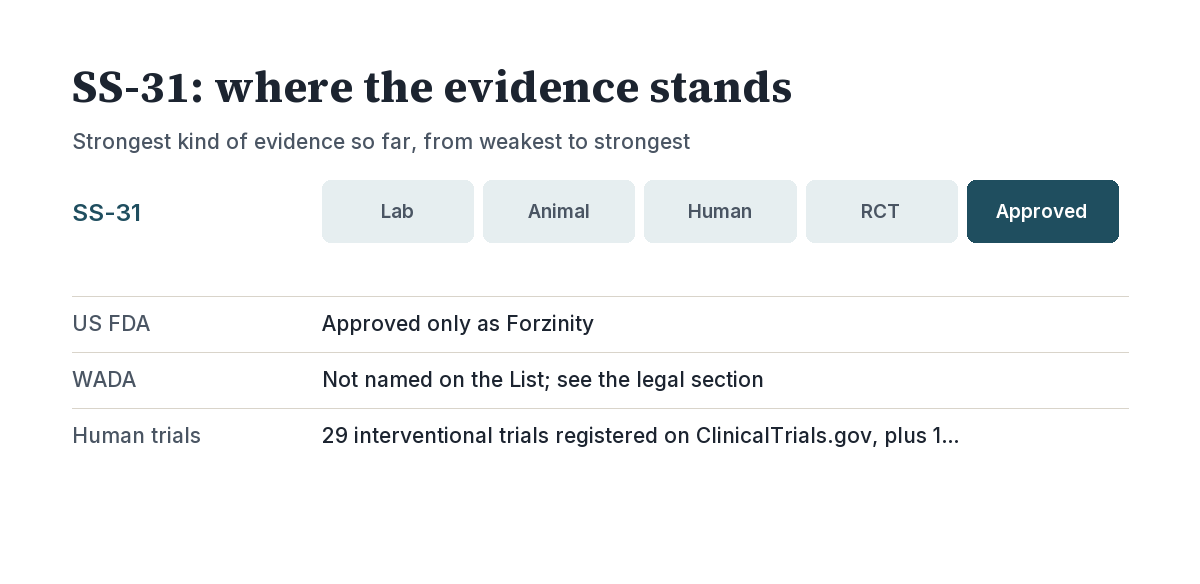
| US FDA | Approved only as Forzinity (NDA 215244), accelerated approval 2025-09-19, to improve muscle strength in Barth syndrome, patients ≥30 kg (Drugs@FDA); unapproved for any other use |
| Research-use “SS-31” | Named by FDA as an unapproved new drug in an August 24, 2026 warning letter to an online seller (FDA warning letter) |
| Compounding (503A/503B) | Not on FDA’s Category 2 list; no FDA statement specific to compounded elamipretide found (see the legal section) |
| WADA 2026 | Not named on the List; see the legal section (WADA 2026 List) |
| EU | Orphan designation for Barth syndrome (2021); designation is not a marketing authorisation (EMA) |
| Strongest evidence | Approved label (Barth syndrome); Human RCTs (n=12 to 300), mostly negative on primary endpoints |
| Human trials | 29 interventional trials registered on ClinicalTrials.gov, plus 1 expanded-access program, e.g. NCT03098797, NCT03323749 |
| Last checked | 2026-10-03 |
Key points:
- In the randomized phase of the Barth syndrome trial, the 6-minute walk was 443.1 m on elamipretide and 443.9 m on placebo at week 12 (TAZPOWER results).
- In its October 2024 briefing, before approval, FDA staff wrote that the evidence did not establish effectiveness in Barth syndrome (FDA briefing).
- The phase 3 trial in primary mitochondrial myopathy (n=218) missed both primary endpoints (Karaa 2023).
- FDA requires a confirmatory randomized trial, scheduled for completion in September 2029 (approval letter).
- Every patient on elamipretide in the Barth trial had an injection-site reaction, and the label warns of serious allergic reactions.
| Identity | Value |
|---|---|
| Sequence | D-Arg-2,6-dimethyl-Tyr-Lys-Phe-NH2 (4 amino acids; D-arginine, the rest L) |
| Molecular formula | C32H49N9O5 (free base); hydrochloride salt C32H49N9O5·3HCl |
| Molecular weight | 639.8 g/mol (free base); 749.2 (salt) |
| CAS | 736992-21-5 |
| PubChem CID | 11764719 |
| Other names | SS-31, MTP-131, Bendavia, Forzinity (brand) |
| Half-life | About 3 to 4 hours in plasma (FDA briefing) |
| Routes studied | Subcutaneous (approved), intravenous, oral, eye drops |
| Class | Mitochondrial cardiolipin binder (Szeto-Schiller peptide) |
What is SS-31 (elamipretide)?
SS-31 is one of the Szeto-Schiller (SS) peptides, short peptides built from alternating aromatic and basic amino acids with a dimethyltyrosine; in lab work these peptides crossed cell membranes and concentrated about 1,000-fold in the inner mitochondrial membrane [Lab] (Zhao 2004). Stealth BioTherapeutics developed it under the codes MTP-131 and Bendavia before it received the name elamipretide (PubChem). It was tested in heart attack, heart failure, kidney disease, eye disease and mitochondrial myopathy before its approval in Barth syndrome, a rare X-linked disease caused by defects in the TAFAZZIN gene that disturb cardiolipin; FDA estimated about 130 affected people in the US (FDA briefing).
How does SS-31 work?
Cardiolipin is a fat (phospholipid) found almost only in the inner membrane of mitochondria, where it shapes the folds (cristae) that hold the energy-producing machinery.
- Cardiolipin binding: SS-31 bound cardiolipin with high affinity in lab tests [Lab] (Birk 2013); the label describes the drug as a cardiolipin binder that localizes to the inner mitochondrial membrane [Approved label] (Forzinity label).
- Cytochrome c peroxidase block: by binding cardiolipin, SS-31 stops cytochrome c from acting as a peroxidase that damages cardiolipin, while leaving its electron-carrying role intact [Lab] (Szeto 2014).
- Cristae protection after ischemia: in rats, pretreatment protected cristae during kidney ischemia, sped ATP recovery and reduced kidney dysfunction [Animal] (Birk 2013).
- Reactive oxygen species: SS peptides reduced mitochondrial oxidant production and cell death in cultured cells and improved contractile force in an isolated heart model [Lab] (Zhao 2004).
- Muscle energetics in people: a single infusion raised maximal ATP production in older adults’ hand muscle right after dosing, with no difference by day 7 [Human RCT, n=39] (Roshanravan 2021).
What the research shows
The table grades each common claim by the strongest evidence behind it, following the site’s editorial policy and methodology. A pattern runs through it: small or early trials reported signals, and the larger controlled trials did not confirm them.
| Claim | Evidence level | Best study and result |
|---|---|---|
| Improves muscle strength in Barth syndrome | Approved label (accelerated) | Forzinity label: no gain in the 12-week randomized phase; median +63 N at week 168 open-label (n=8) |
| Improves walking and fatigue in Barth syndrome | Human RCT (n=12), negative | Reid Thompson 2021: neither primary endpoint met |
| Long-term benefit in Barth syndrome | Human, open-label (n=8–10) | Thompson 2024: 6-minute walk +96.1 m at week 168, uncontrolled |
| Improves primary mitochondrial myopathy | Human RCT (n=218), negative | Karaa 2023: walk difference −3.2 m, p=0.69 |
| Limits heart-attack damage | Human RCT (n=300), negative | Gibson 2016: no reduction in infarct size |
| Improves heart failure | Human RCT (n=71), negative | Butler 2020: no change in heart volume at 4 weeks |
| Slows dry macular degeneration | Human RCT (n=176), primary endpoints not met | Ehlers 2025: 43% slower ellipsoid-zone loss, nominal |
| Protects kidneys during stenting | Human RCT pilot (n=14) | Saad 2017: less hypoxia, higher renal blood flow |
| Raises muscle energy in older adults | Human RCT (n=39) | Roshanravan 2021: brief ATP rise, no fatigue benefit |
| Protects mitochondria under stress | Lab and Animal | Birk 2013, rats: cristae preserved after kidney ischemia |
Barth syndrome
TAZPOWER randomized 12 patients to 12 weeks of elamipretide and 12 weeks of placebo; neither the 6-minute walk nor the fatigue score improved [Human RCT, n=12] (Reid Thompson 2021). FDA put the p-values at 0.97 and 0.89 and refused to file the first application in 2021 because it lacked a single adequate, well-controlled trial (FDA briefing). In the open-label extension, walking distance rose by 96.1 m at week 168 in the 8 patients who stayed [Human, open-label, n=8] (Thompson 2024), and a comparison of those 8 patients with 19 untreated patients from a natural-history study favored the drug [Human, external comparison, not randomized] (Hornby 2022). The approval rests on knee-extensor strength, which FDA treats as reasonably likely, not proven, to predict benefit (FDA press release).
Primary mitochondrial myopathy
A 5-day intravenous trial reported a dose-related gain in walking distance (64.5 m vs 20.4 m, p=0.053) [Human RCT, n=36] (Karaa 2018), and a 4-week crossover found a 19.8 m difference that was not significant [Human RCT, n=30] (Karaa 2020). The 24-week phase 3 MMPOWER-3 found no effect on walking or fatigue [Human RCT, n=218] (Karaa 2023). A post hoc analysis pointed to a possible signal in patients with mtDNA-maintenance (replisome) variants, which led to the NuPower trial [Human, post hoc] (Karaa 2024).
Heart and kidney
A single high-dose infusion reduced left-ventricular volumes in heart failure (−18 mL end-diastolic, P=0.009) [Human RCT, n=36] (Daubert 2017), but four weeks of daily injections in PROGRESS-HF did not change end-systolic volume or ejection fraction [Human RCT, n=71] (Butler 2020). In EMBRACE STEMI, a 1-hour infusion during angioplasty for heart attack did not reduce infarct size (Gibson 2016). In a kidney-artery stenting pilot, hypoxia rose 47% with placebo and fell 6% with elamipretide [Human RCT, n=14] (Saad 2017).
Eye disease
In ReCLAIM-2, 48 weeks of daily injections missed both primary endpoints in dry age-related macular degeneration but showed nominally slower loss of the photoreceptor layer [Human RCT, n=176] (Ehlers 2025); that measure is the primary endpoint of the phase 3 ReNEW trial. Eye drops in Leber hereditary optic neuropathy did not improve visual acuity [Human RCT, n=12] (Karanjia 2024).
Human studies and trials
A ClinicalTrials.gov search on October 3, 2026 (elamipretide, SS-31, MTP-131, Bendavia) returned 29 interventional elamipretide trials and one expanded-access program (NCT04689360). The main ones:
| Trial | Design and n | Status and result |
|---|---|---|
| NCT03098797 TAZPOWER, Barth | Phase 2/3 crossover + extension, n=12 | Completed 2021; primary endpoints missed; basis of approval |
| NCT07531251 4TAZPower, Barth | Phase 3b/4, 72 weeks, est. n=48 | Recruiting since July 2026; confirmatory trial |
| NCT03323749 MMPOWER-3, myopathy | Phase 3, n=218 | Terminated; primary endpoints not met |
| NCT02367014 MMPOWER | Phase 1/2, IV, n=36 | Completed; borderline walk gain |
| NCT02805790 MMPOWER-2 | Phase 2 crossover, n=30 | Completed; walk difference not significant |
| NCT02976038 myopathy extension | Phase 2 open-label, n=28 | Terminated after MMPOWER-3 failed |
| NCT05162768 NuPower | Phase 3, 48 weeks, n=102 | Completed Dec 2024; no results posted |
| NCT01572909 EMBRACE STEMI | Phase 2a, IV, n=300 | Completed; no infarct-size reduction |
| NCT02788747 PROGRESS-HF | Phase 2, n=71 | Completed; no change in heart volume |
| NCT02914665 acute heart failure | Phase 2, n=308 | Completed 2017; no results posted |
| NCT01755858 EVOLVE, renal stenosis | Phase 1/2, n=16 | Terminated; pilot data published |
| NCT03891875 ReCLAIM-2, dry AMD | Phase 2, n=176 | Completed; primary endpoints missed |
| NCT06373731 ReNEW, dry AMD | Phase 3, n=313 | Active, not recruiting; est. completion 2027 |
| NCT02693119 LHON eye drops | Phase 2, n=12 | Completed; acuity endpoint missed |
| NCT05168774 Friedreich ataxia | Phase 1/2, n=20 | Completed 2024; results posted, no publication found |
| NCT02245620 MOTION, older adults | Phase 2, n=41 | Completed; brief ATP rise |
| NCT07275424 SHAPE, healthy ageing | Phase 2a open-label, est. n=30 | Recruiting |
The rest are phase 1 safety and pharmacokinetic studies in healthy volunteers, including NCT01115920 (intravenous, n=40) and two oral studies of 30 people each, plus small trials in heart failure, Fuchs corneal dystrophy and macular disease.
Doses used in studies
These amounts are reported for scientific context only. They are not recommendations.
| Route and amount | Population | Study |
|---|---|---|
| Subcutaneous, 40 mg once daily (20 mg in severe renal impairment) | Barth syndrome, ≥30 kg (approved label) | Forzinity label |
| Subcutaneous, 40 mg daily, 24 weeks | Human, mitochondrial myopathy | Karaa 2023 |
| Subcutaneous, 4 mg or 40 mg daily, 28 days | Human, heart failure | Butler 2020 |
| Intravenous, 0.01–0.25 mg/kg/h for 2 hours | Human, mitochondrial myopathy | Karaa 2018 |
| Intravenous, 0.05 mg/kg/h for 1 hour | Human, heart attack | Gibson 2016 |
| Eye drops, 1% solution | Human, LHON | Karanjia 2024 |
No established human dose exists outside approved labels. The only labeled dose applies to Barth syndrome under a prescriber’s care.
Side effects and safety
The safety record comes mostly from controlled trials of a pharmaceutical-grade product, and it is reasonably consistent: injection-site reactions are near universal, and allergic reactions are the main serious risk.
- Injection-site reactions [Approved label, n=12]: redness in 12 of 12 patients on elamipretide vs 3 of 12 on placebo; pain 75% vs 42%; hardening and itching 67% each vs 17% (Forzinity label). Injection-site reactions occurred in 80% of patients in a myopathy trial [Human RCT, n=30] (Karaa 2020).
- Hypersensitivity [Approved label]: serious allergic reactions needing emergency treatment have been reported, with rash, eczema-like skin reactions or cough, from minutes to months after starting. Two Barth patients stopped treatment because of hives (FDA briefing).
- Eosinophilia [Approved label]: eosinophil counts rose often with 30 days or more of treatment, peaking near day 90 and returning to baseline, without symptoms.
- Kidney function: elamipretide leaves the body in urine; exposure rose 125% in severe renal impairment, and the label halves the dose there.
- Unknowns: carcinogenicity studies have not been done, and FDA requires mouse and rat studies after approval (approval letter). No one aged 65 or older with Barth syndrome was studied.
- Benzyl alcohol: Forzinity contains benzyl alcohol and is not approved for newborns because of the risk of fatal “gasping syndrome”.
Products sold online as “SS-31” are a separate problem. FDA’s August 2026 warning letter treated one seller’s SS-31 as an unapproved new drug (FDA warning letter); such products carry none of the label’s quality controls, and their content and purity are unverified. Per the label, people with a serious allergy to elamipretide or its ingredients must not receive it.
Legal and regulatory status
| Jurisdiction | Status (checked 2026-10-03) |
|---|---|
| US FDA | Forzinity approved 2025-09-19 under accelerated approval, Barth syndrome only (Drugs@FDA) |
| US, online “SS-31” | Unapproved new drug per FDA warning letter, August 2026 |
| US compounding | Not on the Category 2 list; FDA’s 503A rules allow bulk substances that are components of FDA-approved drugs (FDA 503A page), but FDA has published nothing specific on elamipretide |
| WADA | Not named on the 2026 or 2027 List |
| EU | Orphan designations for Barth syndrome (2021) and mitochondrial DNA depletion myopathy (2022); not authorised |
Dated events: FDA refused to file the first application in 2021; Stealth resubmitted it on January 29, 2024; an FDA advisory committee met on October 10, 2024 and voted on whether elamipretide is effective in Barth syndrome (FDA questions); FDA issued an action letter on May 15, 2025 and approved the drug on September 19, 2025 (approval letter). Continued approval may depend on a confirmatory trial verifying clinical benefit; FDA’s schedule has that trial starting in March 2026 and reporting in March 2030.
For sport, elamipretide is not named on the WADA 2027 List. The S0 class covers substances with “no current approval by any governmental regulatory health authority”, and the US approval means S0 no longer obviously fits. No WADA statement on elamipretide was found, so its status in sport is unsettled rather than cleared; see the site’s overview of peptides prohibited in sport. In the EU, the orphan designation gives development support only; EMA states it “does not mean the medicine is available or authorised for use” (EMA).
Related peptides
MOTS-c, a peptide encoded in mitochondrial DNA, is another peptide marketed for “mitochondrial” effects; unlike elamipretide it is named on the WADA List, under S4.4.1 metabolic modulators (WADA 2026 List). For a peptide sold online with even thinner human evidence, see BPC-157.
What users report
The following summarizes unverified self-reports posted online by people who usually bought unregulated “research” products; it is not evidence and may not reflect what those products contained. People who post about SS-31 on forums, Reddit and YouTube commonly describe more energy, better endurance during workouts and faster recovery, and some older posters say they feel less tired in the afternoon. Many say they noticed nothing, or that any change was too subtle to separate from sleep, training or expectation. A recurring complaint is a red, itchy or sore patch at the injection site, sometimes with hives, which matches what trials recorded. Others mention headaches or flushing. Cost and product quality come up often, since buyers cannot confirm what is in an unregulated vial, and some posters suspect underdosed or fake products. A frequent argument is whether a drug that failed its large trials in myopathy and heart failure should be expected to help healthy people at all, and whether the 2025 approval in Barth syndrome says anything about other uses; it does not.
Frequently asked questions
Is SS-31 FDA approved?
Only for one use. Elamipretide received FDA accelerated approval as Forzinity on September 19, 2025, to improve muscle strength in patients with Barth syndrome weighing at least 30 kg. It is not approved for ageing, energy, heart failure or any other condition, and FDA requires a confirmatory trial (FDA).
Is SS-31 the same as elamipretide?
Yes. SS-31 is the research name of the Szeto-Schiller peptide that became elamipretide, also coded MTP-131 and Bendavia; Forzinity is its brand name. Products sold online as “SS-31” are not Forzinity, and FDA treated one seller’s SS-31 as an unapproved new drug in August 2026 (FDA warning letter).
Does elamipretide work for mitochondrial disease?
Not in the largest trial. MMPOWER-3 randomized 218 adults with primary mitochondrial myopathy to elamipretide or placebo for 24 weeks, and it found no difference in walking distance or fatigue (Karaa 2023). A later phase 3 trial in a genetic subgroup, NuPower, completed in 2024 without posted results.
What are the side effects of elamipretide?
Injection-site reactions are the most common: in the Barth syndrome trial every patient on elamipretide had one, mostly redness, pain, itching or hardening. The label also warns of serious allergic reactions and reports temporary rises in eosinophils, a type of white blood cell (Forzinity label).
Is SS-31 banned in sport?
Its status is unsettled. Elamipretide is not named on WADA’s 2026 or 2027 List, and S0 covers only substances without any government approval, which elamipretide now has in the US. No WADA statement on elamipretide was found, so it should not be read as permitted; national anti-doping organizations answer such questions (WADA 2027 List).
References
- US Food and Drug Administration. FDA Grants Accelerated Approval to First Treatment for Barth Syndrome. News release, September 19, 2025. fda.gov
- Stealth BioTherapeutics / FDA. Forzinity (elamipretide) injection, prescribing information, revised 9/2025. accessdata.fda.gov
- US Food and Drug Administration. NDA 215244 accelerated approval letter, September 19, 2025. accessdata.fda.gov
- US Food and Drug Administration. Drugs@FDA: NDA 215244 (Forzinity). accessdata.fda.gov
- US Food and Drug Administration. FDA Briefing Document, NDA 215244 elamipretide, Cardiovascular and Renal Drugs Advisory Committee, October 10, 2024. fda.gov/media/182553
- US Food and Drug Administration. CRDAC meeting October 10, 2024: Questions. fda.gov/media/182607
- US Food and Drug Administration. Warning letter to Peak Performance Peptides, August 24, 2026. fda.gov
- US Food and Drug Administration. Bulk Drug Substances Used in Compounding Under Section 503A of the FD&C Act. fda.gov
- World Anti-Doping Agency. Prohibited List 2026. wada-ama.org
- World Anti-Doping Agency. Prohibited List 2027. wada-ama.org
- European Medicines Agency. EU/3/21/2430, orphan designation for treatment of Barth syndrome. ema.europa.eu
- European Medicines Agency. EU/3/22/2614, orphan designation for treatment of myopathic mitochondrial DNA depletion syndrome. ema.europa.eu
- PubChem. Elamipretide, CID 11764719. pubchem.ncbi.nlm.nih.gov
- Zhao K, et al. 2004. Cell-permeable peptide antioxidants targeted to inner mitochondrial membrane inhibit mitochondrial swelling, oxidative cell death, and reperfusion injury. J Biol Chem. PMID 15178689
- Birk AV, et al. 2013. The mitochondrial-targeted compound SS-31 re-energizes ischemic mitochondria by interacting with cardiolipin. J Am Soc Nephrol. PMID 23813215
- Szeto HH. 2014. First-in-class cardiolipin-protective compound as a therapeutic agent to restore mitochondrial bioenergetics. Br J Pharmacol. PMID 24117165
- Reid Thompson W, et al. 2021. A phase 2/3 randomized clinical trial followed by an open-label extension to evaluate the effectiveness of elamipretide in Barth syndrome. Genet Med. PMID 33077895
- Thompson WR, et al. 2024. Long-term efficacy and safety of elamipretide in patients with Barth syndrome: 168-week open-label extension results of TAZPOWER. Genet Med. PMID 38602181
- Hornby B, et al. 2022. Natural history comparison study to assess the efficacy of elamipretide in patients with Barth syndrome. Orphanet J Rare Dis. PMID 36056411
- Karaa A, et al. 2018. Randomized dose-escalation trial of elamipretide in adults with primary mitochondrial myopathy. Neurology. PMID 29500292
- Karaa A, et al. 2020. A randomized crossover trial of elamipretide in adults with primary mitochondrial myopathy. J Cachexia Sarcopenia Muscle. PMID 32096613
- Karaa A, et al. 2023. Efficacy and safety of elamipretide in individuals with primary mitochondrial myopathy: the MMPOWER-3 randomized clinical trial. Neurology. PMID 37268435
- Karaa A, et al. 2024. Genotype-specific effects of elamipretide in patients with primary mitochondrial myopathy: a post hoc analysis of the MMPOWER-3 trial. Orphanet J Rare Dis. PMID 39574155
- Gibson CM, et al. 2016. EMBRACE STEMI study: a phase 2a trial of intravenous MTP-131 on reperfusion injury. Eur Heart J. PMID 26586786
- Daubert MA, et al. 2017. Novel mitochondria-targeting peptide in heart failure treatment: a randomized, placebo-controlled trial of elamipretide. Circ Heart Fail. PMID 29217757
- Butler J, et al. 2020. Effects of elamipretide on left ventricular function in patients with heart failure with reduced ejection fraction: the PROGRESS-HF phase 2 trial. J Card Fail. PMID 32068002
- Saad A, et al. 2017. Phase 2a clinical trial of mitochondrial protection (elamipretide) during stent revascularization in patients with atherosclerotic renal artery stenosis. Circ Cardiovasc Interv. PMID 28916603
- Ehlers JP, et al. 2025. ReCLAIM-2: a randomized phase II clinical trial evaluating elamipretide in age-related macular degeneration. Ophthalmol Sci. PMID 39605874
- Karanjia R, Sadun AA. 2024. Elamipretide topical ophthalmic solution for the treatment of subjects with Leber hereditary optic neuropathy: a randomized trial. Ophthalmology. PMID 37923251
- Roshanravan B, et al. 2021. In vivo mitochondrial ATP production is improved in older adult skeletal muscle after a single dose of elamipretide in a randomized trial. PLoS One. PMID 34264994
- ClinicalTrials.gov records for elamipretide (NCT03098797, NCT07531251, NCT03323749, NCT05162768, NCT06373731 and others listed above), accessed 2026-10-03. clinicaltrials.gov
Change log
2026-10-23: links to glossary definitions added; no change to the facts.
2026-10-13: links corrected (a link inside a citation or on a generic word removed); no change to the facts.
2026-10-12: links to related entries added; no change to the facts.
2026-10-07: first published after review by the editorial team.