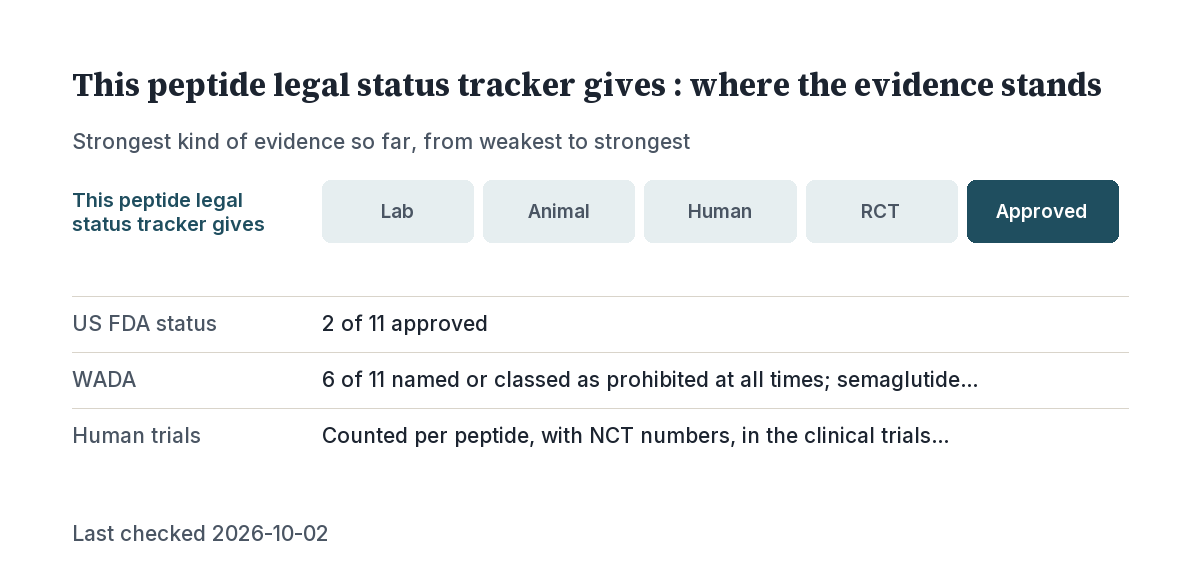
This peptide legal status tracker gives the US FDA, compounding, WADA and UK/EU status of the 11 peptides covered on PeptideWikis, checked against regulator pages on 2026-10-02. Two are FDA-approved drugs: semaglutide (Wegovy, approved 2021-06-04, per Drugs@FDA) and tesamorelin (Egrifta). None of the others is approved, and none is on the 503A bulks list in 21 CFR 216.23. FDA advisers backed BPC-157, KPV, TB-500 and MOTS-c for that list in July 2026, but the vote is advisory and no rule has followed.
| Item | Status |
|---|---|
| US FDA status | 2 of 11 approved: semaglutide and tesamorelin (Drugs@FDA); CagriSema decision anticipated by late 2026 (Novo Nordisk) |
| Compounding (503A/503B) | None on the 503A bulks list; PCAC voted 8–6 (1 abstention) for BPC-157, KPV and TB-500 and 7–5 (2 abstentions) for MOTS-c on 2026-07-23; advisory, no FDA rule yet (FDA). Ipamorelin still Category 2 for 503B |
| WADA 2026 | 6 of 11 named or classed as prohibited at all times; semaglutide not prohibited (USADA); 4 not named |
| Strongest evidence | Approved label for semaglutide and tesamorelin; each other peptide is graded claim by claim in its own entry |
| Human trials | Counted per peptide, with NCT numbers, in the clinical trials inventory |
| Next regulatory step | CagriSema FDA decision (late 2026); WADA 2027 List in force 2027-01-01; retatrutide BLA planned Q1 2027 (Lilly 8-K) |
| Last checked | 2026-10-02 |
Key points:
- Removal from FDA’s Category 2 list is not a move to Category 1: FDA lists 16 substances as “withdrawn by nominators”, including BPC-157 and TB-500, with no new category given (FDA, current as of 2026-04-22).
- FDA states that “retatrutide and cagrilintide cannot be used in compounding under federal law” (FDA, current as of 2026-10-01).
- A “research use only” label did not stop FDA treating tesamorelin, retatrutide and semaglutide products as drugs for human use in an August 2026 warning letter.
- MOTS-c is prohibited in sport as an AMPK activator under S4.4.1, not as a peptide hormone (USADA).
- The EU marketing application for tesamorelin was withdrawn in 2012; at the time of withdrawal, the EMA’s committee was of the opinion that its benefits did not outweigh its risks (EMA).
How to read this tracker
Each row answers four separate legal questions, and a peptide can sit differently on each one. The terms used below:
- FDA approval: a drug is approved when FDA has accepted a marketing application for a named product and indication; approved products appear in Drugs@FDA. Approval of one product does not extend to copies: FDA states that “compounded drugs are not FDA approved” (FDA).
- 503A and 503B: the two federal compounding pathways, for state-licensed pharmacies (503A) and registered outsourcing facilities (503B). Our explainer on what each compounding pathway may do covers the difference.
- 503A bulks list: the regulation naming bulk substances a 503A pharmacy may compound from. It currently holds six substances, all non-peptides (21 CFR 216.23).
- Categories 1–3: FDA’s interim sorting of nominated substances while it evaluates them. Category 2 means FDA “has identified significant safety risks relating to the use of these substances in compounding”, and FDA “does not intend to place bulk drug substances nominated on or after January 7, 2025, into these categories” (FDA). The Category 1 vs Category 2 explainer goes further.
- PCAC: FDA’s Pharmacy Compounding Advisory Committee. Its votes are recommendations; adding a substance to the bulks list takes FDA rulemaking.
- WADA classes: S0 covers any pharmacological substance with “no current approval by any governmental regulatory health authority for human therapeutic use (e.g., drugs under pre-clinical or clinical development…)”; S2 covers peptide hormones and growth factors; S4.4 covers metabolic modulators (WADA 2026 List).
Peptide legal status tracker: FDA approval and compounding
Every cell is linked to the regulator page it comes from. “Not approved” means no application for the substance appears in Drugs@FDA.
| Peptide | US FDA | Compounding (503A/503B) |
|---|---|---|
| BPC-157 | Not approved (Drugs@FDA) | Withdrawn from Category 2 (FDA); PCAC 8–6, 1 abstention, for 503A listing for ulcerative colitis, 2026-07-23 (FDA); advisory, no rule yet |
| TB-500 (thymosin beta-4 fragment) | Not approved (Drugs@FDA) | Withdrawn from Category 2 (FDA); PCAC 8–6, 1 abstention, for wound healing, 2026-07-23; advisory, no rule yet |
| KPV | Not approved (Drugs@FDA) | Withdrawn from Category 2 (FDA); PCAC 8–6, 1 abstention, 2026-07-23; advisory, no rule yet |
| MOTS-c | Not approved (USADA) | Withdrawn from Category 2 (FDA); PCAC 7–5, 2 abstentions, for obesity and osteoporosis, 2026-07-23; advisory, no rule yet |
| GHK-Cu | No approved drug (Drugs@FDA) | Injectable: withdrawn from Category 2 (FDA). Other routes: not on the bulks list (21 CFR 216.23) |
| CJC-1295 | Not approved (Drugs@FDA) | Withdrawn from Category 2 (FDA); not on the July 2026 PCAC agenda |
| Ipamorelin | Not approved (Drugs@FDA) | 503B: Category 2 since 2023-09-29 (FDA) |
| Tesamorelin | Approved: Egrifta, 2010-11-10, BLA 022505 (Drugs@FDA) | Deemed a BLA on 2020-03-23; transitioned biologics are not eligible for 503A/503B exemptions (FDA) |
| Semaglutide | Approved: Wegovy, 2021-06-04 (Drugs@FDA) | Shortage resolved 2025-02-21 (FDA); 503B exclusion proposed 2026-04-30, not final (FDA) |
| Cagrilintide (in CagriSema) | Investigational; CagriSema NDA submitted 2025-12-18 (Novo Nordisk) | “Cannot be used in compounding under federal law” (FDA) |
| Retatrutide | Investigational; BLA planned Q1 2027 (Lilly 8-K) | “Cannot be used in compounding under federal law” (FDA) |
The PCAC vote counts come from trade-press reports of the meeting (AJMC, 2026-07-31); FDA’s meeting page lists the substances and uses reviewed but, as of its last update on 2026-08-06, posts no minutes or votes. The same report notes that the panel’s support ran against FDA staff recommendations.
WADA 2026 and UK/EU status
Sport and medicines law answer different questions: a peptide can be an approved medicine and still be prohibited in sport, as tesamorelin is. The WADA 2027 List takes effect on 2027-01-01; our page on which peptides are prohibited in sport in 2027 tracks the changes.
| Peptide | WADA 2026 | UK / EU note |
|---|---|---|
| BPC-157 | Prohibited at all times, S0 non-approved substances (USADA) | No UK or EU regulator page found |
| TB-500 | Prohibited at all times, peptide hormones and growth factors class (USADA) | No UK or EU regulator page found |
| KPV | Not named; S0 appears to apply as an unapproved substance (our reading of the List) | No UK or EU regulator page found |
| MOTS-c | Prohibited at all times, S4.4.1 AMPK activators (USADA) | No UK or EU regulator page found |
| GHK-Cu | Not named; plain GHK in cosmetics listed as not prohibited, no GHK-Cu ruling (USADA) | No UK or EU regulator page found |
| CJC-1295 | Prohibited at all times, peptide hormones class (USADA) | No UK or EU regulator page found |
| Ipamorelin | Prohibited at all times, peptide hormones class (USADA) | No UK or EU regulator page found |
| Tesamorelin | Prohibited at all times, peptide hormones class (USADA) | EU application withdrawn 2012-06-21 (EMA) |
| Semaglutide | Not prohibited; WADA is monitoring GLP-1 use (USADA) | EU: Wegovy authorised 2022-01-06 (EMA) |
| Cagrilintide | Not named; S0 appears to apply as a drug in clinical development (our reading of the List) | CagriSema “not approved in the US or EU” (Novo Nordisk) |
| Retatrutide | Not named; S0 appears to apply as a drug in clinical development (our reading of the List) | UK: MHRA seized unlicensed retatrutide, 2026-05-29 (MHRA) |
“Not named” is not the same as permitted. USADA sanctioned an athlete in September 2025 for TB-500, CJC-1295, ipamorelin and tesamorelin, all “prohibited at all times”, alongside BPC-157 as a non-approved substance (USADA). Where a row reads “our reading”, WADA has published no substance-specific ruling we could find, and USADA’s Global DRO or Drug Reference Line gives the binding answer for an athlete.
What changed in 2026: dated regulatory events
| Date | Event |
|---|---|
| 2026-02-23 | Novo Nordisk said an FDA decision on CagriSema “is anticipated by late 2026” (Novo Nordisk) |
| 2026-04-22 | FDA’s Category 2 page shows 16 substances “withdrawn by nominators” (FDA) |
| 2026-04-30 | FDA proposed excluding semaglutide, tirzepatide and liraglutide from the 503B bulks list, citing “no clinical need”; comments closed 2026-06-29 (FDA) |
| 2026-05-29 | MHRA seized about 12,000 doses of unlicensed weight-loss medicines, including retatrutide (MHRA) |
| 2026-07-23/24 | PCAC reviewed BPC-157, KPV, TB-500, MOTS-c, emideltide, Semax and Epitalon for the 503A bulks list (FDA) |
| 2026-08-05 | Lilly said it plans to submit the retatrutide BLA in Q1 2027 (SEC) |
| 2026-08-24 | FDA warning letter treated “research use only” tesamorelin, retatrutide and semaglutide as drugs for human use (FDA) |
| 2026-10-01 | FDA’s GLP-1 page, re-dated, still states retatrutide and cagrilintide cannot be compounded (FDA) |
What comes next
Three dated steps could change rows in this tracker. First, FDA would need to publish a proposed rule before any PCAC-backed peptide joins the bulks list; none has been published, and the list in 21 CFR 216.23 still holds six non-peptide substances. Second, an FDA decision on CagriSema is anticipated by late 2026 (Novo Nordisk); no decision had been announced on 2026-10-02. Third, Lilly plans to submit retatrutide for approval in the first quarter of 2027 (Lilly 8-K); the retatrutide approval timeline sets out the review windows that would follow. FDA has also not yet issued its final determination on the 503B GLP-1 exclusion proposed on 2026-04-30 (FDA).
Common misreadings of peptide legal status
- “Withdrawn from Category 2” read as “Category 1”: FDA’s page lists the withdrawn peptides under their own heading and assigns them no new category (FDA). Our introduction to peptides and how they are classed explains why categories exist at all.
- A favorable PCAC vote read as approval: the committee advises FDA. Listing requires rulemaking, and listing would allow 503A compounding from bulk; it would not make any peptide an FDA-approved drug.
- “Research use only” read as a legal route: FDA wrote that, despite such labels, “evidence obtained from your website establishes that your products are intended to be drugs for human use” (FDA). Our page on what the research-use-only label means legally covers the enforcement history.
- An approved ingredient read as an approved product: semaglutide is approved as Wegovy, but FDA states that “compounded drugs are not FDA approved” and are not reviewed “for safety, effectiveness or quality before they are marketed” (FDA).
- Approved in the US read as approved everywhere: tesamorelin is an FDA-approved drug, yet its EU application was withdrawn after the EMA committee concluded “the benefits of Egrifta did not outweigh its risks” (EMA).
How this tracker is checked and updated
Each status is read from the regulator page itself on the “Last checked” date: Drugs@FDA for approvals, FDA’s compounding pages and 21 CFR 216.23 for compounding, the WADA List and USADA pages for sport, and EMA and MHRA pages for the UK and EU. Company statements are used only for filing dates, and trade press only for PCAC vote counts that FDA has not posted. A weekly audit re-reads each source and dates any change in the change log; a new row is added when a new peptide entry is published. The editorial policy describes who the editorial team is and how pages are reviewed. Two limits apply: we could not open the WADA List PDF or FDA’s category list PDF directly on 2026-10-02, so those rows rest on USADA’s published classifications and the dated FDA list as recorded in our entries; and where a UK or EU row reads “no regulator page found”, that is a gap in published guidance, not a finding that the peptide is permitted there.
What users report
These are unverified self-reports from people who usually bought unregulated products, not evidence. On public forums and social media, people who post about peptide legality most often describe confusion after the 2026 headlines: a recurring claim is that BPC-157 and similar peptides “went back to Category 1” or “became legal again”, and threads regularly argue over whether the July advisory vote changed anything. Many posters say a clinic or online seller told them a product was compliant, and later found that the regulator pages said otherwise. Athletes and coaches commonly ask whether a peptide not named on the WADA List is allowed, and replies split between people who assume it is and people who point to the non-approved substances class. Frequent complaints include products whose labels say “not for human consumption”, uncertainty about what a product actually contains, and pages that quote outdated regulatory status without a date. Users outside the US often say they cannot find any statement from their own regulator about the peptide in question.
Frequently asked questions
Is BPC-157 legal in the US?
BPC-157 is not an FDA-approved drug and is not on the 503A bulks list. FDA advisers voted 8–6, with one abstention, on 2026-07-23 to recommend listing it for ulcerative colitis, but that vote is advisory and FDA has published no rule. FDA lists its Category 2 nomination as withdrawn, with no new category (FDA).
Did FDA move peptides to Category 1 in 2026?
No such move appears on FDA’s pages. The Category 2 page, current as of 2026-04-22, lists BPC-157, TB-500, KPV, MOTS-c, CJC-1295 and others as “withdrawn by nominators” and places them in no category. FDA also says it will not categorise substances nominated on or after January 7, 2025 (FDA).
Which peptides in this tracker are banned by WADA?
Six are named or classed as prohibited at all times: BPC-157 (S0), TB-500, CJC-1295, ipamorelin and tesamorelin (peptide hormones), and MOTS-c (S4.4.1 AMPK activators). Semaglutide is not prohibited. KPV, GHK-Cu, retatrutide and cagrilintide are not named, and S0 may apply to unapproved substances (USADA).
Can pharmacies compound retatrutide or cagrilintide?
No. FDA states that “retatrutide and cagrilintide cannot be used in compounding under federal law”, on a page current as of 2026-10-01. Both are investigational: Lilly plans its retatrutide application for the first quarter of 2027, and CagriSema awaits an FDA decision (FDA).
How often is this peptide status tracker updated?
A weekly audit re-reads every cited regulator page, and the “Last checked” date changes whenever the table is re-verified. Known dates that will trigger updates include the CagriSema decision, anticipated by late 2026, and the WADA 2027 List, which takes effect on 2027-01-01 (WADA).
References
- US Food and Drug Administration. Certain bulk drug substances for use in compounding that may present significant safety risks (Category 2). Content current as of 2026-04-22. fda.gov
- US Food and Drug Administration. Bulk drug substances used in compounding under section 503A of the FD&C Act. Content current as of 2026-05-14. fda.gov
- US Food and Drug Administration. Bulk drug substances nominated for use in compounding under section 503A, by category. Updated 2026-05-14. fda.gov
- Code of Federal Regulations. 21 CFR 216.23, Bulk drug substances that can be used to compound drug products under section 503A. ecfr.gov
- US Food and Drug Administration. July 23–24, 2026: Meeting of the Pharmacy Compounding Advisory Committee. Updated 2026-08-06. fda.gov
- US Food and Drug Administration. FDA’s concerns with unapproved GLP-1 drugs used for weight loss. Content current as of 2026-10-01. fda.gov
- US Food and Drug Administration. FDA clarifies policies for compounders as national GLP-1 supply begins to stabilize. fda.gov
- US Food and Drug Administration. FDA proposes to exclude semaglutide, tirzepatide and liraglutide from 503B bulks list. 2026-04-30. fda.gov
- US Food and Drug Administration. Notice to compounders: changes that affect compounding as of March 23, 2020. fda.gov
- US Food and Drug Administration. Warning letter to Peak Performance Peptides (735127). 2026-08-24. fda.gov
- US Food and Drug Administration. Drugs@FDA. accessdata.fda.gov
- US Food and Drug Administration. Drugs@FDA: Wegovy (semaglutide), NDA 215256. accessdata.fda.gov
- US Food and Drug Administration. Drugs@FDA: Egrifta (tesamorelin acetate), BLA 022505. accessdata.fda.gov
- World Anti-Doping Agency. 2026 Prohibited List. wada-ama.org
- World Anti-Doping Agency. 2027 Prohibited List. wada-ama.org
- US Anti-Doping Agency. BPC-157: experimental peptide creates risk for athletes. usada.org
- US Anti-Doping Agency. Anthony McCauley accepts doping sanction. 2025-09-17. usada.org
- US Anti-Doping Agency. What is the MOTS-c peptide? usada.org
- US Anti-Doping Agency. Weight loss drugs: what athletes need to know about GLP-1s. usada.org
- US Anti-Doping Agency. Peptides and growth factors in cosmetics: are they banned? usada.org
- European Medicines Agency. Egrifta: withdrawn application. 2012. ema.europa.eu
- European Medicines Agency. Wegovy: EPAR. ema.europa.eu
- Medicines and Healthcare products Regulatory Agency. Two arrested during the MHRA’s largest-ever seizure of unlicensed weight loss medicines. 2026-05-29. gov.uk
- Novo Nordisk. CagriSema submitted to the US FDA. 2025-12-18. novonordisk.com
- Novo Nordisk. Company announcement. 2026-02-23. novonordisk.com
- Eli Lilly and Company. Form 8-K, Q2 2026 results. 2026-08-05. sec.gov
Change log
2026-10-23: links to glossary definitions added; no change to the facts.
2026-10-04: source links restored (2 references now link to the official text); reviewed by the editorial team.
2026-10-02: first published after review by the editorial team.