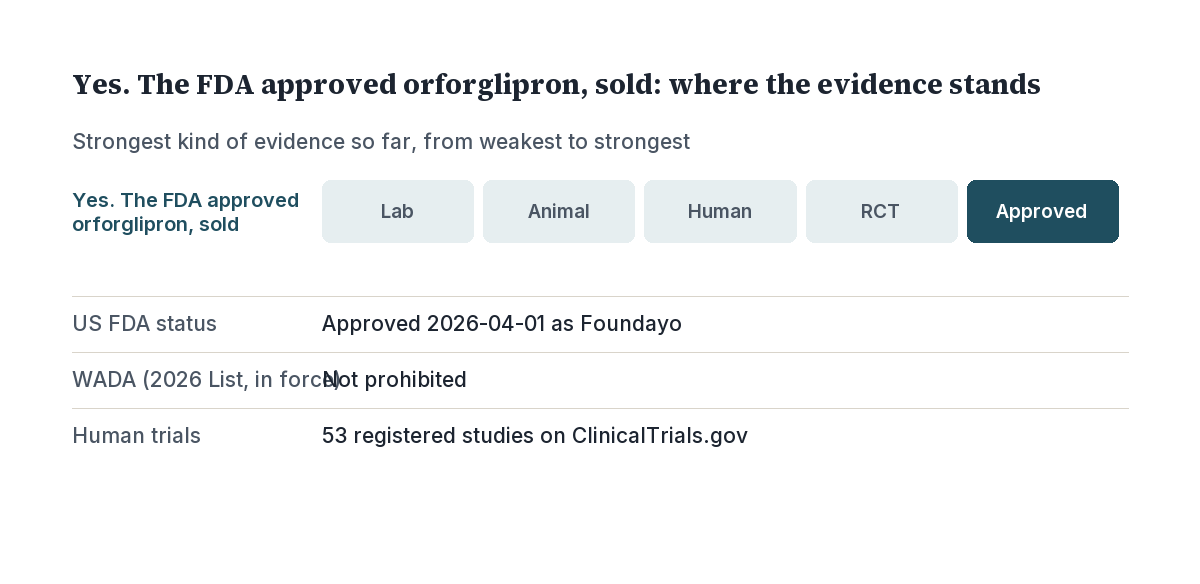
Yes. The FDA approved orforglipron, sold as Foundayo, on April 1, 2026 for chronic weight management in adults with obesity, or overweight plus at least one weight-related condition (FDA). In the 72-week ATTAIN-1 trial, people on the highest dose lost 11.2% of body weight versus 2.1% on placebo [Human RCT, n=3,127] (Wharton 2025). It is a once-daily pill that can be taken with or without food. It is not yet FDA-approved for type 2 diabetes: Lilly submitted that application in the second quarter of 2026, and no decision was listed on Drugs@FDA as of 2026-10-19. The label carries a boxed warning about thyroid C-cell tumors.
| Item | Status |
|---|---|
| US FDA status | Approved 2026-04-01 as Foundayo (NDA 220934) for weight reduction and long-term maintenance in adults with obesity or overweight plus a comorbidity (Drugs@FDA) |
| Type 2 diabetes (US) | Submitted to FDA in Q2 2026 (Lilly 8-K); not approved, no decision listed as of 2026-10-19 |
| Next regulatory step | FDA decision on the diabetes application and a European Commission decision on the EU opinion; no dates announced (checked 2026-10-19) |
| Compounding (503A/503B) | No FDA statement specific to orforglipron found; not on FDA’s drug shortage list (searched 2026-10-19). FDA warns about GLP-1 drugs sold “for research purposes” (FDA) |
| WADA (2026 List, in force) | Not prohibited: not named on the List, and as an approved medicine it falls outside S0 (WADA 2026; USADA) |
| WADA 2027 List | No change: not named on the 2027 List, in force 2027-01-01 (WADA 2027) |
| UK / EU | UK: authorised 2026-08-10 for weight and type 2 diabetes. EU: CHMP positive opinion 2026-10-16, pending EC decision |
| Strongest evidence | Approved label, backed by phase 3 RCTs |
| Human trials | 53 registered studies on ClinicalTrials.gov (searched 2026-10-19), incl. NCT05869903 and NCT05803421 |
| Last checked | 2026-10-19 (status sources re-verified 2026-10-19) |
Key points:
- Foundayo was the first new molecular entity approved under FDA’s national priority voucher pilot, issued 294 days before its standard goal date of January 20, 2027.
- FDA did not send the application to an advisory committee, citing “no controversial issues”.
- Orforglipron is a small molecule, not a peptide, which EMA says is why it was developed as a pill.
- The approval letter requires a 15-year thyroid cancer registry, pregnancy and lactation studies, and a gastric-emptying trial.
- The UK authorised it first in Europe on 2026-08-10, for both weight management and type 2 diabetes.
Orforglipron FDA approval timeline: what happened and when
Orforglipron (development code LY3502970, earlier OWL833) went from its first published structure study to approval in about five and a half years. Lilly holds worldwide rights under a licence from Chugai Pharmaceutical (Lilly 10-Q). The dated steps below come from FDA, EMA, MHRA, Lilly’s SEC filings and the trial publications.
| Date | Milestone | Source |
|---|---|---|
| 2020 | Discovery and receptor structure published: a partial GLP-1 receptor agonist taken by mouth | Kawai 2020 |
| 2023-06-23 | Phase 2 obesity trial published (n=272) | Wharton 2023 |
| 2025-06-21 | ACHIEVE-1 (early type 2 diabetes) published | Rosenstock 2025 |
| 2025-09-16 | ATTAIN-1 (obesity, n=3,127) published | Wharton 2025 |
| 2025-11-06 | FDA awards orforglipron a national priority voucher | FDA |
| 2025-11-20 | ATTAIN-2 (obesity with type 2 diabetes) published | Horn 2026 |
| 2026-01-20 | FDA receives the obesity NDA | FDA letter |
| 2026-02-04 | Lilly reports obesity filings in the US and Japan, and obesity plus diabetes in the EU | Lilly 8-K |
| 2026-04-01 | FDA approves Foundayo for chronic weight management | FDA |
| 2026-04-30 | Lilly reports Foundayo “now available in the U.S.” | Lilly 8-K |
| Q2 2026 | Type 2 diabetes application submitted to FDA | Lilly 8-K |
| 2026-08-04 | FDA approves a labeling supplement (label revised 07/2026) | FDA label |
| 2026-08-10 | MHRA authorises it in the UK for weight and type 2 diabetes | MHRA |
| 2026-09-30 | ACHIEVE-4 cardiovascular safety trial published | Klein 2026 |
| 2026-10-16 | EMA’s CHMP recommends EU authorisation | EMA |
What the FDA approved, and what the label says
Foundayo is approved “in combination with a reduced-calorie diet and increased physical activity to reduce excess body weight and maintain weight reduction long term” in adults with obesity, or with overweight and at least one weight-related condition [Approved label] (Foundayo label). The label advises against using it together with another GLP-1 receptor agonist. Drugs@FDA lists six tablet strengths, from 0.8 mg to 17.2 mg, all prescription-only, and classes the application as a Type 1 new molecular entity reviewed on the standard track (Drugs@FDA).
The label describes a once-daily tablet taken “with or without food”, with an elimination half-life of about 29 to 49 hours and metabolism mainly through the liver enzyme CYP3A4. Orforglipron also slows stomach emptying, most after the first dose. EMA describes orforglipron as “a small, non-peptide molecule” that activates the GLP-1 receptor and says that, as a non-peptide medicine, it is developed to be taken orally (EMA). PubChem gives its formula as C48H48F2N10O5, with a molecular weight of 883.0 (PubChem). In lab work it acted as a partial agonist, favouring G protein signalling over β-arrestin recruitment, and it lowered glucose in mice carrying the human receptor [Lab, Animal] (Kawai 2020). By contrast, the Wegovy pill (oral semaglutide) is a peptide.
Why the approval came 294 days early: the national priority voucher
On 2025-11-06 FDA named orforglipron one of six new recipients of a Commissioner’s National Priority Voucher, a pilot that promises a decision “within months” once a complete application is in (FDA 2025). FDA says vouchers go to products whose makers agreed to “increase affordability, domesticate manufacturing as a national security issue, or address an unmet public health need”; it did not say which applied to orforglipron.
FDA received the application on 2026-01-20 (approval letter). Approval came on 2026-04-01, “50 days after filing” and 294 days before the January 20, 2027 goal date, which FDA called the fastest approval of a new molecular entity since 2002 (FDA 2026). FDA’s target under the program is two months, and by then it had awarded 18 vouchers and issued six decisions. The agency also scheduled a public meeting on the program for June 4, 2026, with written comments open through June 29. For a drug still waiting on its first filing, see the retatrutide FDA approval timeline.
The trials behind the approval
Two 72-week placebo-controlled trials supported the obesity approval (FDA). The trials gave an investigational capsule; the label converts those doses to tablet strengths, so the 36 mg trial dose corresponds to the 17.2 mg tablet (ACHIEVE-4 report). The most encouraging result for weight is ATTAIN-1’s: 54.6% of people on the top dose lost at least 10% of their weight, versus 12.9% on placebo (Wharton 2025).
| Trial | Evidence level | Best result |
|---|---|---|
| Phase 2, obesity (Wharton 2023) | Human RCT, n=272 | -9.4% to -14.7% at 36 weeks vs -2.3% placebo |
| ATTAIN-1, obesity without diabetes (Wharton 2025) | Human RCT, n=3,127 | -11.2% at 72 weeks (36 mg) vs -2.1% placebo |
| ATTAIN-2, obesity with type 2 diabetes (Horn 2026) | Human RCT, n=1,613 | -9.6% at 72 weeks (36 mg) vs -2.5% placebo |
| ATTAIN-MAINTAIN, after injectables (Aronne 2026) | Human RCT, n=376 | Kept 74.7% vs 49.2% of prior loss after tirzepatide; 79.3% vs 37.6% after semaglutide |
| ACHIEVE-3 vs oral semaglutide (Rosenstock 2026) | Human RCT, n=1,698 | HbA1c -1.91% (36 mg) vs -1.47% (semaglutide 14 mg) at 52 weeks |
| ACHIEVE-4 vs insulin glargine (Klein 2026) | Human RCT, n=2,749 | Major cardiac events 4.2% vs 5.0%; HR 0.84, non-inferior |
The FDA label restates the ATTAIN-1 result with its own analysis: -11.1% on the 17.2 mg tablet versus -2.1% on placebo, a 9-point difference (label Table 6). In ATTAIN-MAINTAIN, people who had already lost weight on injectable tirzepatide or semaglutide switched to orforglipron or placebo; the authors note that no group stayed on the injection, and the trial ran one year. Weight results from different trials are cross-trial numbers and should not be ranked against each other.
Type 2 diabetes: submitted, not yet approved in the US
Lilly’s second-quarter 2026 results list “the submission for orforglipron for type 2 diabetes in the U.S.” (Lilly 8-K). As of 2026-10-19 Drugs@FDA lists only the original obesity approval and one labeling supplement, so diabetes is not an approved US use yet. Neither FDA nor Lilly has published a decision date. The diabetes results are encouraging: in ACHIEVE-1, HbA1c fell by 1.24 to 1.48 points over 40 weeks versus 0.41 on placebo, with no severe hypoglycemia [Human RCT, n=559] (Rosenstock 2025). In ACHIEVE-3, both orforglipron doses beat both oral semaglutide doses on HbA1c [Human RCT, n=1,698] (Rosenstock 2026).
What FDA still requires after approval
The approval letter attaches required postmarketing studies (FDA letter). FDA found that routine adverse-event reports would not be enough to assess medullary thyroid cancer, long-term use in children and exposure in pregnancy.
| Requirement | Due |
|---|---|
| Adolescent obesity trial (12 to under 18 years) | Completion March 2028 |
| Child obesity trial (6 to under 12 years) | Completion March 2031 |
| Medullary thyroid carcinoma registry, at least 15 years | Completion August 2042 |
| Pregnancy exposure registry | Completion June 2037 |
| ACHIEVE-4 report on heart events and liver injury | Final report July 2026 |
| Ultrasound trial on retained stomach contents | Completion December 2028 |
| Breast-milk lactation study | Completion June 2028 |
ACHIEVE-4 has since been published: over a median of 2 years, major cardiac events occurred in 4.2% on orforglipron and 5.0% on insulin glargine [Human RCT, n=2,749] (Klein 2026). A pooled analysis of seven phase 3 trials found no case consistent with drug-induced liver injury [Human, n=11,220] (Wharton 2026). A dedicated cardiovascular outcomes trial, ATTAIN-Outcomes, is recruiting an estimated 7,140 people, with primary completion listed for August 2031 (NCT07241390).
Approval outside the US
The UK’s MHRA authorised orforglipron on 2026-08-10 for weight management and for type 2 diabetes, the first regulator in Europe to do so; it is not yet available through the NHS pending a NICE evaluation (MHRA). On 2026-10-16 EMA recommended EU authorisation for both uses, based on two weight studies in 4,740 adults and four diabetes studies in 3,765 adults; the opinion now goes to the European Commission (EMA). Lilly reported an obesity filing in Japan by 2026-02-04 (Lilly 8-K); no Japanese approval was found as of 2026-10-19.
Side effects and safety
Stomach and bowel effects are the main downside. In the pooled label data, nausea affected 35% on the 17.2 mg dose versus 10% on placebo, vomiting 24% versus 4%, and constipation 24% versus 9% [Approved label] (Foundayo label). Hair loss (5% versus 2%) and low blood pressure (2% versus 0.5%) were also more common. The label warns about pancreatitis, severe gastrointestinal reactions, acute kidney injury from dehydration, low blood sugar when combined with insulin or insulin secretagogues, allergic reactions, diabetic eye complications, gallbladder disease and inhaling stomach contents during anesthesia.
The boxed warning is notable: orforglipron “is not pharmacologically active in rats or mice and did not produce tumors in rodents”, but the human relevance of rodent thyroid C-cell tumors seen with other GLP-1 drugs “has not been determined”. It is contraindicated in people with a personal or family history of medullary thyroid carcinoma or MEN 2. Against oral semaglutide, more people on orforglipron stopped because of side effects (9–10% versus 4–5%), and pulse rose more [Human RCT, n=1,698] (Rosenstock 2026). The UK regulator adds that buying GLP-1 medicines “from unregulated sellers carries serious health risks” (MHRA). For the wider cancer question, see do peptides cause cancer?
Anyone who suspects a side effect from orforglipron or any other drug or product can report it to the FDA through MedWatch.
Legal status and sport
In the US, orforglipron is a prescription drug for its approved use. No FDA compounding statement on it was found (FDA pages searched 2026-10-19); its GLP-1 page warns that companies have illegally sold semaglutide, tirzepatide, retatrutide, survodutide and mazdutide “falsely labeled ‘for research purposes’” (FDA). Investigational relatives such as retatrutide and mazdutide cannot be obtained legally outside trials.
For athletes, WADA’s S0 class bans only substances with no current approval for human use (WADA 2026 List). USADA states that “GLP-1s are not prohibited in sport” and names orforglipron among them, while WADA monitors their use (USADA). The 2027 Monitoring Program covers semaglutide and tirzepatide, which stay permitted (USADA 2027). Status for other compounds is in the peptide legal status tracker.
What users report
What follows summarizes unverified self-reports posted online; it is not evidence, and some posters describe unregulated products bought outside pharmacies. People who post about Foundayo on Reddit, X and YouTube most often describe a quieter appetite and fewer food cravings within the first weeks, and many say they like a pill they can take at any time without fasting rules. Weight-loss stories vary widely, and a common thread compares the pace with injectable tirzepatide or semaglutide, with many describing it as slower. The most frequent complaints are nausea, burping, constipation and reflux, often said to be worst early on and to ease later. Insurance coverage and out-of-pocket cost come up constantly, as do questions about whether it can keep weight off after stopping an injection. Some posters report stopping because of stomach effects, and others argue over whether the pill is a step down from injections or a practical long-term option.
Frequently asked questions
When was orforglipron approved by the FDA?
The FDA approved orforglipron, under the brand name Foundayo, on April 1, 2026, for chronic weight management in adults with obesity or with overweight and a weight-related condition. The decision came 50 days after filing and 294 days before its January 20, 2027 goal date, the first new molecular entity approved under FDA’s national priority voucher pilot (FDA).
Is orforglipron approved for type 2 diabetes?
Not in the US as of 2026-10-19. Lilly submitted the type 2 diabetes application to FDA in the second quarter of 2026, and no decision has been published. The UK authorised orforglipron for type 2 diabetes on 2026-08-10, and EMA recommended EU approval for diabetes and weight management on 2026-10-16 (EMA).
Is orforglipron better than semaglutide?
For blood sugar, one head-to-head trial says yes against the oral form. In ACHIEVE-3, orforglipron 36 mg lowered HbA1c by 1.91 points versus 1.47 for oral semaglutide 14 mg over 52 weeks, though more people stopped orforglipron because of side effects (Rosenstock 2026).
Is orforglipron the same as tirzepatide?
No. Tirzepatide (Zepbound, Mounjaro) is a different drug, while orforglipron is a small, non-peptide molecule that activates the GLP-1 receptor and is taken as a daily pill. In ATTAIN-MAINTAIN, people switching from tirzepatide kept 74.7% of their weight loss on orforglipron versus 49.2% on placebo (Aronne 2026).
Is orforglipron banned in sport?
No. WADA’s 2026 and 2027 Prohibited Lists do not name orforglipron, and its non-approved substances class covers only drugs with no current approval for human use. USADA states that “GLP-1s are not prohibited in sport” and lists orforglipron among them, while WADA keeps monitoring how athletes use this drug class (USADA).
References
- US FDA. FDA approves first new molecular entity under National Priority Voucher program. Press release, 2026-04-01. fda.gov
- US FDA. FDA awards second batch of National Priority Vouchers. Press release, 2025-11-06. fda.gov
- US FDA. NDA 220934 approval letter, Foundayo (orforglipron) tablets, 2026-04-01. accessdata.fda.gov
- US FDA. Drugs@FDA: NDA 220934. accessdata.fda.gov
- US FDA. Foundayo (orforglipron) prescribing information, revised 07/2026. accessdata.fda.gov
- US FDA. FDA’s concerns with unapproved GLP-1 drugs used for weight loss (content current 2026-10-01). fda.gov
- Eli Lilly and Company. Form 8-K, Q4 2025 results, 2026-02-04. sec.gov
- Eli Lilly and Company. Form 8-K, Q1 2026 results, 2026-04-30. sec.gov
- Eli Lilly and Company. Form 8-K, Q2 2026 results, 2026-08-05. sec.gov
- Eli Lilly and Company. Form 10-Q, quarter ended 2026-06-30. sec.gov
- European Medicines Agency. New oral GLP-1 medicine for weight management and type 2 diabetes. News, 2026-10-16. ema.europa.eu
- MHRA. UK first in Europe to authorise orforglipron for weight management and type 2 diabetes. 2026-08-10. gov.uk
- World Anti-Doping Agency. The 2026 Prohibited List. wada-ama.org
- World Anti-Doping Agency. The 2027 Prohibited List. wada-ama.org
- USADA. Weight loss drugs: what athletes need to know about GLP-1s. usada.org
- USADA. Athlete advisory: what’s new on the 2027 WADA Prohibited List. usada.org
- Kawai T, et al. Structural basis for GLP-1 receptor activation by LY3502970, an orally active nonpeptide agonist. Proc Natl Acad Sci U S A. 2020. PubMed
- Wharton S, et al. Daily oral GLP-1 receptor agonist orforglipron for adults with obesity. N Engl J Med. 2023. PubMed
- Wharton S, et al. Orforglipron, an oral small-molecule GLP-1 receptor agonist for obesity treatment (ATTAIN-1). N Engl J Med. 2025. PubMed
- Horn DB, et al. Orforglipron for the treatment of obesity in people with type 2 diabetes (ATTAIN-2). Lancet. 2026. PubMed
- Rosenstock J, et al. Orforglipron in early type 2 diabetes (ACHIEVE-1). N Engl J Med. 2025. PubMed
- Rosenstock J, et al. Orforglipron compared with oral semaglutide in type 2 diabetes (ACHIEVE-3). Lancet. 2026. PubMed
- Klein, et al. Cardiovascular safety of orforglipron versus insulin glargine (ACHIEVE-4). Lancet. 2026. PubMed
- Aronne LJ, et al. Orforglipron for maintenance of body weight reduction (ATTAIN-MAINTAIN). Nat Med. 2026. PubMed
- Wharton S, et al. Hepatic safety of orforglipron: pooled analysis of phase 3 trials. Diabetes Obes Metab. 2026. PubMed
- ClinicalTrials.gov. ATTAIN-1 (NCT05869903). clinicaltrials.gov
- ClinicalTrials.gov. ACHIEVE-4 (NCT05803421). clinicaltrials.gov
- ClinicalTrials.gov. ATTAIN-Outcomes (NCT07241390). clinicaltrials.gov
- PubChem. Orforglipron, CID 137319706. pubchem.ncbi.nlm.nih.gov
Change log
2026-10-26: links to related entries added; no change to the facts.
2026-10-23: links to glossary definitions added; no change to the facts.
2026-10-19: first published after review by the editorial team.