The KPV peptide (Lys-Pro-Val) is a three-amino-acid fragment of alpha-melanocyte-stimulating hormone (alpha-MSH), studied for anti-inflammatory effects. It is not approved by the FDA for any use, and its evidence is limited to lab and animal studies. In a May 2026 review, the FDA found no clinical studies or human exposure data for KPV by any route, so its safety in people is unknown. No registered human trial exists.
| Item | Status |
|---|---|
| US FDA status | Not approved; not part of any FDA-approved drug (FDA briefing, 2026) |
| Compounding (503A/503B) | Withdrawn from Category 2 by the nominator; not on the 503A Bulks List; FDA staff recommended against adding it (FDA). The Pharmacy Compounding Advisory Committee voted 8–6 (1 abstention) on 2026-07-23 to recommend 503A listing; advisory only, no FDA rule yet (FDA PCAC meeting; counts as reported by trade press) |
| WADA 2026 | Not named; falls under the S0 “non-approved substances” wording, prohibited at all times (WADA) |
| EU | No authorised product listed by the EMA (per FDA review) |
| Strongest evidence | Animal (mouse and rat colitis models) |
| Human trials | None registered (ClinicalTrials.gov) |
| Last checked | 2026-09-30 |
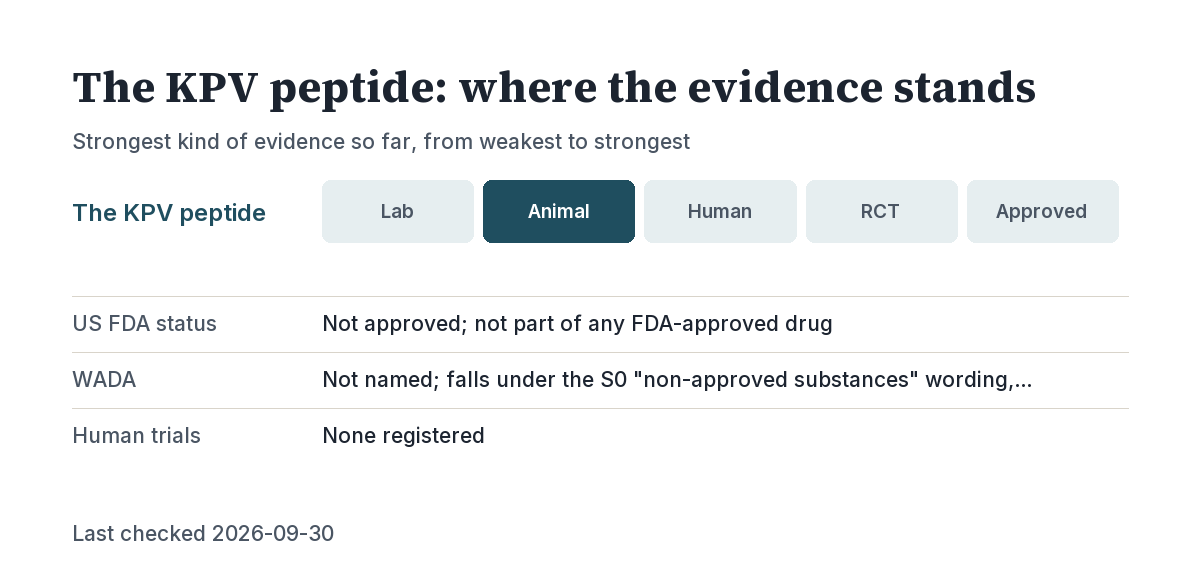
What changed (October 2026): the July 2026 committee outcome is now stated (as reported, against its own staff’s advice), and the sport sections cover the 2027 WADA List, which names “peptides” in general in S0.
Key points:
- KPV is residues 11 to 13 of alpha-MSH, the part linked to its anti-inflammatory action, without the pigment-raising effect of the full hormone.
- Most animal data come from mouse and rat models of colitis (inflammation of the colon), often with KPV packed in nanoparticles or gels.
- An FDA search of its adverse-event database through December 2025 found no reports for KPV, which reflects missing data rather than proven safety.
- No acute, repeat-dose, genetic or reproductive toxicity studies of KPV were found by FDA reviewers.
- On 2026-07-23 an FDA advisory committee voted for listing KPV for compounding, as reported, against its own staff’s advice; any listing still requires FDA rulemaking, and none had been proposed as of 2026-10-26.
| Property | Value |
|---|---|
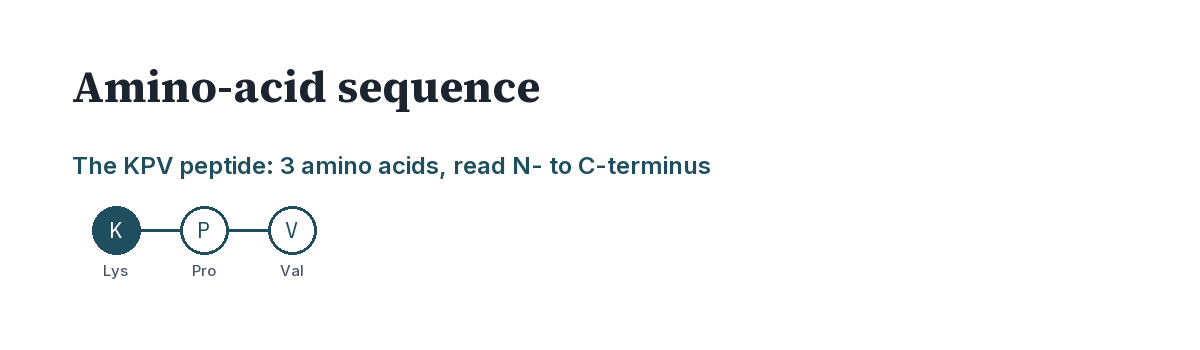
| Sequence | H-Lys-Pro-Val-OH (KPV), 3 amino acids |
| Molecular formula | C16H30N4O4 (PubChem) |
| Molecular weight | 342.43 g/mol (free base); acetate salt 402.5 g/mol |
| CAS number | 67727-97-3 |
| PubChem CID | 125672 |
| Half-life | No human or animal pharmacokinetic data found by FDA |
| Routes studied | Oral (drinking water, nanoparticles), rectal gel, eye drops, gum gel, cell culture |
| Class | Melanocortin-derived tripeptide; anti-inflammatory research peptide |
What is KPV?
KPV is the carboxy-terminal tripeptide of alpha-MSH, a 13-amino-acid hormone cut from the precursor protein proopiomelanocortin. In 1989, researchers in Dallas reported that this fragment reduced chemically induced ear swelling in mice in a dose-related way [Animal] (Hiltz and Lipton, 1989). Interest grew because alpha-MSH darkens skin through the MC1 receptor, while KPV keeps anti-inflammatory activity without that pigment effect, according to a 2008 review by the Münster group (Brzoska et al., 2008). Work since then has focused on the gut, skin, eye and airway. KPV has no United States Adopted Name, and FDA reviewers found products sold under the same common name that were different salts or molecules (FDA, 2026).
How does KPV work?
The mechanism is not settled. FDA reviewers concluded in 2026 that “the molecular targets underlying the pharmacological effects” of KPV “remain unknown” (FDA briefing). The proposed pathways are:
- Uptake by PepT1: In human intestinal and T-cell lines, KPV entered cells through the PepT1 di- and tripeptide transporter, which is induced in the inflamed colon [Lab] (Dalmasso et al., 2008).
- NF-kappaB blockade: In human bronchial cells, KPV entered the nucleus and blocked import of the p65RelA subunit of NF-kappaB, a switch for inflammatory genes [Lab] (Land, 2012).
- No melanocortin receptor binding: In mouse macrophage cells, KPV did not displace MC1 receptor binding at up to 1 mM and did not raise cyclic AMP, yet still inhibited NF-kappaB translocation [Lab] (Mandrika et al., 2001).
- Interleukin-1 beta effects: In mice, KPV reduced white-cell influx in crystal- and IL-1-beta-induced peritonitis, and the effect persisted in mice lacking a working MC1 receptor [Animal] (Getting et al., 2003).
What the research shows about the KPV peptide
| Claim | Evidence level | Best study and result |
|---|---|---|
| Reduces colitis | Animal | Dalmasso 2008: oral KPV lowered DSS and TNBS colitis in mice |
| Speeds recovery in colitis | Animal | Kannengiesser 2008: faster weight regain, less inflammation in 2 mouse models |
| Lowers colitis-linked tumors | Animal | Viennois 2016: fewer tumors in AOM/DSS mice; no effect in a genetic tumor model |
| Heals the cornea | Animal | Bonfiglio 2006: 8 of 8 rabbit corneas healed by 60 h vs none on placebo |
| Eases oral mucositis | Animal | Shao 2021: KPV gel improved gum ulcers in rats after chemotherapy |
| Kills microbes | Lab | Cutuli 2000: inhibited S. aureus and C. albicans in culture |
| Protects skin cells | Lab | Sung 2025: less dust-induced death and IL-1-beta in keratinocytes |
| Limits weight gain | Animal | An 2026: less weight gain in high-fat-fed mice |
| Any effect in people | None | FDA 2026: no human studies found |
Gut inflammation
Colitis is the most studied area. In mice given dextran sodium sulfate (DSS) or TNBS, two chemicals that inflame the colon, KPV added to drinking water lowered inflammatory cytokine expression and tissue damage [Animal] (Dalmasso et al., 2008). A Münster group found faster weight regain and less tissue inflammation in DSS and T-cell transfer colitis, and all KPV-treated mice without a functional MC1 receptor survived DSS colitis [Animal] (Kannengiesser et al., 2008). Later mouse and rat work mostly tested delivery systems: nanoparticles in a colon-targeted gel gave similar effect at a KPV concentration 12,000-fold lower than free solution [Animal] (Laroui et al., 2010), and hyaluronic-acid-coated particles reduced mucosal damage and TNF-alpha [Animal] (Xiao et al., 2017). A rectal hydrogel improved TNBS colitis in rats [Animal] (Zhao et al., 2022). None of these designs has been tested in people.
Colitis-associated cancer
In mice treated with a carcinogen plus DSS, KPV lowered tumor number, and the effect vanished in mice lacking PepT1 [Animal] (Viennois et al., 2016). The same paper reported that KPV did not reduce adenomas in APC-Min mice, a genetic tumor model without induced inflammation. The result is a mouse finding, not evidence of cancer prevention in humans.
Skin, eye and mouth
In rabbits with scraped corneas, KPV eye drops sped re-growth of the surface layer, an effect blocked by a nitric oxide inhibitor [Animal] (Bonfiglio et al., 2006). In rats with chemotherapy-induced mouth ulcers, a KPV gel improved food intake, tissue repair and cytokine levels [Animal] (Shao et al., 2021). Skin work is mostly in cells: KPV reduced particulate-induced cell death in human keratinocytes and a 3D skin model [Lab] (Sung et al., 2025). Passive diffusion through donated human skin was below detection; microneedles and electric current raised it [Lab] (Pawar et al., 2017). A 2019 review called wound healing a candidate use that still needs clinical studies (Böhm and Luger, 2019).
Microbes, viruses and metabolism
In culture, KPV reduced growth of Staphylococcus aureus and Candida albicans [Lab] (Cutuli et al., 2000) and lowered HIV-1 expression in infected monocyte cells [Lab] (Barcellini et al., 2000). A 2026 study reported less fat-cell formation in culture and less weight gain in high-fat-fed mice given oral KPV [Lab, Animal] (An et al., 2026). These are single-group findings without independent replication in the sources reviewed here.
Human studies and trials
No completed human trials. A search of ClinicalTrials.gov for “KPV”, “Lys-Pro-Val” and “lysine-proline-valine” returned no study testing the peptide. The FDA review team searched PubMed, Embase and ClinicalTrials.gov and “did not identify data, such as clinical studies, on the use of KPV in humans”; none of the nine references in the compounding nomination studied KPV in people (FDA briefing, 2026). The only work with human tissue used donated skin in a diffusion chamber, which measures penetration, not effect [Lab] (Pawar et al., 2017).
Doses used in studies
| Route and species | Amount | Study |
|---|---|---|
| Oral, in drinking water; mice | 100 µmol/L | Viennois 2016 |
| Eye drops; rabbits | 1, 5 or 10 mg/mL solution | Bonfiglio 2006 |
| Cell culture; human intestinal cells | Nanomolar range | Dalmasso 2008 |
| Cell culture; human keratinocytes | 50 µg/mL | Sung 2025 |
No established human dose exists outside approved labels. KPV has no approved label, and animal or cell-culture amounts do not translate to people.
Side effects and safety
There are no human safety data. FDA reviewers found no clinical studies or human exposure data via any route and wrote that “potential safety risks associated with the use of KPV in humans are unknown” (FDA briefing, 2026). Their search of the FDA Adverse Event Reporting System through 2025-12-03 retrieved no reports, and the literature held no case reports. FDA notes that such reporting is voluntary and that compounders generally do not report adverse events, so an empty database is not proof of safety.
The same review found no acute toxicity, repeat-dose toxicity, genotoxicity, reproductive toxicity or carcinogenicity studies of KPV. Theoretical risks it named are immunogenicity (the body forming antibodies against a peptide) and aggregation, since peptides as short as two amino acids can clump, which may change activity. FDA found no data to rule either out.
Product quality is a separate risk. FDA judged both KPV and KPV acetate “not well-characterized” because of inconsistent naming, certificates of analysis that listed purity but no impurity limits, and no microbial testing. It also noted that KPV acetate breaks down to a lysine-proline diketopiperazine under acid, alkaline and oxidative stress. Products sold as “research use only” are outside FDA oversight; in 2026 warning letters the agency said such labels did not stop it from treating peptides as drugs intended for human use (FDA warning letter, 2026-08-24; KPV was not among the products named).
No label or regulator lists who should avoid KPV because no product is approved. By general reasoning, the absence of reproductive toxicity data means nothing is known about exposure in pregnancy or breastfeeding, and competitive athletes face the WADA S0 rule described below.
Legal and regulatory status
| Jurisdiction | Status |
|---|---|
| US FDA | Not approved; no USP monograph (FDA 2026) |
| US 503A compounding | Not on the Bulks List; nomination withdrawn; FDA staff proposed not adding it |
| US 503B | Not on the 503A Bulks List; no FDA-approved KPV product exists for outsourcing facilities to compound from (FDA) |
| WADA 2026 | S0 non-approved substances, prohibited at all times (WADA list) |
| WADA 2027 | S0, which from 2027-01-01 names “peptides” in general (USADA athlete advisory) |
| EU | No EMA-authorised product; no European Pharmacopoeia monograph |
Dated events:
- Category 2 and withdrawal: KPV sat in FDA’s Category 2 of bulk substances that may pose significant safety risks. FDA’s page, current as of 2026-04-22, lists it under “nominated but withdrawn” and states that FDA “has not identified any human exposure data on drug products containing KPV administered via any route” (FDA Category 2 page).
- 2026-05-12 FDA evaluation: FDA reviewed KPV free base and KPV acetate on its own initiative for wound healing and inflammatory conditions, for topical cream and gel, and proposed not adding either to the 503A Bulks List (FDA briefing).
- 2026-07-23 advisory committee: The Pharmacy Compounding Advisory Committee discussed KPV alongside BPC-157, TB-500 and MOTS-c (FDA meeting page). Committee votes are advisory. FDA adds substances to the 503A Bulks List through notice-and-comment rulemaking (FDA 503A bulks page).
- WADA: The 2026 list bans at all times any pharmacological substance with “no current approval by any governmental regulatory health authority for human therapeutic use” that no other section covers (WADA 2026 Prohibited List). KPV has no such approval anywhere. On the 2027 List, in force from 2027-01-01, S0 also names “peptides” in general, a description that fits KPV directly (USADA athlete advisory).
Related peptides
- BPC-157: another unapproved peptide studied mainly in rodent gut and tissue models, reviewed by the same FDA committee on the same day.
- GHK-Cu: a tripeptide with skin and wound research, also withdrawn from FDA’s Category 2 list.
- Our overview of peptides banned in sport explains the WADA S0 and S2 classes.
What users report
The following summarises unverified self-reports posted online by people who usually bought unregulated products; it is not evidence and has not been checked. People who post about KPV on forums and social media most often describe using it for gut complaints such as ulcerative colitis, Crohn’s disease, bloating or food sensitivity, and less often for skin redness, eczema or acne. Some say they noticed calmer digestion within one to three weeks; others say they saw no change after several weeks and consider it overrated. A recurring point of debate is whether capsules taken by mouth survive digestion or whether other forms work better, a question the research in mice has not settled for humans. Complaints include mild nausea, headaches, stinging or redness where a cream was applied, and doubts about whether products contained what the label claimed. Many posts describe KPV taken together with other peptides, which makes it impossible to tell which substance caused any effect. Posters also argue about whether reported gut improvements reflect KPV itself, diet changes made at the same time, or the natural ups and downs of inflammatory bowel conditions.
Frequently asked questions
Is KPV approved by the FDA?
No. KPV is not approved for any use in the United States and is not a component of any FDA-approved drug. An FDA review in May 2026 found no human data on KPV by any route and proposed not adding it to the list of substances that pharmacies may use for compounding, citing unknown safety and poor chemical characterization.
Has KPV been tested in humans?
No. ClinicalTrials.gov lists no trial of KPV, and FDA reviewers searching PubMed and Embase in 2026 found no clinical studies, case reports or human exposure data. The research consists of cell-culture work and animal studies, mainly mice and rats with chemically induced colitis, plus one rabbit cornea study and skin-permeation tests on donated tissue.
Is KPV the same as alpha-MSH or Melanotan?
No. KPV is only the last three amino acids of the 13-amino-acid hormone alpha-MSH. In mouse macrophage cells it did not bind the MC1 receptor that drives skin pigmentation, even at high concentrations. Melanotan peptides are longer synthetic analogues designed to activate melanocortin receptors, so their effects and risks differ from those of KPV.
Is KPV banned in sport?
Yes, under the wording of WADA’s S0 class. The 2026 Prohibited List bans at all times any pharmacological substance not covered elsewhere that has no current government approval for human therapeutic use. KPV is not named on the list, but it has no such approval anywhere, so it falls within that description. From 2027, S0 also names “peptides” in general.
Can compounding pharmacies make KPV?
KPV is not on the 503A Bulks List of substances pharmacies may compound. Its nomination was withdrawn from FDA’s Category 2, and an advisory committee voted for listing it on July 23, 2026, as reported. Committee votes are advisory; adding a substance requires FDA rulemaking. FDA staff had recommended against listing KPV in their May 2026 review.
Is KPV good for eczema?
There is no evidence in people. No clinical study has tested KPV in eczema or any other skin disease. The closest data come from mice: in the 1989 report that first described its anti-inflammatory activity, KPV reduced ear swelling caused by the chemical picryl chloride (Hiltz and Lipton, 1989) [Animal]. Its safety in humans is also unknown.
References
- US Food and Drug Administration. FDA Briefing Document: Evaluation of KPV-related bulk drug substances (KPV free base and KPV acetate) for inclusion on the 503A Bulks List. Pharmacy Compounding Advisory Committee, July 23-24, 2026 (dated 2026-05-12). fda.gov/media/193346
- US Food and Drug Administration. Certain bulk drug substances for use in compounding that may present significant safety risks (content current as of 2026-04-22). fda.gov
- US Food and Drug Administration. July 23-24, 2026: Meeting of the Pharmacy Compounding Advisory Committee. fda.gov
- US Food and Drug Administration. Bulk drug substances used in compounding under section 503A of the FD&C Act (content current as of 2026-05-14). fda.gov
- US Food and Drug Administration. Warning letter to an online peptide seller (MARCS-CMS 735063), 2026-08-24. fda.gov
- World Anti-Doping Agency. 2026 Prohibited List, International Standard. wada-ama.org
- ClinicalTrials.gov. Search results for “KPV”. clinicaltrials.gov
- PubChem. Lys-Pro-Val, CID 125672. pubchem.ncbi.nlm.nih.gov
- Hiltz ME, Lipton JM. Antiinflammatory activity of a COOH-terminal fragment of the neuropeptide alpha-MSH. FASEB J. 1989;3(11):2282-4. PMID 2550304
- Brzoska T, Luger TA, Maaser C, Abels C, Böhm M. Alpha-melanocyte-stimulating hormone and related tripeptides. Endocr Rev. 2008;29(5):581-602. PMID 18612139
- Dalmasso G, et al. PepT1-mediated tripeptide KPV uptake reduces intestinal inflammation. Gastroenterology. 2008;134(1):166-78. PMID 18061177
- Kannengiesser K, et al. Melanocortin-derived tripeptide KPV has anti-inflammatory potential in murine models of inflammatory bowel disease. Inflamm Bowel Dis. 2008;14(3):324-31. PMID 18092346
- Land SC. Inhibition of cellular and systemic inflammation cues in human bronchial epithelial cells by melanocortin-related peptides. Int J Physiol Pathophysiol Pharmacol. 2012;4(2):59-73. PMID 22837805
- Mandrika I, Muceniece R, Wikberg JE. Effects of melanocortin peptides on LPS/IFN-gamma-induced NF-kappaB DNA binding and nitric oxide production in RAW 264.7 cells. Biochem Pharmacol. 2001;61(5):613-21. PMID 11239505
- Getting SJ, Schiöth HB, Perretti M. Dissection of the anti-inflammatory effect of the core and C-terminal (KPV) alpha-MSH peptides. J Pharmacol Exp Ther. 2003;306(2):631-7. PMID 12750433
- Viennois E, et al. Critical role of PepT1 in promoting colitis-associated cancer and therapeutic benefits of the anti-inflammatory PepT1-mediated tripeptide KPV in a murine model. Cell Mol Gastroenterol Hepatol. 2016;2(3):340-57. PMID 27458604
- Laroui H, et al. Drug-loaded nanoparticles targeted to the colon with polysaccharide hydrogel reduce colitis in a mouse model. Gastroenterology. 2010;138(3):843-53. PMID 19909746
- Xiao B, et al. Orally targeted delivery of tripeptide KPV via hyaluronic acid-functionalized nanoparticles efficiently alleviates ulcerative colitis. Mol Ther. 2017;25(7):1628-40. PMID 28143741
- Zhao Y, et al. A KPV-binding double-network hydrogel restores gut mucosal barrier in an inflamed colon. Acta Biomater. 2022;143:233-52. PMID 35245681
- Bonfiglio V, et al. Effects of the COOH-terminal tripeptide alpha-MSH(11-13) on corneal epithelial wound healing: role of nitric oxide. Exp Eye Res. 2006;83(6):1366-72. PMID 16965771
- Shao W, et al. In situ mucoadhesive hydrogel capturing tripeptide KPV: effect on chemotherapy-induced oral mucositis. Biomater Sci. 2021;10(1):227-42. PMID 34846053
- Sung J, et al. Lysine-Proline-Valine peptide mitigates fine dust-induced keratinocyte apoptosis and inflammation. Tissue Cell. 2025;95:102837. PMID 40073467
- Pawar K, et al. Transdermal iontophoretic delivery of lysine-proline-valine (KPV) peptide across microporated human skin. J Pharm Sci. 2017;106(7):1814-20. PMID 28343991
- Böhm M, Luger T. Are melanocortin peptides future therapeutics for cutaneous wound healing? Exp Dermatol. 2019;28(3):219-24. PMID 30661264
- Cutuli M, et al. Antimicrobial effects of alpha-MSH peptides. J Leukoc Biol. 2000;67(2):233-9. PMID 10670585
- Barcellini W, et al. Alpha-melanocyte-stimulating hormone peptides inhibit HIV-1 expression in chronically infected promonocytic U1 cells and in acutely infected monocytes. J Leukoc Biol. 2000;68(5):693-9. PMID 11073109
- An SH, Park JY, Lee SJ. KPV attenuates adipogenesis and lipid metabolism through modulation of ROS-mediated AKT/mTORC1/PPARgamma signaling. Tissue Cell. 2026;104:103837. PMID 42585803
- USADA. Athlete advisory: 2027 Prohibited List (2026-10-06). usada.org
Change log
2026-10-27: July 2026 committee outcome stated (as reported); 2027 WADA List added; own page title; reviewed by the editorial team.
2026-10-23: links to glossary definitions added; no change to the facts.
2026-10-13: Status box: the compounding committee’s 8–6 vote to recommend 503A listing moved into the Status column, where readers look for it; reviewed by the editorial team.
2026-10-13: headline shortened on 2026-10-12 (now “KPV peptide: benefits, evidence and legal status”); no change to the facts.
2026-10-06: links to related entries were added on 2026-10-05; no change to the facts.
2026-10-04: FAQ expanded with one question readers search for (eczema); reviewed by the editorial team.
2026-09-30: status box updated with the FDA advisory committee vote / next regulatory step (Study loop L-2).
2026-09-30: first published after review by the editorial team.