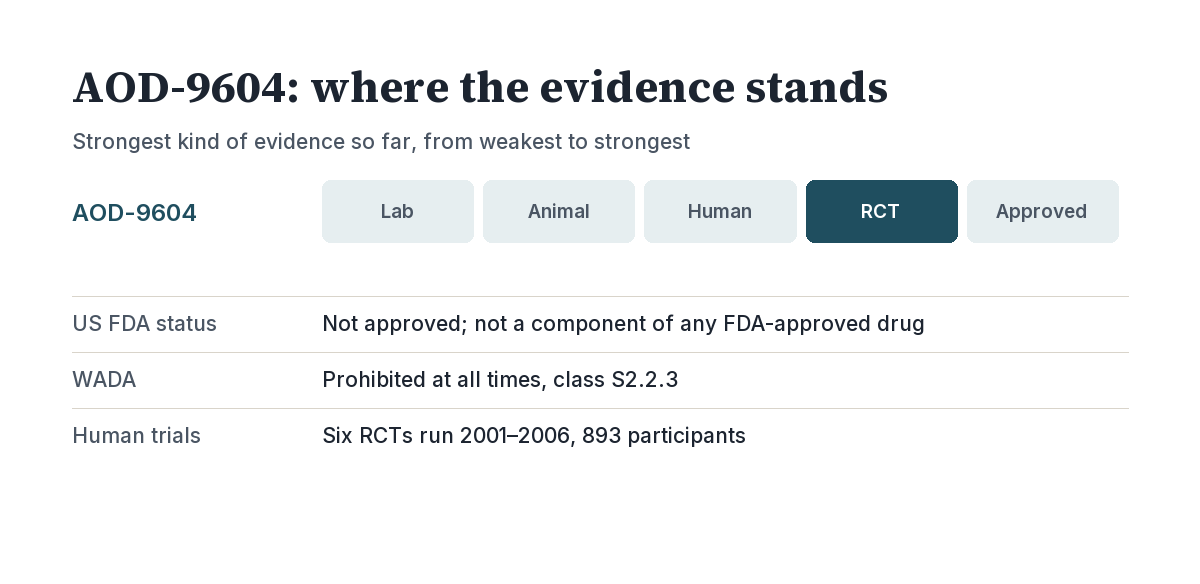
AOD-9604 is a synthetic 16-amino-acid fragment of human growth hormone (hGH 177-191 plus an extra tyrosine), developed in Australia as an oral anti-obesity drug. It is not approved by the FDA, and no approval elsewhere was found. Its strongest evidence is a set of six sponsor-run human trials: they found it well tolerated, but the largest, a 24-week phase 2b study, missed its weight-loss endpoint and development for obesity was stopped in 2007, according to FDA’s 2024 review.
| Item | Status |
|---|---|
| US FDA status | Not approved; not a component of any FDA-approved drug (FDA, Nov 2024) |
| Compounding (503A/503B) | Not on the 503A Bulks List. FDA’s advisory committee voted 12–0 against listing (0 yes, 12 no) on 2024-12-04 (minutes); FDA lists it under former Category 2 substances whose nominations were withdrawn, with stated safety risks (page current 2026-04-22) |
| WADA 2026 | Prohibited at all times, class S2.2.3 (growth hormone fragments, named) (WADA 2026 List) |
| Australia | Added to the Poisons Standard as a performance and image enhancing drug, per FDA’s 2024 review |
| Strongest evidence | Human RCTs (sponsor-funded): safety acceptable; no significant weight loss in the 502-person phase 2b trial |
| Human trials | Six RCTs run 2001–2006, 893 participants (Stier 2013); none registered on ClinicalTrials.gov (searched 2026-10-07) |
| Last checked | 2026-10-12 (status sources re-verified 2026-10-07) |
Key points:
- In obese mice and rats, AOD-9604 reduced weight gain and raised fat burning without the high blood sugar seen with full growth hormone [Animal].
- It does not bind the growth hormone receptor in cell tests, and IGF-1 did not change in the human trials.
- FDA reviewers flagged bone-marker and liver findings in animal toxicology and equivocal genotoxicity tests.
- No human data exist for injection under the skin, a form widely marketed by clinics, according to FDA’s review.
- FDA has received no adverse-event reports for it (FAERS searched through 2024-01-07), which FDA says does not mean it is safe.
What changed (October 2026): a dated table now lists AOD-9604’s trial and regulatory history, the 2027 WADA List status is added, and FDA’s compounding pages and the Federal Register were re-checked on 2026-10-26, with no new FDA action found.
| Identity | Detail |
|---|---|
| Sequence | Tyr-hGH 177-191: YLRIVQCRSVEGSCGF, disulfide bond between cysteines 7 and 14 |
| Length | 16 amino acids (hexadecapeptide) |
| Molecular formula | C78H123N23O23S2 (free base) |
| Molecular weight | 1,815.09 g/mol (free base); 1,875.1 g/mol (acetate) |
| CAS / UNII | 221231-10-3 / 7UP768IP4M (FDA notes conflicting CAS numbers in circulation) |
| PubChem CID | 71300630 |
| Half-life | About 3 minutes after IV dosing in pigs; about 4 minutes in rat blood in vitro (no human data) |
| Routes studied | Intravenous and oral in humans; oral, intravenous, intraperitoneal, infusion pump and intra-articular in animals |
| Class | Growth hormone fragment (C-terminal “lipolytic domain” analogue) |
What is AOD-9604?
AOD-9604 (Advanced Obesity Drug 9604, also written AOD9604 or Tyr-hGH 177-191) grew out of work at Monash University in Australia on the tail end of the growth hormone molecule. In 1994 that group reported that the bare 177-191 fragment reduced weight gain and fat mass in obese mice [Animal] (Natera 1994). An extra tyrosine at the front stabilizes the peptide (Stier 2013), and Metabolic Pharmaceuticals “first developed and patented” AOD-9604 in the late 1990s, as FDA’s 2024 evaluation records. By February 2002 the company had phase 2a trials underway (Wilding 2004). The WADA Prohibited List names “hGH 176-191” alongside AOD-9604 as a growth hormone fragment.
How does AOD-9604 work?
- Fat breakdown without the growth hormone receptor: in obese mice, AOD-9604 raised fat oxidation and plasma glycerol (a marker of fat breakdown), yet it did not compete for the hGH receptor or make receptor-bearing cells divide [Animal; Lab] (Heffernan, Int J Obes 2001).
- Beta-3 adrenergic link: in mice lacking the beta-3 adrenergic receptor, long-term AOD-9604 failed to change body weight or lipolysis, while it raised beta-3 receptor expression in normal obese mice, though the authors concluded the effect is not mediated directly through that receptor [Animal] (Heffernan, Endocrinology 2001).
- No growth hormone-style blood sugar effect: unlike hGH, AOD-9604 did not cause high blood sugar or lower insulin secretion in mice [Animal] (Heffernan, Int J Obes 2001), and in obese Zucker rats it left insulin sensitivity unchanged [Animal] (Ng 2000).
- No IGF-1 rise in people: serum IGF-1 did not differ from placebo across the human trials (P = 0.50844 at 12 weeks and P = 0.75754 at 24 weeks in the largest) [Human RCT, n=502] (Stier 2013).
- Unknown target: FDA’s reviewers concluded that “the molecular target(s) and the mechanism(s) of action … remain unknown” (FDA 2024).
What the research shows
| Claim | Evidence level | Best study and result |
|---|---|---|
| Weight loss in people with obesity | Human RCT (n=502): not shown | OPTIONS phase 2b, 24 weeks: weight loss vs placebo “too low to reach statistical significance” (FDA 2024) |
| Smaller weight and waist changes | Human RCT (n=300), abstract only | Herd 2005: 1 mg arm −0.22 kg/week vs placebo −0.07 kg/week; FDA located no full publication (FDA 2024) |
| Reduces weight gain in obese rodents | Animal | Ng 2000, Zucker rats: 15.8 vs 35.6 g gain over 19 days (PubMed) |
| Spares blood sugar and insulin | Animal; Human RCT (OGTT) | No glucose rise in mice (Heffernan 2001); no OGTT change in trials (Stier 2013) |
| Cartilage repair in osteoarthritis | Animal | Rabbit knee model, n=32: lower damage scores than saline (Kwon 2015) |
| Anti-aging, bone repair, skin care | None found | No study located; these are marketing uses FDA catalogued (FDA 2024) |
Weight loss. The animal findings were encouraging: in obese Zucker rats, daily oral AOD-9604 cut body weight gain by more than half over 19 days [Animal] (Ng 2000), and obese mice treated for 14 days gained significantly less weight [Animal] (Heffernan 2001). In people the signal was small. Early trials summarized by FDA showed no statistically significant weight loss versus placebo; in a one-week study the 10 mg group lost about 1 kg against 0.6 kg on placebo [Human RCT, n=36]. A 12-week trial in 300 adults was reported only as a meeting abstract, with the 1 mg arm losing 0.22 kg a week versus 0.07 kg on placebo [Human RCT, n=300] (FDA 2024). The decisive OPTIONS trial is covered below.
Joints and cartilage. In 32 rabbits with chemically induced knee osteoarthritis, weekly AOD-9604 injected into the joint lowered cartilage damage scores compared with saline, and combining it with hyaluronic acid worked better than either alone [Animal] (Kwon 2015). No human joint study was found. A 2026 narrative review of peptides used for musculoskeletal injuries, AOD-9604 among them, found favorable results in animal models but scarce human safety data and a potential for serious harm [Narrative review] (Mendias and Awan 2026).
Human studies and trials
Metabolic Pharmaceuticals funded six randomized, double-blind, placebo-controlled trials between 2001 and 2006, with 893 participants in total, and the two largest were notified to Australia’s TGA clinical trial scheme (Stier 2013). Efficacy results for the largest trial come from the company’s 2007 announcement as quoted by FDA’s 2024 review. No AOD-9604 study is registered on ClinicalTrials.gov (searched 2026-10-07), and a PubMed search the same day found no human trial published after 2013.
| Trial | Design and n | Result |
|---|---|---|
| METAOD001 | Phase 1, single IV doses, 15 healthy men | No serious adverse events; most common event headache |
| METAOD002 | Phase 2a, single IV doses, 23 obese men | Headache in 16 of 23; euphoria in 5 on AOD-9604, none on placebo |
| METAOD003 | Phase 2a, single oral doses, 17 obese men | One serious diarrhoea case judged possibly related (54 mg) |
| METAOD004 | Phase 2a, 7 days oral, 36 obese men | More headache, diarrhoea and flatulence at 54 mg |
| METAOD005 | Phase 2b, 12 weeks oral, 300 adults | Five serious adverse events (four cancers, one lipoma), judged unrelated; no IGF-1 change |
| METAOD006 (OPTIONS) | Phase 2b, 24 weeks oral, 502 randomized | Missed the 12-week weight-loss endpoint; obesity program ended 2007-02-21 |
OPTIONS was built to detect a 1.8 kg difference from placebo with 80% power, and it ran with a dietitian-supervised diet and exercise program. The company reported that weight loss versus placebo at 12 and 24 weeks “was too low to reach statistical significance” and said the results “do not support the commercial viability of the drug as a treatment for obesity”. FDA found no publication of this trial in the medical literature, and that no human data exist for the subcutaneous or topical routes now marketed.
Doses used in studies
| Route and species | Amount | Study |
|---|---|---|
| Intravenous, humans | 25–400 µg/kg, single infusions | METAOD001–002 (Stier 2013) |
| Oral, humans | 9, 27 or 54 mg (single or 7 days) | METAOD003–004 (Stier 2013) |
| Oral, humans | 1–30 mg/day for 12 weeks | METAOD005 (Stier 2013) |
| Oral, humans | 0.25, 0.5 or 1 mg/day for 24 weeks | METAOD006 (Stier 2013) |
| Oral, obese rats | 500 µg/kg/day for 19 days | Ng 2000 |
| Intra-articular, rabbits | 0.25 mg weekly | Kwon 2015 |
No established human dose exists outside approved labels.
Side effects and safety
Reported in trials. The sponsor’s pooled report describes a safety and tolerability profile “indistinguishable from placebo”, with no antibodies against the peptide and no change in IGF-1 or glucose tolerance [Human RCT, n=893 across six trials] (Stier 2013). The most common events were headache, diarrhoea and flatulence with oral dosing and headache, fatigue, low blood sugar and dizziness with IV dosing. Events judged possibly related included euphoria and one severe feeling of chest tightness after IV infusion, and one serious case of diarrhoea at 54 mg. In the 12-week trial five participants developed cancers (basal cell carcinoma, squamous cell carcinoma, breast cancer, melanoma) or a lipoma, all judged unrelated by the investigator. The authors had financial ties to the developer (a shareholding in its parent company and consulting roles), and the report gives few event-level details.
FDA’s reading. FDA’s 2024 reviewers said they had “concerns about the reports of various cancers” because the information was insufficient to judge whether they were unrelated. In animal toxicology they flagged dose-dependent changes in serum osteocalcin in rats as a possible bone-health signal, liver-cell vacuolation in monkeys after nine months as a possible liver signal, and “equivocal mutagenic signals” in genotoxicity tests [Animal; Lab]. No reproductive or cancer studies in animals were identified. A FAERS search through 2024-01-07 found no reports, which FDA says “does not imply that the substance is safe”.
Product quality and contamination. FDA warns that compounded AOD-9604 “may pose significant risk for immunogenicity for certain routes of administration”, may have problems with peptide impurities and characterization, and has been linked to serious adverse events “though causality is not clear” (FDA Category 2 page). In 2021 a compounding pharmacy recalled AOD-9604 injections for lack of sterility assurance, as recorded in an FDA warning letter. AOD-9604 has been identified in unknown preparations seized by Belgian authorities (Vanhee 2014) and in confiscated vials in the USA (Cox 2015), outside any regulated supply chain. For background, see our explainer on what a “research use only” label means.
Who should not use it. No regulator has issued a label, so there are no labelled contraindications. FDA’s review found insufficient information to support safety with long-term use.
What users report
What follows are unverified self-reports from people who usually bought unregulated products, not evidence. People who post about AOD-9604 on forums and social media most often describe it as a gentle fat-loss aid and say any change was slow and modest, often only noticeable when paired with diet changes or other compounds. Some describe less belly fat or easier weight control; many others say they noticed nothing at all, and threads asking “does AOD-9604 work” commonly end with people concluding it did little for them. Joint-pain relief is a second recurring claim, usually mentioned alongside other peptides, which makes any single effect hard to separate. Common complaints are injection-site redness or itching, headaches, cost relative to the result, and doubts about whether the vial contained what the label said. A recurring argument is whether the failed human trials matter, since the trials used oral tablets while most users now inject it; others point to the trial results as the reason they stopped.
Legal and regulatory status
| Jurisdiction | Status (checked 2026-10-07) |
|---|---|
| US, FDA approval | Not approved; no FDA-approved drug contains it |
| US, 503A compounding | Not on the 503A Bulks List; not in any 503A category on FDA’s list updated 2026-05-14 (FDA) |
| US, 503B outsourcing | No outsourcing facility reported compounding it in 2017–2023 (FDA 2024) |
| WADA (sport) | Prohibited at all times, S2.2.3 |
| WADA 2027 (from 2027-01-01) | Still prohibited at all times, S2 (USADA) |
| Australia | Poisons Standard listing as a performance and image enhancing drug (per FDA 2024) |
| EU / UK | No EMA or European Pharmacopoeia listing found in FDA’s 2024 search; no approval found |
2024-12-04, FDA advisory vote. After the original nominators withdrew, FDA evaluated AOD-9604 for the 503A Bulks List on its own initiative and recommended against it, finding “a lack of evidence to support the effectiveness” for obesity by any route (FDA briefing). The Pharmacy Compounding Advisory Committee agreed 12–0 that it should not be placed on the list (final minutes, approved 2025-02-21). FDA’s safety-risk page still lists AOD-9604 under substances “previously in category 2” whose nominations were withdrawn, with the warning that “the agency lacks sufficient information to know whether the drug would cause harm” (FDA, current 2026-04-22). AOD-9604 was not on the agenda of the July 23–24, 2026 advisory meeting (see our summary of that vote), and no later FDA action on AOD-9604 appears on FDA’s compounding pages or in the Federal Register as of 2026-10-26. Our guide to FDA’s 503A categories explains what these lists mean.
Sport. The 2026 WADA Prohibited List, in force from 1 January 2026, names “AOD-9604 and hGH 176-191” as growth hormone fragments under S2.2.3, prohibited in and out of competition. USADA’s summary of the 2027 List, in force from 1 January 2027, still lists AOD-9604 and hGH 176-191 as prohibited under S2 (USADA). See our overview of peptides banned in sport.
Dated events, as of October 2026:
| Date | Event | Source |
|---|---|---|
| 1994 | Monash University researchers report that the hGH 177-191 fragment cut weight gain in obese mice [Animal] | Natera 1994 |
| 2001–2006 | Six sponsor-funded trials in 893 people | Stier 2013 |
| 2007-02-21 | The developer says the phase 2b results do not support the drug for obesity; development ends | FDA 2024 |
| 2024-12-04 | FDA advisers vote 0 yes, 12 no on adding it to the 503A list for obesity | Minutes |
| 2026-01-01 | The 2026 WADA List names it under S2.2.3 | WADA |
| 2026-04-22 | FDA’s safety-risk page lists it among former Category 2 substances whose nominations were withdrawn | FDA |
| 2026-05-14 | FDA’s 503A category lists, updated, place it in no category | FDA |
| 2027-01-01 | The 2027 WADA List takes effect; it is still prohibited under S2 | USADA |
Related peptides
AOD-9604 is often grouped with peptides that act on the growth hormone axis, though it works differently: it is a piece of growth hormone, not a releaser of it. Tesamorelin (Egrifta) is a growth hormone-releasing hormone (GHRH) analogue. CJC-1295 was reviewed by the same advisory committee on the same day in December 2024. Ipamorelin is a ghrelin-mimetic growth hormone secretagogue.
Frequently asked questions
What is AOD-9604 used for?
AOD-9604 was developed as an oral treatment for obesity, and that is the only use tested in human trials. Today it is also marketed for joint, cartilage and anti-aging uses that have no human evidence. FDA catalogued uses including osteoarthritis, osteoporosis, diabetes and skin care on clinic websites in its 2024 review; no human trial of those uses was found on PubMed or ClinicalTrials.gov (searched 2026-10-07).
Does AOD-9604 work for weight loss?
Not in the largest human test. It reduced weight gain in obese rats and mice, but the 24-week OPTIONS trial in 502 adults found weight loss versus placebo “too low to reach statistical significance”, and the developer ended the obesity program in February 2007, according to FDA’s evaluation. Smaller trials showed only modest differences.
Is AOD-9604 the same as HGH?
No. AOD-9604 is a 16-amino-acid piece of the 191-amino-acid growth hormone molecule, covering positions 177-191 plus one tyrosine. In cell tests it did not bind the growth hormone receptor or trigger cell growth, unlike full hGH, as reported by Heffernan and colleagues in 2001. Human trials found no rise in IGF-1.
Is AOD-9604 safe?
Its safety is not established. The sponsor’s six trials, totalling 893 people, reported side effects similar to placebo over up to 24 weeks of oral use (Stier 2013). FDA reviewers, however, noted cancers reported in one trial, animal bone and liver signals, equivocal genotoxicity results and no human data for injection.
Why is AOD-9604 not approved?
Its developer terminated the obesity program in February 2007 after the phase 2b trial missed its weight-loss endpoint. In December 2024 FDA also advised against allowing it in compounding, and its advisory committee voted 12–0 against listing, as recorded in the meeting minutes. No approval by any regulator was found when this page was checked.
Is AOD-9604 banned in sport?
Yes. The 2026 WADA Prohibited List names AOD-9604 and hGH 176-191 as growth hormone fragments under class S2.2.3, banned at all times, in and out of competition, in the official list. An anti-doping laboratory has published a validated urine test for it and identified its likely breakdown products (Cox 2015). The 2027 List, in force from 1 January 2027, keeps it under S2 (USADA).
References
- US Food and Drug Administration. FDA Briefing Document, Pharmacy Compounding Advisory Committee, December 4, 2024: Evaluation of AOD-9604-related bulk drug substances. 2024. fda.gov/media/183584
- US Food and Drug Administration. Final Summary Minutes of the Pharmacy Compounding Advisory Committee Meeting, December 4, 2024 (approved February 21, 2025). fda.gov/media/185642
- US Food and Drug Administration. Certain bulk drug substances for use in compounding that may present significant safety risks. Content current as of 2026-04-22. fda.gov
- US Food and Drug Administration. Bulk drug substances nominated for use in compounding under section 503A (category lists), updated May 14, 2026. fda.gov/media/94155
- Stier H, Vos E, Kenley D. Safety and tolerability of the hexadecapeptide AOD9604 in humans. J Endocrinol Metab. 2013;3(1-2):7-15. doi:10.4021/jem157w
- Heffernan MA, Thorburn AW, Fam B, et al. Increase of fat oxidation and weight loss in obese mice caused by chronic treatment with human growth hormone or a modified C-terminal fragment. Int J Obes Relat Metab Disord. 2001;25(10):1442-9. PMID 11673763
- Heffernan M, Summers RJ, Thorburn A, et al. The effects of human GH and its lipolytic fragment (AOD9604) on lipid metabolism following chronic treatment in obese mice and beta(3)-AR knock-out mice. Endocrinology. 2001;142(12):5182-9. PMID 11713213
- Ng FM, Sun J, Sharma L, et al. Metabolic studies of a synthetic lipolytic domain (AOD9604) of human growth hormone. Horm Res. 2000;53(6):274-8. PMID 11146367
- Natera SH, Jiang WJ, Ng FM. Reduction of cumulative body weight gain and adipose tissue mass in obese mice: response to chronic treatment with synthetic hGH 177-191 peptide. Biochem Mol Biol Int. 1994;33(5):1011-21. PMID 7987248
- Kwon DR, Park GY. Effect of intra-articular injection of AOD9604 with or without hyaluronic acid in rabbit osteoarthritis model. Ann Clin Lab Sci. 2015;45(4):426-32. PMID 26275694
- Wilding J. AOD-9604 Metabolic. Curr Opin Investig Drugs. 2004;5(4):436-40. PMID 15134286
- Cox HD, Smeal SJ, Hughes CM, et al. Detection and in vitro metabolism of AOD9604. Drug Test Anal. 2015;7(1):31-8. PMID 25208511
- Vanhee C, Moens G, Deconinck E, De Beer JO. Identification and characterization of peptide drugs in unknown pharmaceutical preparations seized by the Belgian authorities: case report on AOD9604. Drug Test Anal. 2014;6(9):964-8. PMID 24976118
- World Anti-Doping Agency. Prohibited List 2026 (in force 1 January 2026). wada-ama.org
- US Food and Drug Administration. Warning letter, 2022-01-26 (compounded AOD-9604 recall for lack of sterility assurance). fda.gov
- National Library of Medicine. PubChem compound summary, CID 71300630 (AOD-9604). pubchem.ncbi.nlm.nih.gov
- ClinicalTrials.gov. Search for AOD-9604 (searched 2026-10-07). clinicaltrials.gov
- Mendias CL, Awan TM. Safety and efficacy of approved and unapproved peptide therapies for musculoskeletal injuries and athletic performance. Sports Med. 2026;56(8):1921-35. PMID 41966639
- US Anti-Doping Agency. Athlete advisory: 2027 Prohibited List. 2026-10-06. usada.org
Change log
2026-10-26: new H1; dated table of trial and regulatory events; 2027 WADA List added; FDA compounding pages and the Federal Register re-checked; 2026 narrative review added; reviewed by the editorial team.
2026-10-23: links to glossary definitions added; no change to the facts.
2026-10-18: mouse blood-sugar finding now cited to Heffernan 2001, the study that reported it; reviewed by the editorial team.
2026-10-12: links to related entries added; no change to the facts.
2026-10-12: first published after review by the editorial team.