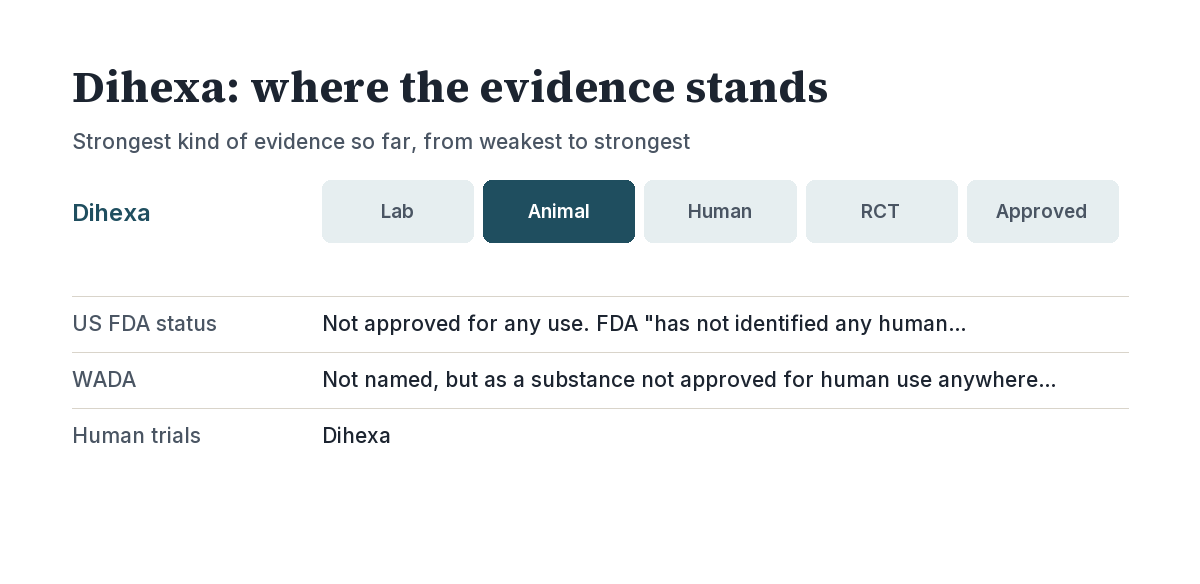
Dihexa (PNB-0408) is a small, modified peptide derived from angiotensin IV, built on two amino acids (tyrosine and isoleucine) and designed at Washington State University to act on the brain’s hepatocyte growth factor (HGF)/c-Met system. Its strongest evidence is animal work: in rats, oral dihexa completely reversed a drug-induced learning deficit and improved learning in 24-month-old rats (Animal, n=6–8 per group). Dihexa is not FDA approved, no human trial of dihexa itself was found, and FDA reports no human exposure data on any dihexa product.
| Item | Status |
|---|---|
| US FDA status | Not approved for any use. FDA “has not identified any human exposure data” on dihexa acetate products by any route (FDA, page updated 2026-04-22) |
| Compounding (503A/503B) | Formerly in FDA Category 2 (significant safety risks) for 503A; nomination withdrawn by the nominator, so no longer listed. Not on the 503A Bulks List; no next FDA step announced as of 2026-10-25 |
| WADA | Not named, but as a substance not approved for human use anywhere it falls under S0 (non-approved substances) on the 2026 List. The 2027 List (in force 2027-01-01) names “peptides” in general under S0; status unchanged: prohibited |
| Strongest evidence | Animal (rats, mice, zebrafish); two key mechanism papers retracted in 2025 |
| Human trials | Dihexa: none found on ClinicalTrials.gov (searched 2026-10-25). Its prodrug fosgonimeton: 5 registered trials; the phase 2/3 NCT04488419 missed its primary endpoint |
| Last checked | 2026-10-25 |
Key points:
- The paper that described dihexa’s HGF/c-Met mechanism was retracted in April 2025; the paper that introduced dihexa carries an expression of concern.
- Athira Pharma reported in an October 2021 SEC filing that its drug fosgonimeton (ATH-1017) “metabolizes rapidly in plasma into” dihexa.
- Fosgonimeton was well tolerated in 88 people in phase 1 but did not beat placebo on the main goal of a 312-patient Alzheimer’s trial.
- No study of a dihexa nasal spray, capsule or tablet in humans was found on PubMed (searched 2026-10-25).
- c-Met, the receptor dihexa is thought to boost, is abnormally activated in many human cancers, a theoretical risk that has not been tested for dihexa.
| Property | Value |
|---|---|
| Chemical name | N-hexanoic-Tyr-Ile-(6) aminohexanoic amide |
| Code name | PNB-0408 |
| Molecular formula | C27H44N4O5 |
| Molecular weight | 504.7 g/mol |
| PubChem CID | 129010512 |
| Half-life | 12.68 days IV, 8.83 days IP (rats; paper under expression of concern) |
| Routes studied | Oral, IV, IP, intracerebroventricular (animals only) |
| Class | Angiotensin IV analog; proposed HGF/c-Met modulator |
What is dihexa?
Dihexa grew out of work on angiotensin IV (AngIV), a six-amino-acid fragment of the blood-pressure hormone angiotensin. AngIV-related peptides had long been studied as memory-enhancing agents, but they broke down quickly and could not cross the gut or the blood-brain barrier. A Washington State University group led by Joseph Harding found that the activity sat in the first three amino acids of an AngIV analog, then modified that core into a smaller, more stable molecule named dihexa, reported in 2013 (Animal). Athira Pharma, which exclusively licensed dihexa from the university, sought to develop it from 2011 to 2015 before moving to a prodrug, fosgonimeton.
Is dihexa a peptide? Strictly, it is a peptidomimetic: two standard amino acids (tyrosine and isoleucine) capped with a hexanoyl group at one end and a 6-aminohexanoic amide at the other, per its PubChem record.
How does dihexa work?
- HGF/c-Met activation: dihexa was reported to bind HGF and switch on its receptor, c-Met, but that paper was retracted in 2025, as was a related 2012 paper on AngIV analogs as HGF/Met modifiers (Lab and Animal, retracted).
- New synapses: in lab experiments, dihexa showed “marked synaptogenic activity”, meaning it promoted the formation of new connections between neurons, according to the 2013 founding paper (Lab; expression of concern).
- Brain entry: after dosing in rats, “all of the brain regions examined avidly concentrated dihexa”, evidence it crosses the blood-brain barrier (Animal; same paper).
- PI3K/AKT signaling and inflammation: in Alzheimer’s-model mice, dihexa lowered the inflammatory signals IL-1β and TNF-α and raised IL-10, effects the authors tied to the PI3K/AKT pathway (Animal).
- Use as a MET modulator by another group: a 2025 rat study from a separate laboratory used dihexa as “a positive modulator of MET” and saw a dose-dependent effect on memory, though it did not test the mechanism itself (Animal).
Nothing in the published research cited here describes dihexa as a stimulant; the proposed mechanism is growth-factor signaling, not the dopamine or norepinephrine release typical of stimulants.
Benefits of dihexa: what the research shows
The most promising potential benefit of dihexa is restoring memory in models of brain aging and injury. In rats, an oral dose of 2 mg/kg reversed a scopolamine-induced learning deficit (n=8 per group) and improved maze learning in 24-month-old rats (n=6 per group). In rats with repeated mild brain injury, the highest dose of dihexa infused into the brain gave working-memory scores of 81.5% against 67.1% with vehicle, with a pre-injury baseline of 77.4%. Every one of these results is from animals; no benefit has been shown in people.
| Claim | Evidence level | Best study and result |
|---|---|---|
| Reverses drug-induced memory loss | Animal | McCoy 2013, rats, n=8/group: oral 2 mg/kg fully reversed scopolamine deficit (P<0.001); expression of concern |
| Improves memory in aging | Animal | McCoy 2013, 24-month-old rats, n=6/group: better maze learning on most days (P<0.05) |
| Alzheimer’s-model memory | Animal | Sun 2021, APP/PS1 mice: restored spatial learning, lowered IL-1β and TNF-α |
| Memory after brain injury | Animal | Martino 2025, rats, n=52: working memory 81.5% vs 67.1% vehicle |
| Nerve repair | Animal | Weiss 2021, rats: stem cells plus dihexa improved limb function at 8–16 weeks |
| Hearing-cell protection | Animal | Uribe 2015, zebrafish: 1 μM protected hair cells from aminoglycosides |
| Parkinson’s motor symptoms | Animal (review) | Wright 2015: review by the developing lab; no independent data found |
| Huntington’s-like symptoms | Animal (negative) | Wells 2024, 40 rats: no protection |
| Cognition in people | No data | No human study of dihexa found (PubMed, ClinicalTrials.gov, 2026-10-25) |
Memory and dementia models
Dihexa’s case rests on dementia models. The founding study described “excellent antidementia activity in the scopolamine and aged rat models” (Animal), and a later group outside the original lab found that dihexa restored water-maze learning in APP/PS1 mice, a strain bred to develop Alzheimer’s-like amyloid plaques, while increasing neuron counts and the synaptic protein synaptophysin (Animal). A 2018 systematic review found that eight of nine animal studies of AngIV and its analogs, including dihexa, improved spatial working memory or passive-avoidance learning, while noting the peptides worked best when given directly into the brain near the time of learning (Animal). The developing lab’s 2015 review called dihexa “orally active” and able to penetrate the blood-brain barrier.
Brain injury
The 2025 traumatic brain injury study is one of the more encouraging results because it came from a separate group. In 33 male and 19 female rats given repeated closed-head impacts, dihexa infused into the brain at 1 nmol per day brought working memory back to slightly above pre-injury levels (Animal). Because it was given directly into the brain, the study says little about pills or sprays.
Nerves, hearing and other models
Beyond the brain, dihexa combined with mesenchymal stem cells improved limb function after sciatic nerve repair in rats, and in zebrafish it protected the hair cells of the lateral line, which resemble inner-ear cells, from aminoglycoside antibiotics (both Animal). Not every model has responded: in a 2024 study of 40 rats, dihexa “did not protect rats from the deficits” of a Huntington’s-like toxin (Animal).
The retractions
Much of the early dihexa literature comes from one laboratory, and part of it has been withdrawn. In October 2021, an Athira board committee concluded that the company’s former chief executive, Leen Kawas, “altered images in her 2011 doctoral dissertation and at least four research papers” co-authored at Washington State University and published from 2011 to 2014, and that the university’s dihexa patent incorporates images from her papers, “certain of which were altered” (Athira 8-K). The Journal of Pharmacology and Experimental Therapeutics retracted the 2014 mechanism paper and a 2012 HGF/Met paper in April 2025, and the 2013 founding paper carries a 2021 expression of concern. The behavioral findings in that founding paper have not been retracted, and the mouse and rat studies from other groups stand on their own.
Human studies and trials
No completed or registered human trial of dihexa itself was found on ClinicalTrials.gov or PubMed (searched 2026-10-25). The closest human evidence comes from fosgonimeton (ATH-1017), which Athira described as a prodrug that “metabolizes rapidly in plasma into” dihexa (Athira 8-K). Its results do not automatically transfer to dihexa sold as capsules or sprays, which differ in route, purity and dose.
| Study (fosgonimeton) | Design and n | Status and result |
|---|---|---|
| Phase 1, Hua 2022 | Placebo-controlled, n=88 (48 young, 29 elderly, 11 with Alzheimer’s) | Completed; “safe and well-tolerated across all doses”; P300 brain-wave latency improved in Alzheimer’s group (p=0.027) |
| NCT04491006 (ACT-AD) | Phase 2, n=77, daily injection vs placebo | Completed 2022-05-20; results posted |
| NCT04488419 (LIFT-AD) | Phase 2/3; 554 enrolled; 312 in topline analysis, 40 mg daily, 26 weeks | Completed; missed primary endpoint (p=0.70) |
| NCT04886063 | Phase 2/3 open-label extension, n=423 | Terminated 2024 after LIFT-AD missed its endpoint |
| NCT04831281 (SHAPE) | Phase 2, Parkinson’s dementia / Lewy body, n=28 | Terminated; “study design limitations” |
| NCT05511558 | Phase 1 metabolism study, n=8 | Completed |
In the largest trial, LIFT-AD, fosgonimeton produced a “-0.08 change in GST favoring fosgonimeton that did not reach statistical significance (p=0.70)”, where GST is a combined score of cognition and daily function, according to Athira’s September 2024 release (Human RCT, n=312). The drug was “generally well tolerated”, with more adverse events than placebo, “mainly driven by injection site reactions”.
Doses used in studies
| Route and amount | Species | Study |
|---|---|---|
| Oral, 1.25 and 2.0 mg/kg | Rat | McCoy 2013 |
| IP, 0.05–0.50 mg/kg; IV, 10 mg/kg | Rat | McCoy 2013 |
| Into the brain, 1 pmol or 1 nmol per day | Rat | Martino 2025 |
| 1 μM in water | Zebrafish | Uribe 2015 |
| Fosgonimeton (prodrug), injection, 2–90 mg | Human | Hua 2022 |
No established human dose exists outside approved labels.
Side effects and safety: is dihexa safe?
Reported adverse effects: none have been published for dihexa in people, because no human study of dihexa was found. FDA states it “lacks important information regarding any safety issues raised by dihexa acetate, including whether it would cause harm if administered to humans” (FDA).
Prodrug data: fosgonimeton, which turns into dihexa in the blood, was well tolerated in a phase 1 study of 88 people, and the main side-effect signal in the 26-week LIFT-AD trial was injection-site reactions (Athira) (Human RCT). These were short trials of a pharmaceutical-grade drug under medical supervision.
Theoretical cancer risk: c-Met signaling drives “proliferation, motility, migration and invasion”, and the pathway is abnormally activated in human cancers through mutation, amplification or overexpression (Organ and Tsao 2011, review). A drug that boosts c-Met could in principle feed an existing tumor. This is reasoning from the mechanism; no study found has tested it for dihexa.
Long half-life: in rats, dihexa’s elimination half-life was reported as 12.68 days after IV dosing (McCoy 2013, Animal), so any effect, wanted or not, could persist for weeks. That paper reported no toxicity data.
Product quality: dihexa sold online is not an approved drug, so nothing ensures its identity, purity or dose. How FDA treats unapproved “research use only” products is covered in our explainer on what the research-use-only label means.
Who should avoid it: no regulator has issued dihexa-specific guidance beyond noting the absence of human data. Given the c-Met mechanism, people with a current or past cancer face the clearest theoretical risk, and competitive athletes face an anti-doping violation.
Anyone who suspects a side effect from dihexa or any other drug or product can report it to the FDA through MedWatch.
What users report
What follows are unverified self-reports from people who usually bought unregulated products; they are not evidence. People who post about dihexa on forums, Reddit and YouTube most often describe sharper recall, easier word-finding and better focus, usually noticed within days to a couple of weeks, and some say effects lingered for weeks after stopping, which they link to the long half-life. Others report no noticeable effect at all. Recurring complaints include headaches, irritability, poor sleep and an anxious or overstimulated feeling, although no study classifies dihexa as a stimulant. A frequent worry is cancer risk because of the c-Met mechanism, and threads often argue about whether that risk matters for healthy people. Posters also debate whether oral, capsule, cream or nasal-spray products work at all, whether vendor products contain what the label says, and how dihexa compares with Semax or Cerebrolysin. Several discussions mention the 2025 retractions and question how much of the original research can be trusted.
Is dihexa legal? Regulatory status
| Jurisdiction | Status (checked 2026-10-25) |
|---|---|
| US FDA | Not approved; no human exposure data identified by FDA |
| US compounding | Removed from Category 2 after the nominator withdrew it; not on the 503A Bulks List |
| WADA 2026 List | S0 non-approved substance (not named) |
| WADA 2027 List | S0; “peptides” now named in S0; in force 2027-01-01 |
In US compounding law, FDA’s Category 2 holds nominated substances where “FDA has identified significant safety risks relating to the use of these substances in compounding pending further evaluation”. Dihexa acetate was in that category until its nominator withdrew the nomination; it now sits under the withdrawn nominations on FDA’s Category 2 page, alongside peptides such as GHK-Cu (copper peptide) and AOD-9604, the HGH fragment. Removal is not approval. What the categories mean is set out in Category 1 vs Category 2 peptides.
For athletes, USADA defines S0 as substances “not approved by any government regulatory authority” for human use (USADA), which covers dihexa. USADA’s 2027 advisory adds that “even if a peptide is not named” on the List, it “may still be prohibited”. More detail is in our page on WADA-banned peptides in 2027. No dihexa-specific ruling from UK, EU, Australian or Canadian regulators was found in this review (2026-10-25).
Related peptides
- Semax: an ACTH(4-7)-derived neuropeptide studied for cognition.
- Cerebrolysin: a brain-derived peptide preparation licensed outside the US.
- Pinealon: a short bioregulator peptide from ageing research.
- Selank: a tuftsin-derived peptide studied for anxiety and cognition.
Frequently asked questions
Is dihexa safe?
Its safety in people is unknown. No human study of dihexa itself was found, and FDA says it lacks information on “whether it would cause harm if administered to humans”. Its prodrug fosgonimeton was well tolerated in trials, mainly causing injection-site reactions (Athira), but the c-Met pathway dihexa targets is abnormally activated in many cancers, a theoretical risk that has not been studied (Organ and Tsao 2011).
Is dihexa FDA approved or legal?
Dihexa is not FDA approved for any use. It was in FDA’s Category 2 of compounding substances with safety risks until its nominator withdrew it, which did not make it approved or add it to the 503A Bulks List. For athletes, it falls under WADA’s S0 class of non-approved substances, which USADA describes as prohibited.
Is dihexa a peptide or a nootropic?
Dihexa is a modified peptide, or peptidomimetic: two amino acids, tyrosine and isoleucine, with chemical caps on each end, derived from angiotensin IV. It is often called a nootropic because it was developed as a memory-enhancing drug, and in rats it reversed drug-induced learning deficits, but it has no proven cognitive effect in people.
Is dihexa a stimulant?
No published study cited here classifies dihexa as a stimulant. Its proposed mechanism is boosting the HGF/c-Met growth-factor system to encourage new connections between neurons, not releasing dopamine or norepinephrine. A 2015 review by the developing lab described it as a compound that facilitates memory consolidation and retrieval in animals, a different profile from stimulants.
Has dihexa been tested as a nasal spray or capsule?
No human study of a dihexa nasal spray, capsule or tablet was found on PubMed or ClinicalTrials.gov (searched 2026-10-25). The only oral data come from rats, where dihexa given by stomach tube at 2 mg/kg improved memory. The human trials used a different molecule, the injected prodrug fosgonimeton (NCT04488419).
References
- McCoy AT, Benoist CC, Wright JW, et al. (2013). Evaluation of metabolically stabilized angiotensin IV analogs as procognitive/antidementia agents. J Pharmacol Exp Ther 344(1):141-54. Expression of concern 2021. PMC3533412
- Benoist CC, Kawas LH, Zhu M, et al. (2014). The procognitive and synaptogenic effects of angiotensin IV-derived peptides are dependent on activation of the hepatocyte growth factor/c-met system. J Pharmacol Exp Ther 351(2):390-402. Retracted 2025. PubMed 25187433
- Kawas LH, et al. (2012). Development of angiotensin IV analogs as hepatocyte growth factor/Met modifiers. J Pharmacol Exp Ther. Retracted 2025. PubMed 22129598
- McCoy AT, et al. (2013), expression of concern record. PubMed 23055539
- Athira Pharma, Inc. (2021-10-21). Form 8-K. US Securities and Exchange Commission. sec.gov
- Sun X, Deng Y, Fu X, et al. (2021). AngIV-analog dihexa rescues cognitive impairment and recovers memory in the APP/PS1 mouse via the PI3K/AKT signaling pathway. Brain Sci 11(11):1487. PubMed 34827486
- Martino KA, Nakhre A, Demarest RM, Devilbiss DM (2025). Hepatocyte growth factor/MET activator rescues working memory deficits after repeated mild traumatic brain injury. Neurotrauma Rep 6(1):991-998. PMC13629188
- Weiss JB, Phillips CJ, Malin EW, et al. (2021). Stem cell, granulocyte-colony stimulating factor and/or dihexa to promote limb function recovery in a rat sciatic nerve damage-repair model. Ann Med Surg 71:102917. PubMed 34703584
- Uribe PM, Kawas LH, Harding JW, Coffin AB (2015). Hepatocyte growth factor mimetic protects lateral line hair cells from aminoglycoside exposure. Front Cell Neurosci 9:3. PubMed 25674052
- Wells RG, Azzam AF, Hiller AL, Sardinia MF (2024). Effects of an angiotensin IV analog on 3-nitropropionic acid-induced Huntington’s disease-like symptoms in rats. J Huntingtons Dis 13(1):55-66. PubMed 38489193
- Wright JW, Kawas LH, Harding JW (2015). The development of small molecule angiotensin IV analogs to treat Alzheimer’s and Parkinson’s diseases. Prog Neurobiol. PubMed 25455861
- Wright JW, Harding JW (2015). The brain hepatocyte growth factor/c-Met receptor system: a new target for the treatment of Alzheimer’s disease. J Alzheimers Dis. PubMed 25649658
- Ho JK, Nation DA (2018). Cognitive benefits of angiotensin IV and angiotensin-(1-7): a systematic review of experimental studies. Neurosci Biobehav Rev. PMC8916541
- Organ SL, Tsao MS (2011). An overview of the c-MET signaling pathway. Ther Adv Med Oncol 3(1 Suppl):S7-S19. PMC3225017
- Hua X, Church K, Walker W, et al. (2022). Safety, tolerability, pharmacokinetics, and pharmacodynamics of the positive modulator of HGF/MET, fosgonimeton, in healthy volunteers and subjects with Alzheimer’s disease. J Alzheimers Dis 86(3):1399-1413. PubMed 35180125
- Athira Pharma (2024-09-03). Topline results from phase 2/3 LIFT-AD clinical trial of fosgonimeton (Exhibit 99.1). sec.gov
- ClinicalTrials.gov. NCT04488419 (LIFT-AD). clinicaltrials.gov
- ClinicalTrials.gov. NCT04491006 (ACT-AD). clinicaltrials.gov
- ClinicalTrials.gov. NCT04886063 (open-label extension). clinicaltrials.gov
- ClinicalTrials.gov. NCT04831281 (SHAPE). clinicaltrials.gov
- ClinicalTrials.gov. NCT05511558 ([14C]-fosgonimeton metabolism study). clinicaltrials.gov
- ClinicalTrials.gov. Search: dihexa (searched 2026-10-25). clinicaltrials.gov
- US Food and Drug Administration. Certain bulk drug substances for use in compounding that may present significant safety risks (updated 2026-04-22). fda.gov
- US Food and Drug Administration. Bulk drug substances used in compounding under section 503A of the FD&C Act (updated 2026-05-14). fda.gov
- USADA. #AskUSADA: What is a non-approved substance and why are they prohibited? usada.org
- USADA. Athlete advisory: what’s new on the 2027 WADA Prohibited List? usada.org
- PubChem. Dihexa, CID 129010512. National Library of Medicine. pubchem.ncbi.nlm.nih.gov
Change log
2026-10-26: links to related entries added; no change to the facts.
2026-10-25: first published after review by the editorial team.