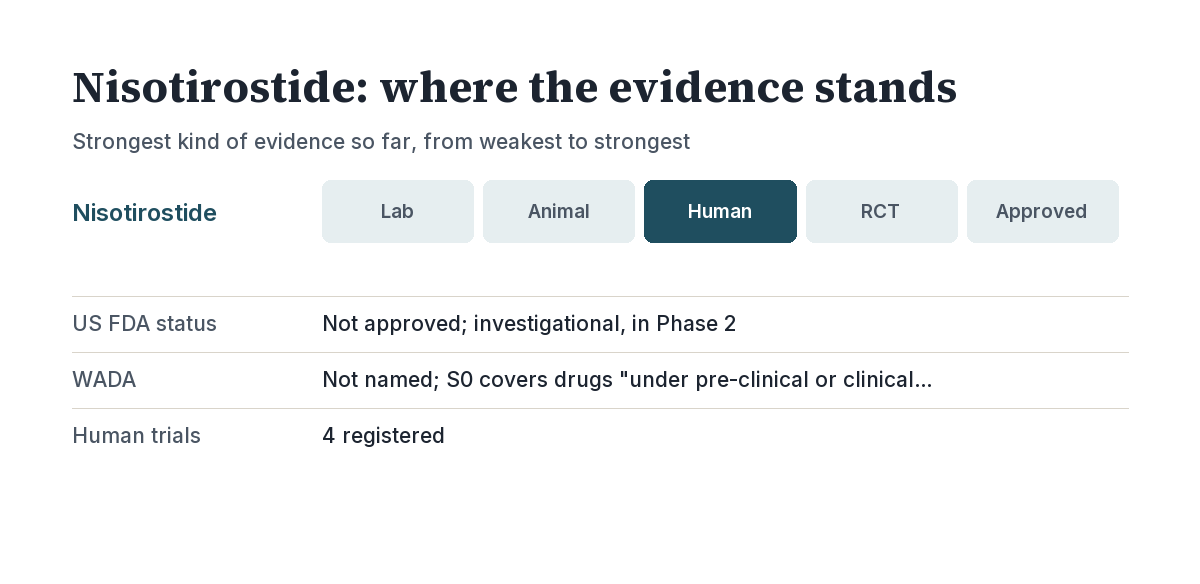
Nisotirostide (LY3457263) is an investigational once-weekly injectable peptide from Eli Lilly that selectively activates the NPY2 receptor, the receptor used by the gut hormone PYY. It is being developed as an add-on to GLP-1 drugs for type 2 diabetes and obesity. It is not FDA approved. The strongest evidence is a Phase 1 study (N=65): added to dulaglutide, a single dose produced up to 2.58 kg more weight loss than dulaglutide alone (Briere et al., 2026).
| Item | Status |
|---|---|
| US FDA status | Not approved; investigational, in Phase 2 (NCT06897475) as of 2026-10-05 |
| Compounding (503A/503B) | Not named on FDA’s 503A category pages (FDA, current 2026-05-14; Category 2 page, 2026-04-22), checked 2026-10-05 |
| WADA 2026 | Not named; S0 covers drugs “under pre-clinical or clinical development” with no approval, prohibited at all times (WADA) |
| Strongest evidence | Human Phase 1 (N=65), single doses; abstract only, no posted registry results |
| Human trials | 4 registered: 3 completed Phase 1 (NCT04641312, NCT05377333, NCT05582096), 1 recruiting Phase 2 |
| Next readout | Phase 2 primary completion May 2027 (estimated, per registry) |
| UK | Investigational; UK Phase 2 sites, ethics favourable opinion 2025-06-19 (HRA) |
| Last checked | 2026-10-05 |
Key points:
- On its own, a 1 mg dose lowered body weight by 0.75 kg versus placebo, a difference that was not statistically significant [Human, Phase 1].
- In mice, it cut body weight by up to 12% alone and up to 31% with a GLP-1 drug, and improved glucose control independent of weight loss [Animal].
- Nausea and vomiting were the most common side effects in people; they were dose-dependent and mild to moderate.
- Two other completed Phase 1 trials (with dulaglutide and with tirzepatide) have no results posted as of 2026-10-05.
- It cannot be obtained legally outside a clinical trial; there is no approved product.
| Property | Detail |
|---|---|
| Names | Nisotirostide (INN); LY3457263, LY-3457263 (FDA GSRS) |
| Molecular formula | C230H343N59O65 (PubChem) |
| Molecular weight | About 4,975 g/mol (PubChem) |
| CAS number | 2663844-45-7 (FDA GSRS) |
| FDA UNII | 3R5UFO57X5 |
| PubChem CID | 171921325 and 171118544 (two records) |
| Half-life | Not published; Phase 1 PK “supported a once-weekly dosing regimen” |
| Route studied | Subcutaneous injection |
| Class | Selective NPY2 receptor agonist |
| Developer | Eli Lilly and Company |
What is nisotirostide?
Nisotirostide is a synthetic peptide drug candidate from Eli Lilly, registered under the code LY3457263 and the international nonproprietary name nisotirostide (FDA GSRS). Its developers describe it as “a novel selective NPY2 receptor agonist under development as adjunctive therapy for people with type 2 diabetes (T2D) on glucagon-like peptide-1 receptor agonists” (Briere et al., 2026). In other words, it is meant to be used alongside a GLP-1 drug such as semaglutide, tirzepatide or dulaglutide rather than replace one. Human testing began with a single-dose study that started in November 2020 (NCT04641312). The first peer-reviewed results appeared in Molecular Metabolism on 2026-10-03, and a Phase 2 trial has been recruiting since March 2025 (NCT06897475).
How does nisotirostide work? (mechanism of action)
The NPY2 receptor (also written Y2R) is one of the receptors for neuropeptide Y and for peptide YY (PYY), a hormone released by the gut after meals. Nisotirostide’s mechanism of action is to activate this receptor selectively; how much of the known PYY biology carries over to it is still being tested.
- Selective NPY2 activation: nisotirostide “potently and selectively activated NPY2 receptor signaling in vitro” [Lab] (Briere et al., 2026). The abstract does not give the potency figures.
- Appetite pathway: the natural hormone PYY(3-36) reduces food intake through this receptor; it cut food intake in normal mice but not in mice lacking the Y2 receptor [Animal] (Batterham et al., 2002).
- Appetite in people: an infusion of PYY(3-36) cut calorie intake at a buffet lunch by 30% in obese and 31% in lean volunteers [Human RCT, crossover, n=24] (Batterham et al., 2003). This was the natural hormone, not nisotirostide.
- Add-on to GLP-1 drugs: in mice, nisotirostide plus a GLP-1 drug reduced body weight by up to 31%, compared with up to 12% for nisotirostide alone, which the authors describe as synergism [Animal] (Briere et al., 2026).
- Glucose control: nisotirostide-treated mice “showed improved glucose control, independent of weight loss” [Animal] (Briere et al., 2026).
What the research shows
| Claim | Evidence level | Best study and result |
|---|---|---|
| Selectively activates NPY2 | Lab (in vitro) | Briere 2026: potent, selective NPY2 signaling; figures not in abstract |
| Reduces body weight alone | Animal; Human Phase 1 | Briere 2026: up to 12% in mice; 1 mg in people: −0.75 kg vs placebo, not significant |
| Adds weight loss to a GLP-1 drug | Human Phase 1 (N=65) | Briere 2026: up to −2.58 kg vs dulaglutide alone (p<0.05); mice: up to 31% |
| Improves glucose control | Animal | Briere 2026: better glucose control in mice, independent of weight loss; human figures not in abstract |
| Lowers HbA1c in type 2 diabetes | Untested (trial ongoing) | NCT06897475: HbA1c change at week 24, n≈200, due 2027 |
| Once-weekly dosing is feasible | Human Phase 1 | Briere 2026: PK “supported a once-weekly dosing regimen” |
| Works with tirzepatide | No published data | NCT05582096: completed, n=38, no results posted |
Body weight
The most encouraging human finding is the add-on effect. In the Phase 1 study, participants with type 2 diabetes already on dulaglutide 1.5 mg once weekly received a single subcutaneous dose of nisotirostide, and weight fell by up to 2.58 kg more than with dulaglutide alone (p<0.05) [Human, Phase 1, N=65] (Briere et al., 2026). On its own, 1 mg reduced mean weight by 0.75 kg versus placebo, which was not statistically significant. That pattern matches the mouse data, where the combination with a GLP-1 drug (up to 31%) far exceeded nisotirostide alone (up to 12%) [Animal]. These are short single-dose results; the abstract gives no figure for weight loss sustained over months.
Blood glucose
In mice, nisotirostide improved glucose control independent of weight loss [Animal], and the authors conclude that “preclinical metabolic benefits, including weight-independent glucose improvements, translated clinically” (Briere et al., 2026). The abstract does not report the human glucose or HbA1c figures behind that statement. The registered Phase 2 trial will test HbA1c directly in people whose diabetes is not at goal on semaglutide or tirzepatide (NCT06897475).
Why PYY-type drugs are of interest
The appetite effect of the NPY2 pathway has been studied in people for two decades. In a double-blind crossover study, PYY(3-36) infusion lowered buffet-lunch calorie intake by 30% in 12 obese and 31% in 12 lean subjects [Human RCT, n=24] (Batterham et al., 2003). A later dose-ranging study found the effect was only significant at pharmacologic blood levels and that nausea was the most common side effect [Human RCT, healthy men] (Degen et al., 2005). Nisotirostide’s add-on design is one way of testing this pathway next to GLP-1 drugs.
Human studies and trials
A search of ClinicalTrials.gov on 2026-10-05 found four registered trials of LY3457263 (none listed under the name nisotirostide), all sponsored by Eli Lilly. A PubMed search the same day found one indexed paper (Briere et al., 2026), which reports NCT04641312.
| Trial | Design and n | Status and result |
|---|---|---|
| NCT04641312 | Phase 1 single ascending dose; healthy adults and T2D on dulaglutide; n=67 enrolled | Completed 2021-12; published 2026 (N=65 analysed): see results above |
| NCT05377333 | Phase 1 multiple ascending dose; T2D, alone or with dulaglutide; n=94 | Completed 2023-11; no results posted |
| NCT05582096 | Phase 1 multiple doses with tirzepatide; overweight or obesity; n=38 | Completed 2023-06; no results posted |
| NCT06897475 | Phase 2, 3 dose arms vs placebo; T2D on semaglutide or tirzepatide; n≈200 | Recruiting; primary completion May 2027 (est.) |
The registry lists 67 enrolled in NCT04641312, while the paper reports N=65; the abstract does not explain the difference. In the UK, the Phase 2 study received a favourable ethics opinion on 2025-06-19 and plans about 40 of its roughly 200 participants there, each taking part for up to 40 weeks (HRA). Readers following Lilly’s other incretin programs can compare this early stage with the retatrutide approval timeline and Phase 3 readouts.
Doses used in studies
| Route and amount | Species | Study |
|---|---|---|
| Subcutaneous, single dose 0.025 to 1 mg | Human (healthy and T2D) | Briere 2026 (NCT04641312) |
| Background: dulaglutide 1.5 mg once weekly | Human (T2D) | Briere 2026 |
| Subcutaneous, once weekly, 3 dose levels (amounts not posted) | Human (T2D) | NCT06897475 |
The mouse doses are not given in the abstract. No established human dose exists outside approved labels.
Side effects and safety
Reported in people: “Gastrointestinal adverse events, such as nausea and vomiting, were the most commonly reported with nisotirostide; these were dose-dependent and mild-to-moderate in severity” [Human, Phase 1, N=65] (Briere et al., 2026). The abstract gives no per-dose rates and no serious adverse event count. The authors call the tolerability profile “manageable”.
Plausible risks from the drug class: nausea was also the most common side effect of the natural hormone PYY(3-36), especially at the highest dose [Human RCT] (Degen et al., 2005). Because GLP-1 drugs are also given in these trials, whether stomach side effects add up when the two are combined over months is an open question for the Phase 2 trial.
Unknowns: all published human exposure is single doses in 65 people. Results from the two multiple-dose Phase 1 trials have not been posted (NCT05377333, NCT05582096, checked 2026-10-05). Long-term safety, effects in pregnancy and drug interactions beyond GLP-1 drugs have not been reported in the published abstract.
Unregulated products: any nisotirostide sold outside a trial is unapproved, and its identity, purity and dose cannot be verified. FDA has warned companies that illegally sold related investigational weight-loss drugs “falsely labeled ‘for research purposes’ or ‘not for human consumption’” (FDA, 2026); that page does not name nisotirostide. No label or regulator has issued contraindications, because there is no approved product.
Legal and regulatory status
| Jurisdiction | Status (checked 2026-10-05) |
|---|---|
| US FDA | Not approved; investigational, Phase 2 (NCT06897475) |
| US compounding | Not named on FDA’s 503A categories page (current 2026-05-14) or Category 2 page (2026-04-22) |
| WADA 2026 | Not named; falls within S0 non-approved substances, prohibited at all times (WADA) |
| UK | Investigational; Phase 2 sites with ethics approval 2025-06-19 (HRA) |
FDA says it “does not intend to place bulk drug substances nominated on or after January 7, 2025, into these categories” (FDA). What those categories mean is explained in our guide to Category 1 vs Category 2 peptides and FDA’s 503A lists. For athletes, WADA’s S0 class covers any substance with “no current approval by any governmental regulatory health authority for human therapeutic use (e.g. drugs under pre-clinical or clinical development…)” (WADA); nisotirostide has no such approval. No EU, Australian or Canadian authorization was found in the sources checked on 2026-10-05; the registered trials are the only lawful route to the drug.
Related peptides
- Retatrutide (LY3437943): Lilly’s investigational GIP, GLP-1 and glucagon receptor agonist.
- CagriSema (cagrilintide + semaglutide): another approach that pairs a second gut-hormone pathway (amylin) with a GLP-1 drug.
What users report
These are unverified self-reports from people who usually bought unregulated products, not evidence. First-hand accounts of nisotirostide are rare compared with retatrutide or tirzepatide, and most public mentions are reactions to the October 2026 Phase 1 paper rather than descriptions of personal use. The discussion mainly happens in GLP-1 and weight-loss communities, where people already on semaglutide or tirzepatide ask whether an NPY2 drug could add to their results once weight loss slows. The most common argument is over whether the 2.58 kg single-dose difference is meaningful: some read it as a modest early signal, while others point to the much larger mouse result and expect more from repeated dosing. Nausea comes up often, with posters noting that it is the same complaint GLP-1 drugs cause. A recurring caution is that material sold under the name has no approved reference product, so its identity and purity cannot be checked, and some say they will wait for the Phase 2 results.
Frequently asked questions
What is nisotirostide’s mechanism of action?
Nisotirostide is a selective agonist of the NPY2 receptor, the receptor through which the gut hormone PYY(3-36) reduces appetite. In vitro it “potently and selectively activated NPY2 receptor signaling” (Briere et al., 2026). It is designed to be added to a GLP-1 drug, which acts on a different receptor, rather than to replace it.
Is nisotirostide FDA approved?
No. As of 2026-10-05 nisotirostide is investigational, with a Phase 2 trial in type 2 diabetes still recruiting about 200 participants. Its primary outcome is the change in HbA1c at week 24, with primary completion estimated for May 2027 (NCT06897475). There is no approved product in the US.
How much weight loss did nisotirostide cause in trials?
In a single-dose Phase 1 study of 65 people, 1 mg alone reduced mean body weight by 0.75 kg versus placebo, which was not statistically significant. Added to dulaglutide, it produced up to 2.58 kg more weight loss than dulaglutide alone (p<0.05), according to the same Briere et al. (2026) report. Longer trials have not reported results.
Is nisotirostide the same as PYY?
No. PYY is a natural gut hormone, while nisotirostide is a synthetic drug candidate that acts selectively on one of PYY’s receptors, NPY2, with pharmacokinetics that supported once-weekly dosing. Natural PYY(3-36) cut food intake in normal mice but not in mice lacking that receptor (Batterham et al., 2002).
Is nisotirostide banned in sport?
It is not named on WADA’s 2026 Prohibited List, but the S0 class covers substances with no government approval for human therapeutic use, including drugs “under pre-clinical or clinical development”. Nisotirostide has no such approval, so S0 applies, and S0 substances are prohibited at all times (WADA).
References
- Briere DA, Leohr JK, Linnebjerg H, et al. (2026). Nisotirostide (LY3457263), a novel NPY2 receptor agonist for type 2 diabetes and obesity: from discovery to clinical proof of concept. Molecular Metabolism. PMID 42829171; doi:10.1016/j.molmet.2026.102452
- Eli Lilly and Company. A Study of LY3457263 in Healthy Participants and Participants With Type 2 Diabetes. ClinicalTrials.gov NCT04641312
- Eli Lilly and Company. A Study of LY3457263 Alone and in Combination With Dulaglutide (LY2189265) in Participants With Type 2 Diabetes. ClinicalTrials.gov NCT05377333
- Eli Lilly and Company. A Study of LY3457263 in Obese Participants. ClinicalTrials.gov NCT05582096
- Eli Lilly and Company. A Study of LY3457263 Compared With Placebo in Participants With Type 2 Diabetes on a Stable Dose of Semaglutide or Tirzepatide. ClinicalTrials.gov NCT06897475
- Health Research Authority (UK). GZFD LY3457263 research summary, IRAS 1011791. hra.nhs.uk
- US FDA. Global Substance Registration System: nisotirostide, UNII 3R5UFO57X5. precision.fda.gov
- National Center for Biotechnology Information. PubChem: nisotirostide. pubchem.ncbi.nlm.nih.gov
- Batterham RL, Cowley MA, Small CJ, et al. (2002). Gut hormone PYY(3-36) physiologically inhibits food intake. Nature. PMID 12167864
- Batterham RL, Cohen MA, Ellis SM, et al. (2003). Inhibition of food intake in obese subjects by peptide YY3-36. New England Journal of Medicine. PMID 12954742
- Degen L, Oesch S, Casanova M, et al. (2005). Effect of peptide YY3-36 on food intake in humans. Gastroenterology. PMID 16285944
- US FDA. Bulk drug substances used in compounding under section 503A of the FD&C Act (content current as of 2026-05-14). fda.gov
- US FDA. Certain bulk drug substances for use in compounding that may present significant safety risks (updated 2026-04-22). fda.gov
- US FDA. FDA’s concerns with unapproved GLP-1 drugs used for weight loss (content current as of 2026-10-01). fda.gov
- World Anti-Doping Agency. Prohibited List 2026, S0 Non-Approved Substances. wada-ama.org
Change log
2026-10-23: links to glossary definitions added; no change to the facts.
2026-10-13: links corrected (a link inside a citation or on a generic word removed); no change to the facts.
2026-10-12: links to related entries added; no change to the facts.
2026-10-07: source link restored; reviewed by the editorial team.
2026-10-05: first published after review by the editorial team.