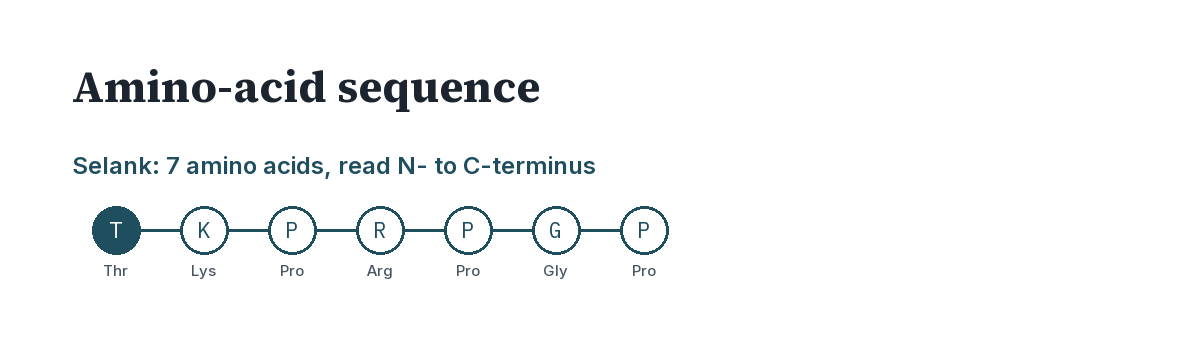
Selank is a synthetic seven-amino-acid peptide (Thr-Lys-Pro-Arg-Pro-Gly-Pro), a longer analog of the immune peptide tuftsin, developed in Russia as an anti-anxiety drug. Its strongest evidence is a handful of small Russian human trials in anxiety disorders.
Selank is not approved by the US Food and Drug Administration (FDA), but it is one of 14 peptide drugs registered in the Russian Federation, where it is classed as an anxiolytic. In one small Russian trial it eased anxiety about as well as the benzodiazepine medazepam, with an added anti-fatigue effect [Human trial, n=62] (Zozulia 2008). Those trials were small, appeared in Russian journals with only English abstracts available, and none is registered on ClinicalTrials.gov. FDA says it lacks important information on Selank’s safety in humans.
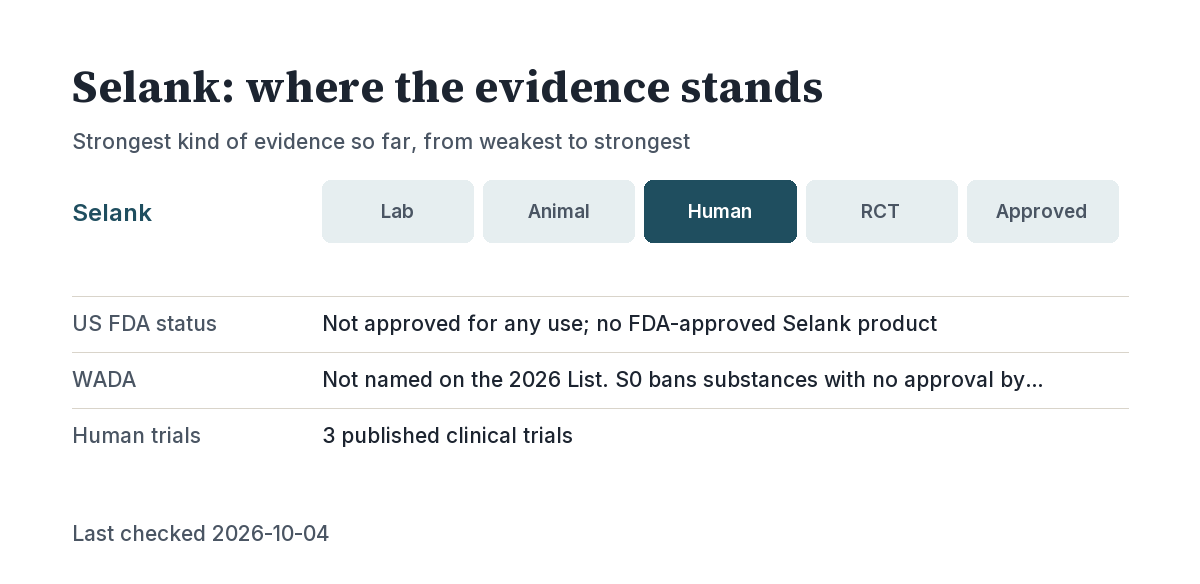
| Item | Status |
|---|---|
| US FDA status | Not approved for any use; no FDA-approved Selank product (FDA) |
| Compounding (503A/503B) | Selank acetate was nominated, then withdrawn; FDA lists it under “nominated but withdrawn” (page updated 2026-04-22). In no category; not on the July 2026 advisory-committee agenda; no FDA review announced |
| WADA 2026 | Not named on the 2026 List. S0 bans substances with no approval by any government health authority; Selank is registered in Russia, and no public WADA ruling on it was found. Athletes need a ruling from their anti-doping agency |
| Russia | Registered peptide drug, group “anxiolytic” (Deigin 2022) |
| Strongest evidence | Human comparative trials, n=60–70, Russia; blinding and randomization not described in the English abstracts |
| Human trials | 3 published clinical trials (2008–2015) plus 2 small mechanism studies; 0 registered on ClinicalTrials.gov |
| Last checked | 2026-10-04 |
What changed (October 2026): the sport section and the sport question now cover the 2027 WADA List, which names “peptides” in general in S0 from 2027-01-01.
Key points:
- Selank adds Pro-Gly-Pro to the end of tuftsin, a fragment of human immunoglobulin G, to make it more stable in the body (Volkova 2016).
- Adding Selank to the benzodiazepine phenazepam reduced sedation and cognitive side effects in a 70-patient trial (Medvedev 2015) [Human trial, n=70].
- Its proposed mechanisms, GABA modulation and slower breakdown of enkephalins, come mainly from rat, mouse and lab studies.
- FDA flags a risk of immune reactions from aggregation and impurities in compounded Selank.
- Selank sold online is unregulated; a medicines-control lab found it in seized preparations (Vanhee 2020).
| Property | Value |
|---|---|
| Sequence | Thr-Lys-Pro-Arg-Pro-Gly-Pro (7 amino acids) (Deigin 2022) |
| Molecular formula | C33H57N11O9 (PubChem) |
| Molecular weight | 751.9 g/mol |
| PubChem CID | 11765600 |
| Other names | Selank acetate, TP-7 (FDA) |
| Routes studied | Intranasal and intraperitoneal in rats and mice (Volkova 2016, Semenova 2008) |
| Class | Tuftsin analog; anxiolytic peptide |
What is Selank?
Selank was designed at the Institute of Molecular Genetics of the Russian Academy of Sciences together with the V.V. Zakusov Research Institute of Pharmacology (Volkova 2016). Its starting point was tuftsin, the four-amino-acid fragment Thr-Lys-Pro-Arg of the human immunoglobulin G heavy chain. The designers added three amino acids (Pro-Gly-Pro) to the end “to improve its metabolic stability and yield a relatively longer duration.” A 2022 review of Russian peptide drugs lists Selank among the 14 peptide products registered in the Russian Federation, in the anxiolytic group (Deigin 2022). Outside Russia we found no marketing approval. In the US it has been sold as a dietary supplement, which a 2021 pharmacology review flagged as a concern (Doyno 2021).
How does Selank work?
The mechanism is not settled. Most of the work comes from the Russian groups that developed the peptide, and almost all of it was done in animals or cells:
- GABA modulation: in rats given intranasal Selank, the expression of genes involved in nerve signaling changed within 1 hour, and the authors proposed that Selank “allosterically” alters how strongly the GABA receptor binds GABA [Animal] (Volkova 2016). In human neuroblastoma cells, however, Selank had “no direct effect” on GABA-system gene expression [Lab] (Filatova 2017).
- Enkephalin protection: Selank blocked the enzymes that break down enkephalins, the body’s own opioid-like peptides, with an IC50 (the concentration giving 50% inhibition) of 15–20 µM in plasma and human serum [Lab] (Zozulya 2001; Kost 2001). In anxious BALB/c mice it lengthened the half-life of plasma leu-enkephalin, but it had no effect in C57Bl/6 mice [Animal] (Sokolov 2002).
- Immune signaling: in mice, one injection changed the expression of 34 inflammation-related genes in the spleen [Animal] (Kolomin 2011). In blood cells from patients with depression, but not healthy controls, it suppressed interleukin-6 gene expression, although IL-6 concentration in the patients’ cell cultures rose [Lab, human cells] (Uchakina 2008).
- Brain networks: in 52 healthy volunteers, Selank and the related peptide Semax changed resting-state connectivity between the right amygdala and the temporal cortex within 20 minutes [Human, n=52] (Panikratova 2020).
What the research shows
For a nootropic peptide, Selank has a sizeable literature: 68 PubMed records, three of them indexed as clinical trials (PubMed search). The table grades each claim by the best study behind it.
| Claim | Evidence level | Best study and result |
|---|---|---|
| Reduces anxiety in GAD | Human trial (n=62) | Zozulia 2008: effect similar to medazepam |
| Reduces anxiety in phobic and somatoform disorders | Human trial (n=60) | Medvedev 2014: “pronounced anxiolytic” effect vs phenazepam; lasted a week after stopping |
| Reduces benzodiazepine side effects | Human trial (n=70) | Medvedev 2015: less sedation and cognitive impairment with phenazepam + Selank |
| Anti-fatigue / stimulant effect | Human trial (n=62) | Zozulia 2008: “antiasthenic and psychostimulant effects” |
| Improves memory or cognition | Animal; “mild nootropic” in one human trial | Kolik 2019: prevented memory deficits in alcohol-exposed rats |
| Changes brain connectivity | Human (n=52, healthy) | Panikratova 2020: amygdala–temporal cortex changes |
| Immune modulation | Lab, animal, human (n not reported) | Uchakina 2008: Th1/Th2 shift after 14 days |
| Antiviral against influenza | Lab and animal | Ershov 2009: blocked H3N2 replication in cells |
| No dependence or withdrawal | Asserted, not measured | Stated in the introduction of Volkova 2016; no dependence study found |
Anxiety
Anxiety is where Selank’s human evidence is strongest. In a 62-patient study of generalized anxiety disorder (GAD) and neurasthenia, a syndrome of fatigue and irritability, 30 patients took Selank and 32 took the benzodiazepine medazepam. On the Hamilton, Zung and Clinical Global Impression scales, the anti-anxiety effects of the two drugs were similar, and Selank also showed “antiasthenic and psychostimulant effects” [Human trial, n=62] (Zozulia 2008). In 60 patients with phobic-anxiety and somatoform disorders, Selank was compared with phenazepam. The authors reported “pronounced anxiolytic and mild nootropic effects”, an effect that lasted about a week after the last dose, and better quality of life [Human trial, n=60] (Medvedev 2014). These results are encouraging. Still, the English abstracts give no doses, effect sizes, randomization or blinding details, and we found no independent replication outside Russia.
Use alongside benzodiazepines
In 70 patients with anxiety disorders, 40 received phenazepam plus Selank and 30 received phenazepam alone. The combination worked faster and “decreased the level of undesirable side-effects of phenazepam”, including cognitive impairment, sedation and sexual dysfunction [Human trial, n=70] (Medvedev 2015). In rats under 14 days of chronic mild stress, Selank plus diazepam increased time in the open arms of an elevated maze 8.9-fold compared with saline [Animal] (Kasian 2017).
Memory and cognition
The cognition data come mostly from rats. In rats exposed to low oxygen before birth, Selank improved sensory attention two- to threefold and sped learning 1.5-fold (p<0.01) [Animal] (Semenova 2008). In rats that drank alcohol for 30 weeks, a 7-day course prevented memory and attention problems during withdrawal (p<0.01) and blocked an alcohol-induced rise in brain-derived neurotrophic factor (BDNF) [Animal] (Kolik 2019). The only human signal is the “mild nootropic” effect noted in the 2014 anxiety trial.
Immune and antiviral effects
Because tuftsin is an immune peptide, Selank has also been studied as an immunomodulator. In patients with anxiety-asthenic disorders, a 14-day course shifted the balance of Th1 and Th2 cytokines [Human, n not reported] (Uchakina 2008). In cell culture, Selank added 24 hours before infection completely suppressed replication of an H3N2 influenza strain, and in animals it induced interferon-alpha gene expression [Lab, Animal] (Ershov 2009). We found no human infection study.
Human studies and trials
A search of ClinicalTrials.gov on 2026-10-04 found no registered Selank trial; it returns only two unrelated brain-stimulation studies. The published human studies are:
| Study | Design and n | Result |
|---|---|---|
| Zozulia 2008 | Comparative trial, GAD and neurasthenia, n=62 (30 vs 32 medazepam) | Anti-anxiety effect similar to medazepam; anti-fatigue effect |
| Medvedev 2014 | Comparative trial vs phenazepam, n=60 | Anxiolytic effect lasting a week after stopping |
| Medvedev 2015 | Phenazepam + Selank (40) vs phenazepam (30), n=70 | Faster effect, fewer phenazepam side effects |
| Uchakina 2008 | 14-day course in anxiety-asthenic disorders; n not reported | Th1/Th2 cytokine shift |
| Panikratova 2020 | Selank vs Semax vs placebo, healthy, n=52 | Amygdala connectivity changes at 5–20 min |
All five were run in Russia and published in Russian journals. None of the three anxiety trials is described as placebo-controlled in its abstract, and none carries a phase label or a registry number.
Doses used in studies
The English abstracts of the human trials do not report the Selank dose. The doses below are from animal and lab studies and cannot be converted into human amounts.
| Route and amount | Species | Study |
|---|---|---|
| Intranasal, 300 µg/kg, single dose | Rat | Volkova 2016 |
| Intranasal, 300 µg/kg (with diazepam 1 mg/kg oral) | Rat | Kasian 2017 |
| Intraperitoneal, 300 µg/kg | Rat | Semenova 2008 |
| Intraperitoneal, 0.3 mg/kg/day for 7 days | Rat | Kolik 2019 |
| Intraperitoneal, 100 µg/kg | Mouse | Kolomin 2011 |
| 10⁻⁷ M in culture | Human blood cells | Uchakina 2008 |
No established human dose exists outside approved labels.
Side effects and safety
Reported adverse effects. The English abstracts of the three clinical trials list no adverse events for Selank, but they also give no adverse-event counts, so its tolerability cannot be judged from them [Human trials, n=60–70] (Zozulia 2008; Medvedev 2014). The claim that Selank causes no dependence or withdrawal comes from the introduction of a paper by its developers (Volkova 2016), not from a published dependence study. We found no long-term safety data.
Regulator concerns. FDA says compounded selank acetate “may pose risk for immunogenicity for certain routes of administration”, meaning it may trigger an immune reaction, because of “the potential for aggregation and peptide-related impurities”. FDA also says it “lacks important information regarding any safety issues raised by selank acetate administered to humans” (FDA).
Theoretical risks. A 2021 review in the Journal of Clinical Pharmacology grouped Selank with phenibut as poorly studied Russian drugs with GABA-related mechanisms that are sold in the US as supplements. The review notes that respiratory depression, coma and death have occurred when GABA-acting drugs of this kind are used in high doses or with other sedatives, and argues that such agents should be evaluated for abuse potential before public access (Doyno 2021). The 2015 trial combined Selank with phenazepam in patients under treatment (Medvedev 2015); combinations with alcohol or other sedatives have not been studied in people. The immune effects seen in mice (Kolomin 2011) have not been assessed for safety in people with immune disease.
Unregulated products. Selank sold online as a powder or nasal spray is not made to pharmaceutical standards. A medicines-control laboratory identified Selank and Semax in two suspicious seized preparations (2017–2018) and urged control agencies to prepare for these “potentially dangerous molecules” (Vanhee 2020). Our explainer on research-use-only peptides covers what that label means legally.
Who should not use it. No regulator outside Russia has issued a label, so there are no official contraindications in the US, UK or EU. The trials we found did not study pregnancy, breastfeeding or children. In mouse embryonic stem cells, Selank reduced the share of cells becoming GABA-producing neurons by 61%, although the authors concluded it was not toxic [Lab] (Kobylyanskii 2017).
Legal and regulatory status
| Jurisdiction | Status (checked 2026-10-04) |
|---|---|
| US FDA | Not approved; no FDA-approved product |
| US compounding | Nomination withdrawn; listed as “nominated but withdrawn” (FDA, updated 2026-04-22); not on the 503A Bulks List |
| US advisory committee | Not on the July 23–24, 2026 PCAC agenda; no review announced |
| WADA | Not named on the 2026 List; S0 may apply where no approval exists. No public ruling found |
| Russia | Registered anxiolytic peptide drug (Deigin 2022) |
In the US, Selank’s compounding position is unresolved. FDA’s interim policy sorts nominated bulk substances into Category 1 (FDA does not intend to act), Category 2 (safety risks) or Category 3 (insufficient information) (FDA). Selank acetate now sits in none of them: its nomination was withdrawn, and FDA moved it to the withdrawn table on its Category 2 page (FDA). Withdrawal is not the same as Category 1 status, as our guide to FDA’s compounding categories explains. The related peptide Semax was reviewed at the July 2026 Pharmacy Compounding Advisory Committee meeting, but Selank was not on the agenda. FDA has announced no review of Selank. Our PCAC explainer covers the July votes, and the peptide legal status tracker lists every peptide’s status side by side.
For athletes, WADA’s S0 class prohibits at all times any substance “with no current approval by any governmental regulatory health authority for human therapeutic use” (WADA); USADA names BPC-157 as an example. Selank’s Russian registration complicates that test, and we found no published WADA or USADA ruling on Selank, so its status in sport is unresolved rather than permitted. The 2027 List, in force from 2027-01-01, names “peptides” in general in S0 but keeps the same approval test, so Selank’s Russian registration still leaves the question open; USADA’s summary of the 2027 changes does not name Selank (USADA athlete advisory). Our WADA peptide page lists the peptide classes that are named.
Related peptides
- Semax: a nootropic heptapeptide studied alongside Selank by the same Russian research groups. The two were compared in the 2020 brain-imaging study (Panikratova 2020) and in experiments on enkephalin-degrading enzymes, where Semax had an IC50 of 10 µM against Selank’s 20 µM (Kost 2001).
What users report
What follows are unverified self-reports, mostly from people who bought unregulated products; they are not evidence. People who post about Selank on Reddit, YouTube and nootropic forums most often describe calmer mood and less social or performance anxiety without the drowsiness they associate with benzodiazepines. Many say the effect is subtle and comes on within minutes to an hour, and a sizeable share report noticing nothing at all. Common complaints are nasal irritation, headache, fatigue or a “flat” feeling, and effects that wear off quickly. Cost and doubts about whether a product actually contains Selank come up repeatedly, since buyers have no way to check purity. Threads often argue over whether the effect is real or placebo, whether Selank should be paired with Semax, and whether tolerance builds. Some posters with anxiety disorders say it helped less than their prescribed treatment, and others caution against combining it with alcohol or sedatives.
Frequently asked questions
Is Selank FDA approved?
No. Selank is not approved by the FDA for any use, and no FDA-approved product exists. FDA lists selank acetate as a compounding nomination that was withdrawn and says it “lacks important information” about its safety in humans (FDA). It is registered as an anxiolytic drug in Russia.
What is Selank used for?
In Russia, Selank is registered as an anxiolytic, a drug for anxiety. Its human trials studied generalized anxiety disorder, neurasthenia, and phobic and somatoform disorders. In 62 patients its anti-anxiety effect was similar to that of medazepam (Zozulia 2008). Memory, immune and antiviral effects rest mainly on animal and lab data.
Is Selank a benzodiazepine?
No. Selank is a seven-amino-acid peptide derived from tuftsin, not a benzodiazepine. Rat studies suggest it may modulate GABA signaling indirectly, the system benzodiazepines act on (Volkova 2016). In one Russian trial, adding it to the benzodiazepine phenazepam reduced that drug’s sedation and cognitive side effects.
Is Selank banned in sport?
Selank is not named on WADA’s 2026 Prohibited List, but WADA’s S0 class bans any substance with no government approval for human use (WADA). Selank is registered in Russia, and we found no public WADA or USADA ruling on it, so athletes need a ruling from their anti-doping agency before assuming it is allowed. The 2027 List names peptides in S0 but keeps the same approval test.
What is the difference between Selank and Semax?
Both are Russian heptapeptides from the same research groups. Selank is derived from the immune peptide tuftsin and is registered for anxiety, while Semax is described as a nootropic. In 52 healthy volunteers, the two had both shared and distinct effects on connectivity between the amygdala and the temporal cortex (Panikratova 2020).
References
- US Food and Drug Administration. Certain bulk drug substances for use in compounding that may present significant safety risks (updated 2026-04-22). fda.gov
- US Food and Drug Administration. Bulk drug substances used in compounding under section 503A of the FD&C Act. fda.gov
- US Food and Drug Administration. July 23–24, 2026: Meeting of the Pharmacy Compounding Advisory Committee. fda.gov
- World Anti-Doping Agency. Prohibited List 2026. wada-ama.org
- US Anti-Doping Agency. #AskUSADA – What is a non-approved substance and why are they prohibited? usada.org
- Deigin VI, Poluektova EA, Beniashvili AG, Kozin SA, Poluektov YM. Development of peptide biopharmaceuticals in Russia. Pharmaceutics. 2022. PMC9030433
- National Center for Biotechnology Information. PubChem Compound Summary for CID 11765600, Selank. pubchem.ncbi.nlm.nih.gov
- Volkova A, Shadrina M, Kolomin T, et al. Selank administration affects the expression of some genes involved in GABAergic neurotransmission. Front Pharmacol. 2016. PMID 26924987
- Filatova E, Kasian A, Kolomin T, et al. GABA, Selank, and olanzapine affect the expression of genes involved in GABAergic neurotransmission in IMR-32 cells. Front Pharmacol. 2017. PMID 28293190
- Zozulya AA, Kost NV, Sokolov OY, et al. The inhibitory effect of Selank on enkephalin-degrading enzymes as a possible mechanism of its anxiolytic activity. Bull Exp Biol Med. 2001. PMID 11550013
- Kost NV, Sokolov OIu, Gabaeva MV, et al. Semax and selank inhibit the enkephalin-degrading enzymes from human serum. Bioorg Khim. 2001. PMID 11443939
- Sokolov OY, Meshavkin VK, Kost NV, Zozulya AA. Effects of Selank on behavioral reactions and activities of plasma enkephalin-degrading enzymes in mice with different phenotypes of emotional and stress reactions. Bull Exp Biol Med. 2002. PMID 12432865
- Zozulia AA, Neznamov GG, Siuniakov TS, et al. Efficacy and possible mechanisms of action of a new peptide anxiolytic selank in the therapy of generalized anxiety disorders and neurasthenia. Zh Nevrol Psikhiatr Im S S Korsakova. 2008. PMID 18454096
- Medvedev VE, Tereshchenko ON, Israelian AIu, et al. A comparison of the anxiolytic effect and tolerability of selank and phenazepam in the treatment of anxiety disorders. Zh Nevrol Psikhiatr Im S S Korsakova. 2014. PMID 25176261
- Medvedev VE, Tereshchenko ON, Kost NV, et al. Optimization of the treatment of anxiety disorders with selank. Zh Nevrol Psikhiatr Im S S Korsakova. 2015. PMID 26356395
- Uchakina ON, Uchakin PN, Miasoedov NF, et al. Immunomodulatory effects of selank in patients with anxiety-asthenic disorders. Zh Nevrol Psikhiatr Im S S Korsakova. 2008. PMID 18577961
- Panikratova YR, Lebedeva IS, Sokolov OY, et al. Functional connectomic approach to studying Selank and Semax effects. Dokl Biol Sci. 2020. PMID 32342318
- Kasian A, Kolomin T, Andreeva L, et al. Peptide Selank enhances the effect of diazepam in reducing anxiety in unpredictable chronic mild stress conditions in rats. Behav Neurol. 2017. PMID 28280289
- Kolik LG, et al. Selank, peptide analogue of tuftsin, protects against ethanol-induced memory impairment. Bull Exp Biol Med. 2019. PMID 31625062
- Semenova TP, et al. Use of Selank to correct measures of integrative brain activity and biogenic amine levels in adult rats resulting from antenatal hypoxia. Neurosci Behav Physiol. 2008. PMID 18197389
- Kolomin T, Shadrina M, Andreeva L, et al. Expression of inflammation-related genes in mouse spleen under tuftsin analog Selank. Regul Pept. 2011. PMID 21609736
- Ershov FI, et al. Antiviral activity of immunomodulator Selank in experimental influenza infection. Vopr Virusol. 2009. PMID 19882898
- Doyno CR, White CM. Sedative-hypnotic agents that impact gamma-aminobutyric acid receptors: focus on flunitrazepam, gamma-hydroxybutyric acid, phenibut, and selank. J Clin Pharmacol. 2021. PMID 34396551
- Vanhee C, Francotte A, Janvier S, Deconinck E. The occurrence of putative cognitive enhancing research peptides in seized pharmaceutical preparations. Drug Test Anal. 2020. PMID 31667971
- ClinicalTrials.gov. Search: intervention “selank” (searched 2026-10-04). clinicaltrials.gov
- PubMed. Search: selank[tiab] AND (clinical trial[pt] OR randomized controlled trial[pt]) (searched 2026-10-04). pubmed.ncbi.nlm.nih.gov
- USADA. Athlete advisory: 2027 Prohibited List (2026-10-06). usada.org
Change log
2026-10-27: sport section and sport FAQ updated for the 2027 WADA List; own page title; reviewed by the editorial team.
2026-10-23: links to glossary definitions added; no change to the facts.
2026-10-13: links corrected (a link inside a citation or on a generic word removed); no change to the facts.
2026-10-05: USADA source link restored; FDA wording quoted in full; an uncited sentence replaced; reviewed by the editorial team.
2026-10-04: safety section completed: the full risk the Doyno 2021 review describes for GABA-acting drugs (respiratory depression, coma, death; abuse-potential evaluation) and a lab finding in mouse embryonic stem cells; reviewed by the editorial team.
2026-10-04: first published after review by the editorial team.