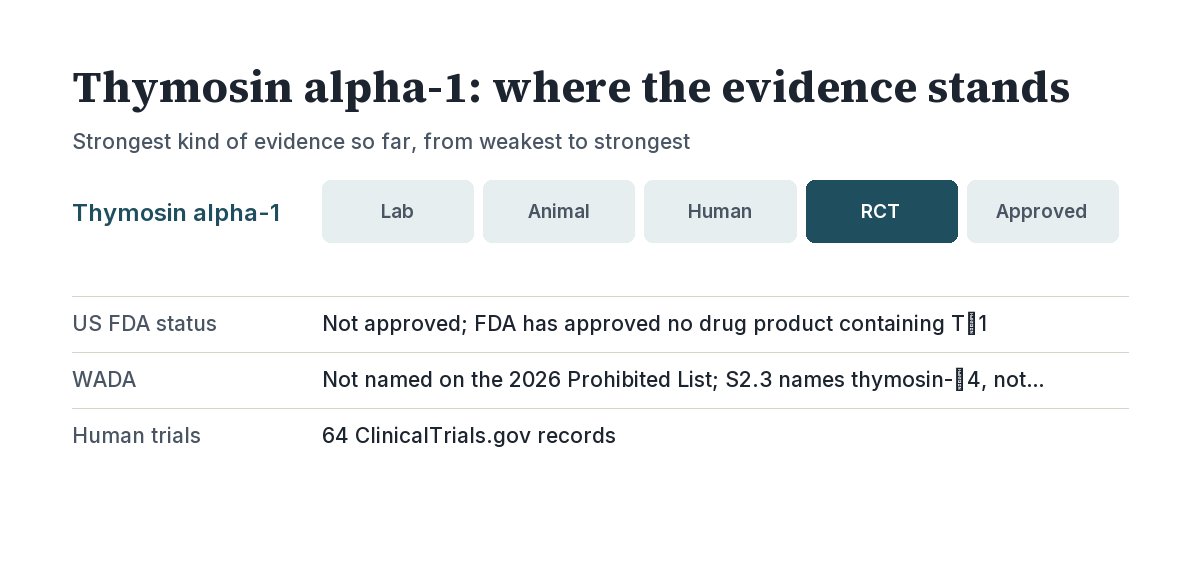
Thymosin alpha-1 (Tα1, thymalfasin, brand name Zadaxin) is a 28-amino-acid immune-modulating peptide first isolated from calf thymus in 1977. It is not FDA-approved for any use; its maker reported approvals in over 30 other countries in its 2016 annual filing, mainly for hepatitis B. Its strongest evidence is human randomized trials, with mixed results: the largest, a 1,106-patient sepsis trial, found no mortality benefit.
| Item | Status |
|---|---|
| US FDA status | Not approved; FDA has approved no drug product containing Tα1 (FDA, 2024); no Drugs@FDA listing as of 2026-10-06 |
| Compounding (503A/503B) | PCAC voted 4–17 on 2024-12-04 against the 503A Bulks List (FDA minutes); withdrawn from Category 2 by nominators (FDA, 2026-04-22); not on the 503A Bulks List as of 2026-10-06 (21 CFR 216.23) |
| WADA 2026 | Not named on the 2026 Prohibited List; S2.3 names thymosin-β4, not alpha-1; whether S0 (non-approved substances) applies is not addressed by WADA (WADA) |
| Outside the US | Zadaxin approved in over 30 countries, principally for hepatitis B, per the maker’s 2016 filing (SciClone 10-K); FDA notes no approval in Japan or Europe except Italy |
| Strongest evidence | Human RCTs (largest n=1,106, Wu 2025) and a 2026 Cochrane review rating the hepatitis B evidence low to very low certainty (Naing 2026) |
| Human trials | 64 ClinicalTrials.gov records (searched 2026-10-06), e.g. NCT02867267, NCT05086614 |
| Last checked | 2026-10-11 |
What changed (October 2026): the sport section now covers the 2027 WADA List, which names “peptides” in general in S0 from 2027-01-01 but keeps the same approval test.
Key points:
- Tα1 is the starting segment of a larger protein, prothymosin alpha, which rat studies found in brain, liver, kidney, lung and spleen as well as thymus (Haritos 1984).
- In lab and mouse studies it acts on dendritic cells through Toll-like receptor 9 (TLR9), steering both immune activation and tolerance (Romani 2006).
- A 2026 Cochrane review of 10 hepatitis B trials found possible benefits but rated the certainty low to very low (Naing 2026).
- FDA’s 2024 review found a lack of evidence for all 12 uses it examined and flagged immunogenicity risk for compounded versions (FDA, 2024).
- In trials the most common reported side effects were injection-site irritation, redness and discomfort; FDA also lists rarer serious events, including fatal ones, in stem-cell transplant recipients.
| Property | Value |
|---|---|
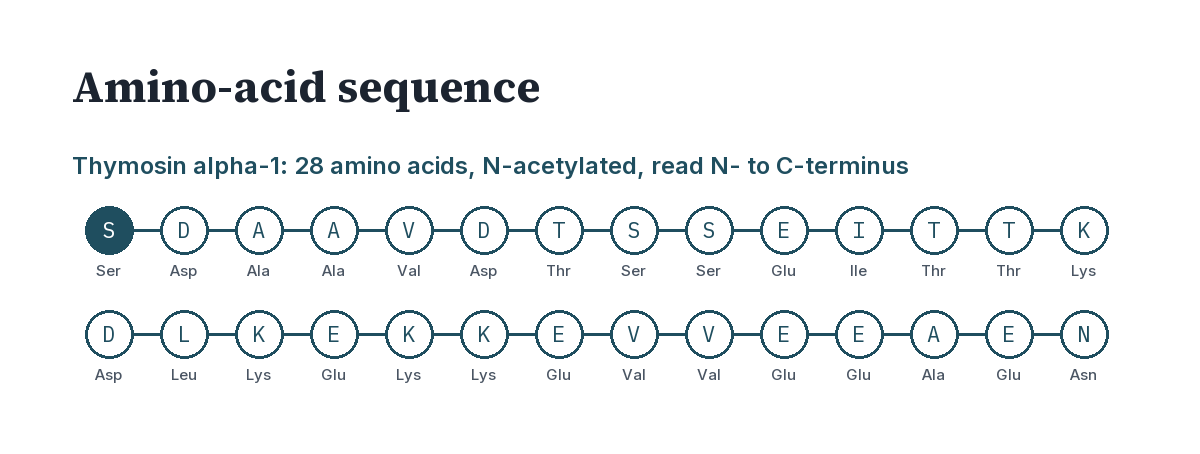
| Sequence | Ac-Ser-Asp-Ala-Ala-Val-Asp-Thr-Ser-Ser-Glu-Ile-Thr-Thr-Lys-Asp-Leu-Lys-Glu-Lys-Lys-Glu-Val-Val-Glu-Glu-Ala-Glu-Asn-OH (FDA) |
| Length | 28 amino acids, N-terminally acetylated |
| Molecular formula | C129H215N33O55 |
| Molecular weight | 3108.3 g/mol |
| CAS number | 62304-98-7 |
| PubChem CID | 16130571 |
| Half-life (human, subcutaneous) | Under 3 hours (Rost 1999) |
| Routes studied | Mostly subcutaneous injection in humans; intravenous in rats |
| Class | Thymic peptide; immunomodulator |
What is thymosin alpha-1?
Thymosin alpha-1 was the first peptide sequenced from “thymosin fraction 5”, a calf-thymus extract. In 1977 Goldstein and colleagues reported it as a heat-stable, highly acidic chain of 28 amino acids and proposed a naming system for the fraction’s peptides (Goldstein 1977). In 1984 researchers found that rat thymus extracts held no free Tα1 but a roughly 112-residue protein, prothymosin alpha, with the Tα1 sequence at its start; Tα1 appears to be cut from it during extraction (Haritos 1984). The drug version, thymalfasin, is made synthetically with the same sequence (FDA, 2024). SciClone Pharmaceuticals sold it as Zadaxin, with China accounting for about 96% of its 2015 revenue (SciClone 10-K).
How does thymosin alpha-1 work?
- Toll-like receptor signaling: In mouse and dendritic-cell experiments, Tα1 matured dendritic cells and raised interleukin-12 through MyD88-dependent Toll-like receptor pathways, and protected transplanted mice from the fungus Aspergillus [Animal] (Romani 2004).
- Immune tolerance: Tα1 shaped T-cell priming and tolerance by human and mouse dendritic cells, and in the mouse cells it switched on the enzyme IDO through TLR9 and type I interferon signaling, producing interleukin-10 and regulatory T cells [Lab and Animal] (Romani 2006).
- Regulator’s summary: FDA describes its immune effects as “mediated at least in part” by TLR9 on dendritic and lymphoid progenitor cells [Lab and Animal] (FDA, 2024).
- T-cell markers in patients: In 76 people with severe COVID-19, treated patients had lower PD-1 and Tim-3 “exhaustion” markers on CD8+ T cells [Human, retrospective, n=76] (Liu 2020).
What the research shows
| Claim | Evidence level | Best study and result |
|---|---|---|
| Lowers sepsis mortality | Human RCT (n=1,106) | Wu 2025: 23.4% vs 24.1% at 28 days, HR 0.99, no difference |
| Clears hepatitis B | Human RCTs; Cochrane review (10 RCTs, n=1,349) | Naing 2026: possible benefit, low to very low certainty |
| Improves hepatitis C cure rates | Human RCT (n=552) | Ciancio 2012: SVR 12.7% vs 10.5%, P=0.407 |
| Helps metastatic melanoma | Human RCT (n=488) | Maio 2010: median survival 9.4 vs 6.6 months, P=.08 |
| Prevents infection in severe pancreatitis | Human RCT (n=508) | Ke 2022: 15.7% vs 18.1%, p=0.48 |
| Lowers COVID-19 mortality | Meta-analysis (9 studies) | Shang 2023: RR 1.03, p=0.92 |
| Raises CD4 counts in HIV | Human RCT (n=20) | Chadwick 2003: no CD4 difference at 12 weeks |
| Improves survival in HBV liver failure | Human RCT, open-label (n=120) | Chen 2022: 75.0% vs 53.4% transplant-free at 90 days |
| Boosts antifungal immunity | Animal (mice) | Romani 2004: protected transplanted mice from aspergillosis |
Sepsis
The ETASS trial in six Chinese hospitals (n=361) reported 28-day mortality of 26.0% with Tα1 against 35.0% with standard care, a borderline result (P=0.062; log-rank P=0.049), plus better recovery of the immune marker mHLA-DR [Human RCT, n=361] (Wu 2013). The larger, double-blind, placebo-controlled TESTS trial across 22 centres did not confirm it: 23.4% vs 24.1% (HR 0.99; P=0.93), with no secondary or safety outcome differing significantly [Human RCT, n=1,106] (Wu 2025). Its pre-specified subgroups hinted at benefit in people with diabetes (HR 0.58) and possible harm under age 60 (HR 1.67), which are hypotheses rather than findings. A 2025 meta-analysis of 11 RCTs pooled a lower 28-day mortality (OR 0.73) but found no benefit when restricted to high-quality (OR 0.82) or multi-center trials, and judged the total sample too small (Gu 2025).
Hepatitis B and C
Hepatitis B is the use Zadaxin was mainly approved for abroad. Results vary by trial. In one trial, a 26-week course reached a complete virological response in 40.6% vs 9.4% of untreated controls at 18 months (P=.004), though no responder lost hepatitis B surface antigen [Human RCT, n=98] (Chien 1998). A multicentre double-blind phase 3 trial found complete response in 14% vs 4% (P=0.084) and its authors wrote that it did “not confirm” earlier efficacy [Human RCT, n=97] (Mutchnick 1999). The 2026 Cochrane review of chronic hepatitis B included 10 trials (1,349 people); in the 3 trials that reported deaths (907 people) Tα1 “may reduce” all-cause mortality (RR 0.53), and in 5 trials (1,056 people) serious adverse events (RR 0.72), but it rated the certainty very low or low and found no ongoing trials (Naing 2026). In hepatitis C, adding Tα1 to interferon raised end-of-treatment biochemical response to 37.1% from 16.2% (P=.04) [Human RCT, n=109] (Sherman 1998), but a 552-patient placebo-controlled trial with peginterferon and ribavirin found no difference in cure rates (Ciancio 2012). FDA’s review notes that oral antivirals with established efficacy are now preferred for both infections, with cure rates above 90% for hepatitis C (FDA, 2024).
Cancer
The largest cancer trial randomized 488 people with metastatic melanoma to chemotherapy with or without Tα1. Median overall survival was 9.4 months with Tα1 vs 6.6 months (HR 0.80; P=.08), and adding Tα1 caused no extra toxicity [Human RCT, n=488] (Maio 2010). FDA’s review read the same trial as failing to show a significant difference in response rate with any Tα1 arm. The biggest registered cancer trial, a phase 3 trial of Tα1 after colorectal cancer surgery with an estimated 2,500 patients, is still recruiting (NCT05086614).
COVID-19, HIV and vaccine response
Early pandemic data from Wuhan were encouraging: in a retrospective review, mortality was 11.11% with Tα1 vs 30.00% without (P=.044) [Human, retrospective, n=76] (Liu 2020). Later pooled data did not hold up: a meta-analysis of 9 studies and 5,352 patients found no mortality effect (RR 1.03) (Shang 2023). A US pilot RCT saw faster CD4+ T-cell recovery in patients on low-flow oxygen but no significant difference in clinical recovery [Human RCT, n=49] (Shehadeh 2023). In HIV, a 12-week trial found no CD4 count difference, though a thymus-output marker rose [Human RCT, n=20] (Chadwick 2003). FDA found the data insufficient to judge Tα1 as a vaccine adjuvant, and a US phase 1 trial in older adults receiving COVID-19 boosters is recruiting (NCT06821100).
Critical care and liver failure
In predicted severe acute necrotising pancreatitis, a double-blind trial found Tα1 did not reduce infected necrosis (15.7% vs 18.1%) [Human RCT, n=508] (Ke 2022). In hepatitis B-related acute-on-chronic liver failure, an open-label trial reported 90-day transplant-free survival of 75.0% vs 53.4% (p=0.030) and fewer new infections (32.1% vs 58.6%), though a competing-risk analysis showed no survival difference [Human RCT, n=120] (Chen 2022).
Human studies and trials
A ClinicalTrials.gov search for thymosin alpha-1, thymalfasin or Zadaxin returned 64 records on 2026-10-06: 24 completed, 10 recruiting, 17 of unknown status and the rest not yet recruiting, withdrawn, active, enrolling by invitation or terminated (ClinicalTrials.gov). Some records list Tα1 only as one part of a combination. The main ones:
| Trial | Design and status | Result |
|---|---|---|
| NCT02867267 TESTS, sepsis | Phase 3, n=1,106, completed | No 28-day mortality difference (23.4% vs 24.1%) |
| NCT00711620 ETASS, severe sepsis | RCT, n=361, completed | 26.0% vs 35.0%, P=0.062 |
| NCT01178996 hepatitis C | Phase 3, n=552, completed | SVR 12.7% vs 10.5%, no difference |
| NCT00911443 melanoma | Phase 2, n=488, completed | Survival 9.4 vs 6.6 months, P=.08 |
| NCT02473406 pancreatitis | Phase 4, n=508, completed | Infected necrosis 15.7% vs 18.1% |
| NCT03082885 HBV liver failure | Open-label, n=120, completed | Transplant-free survival 75.0% vs 53.4% |
| NCT04487444 COVID-19 | Phase 2, n=56, terminated (slow enrollment) | Pilot: no significant recovery difference |
| NCT04428008 dialysis, COVID-19 | Phase 2, completed | Interim report (Tuthill 2023): 3 vs 7 deaths |
| NCT05086614 colorectal cancer | Phase 3, est. 2,500, recruiting | Primary completion 2027-03-31 |
| NCT06821100 COVID-19 booster, older adults | Phase 1, est. 75, recruiting | Safety outcome; completion 2026-12-01 |
Two SciClone phase 3 trials in hepatitis C non-responders (NCT00039962, NCT00040027, 500 patients each) are listed as completed; no results were posted in the registry fields checked on 2026-10-06. The clinical trials inventory tracks registered trials across peptides.
Doses used in studies
| Route and amount | Species | Study |
|---|---|---|
| Subcutaneous, 1.6 mg twice a week for 26 or 52 weeks | Human (hepatitis B) | Chien 1998 |
| Subcutaneous, 1.6 mg twice weekly for 48 weeks, with peginterferon and ribavirin | Human (hepatitis C) | Ciancio 2012 |
| Subcutaneous, 1.6 mg every 12 h for 7 days, then once daily for 7 days | Human (pancreatitis) | Ke 2022 |
| 1.6, 3.2 or 6.4 mg with chemotherapy | Human (melanoma) | Maio 2010 |
| Subcutaneous, 3.2 mg twice weekly for 12 weeks | Human (HIV) | Chadwick 2003 |
| Subcutaneous, 900 µg/m², single and 5-day | Human (healthy, n=9) | Rost 1999 |
| Intravenous, about 0.175 mg/kg | Rat | FDA, 2024 |
FDA’s review found that trials used about 1 to 16 mg, most often 1.6 mg by subcutaneous injection, for periods from 1 day to 12 months (FDA, 2024). No established human dose exists outside approved labels.
Side effects and safety
Across trials, Tα1 has been well tolerated. FDA’s review concluded that in most studies it “has not been associated with significant adverse events attributable to Ta1” at 1–16 mg for up to 12 months, with injection-site irritation, redness and discomfort the most common complaints [Human RCTs] (FDA, 2024). In the 1,106-patient sepsis trial no safety outcome differed significantly from placebo [Human RCT] (Wu 2025), and the Cochrane hepatitis B review found fewer serious adverse events with Tα1 (RR 0.72, low certainty) (Naing 2026).
FDA’s review also lists less common events reported in studies:
- Liver enzyme (ALT) flares in chronic hepatitis B.
- Thyroid (TSH) abnormalities in chronic hepatitis C.
- Fatal immune hemolytic anemia and engraftment failure in stem-cell transplant recipients.
Theoretical risks. Because Tα1 stimulates immunity, FDA warns it could cause or worsen graft-versus-host disease in transplant recipients. Labels for Tα1 products outside the US carry warnings or contraindications for children, pregnant and breastfeeding women, people with autoimmune disease and immunosuppressed people. FDA’s December 2024 review identified no carcinogenicity studies of either form, and animal toxicity data exist only as summaries in a product monograph (FDA, 2024).
Compounded and unregulated products. FDA judged both forms of the compounding ingredient “not well-characterized”, citing missing data on impurities, aggregates and endotoxin, and a potential for immunogenicity (an immune reaction against the peptide itself) when injected. Its Category 2 entry says the safety information is “inadequate” to understand the extent of any safety issues. FDA also found a US website advertising compounded Tα1 as “FDA-approved” when no such product exists. In 2020 FDA warned a seller offering “Thymosin Alpha 1” for COVID-19 that it was an unapproved new drug and misbranded (FDA warning letter, 2020). Products sold as research use only peptides carry no guarantee of identity, purity or sterility.
Legal and regulatory status
| Jurisdiction | Status (checked 2026-10-06) |
|---|---|
| US FDA | Not approved; no Drugs@FDA listing (FDA) |
| US orphan designations | Melanoma, chronic hepatitis B, liver cancer (SEC) |
| US compounding | PCAC 4–17 against 503A listing; not on the list (eCFR) |
| WADA | Not named in 2026 list (WADA) |
| EU | Not approved except Italy, per FDA; EU orphan designation for liver cancer (SciClone) |
| China and others | Approved in over 30 countries, mainly hepatitis B (SciClone) |
FDA advisory vote, December 2024. FDA’s Pharmacy Compounding Advisory Committee reviewed Tα1 for the 503A Bulks List, the list of ingredients pharmacies may compound from. FDA proposed not to list it; members voted 4 yes and 17 no for both the free base and the acetate salt, with several citing no compelling evidence of effectiveness and safety (PCAC minutes). Tα1 was not among the seven peptides on the agenda of the July 2026 committee meeting (Federal Register); see the July 2026 PCAC peptide vote for those.
Category 2 withdrawal, 2026. FDA’s Category 2 page, current as of 2026-04-22, moves Tα1 to the list of substances “withdrawn by the nominators” (FDA). Leaving Category 2 is not the same as being added to the 503A Bulks List; the codified list in 21 CFR 216.23 did not include Tα1 in the eCFR version of 2026-10-01 (eCFR). The difference is explained in Category 1 vs Category 2 peptides.
Sport. The WADA 2026 list does not name thymosin alpha-1; its growth-factor class S2.3 names thymosin-β4 and TB-500 (WADA 2026 list). The S0 class bans substances with “no current approval by any governmental regulatory health authority”; whether S0 reaches a drug approved abroad but not in the US is not addressed in any WADA or USADA document found on 2026-10-06. The 2027 List, in force from 2027-01-01, names “peptides” in general in S0 but keeps that approval test, so the question stays open for a peptide approved abroad as Zadaxin; USADA’s summary of the 2027 changes does not mention thymosin alpha-1 (USADA athlete advisory). The WADA banned peptides page covers the named peptides.
Related peptides
- TB-500 (thymosin beta-4): shares the “thymosin” name from the same thymus fraction, but is a different peptide studied for tissue repair and is named on the WADA list.
- KPV peptide: another immune-modulating peptide, studied mainly for inflammation.
What users report
The reports below are unverified self-reports from people who usually bought unregulated products; they are not evidence. People who post about thymosin alpha-1 on forums and social media most often describe using it for frequent colds, slow recovery from viral illness, long COVID, chronic fatigue or Lyme disease, and as general “immune support”. The effects they most often claim are fewer or shorter infections and more energy, usually described over several weeks rather than days. Many say they noticed nothing at all, and some argue that any benefit is hard to separate from natural recovery. Recurring complaints include redness or itching where the injection went, fatigue or flu-like feelings early on, high cost, and doubts about whether the product contained the stated peptide. A frequent argument is whether results seen in hospital trials with the licensed product say anything about grey-market products used by healthy people, and whether stimulating immunity is wise for people with autoimmune conditions.
Frequently asked questions
Is thymosin alpha-1 FDA approved?
No. Thymosin alpha-1 is not approved by FDA for any use, and FDA stated in 2024 that it has approved no drug product containing it. An FDA advisory committee voted 4–17 in December 2024 against adding it to the 503A Bulks List for compounding (FDA minutes). It is approved in other countries under the brand Zadaxin.
What is thymosin alpha-1 used for?
Where approved abroad, thymosin alpha-1 (Zadaxin) is used mainly for chronic hepatitis B and as an immune enhancer, with some approvals for hepatitis C and use alongside chemotherapy (SciClone 10-K). Trials have also tested it in sepsis, COVID-19, HIV and cancers, with mixed results. FDA found insufficient evidence for all 12 uses it reviewed.
What is thymosin alpha-1 peptide?
Thymosin alpha-1 is a 28-amino-acid peptide, acetylated at one end, with a molecular weight of 3108.3. It was first sequenced from calf thymus in 1977 (Goldstein 1977) and is the starting segment of the larger protein prothymosin alpha (Haritos 1984). The synthetic drug form is called thymalfasin.
Does thymosin alpha-1 work for sepsis?
The best evidence says probably not for lowering deaths overall. The double-blind TESTS trial of 1,106 adults found 28-day mortality of 23.4% with thymosin alpha-1 and 24.1% with placebo, a hazard ratio of 0.99 (Wu 2025). An earlier, smaller trial had suggested a benefit, and subgroup signals remain untested.
Is thymosin alpha-1 the same as thymosin beta-4?
No. They share the “thymosin” family name, but they are different peptides. Thymosin alpha-1 is a 28-amino-acid immune modulator, while TB-500 is a fragment of thymosin beta-4 that is treated separately by regulators and sport. WADA’s 2026 list names thymosin-β4 under growth factors but does not name thymosin alpha-1 (WADA).
References
- Goldstein AL, et al. 1977. Thymosin alpha1: isolation and sequence analysis of an immunologically active thymic polypeptide. Proc Natl Acad Sci USA. PubMed 265536
- Haritos AA, et al. 1984. Prothymosin alpha: isolation and properties of the major immunoreactive form of thymosin alpha 1 in rat thymus. Proc Natl Acad Sci USA. PubMed 6583693
- National Library of Medicine. Thymalfasin, PubChem CID 16130571. PubChem
- US FDA. 2024. Thymosin Alpha-1 (Ta1) Related Bulk Drug Substances, Pharmacy Compounding Advisory Committee briefing slides, December 4, 2024. FDA
- US FDA. 2025. Final Summary Minutes of the Pharmacy Compounding Advisory Committee Meeting, December 4, 2024. FDA
- US FDA. Certain bulk drug substances for use in compounding that may present significant safety risks (content current as of 2026-04-22). FDA
- 21 CFR 216.23, Bulk drug substances that can be used to compound drug products in accordance with section 503A. eCFR
- World Anti-Doping Agency. 2025. The 2026 Prohibited List. WADA
- SciClone Pharmaceuticals. 2016. Form 10-K for the fiscal year ended December 31, 2015. SEC
- Haritos AA, et al. 1984. Distribution of prothymosin alpha in rat tissues. Proc Natl Acad Sci USA. PubMed 6584887
- US Food and Drug Administration. 2026. Pharmacy Compounding Advisory Committee; notice of meeting, July 23–24, 2026. Federal Register 2026-07361. Federal Register
- Rost KL, et al. 1999. Pharmacokinetics of thymosin alpha1 after subcutaneous injection of three different formulations in healthy volunteers. Int J Clin Pharmacol Ther. PubMed 10027483
- Romani L, et al. 2004. Thymosin alpha 1 activates dendritic cells for antifungal Th1 resistance through toll-like receptor signaling. Blood. PubMed 14982877
- Romani L, et al. 2006. Thymosin alpha1 activates dendritic cell tryptophan catabolism and establishes a regulatory environment for balance of inflammation and tolerance. Blood. PubMed 16741252
- Wu J, et al. 2025. The efficacy and safety of thymosin α1 for sepsis (TESTS). BMJ. PubMed 39814420
- Wu J, et al. 2013. The efficacy of thymosin alpha 1 for severe sepsis (ETASS). Crit Care. PubMed 23327199
- Gu B, et al. 2025. Efficacy of thymosin α1 for sepsis: a systematic review and meta-analysis of randomized controlled trials. Front Cell Infect Microbiol. PubMed 40969554
- Naing C, et al. 2026. Thymosin-α1 for people with chronic hepatitis B. Cochrane Database Syst Rev. PubMed 42713852
- Chien RN, et al. 1998. Efficacy of thymosin alpha1 in patients with chronic hepatitis B: a randomized, controlled trial. Hepatology. PubMed 9581695
- Mutchnick MG, et al. 1999. Thymosin alpha1 treatment of chronic hepatitis B: results of a phase III multicentre, randomized, double-blind and placebo-controlled study. J Viral Hepat. PubMed 10607256
- Sherman KE, et al. 1998. Combination therapy with thymosin alpha1 and interferon for the treatment of chronic hepatitis C infection. Hepatology. PubMed 9537454
- Ciancio A, et al. 2012. Thymosin alpha-1 with peginterferon alfa-2a/ribavirin for chronic hepatitis C not responsive to IFN/ribavirin. J Viral Hepat. PubMed 22233415
- Maio M, et al. 2010. Large randomized study of thymosin alpha 1, interferon alfa, or both in combination with dacarbazine in patients with metastatic melanoma. J Clin Oncol. PubMed 20194853
- Ke L, et al. 2022. Immune enhancement in patients with predicted severe acute necrotising pancreatitis. Intensive Care Med. PubMed 35713670
- Chen JF, et al. 2022. Safety and efficacy of Thymosin α1 in the treatment of hepatitis B virus-related acute-on-chronic liver failure. Hepatol Int. PubMed 35616850
- Liu Y, et al. 2020. Thymosin alpha 1 reduces the mortality of severe coronavirus disease 2019 by restoration of lymphocytopenia and reversion of exhausted T cells. Clin Infect Dis. PubMed 32442287
- Shang W, et al. 2023. Thymosin alpha1 use in adult COVID-19 patients: a systematic review and meta-analysis on clinical outcomes. Int Immunopharmacol. PubMed 36527881
- Shehadeh F, et al. 2023. A pilot trial of thymalfasin (thymosin-α-1) to treat hospitalized patients with hypoxemia and lymphocytopenia due to COVID-19. J Infect Dis. PubMed 36056913
- Chadwick D, et al. 2003. A pilot study of the safety and efficacy of thymosin alpha 1 in augmenting immune reconstitution in HIV-infected patients with low CD4 counts taking HAART. Clin Exp Immunol. PubMed 14632754
- Tuthill CW, et al. 2023. A pilot trial of thymalfasin (Ta1) to prevent COVID-19 infection and morbidities in renal dialysis patients: preliminary report. Int Immunopharmacol. PubMed 36881981
- US FDA. 2020. Warning letter to Paradigm RE LLC, December 7, 2020. FDA
- ClinicalTrials.gov. Search results for thymosin alpha 1 / thymalfasin / Zadaxin (searched 2026-10-06), including NCT02867267, NCT00711620, NCT01178996, NCT00911443, NCT02473406, NCT03082885, NCT04487444, NCT04428008, NCT05086614, NCT06821100. ClinicalTrials.gov
- USADA. Athlete advisory: 2027 Prohibited List (2026-10-06). usada.org
Change log
2026-10-27: sport section updated for the 2027 WADA List; own page title; reviewed by the editorial team.
2026-10-23: links to glossary definitions added; no change to the facts.
2026-10-18: IDO finding limited to mouse dendritic cells, as in Romani 2006; reviewed by the editorial team.
2026-10-12: Cochrane figures now give the number of trials behind each result; the missing carcinogenicity studies are sourced to FDA’s 2024 review; reviewed by the editorial team.
2026-10-12: links to related entries added; no change to the facts.
2026-10-11: first published after review by the editorial team.