Mazdutide (LY3305677, IBI362) is a once-weekly injected peptide that activates both the GLP-1 and glucagon receptors, approved in China since 2025 and backed by phase 3 human trials. In the GLORY-1 trial of 610 adults, the 6 mg dose lowered body weight by 14.01% at 48 weeks, against a 0.30% change on placebo (Ji et al., 2025). China approved it for weight management and type 2 diabetes; it has no FDA approval and is investigational in the United States (FDA).
| Item | Status |
|---|---|
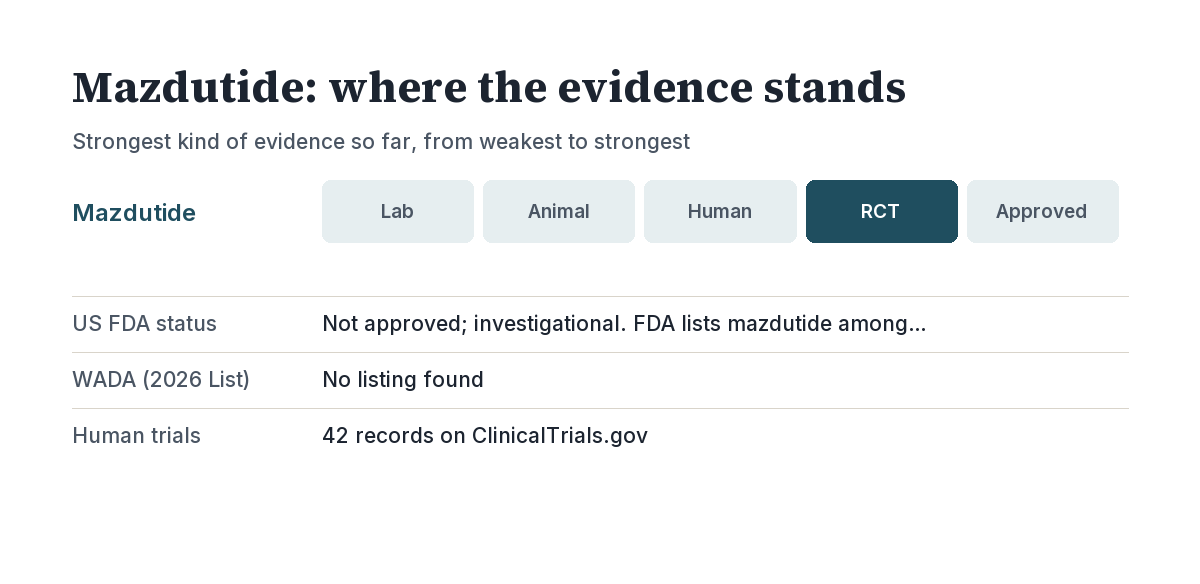
| US FDA status | Not approved; investigational. FDA lists mazdutide among unapproved drugs it has warned sellers about (FDA, page current 2026-10-01) |
| Compounding (503A/503B) | No route found: not a component of any FDA-approved drug, and not named on FDA’s 503A bulks page or Category 2 page as of 2026-10-18 (FDA 503A; FDA Category 2) |
| WADA (2026 List) | No listing found (2026-10-18); USADA states GLP-1 drugs “are not prohibited in sport” (USADA) |
| WADA (2027 List, from 2027-01-01) | No change found: mazdutide is not named; semaglutide and tirzepatide are on the Monitoring Program, not the List (USADA 2027 advisory) |
| China (NMPA) | Approved 2025-06-27 for chronic weight management and 2025-09-19 for type 2 diabetes (Innovent) |
| Next regulatory step | China: 9 mg application under NMPA review since 2025-11-25 (Innovent). US: no FDA filing announced as of 2026-10-18 |
| Strongest evidence | Human RCT, phase 3 (5 published or reported trials, n=320 to 731) |
| Human trials | 42 records on ClinicalTrials.gov (searched 2026-10-18), e.g. NCT05607680, NCT06124807 |
| Last checked | 2026-10-18 |
Key points:
- Mazdutide is an analogue of oxyntomodulin, a gut hormone; Innovent markets it in China under an exclusive license from Eli Lilly (Innovent).
- At a higher 9 mg dose, the phase 3 GLORY-2 trial (n=461) reported a 16.65% mean weight loss at 60 weeks, against 1.50% on placebo (Gao et al., 2026).
- In the US phase 2 trial (n=179), the 16 mg arm lost 18.1% at 32 weeks, and 20% of that arm stopped treatment because of side effects (Hsia et al., 2026).
- Nausea, vomiting and diarrhea are the most common side effects in the published trials.
- FDA has warned companies selling mazdutide labeled “for research purposes”; such products are unapproved drugs.
| Property | Detail |
|---|---|
| Code names | LY3305677 (Lilly), IBI362 (Innovent) |
| Molecular formula | C207H317N45O65 (PubChem) |
| Molecular weight | About 4,476 g/mol (PubChem, computed) |
| PubChem CID | 167312357 |
| Routes studied | Subcutaneous injection, once weekly |
| Class | Dual GLP-1 / glucagon receptor agonist; oxyntomodulin analogue |
What is mazdutide?
Mazdutide is a synthetic analogue of oxyntomodulin, a hormone released by the gut. Innovent describes it as “a mammalian oxyntomodulin (OXM) analogue” and “the first marketed dual GCG/GLP-1 receptor agonist” (Innovent, 2025). Eli Lilly developed it under the code LY3305677; its earliest registered human study was a phase 1 trial in healthy volunteers that began in 2016 (NCT02972645). Innovent holds an exclusive license from Lilly to develop and sell it in China, where it ran the phase 3 GLORY (obesity) and DREAMS (type 2 diabetes) programs. China’s National Medical Products Administration (NMPA) approved it in June 2025 for weight management.
How does mazdutide work?
- GLP-1 receptor: mazdutide activates the GLP-1 receptor; in the DREAMS-1 trial it lowered HbA1c (a three-month blood sugar average) by up to 2.15% [Human RCT, n=320] (Zhu et al., 2026).
- Glucagon receptor: it also activates the glucagon receptor, which the sponsor says is meant to “increase energy expenditure and improve hepatic fat metabolism” [sponsor description, not a measured result] (Innovent, 2025).
- Liver fat: in high-fat-diet mice, mazdutide lowered MRI-measured liver fat more than semaglutide (−5.59% vs −3.30%, P=.02) [Animal, 42 mice] (Xia et al., 2025).
- Weekly dosing in trials: the phase 3 trials gave it once a week by injection under the skin [Human RCT] (Ji et al., 2025).
This two-receptor design is what sets mazdutide apart from tirzepatide (Zepbound, Mounjaro), which FDA describes as activating the GLP-1 and GIP receptors (FDA). Lilly’s investigational retatrutide, covered in its own entry, is a separate molecule.
Benefits of mazdutide: what the research shows
The most promising potential benefit of mazdutide is weight loss: in GLORY-1 (n=610), 82.0% of people on 6 mg lost at least 5% of their body weight by week 32, against 10.5% on placebo (Ji et al., 2025). The second is blood sugar control in type 2 diabetes, where mazdutide beat dulaglutide on HbA1c in a 731-person phase 3 trial (Guo et al., 2026). A third, liver fat reduction, rests so far on a sponsor-reported trial subgroup and mouse work.
| Claim | Evidence level | Best study and result |
|---|---|---|
| Weight loss in obesity | Human RCT, phase 3 (n=610) | Ji 2025: −14.01% (6 mg) vs +0.30% placebo, week 48 |
| Larger loss at higher dose | Human RCT, phase 3 (n=461) | Gao 2026: −16.65% (9 mg) vs −1.50%, week 60 |
| Weight loss in US adults | Human RCT, phase 2 (n=179) | Hsia 2026: −18.1% (16 mg) vs −0.9%, week 32 |
| Lower HbA1c in type 2 diabetes | Human RCT, phase 3 (n=320) | Zhu 2026: −2.15% (6 mg) vs −0.14%, week 24 |
| Better than dulaglutide on HbA1c and weight | Human RCT, phase 3 (n=731) | Guo 2026: HbA1c −0.30%, weight −5.76% vs dulaglutide (6 mg) |
| Better than semaglutide 1 mg on a combined goal | Human RCT, phase 3, open-label (n=349), sponsor-reported | DREAMS-3: 48.0% vs 21.0% reached HbA1c <7% plus ≥10% weight loss |
| Less liver fat | Human RCT subgroup, sponsor-reported; Animal | Innovent: −80.24% (6 mg) vs −5.27% in GLORY-1 participants with ≥10% liver fat |
| Cognition in diabetes | Animal (db/db mice) | Dong 2025: better cognitive tests than dulaglutide |
Weight management
Weight loss is the best-supported effect. GLORY-1 enrolled 610 Chinese adults with a BMI of 28 or more, or 24 to 27.9 with a weight-related condition, and found mean weight changes at week 32 of −10.09% on 4 mg and −12.55% on 6 mg, against +0.45% on placebo [Human RCT] (Ji et al., 2025). By week 48, 49.5% of the 6 mg group had lost at least 15%, and the authors reported “beneficial effects on all prespecified cardiometabolic measures.” GLORY-2 tested 9 mg in 461 adults with a BMI of 30 or more; 84.3% lost at least 5% by week 60, against 33.1% on placebo [Human RCT] (Gao et al., 2026). Both trials were run in China; the US phase 2 trial found a similar dose-dependent pattern, from −7.3% on 3 to 6 mg to −18.1% on 16 mg at week 32 [Human RCT, n=179] (Hsia et al., 2026).
Type 2 diabetes
In DREAMS-1, people with type 2 diabetes treated by diet and exercise alone lowered HbA1c by 1.57% on 4 mg and 2.15% on 6 mg at week 24, and lost 5.61% and 7.81% of body weight [Human RCT, n=320] (Zhu et al., 2026). In DREAMS-2, both doses were non-inferior and superior to dulaglutide 1.5 mg on HbA1c at week 28, with greater weight loss (both P<0.0001) [Human RCT, n=731] (Guo et al., 2026). Innovent reported that in DREAMS-3, an open-label trial against semaglutide 1 mg, HbA1c fell 2.03% versus 1.84% and weight fell 10.29% versus 6.00% at week 32 [Human RCT, sponsor-reported; no journal publication found as of 2026-10-18] (Innovent, 2025).
Liver fat and other areas
In GLORY-1 participants who started with at least 10% liver fat, Innovent reported liver fat falls of 65.85% on 4 mg and 80.24% on 6 mg at week 48, against 5.27% on placebo [Human RCT subgroup, sponsor-reported] (Innovent, 2025). In mice, it outperformed semaglutide on liver fat [Animal] (Xia et al., 2025), and in diabetic db/db mice it improved cognitive test scores compared with dulaglutide [Animal] (Dong et al., 2025). Human trials in fatty liver disease, heart failure, sleep apnea and alcohol use disorder are registered, with no results posted on ClinicalTrials.gov as of 2026-10-18.
Human studies and trials
A ClinicalTrials.gov search for mazdutide returned 42 records on 2026-10-18, including investigator-led studies in China (ClinicalTrials.gov). The published and reported trials are below.
| Trial | Design and n | Result |
|---|---|---|
| Phase 1b, China (Ji 2021) | RCT, 12 per dose cohort, 12 weeks | −4.81% to −6.40% vs +0.60%; no serious adverse events |
| Phase 2 obesity, China, NCT04904913 | RCT, n=248, 24 weeks | Ji 2023: −6.7% to −11.3% vs +1.0% |
| Phase 2 type 2 diabetes, China | RCT, n=250, 20 weeks | Zhang 2024: HbA1c −1.41% to −1.67%; weight up to −7.1% |
| Phase 2 9 mg, China | RCT, n=80, 24 weeks | Ji 2026: −12.78% vs +1.80% |
| Phase 1 high dose, Lilly, NCT05623839 | RCT, n=32, 20 weeks, up to 16 mg | Bhattachar 2025: −20.0% and −21.0% vs −0.1% |
| Phase 2 US, Lilly, NCT06124807 | RCT, n=179, 48 weeks | Hsia 2026: −7.3% to −18.1% vs −0.9% at week 32 |
| GLORY-1, NCT05607680 | Phase 3 RCT, n=610, 48 weeks | Ji 2025: −11.00% and −14.01% vs +0.30% |
| GLORY-2, NCT06164873 | Phase 3 RCT, n=461, 60 weeks, 9 mg | Gao 2026: −16.65% vs −1.50% |
| DREAMS-1, NCT05628311 | Phase 3 RCT, n=320, 24 weeks | Zhu 2026: HbA1c −1.57% and −2.15% vs −0.14% |
| DREAMS-2, NCT05606913 | Phase 3 RCT vs dulaglutide, n=731, 28 weeks | Guo 2026: superior on HbA1c and weight |
| DREAMS-3, NCT06184568 | Phase 3 open-label vs semaglutide, n=349, 32 weeks | Sponsor-reported: composite goal 48.0% vs 21.0% |
Ongoing and unreported trials, as listed on ClinicalTrials.gov on 2026-10-18:
- GLORY-3 (NCT06884293): phase 3, mazdutide versus semaglutide in 479 adults with overweight or obesity and fatty liver disease; active, not recruiting; primary completion 2026-12-31.
- GLORY-OSA (NCT06931028): phase 3, obstructive sleep apnea, about 260 participants; recruiting.
- NCT07255209: phase 3 in 180 Chinese adolescents with obesity or overweight; recruiting.
- NCT06862908 (heart failure with obesity, phase 2, n=141) and NCT06937749 (MASH, a severe form of fatty liver disease, phase 2, about 165).
- Lilly: NCT06817356, a phase 2 trial in alcohol use disorder (n=308), completed with no results posted, and NCT06143956, a phase 2 weight-management master protocol that includes LY3305677.
Doses used in studies
| Route | amount | Species | Study |
|---|---|---|
| Subcutaneous, weekly | 3 to 6 mg | Human | Ji 2023, phase 2 |
| Subcutaneous, weekly | 4 or 6 mg | Human | GLORY-1; DREAMS-1; DREAMS-2 |
| Subcutaneous, weekly | 9 mg | Human | GLORY-2 |
| Subcutaneous, weekly | 10 or 16 mg | Human | Hsia 2026, US phase 2 |
No established human dose exists outside approved labels.
Side effects and safety
Stomach and gut effects dominate. In GLORY-2 (9 mg), vomiting affected 53.1% of the mazdutide group versus 1.3% on placebo, nausea 46.9% versus 3.2%, and diarrhea 39.4% versus 6.5%; most cases were mild to moderate, and 2.9% stopped treatment because of side effects [Human RCT, n=461] (Gao et al., 2026). At 4 and 6 mg in GLORY-1, discontinuation for side effects was 0.5% to 1.5% across groups [Human RCT, n=610] (Ji et al., 2025). Tolerability falls at higher doses: in the US phase 2 trial, 20% of the 16 mg arm stopped treatment because of side effects, mostly gastrointestinal [Human RCT, n=179] (Hsia et al., 2026). Against dulaglutide, gastrointestinal side effects were more frequent with mazdutide [Human RCT, n=731] (Guo et al., 2026).
Unknowns: the longest published trial lasted 60 weeks, and no cardiovascular outcome trial result was found on ClinicalTrials.gov as of 2026-10-18; a coronary plaque study and a heart failure trial are registered but unreported (ClinicalTrials.gov). No FDA label exists, so there is no US list of warnings or of people who should not use it.
Unregulated products carry their own risk. FDA says it has warned companies that “illegally sold unapproved drugs containing semaglutide, tirzepatide, retatrutide, survodutide or mazdutide that are falsely labeled ‘for research purposes’ or ‘not for human consumption’” (FDA). No regulator checks the identity, purity or strength of such products; our page on what the “research use only” label means legally explains the background.
Anyone who suspects a side effect from mazdutide or any other drug or product can report it to the FDA through MedWatch.
What users report
These are unverified self-reports from people who usually bought unregulated products, not evidence. People who post about mazdutide on Reddit, X and weight-loss forums commonly describe a strong drop in appetite and steady weight loss, and many say the effect felt similar to tirzepatide’s. Some say they chose it hoping the glucagon component would add energy or help with liver fat. A recurring complaint is nausea, vomiting and diarrhea, especially in the first weeks, and some report constipation, fatigue or a faster heartbeat. Others report little effect and suspect under-filled or mislabeled products. Cost and uncertainty about product quality come up often, as does frustration that the drug is approved in China but not in the United States. Users argue about whether it differs meaningfully from tirzepatide or retatrutide, and whether research-labeled products contain mazdutide at all.
Legal and regulatory status
| Jurisdiction | Status (checked 2026-10-18) |
|---|---|
| US FDA | Not approved; investigational. Research-labeled sellers warned (FDA) |
| US compounding | No route found: no FDA-approved product, not named on the 503A bulks page (FDA) |
| China | Approved: weight management (2025-06-27), type 2 diabetes (2025-09-19); 9 mg under review (Innovent) |
| WADA 2026 and 2027 | Not named; GLP-1 drugs not prohibited (USADA) |
In the US, mazdutide can be obtained legally only inside a clinical trial. A 503A pharmacy may compound with a bulk substance only if it has a USP monograph, is a component of an FDA-approved drug, or is on the 503A bulks list, and FDA does not intend to place substances nominated on or after January 7, 2025, into its interim categories (FDA). Our explainer on what FDA’s Category 1 and Category 2 compounding lists mean covers that system. No US filing for mazdutide had been announced as of 2026-10-18; for a Lilly incretin drug further along that path, see the retatrutide FDA approval timeline and filing window.
China approved mazdutide on 2025-06-27 for chronic weight management in adults with a BMI of 28 or more, or 24 or more with at least one weight-related condition (Innovent), and on 2025-09-19 for blood sugar control in type 2 diabetes, alone or with metformin, sulfonylureas or SGLT2 inhibitors (Innovent).
In sport, WADA’s S0 class covers substances not “approved for human therapeutic use by any governmental health agency anywhere in the world” (USADA). Mazdutide’s Chinese approval suggests S0 does not apply, but no WADA or USADA ruling naming mazdutide was found on 2026-10-18; the 2027 Monitoring Program tracks semaglutide and tirzepatide without banning them. Our page on which peptides WADA prohibits in 2027 lists the peptides that are banned.
Related peptides
- CagriSema (cagrilintide + semaglutide): an amylin and GLP-1 combination for weight management.
- Wegovy pill (oral semaglutide): a GLP-1 agonist taken by mouth.
- Nisotirostide: another investigational Lilly peptide in the metabolic pipeline.
Frequently asked questions
Is mazdutide FDA approved?
No. Mazdutide has no FDA approval for any use and remains investigational in the United States, where Lilly has run a 179-person phase 2 trial. FDA lists it among the unapproved drugs it has warned research-labeled sellers about, and no US filing had been announced as of 2026-10-18 (FDA).
Is mazdutide approved in China?
Yes. China’s NMPA approved mazdutide on 2025-06-27 for chronic weight management in adults with obesity, or overweight with a related condition, and on 2025-09-19 for blood sugar control in type 2 diabetes. A higher 9 mg dose has been under review since November 2025 (Innovent).
Is mazdutide a peptide?
Yes. Mazdutide is a synthetic analogue of oxyntomodulin, a hormone made in the gut, and every trial so far has given it by injection. Its PubChem entry lists the formula C207H317N45O65 and a molecular weight of about 4,476 g/mol, far larger than a typical small-molecule drug (PubChem).
Is mazdutide the same as tirzepatide?
No. Both are once-weekly injections, but they act on different receptor pairs: tirzepatide on GIP and GLP-1, mazdutide on glucagon and GLP-1. Tirzepatide is FDA-approved as Zepbound and Mounjaro; mazdutide is not. Innovent calls mazdutide the first marketed dual glucagon/GLP-1 agonist (Innovent).
Is mazdutide available in the USA?
Only inside clinical trials: no FDA approval or lawful compounding route was found as of 2026-10-18, and “research” products sold online are unapproved drugs (FDA).
References
- Ji L, Jiang H, Bi Y, et al. 2025. Once-Weekly Mazdutide in Chinese Adults with Obesity or Overweight (GLORY-1). N Engl J Med. PMID 40421736
- Gao L, Jiang H, Cai H, et al. 2026. Treatment With 9-mg Mazdutide for Weight Reduction in Chinese Adults With Obesity: The GLORY-2 Randomized Clinical Trial. JAMA. PMID 42251595
- Hsia SH, Bays HE, Billings LK, et al. 2026. Efficacy and safety of mazdutide in adults with obesity or overweight: a US-based, multicentre, phase 2, randomised, placebo-controlled clinical trial. Lancet Diabetes Endocrinol. PMID 42628555
- Zhu D, Zhao J, Cai H, et al. 2026. Mazdutide versus placebo in Chinese adults with type 2 diabetes (DREAMS-1). Nature. PMID 41407859
- Guo L, Zhang B, Xue X, et al. 2026. Mazdutide versus dulaglutide in Chinese adults with type 2 diabetes (DREAMS-2). Nature. PMID 41407860
- Ji L, Jiang H, Cheng Z, et al. 2023. A phase 2 randomised controlled trial of mazdutide in Chinese overweight adults or adults with obesity. Nat Commun. PMID 38092790
- Ji L, Jiang H, Cheng Z, et al. 2026. Mazdutide 9 mg in Chinese adults with a body mass index ≥30 kg/m² but without diabetes: a phase 2 randomized controlled trial. Med. PMID 41875890
- Zhang B, Cheng Z, Chen J, et al. 2024. Efficacy and Safety of Mazdutide in Chinese Patients With Type 2 Diabetes: a phase 2 trial. Diabetes Care. PMID 37943529
- Bhattachar SN, Tham LS, Li Y, et al. 2025. Mazdutide reduces body weight in adults with overweight or obesity: a high-dose phase 1 trial. Diabetes Obes Metab. PMID 40832785
- Ji L, Jiang H, An P, et al. 2021. IBI362 (LY3305677) in Chinese adults with overweight or obesity: a phase 1b study. EClinicalMedicine. PMID 34430840
- Xia H, Min Y, Wang Y, et al. 2025. Multiparametric MRI evaluation of liver fat and iron after GLP-1 receptor and glucagon receptor dual-agonist treatment in a high-fat diet-induced mouse model. Radiology. PMID 40828048
- Dong W, Bai J, Yuan Q, et al. 2025. Mazdutide, a dual agonist targeting GLP-1R and GCGR, mitigates diabetes-associated cognitive dysfunction. EBioMedicine. PMID 40479843
- Innovent Biologics. 2025-06-27. Mazdutide received approval from China’s NMPA for chronic weight management (press release). Link
- Innovent Biologics. 2025-09-19. Mazdutide received approval from China’s NMPA for glycemic control in adults with type 2 diabetes (press release). Link
- Innovent Biologics. 2025-10-26. Mazdutide shows superiority over semaglutide in head-to-head phase 3 trial DREAMS-3 (press release). Link
- Innovent Biologics. 2025-11-25. Mazdutide 9 mg supplementary application accepted for review by China’s NMPA (press release). Link
- US Food and Drug Administration. FDA’s concerns with unapproved GLP-1 drugs used for weight loss (content current 2026-10-01). Link
- US Food and Drug Administration. Bulk drug substances used in compounding under section 503A of the FD&C Act (content current 2026-05-14). Link
- US Food and Drug Administration. Certain bulk drug substances for use in compounding that may present significant safety risks (content current 2026-04-22). Link
- US Food and Drug Administration. FDA approves new medication for chronic weight management (Zepbound press announcement). Link
- USADA. Weight loss drugs: what athletes need to know about GLP-1s. Link
- USADA. Athlete advisory: what’s new on the 2027 WADA Prohibited List. Link
- PubChem. Mazdutide, CID 167312357. National Library of Medicine. Link
- ClinicalTrials.gov. Search results for intervention “mazdutide” (searched 2026-10-18), and records NCT02972645, NCT04904913, NCT05623839, NCT06124807, NCT05607680, NCT06164873, NCT05628311, NCT05606913, NCT06184568, NCT06884293, NCT06931028, NCT07255209, NCT06862908, NCT06937749, NCT06817356, NCT06143956. Link
Change log
2026-10-26: links to related entries added; no change to the facts.
2026-10-23: links to glossary definitions added; no change to the facts.
2026-10-19: links to related entries added; no change to the facts.
2026-10-18: first published after review by the editorial team.