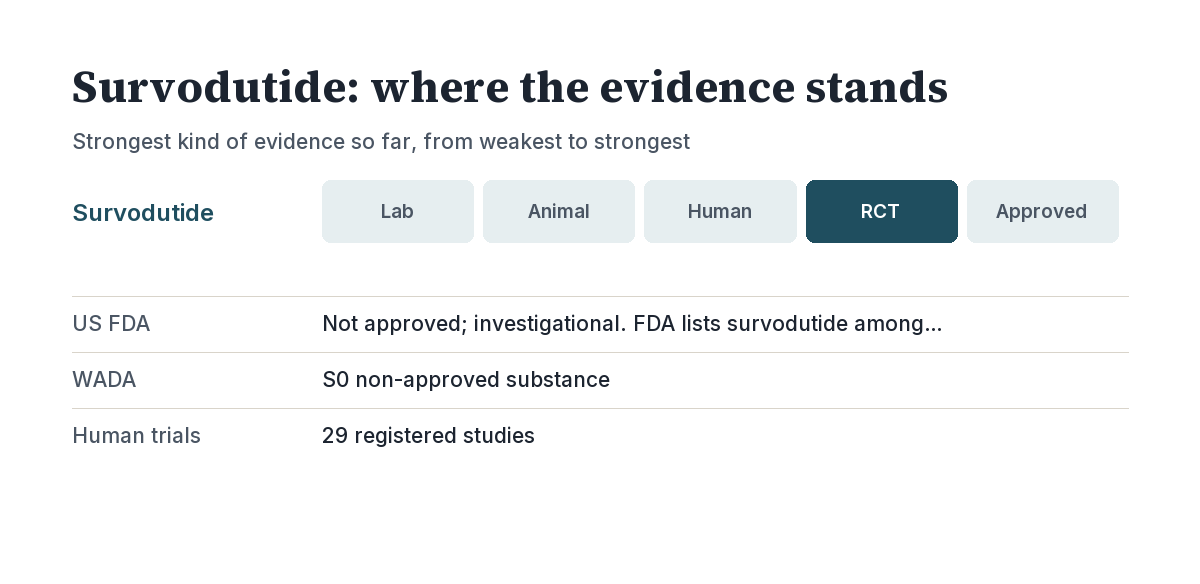
Survodutide (BI 456906) is an investigational once-weekly injectable peptide that activates both the glucagon and GLP-1 receptors; its strongest evidence comes from phase 3 randomized trials in obesity and fatty liver disease. In the phase 3 SYNCHRONIZE-1 trial (n=725), adults with obesity lost a mean 12.2% to 13.0% of body weight over 76 weeks, versus 5.4% with placebo [Human RCT] (le Roux, NEJM 2026). It is not FDA approved as of 2026-10-20, and gastrointestinal side effects were common in every trial.
| Item | Status |
|---|---|
| US FDA | Not approved; investigational. FDA lists survodutide among unapproved drugs sold illegally as “research” products (FDA, current 2026-10-01) |
| Compounding (503A/503B) | Not in any FDA bulks category as of 2026-10-20 (FDA Category 2 page); not a component of any FDA-approved drug |
| WADA | S0 non-approved substance (approved by no regulator), prohibited at all times (USADA). |
| EU / China | Not authorized; EMA PRIME scheme (Nov 2023); NMPA breakthrough designation (2024) (Zealand, 2026-06-07) |
| Strongest evidence | Human RCT, phase 3 (n=725, n=752, n=216) |
| Human trials | 29 registered studies (ClinicalTrials.gov, searched 2026-10-20); 6 phase 3 trials completed |
| Next regulatory step | No filing date announced; cardiovascular outcomes results expected later in 2026 (Boehringer, 2026-10-01) |
| Last checked | 2026-10-20 |
Key points:
- The “16.6% weight loss” headline is the efficacy estimand, which assumes people kept taking the drug; the trial’s primary analysis, counting everyone randomized, gave 12.2% to 13.0% (Zealand, 2026-04-28).
- In people with obesity and type 2 diabetes (SYNCHRONIZE-2, n=752), weight fell 8.2% to 9.8% versus 3.9% with placebo, and HbA1c fell 0.8 to 0.9 points [Human RCT] (Wharton, NEJM 2026).
- In adults with fatty liver disease, 68.5% on survodutide cut liver fat by at least 30% versus 28.6% on placebo when everyone randomized was counted, and 84.2% versus 24.3% assuming people stayed on treatment [Human RCT, n=216] (Kaplan, Nat Med 2026).
- A cardiovascular safety trial with 5,531 participants enrolled finished on 2026-06-30; its results have not been announced.
- Survodutide is not obtainable legally outside clinical trials.
| Property | Detail |
|---|---|
| Code name | BI 456906 |
| Class | Glucagon receptor / GLP-1 receptor dual agonist |
| Structure | Acylated peptide with a C18 fatty acid for once-weekly action (Zimmermann 2022) |
| Molecular formula | C192H289N47O61 |
| Molecular weight | About 4,232 g/mol |
| PubChem CID | 171378821 |
| Route studied | Subcutaneous injection |
| Developer | Boehringer Ingelheim, licensed from Zealand Pharma |
What is survodutide?
Survodutide is a synthetic peptide developed by Boehringer Ingelheim under a license from Zealand Pharma, which receives royalties and up to EUR 315 million in milestone payments (Zealand, 2026-04-28). It was chosen from 19 candidate dual agonists for its balance of glucagon and GLP-1 receptor activity (Thomas 2024). First human studies reported placebo-corrected weight loss of up to 13.8% at week 16 [Human, phase 1, n=149] (Jungnik 2023). FDA granted Fast Track designation in May 2021 and Breakthrough Therapy designation for MASH (a fatty liver disease with inflammation) in September 2024 (Zealand, 2026-06-07). It is now in phase 3 for obesity and liver disease.
How does survodutide work?
- GLP-1 receptor: in mice, survodutide improved oral glucose tolerance by a similar amount to semaglutide, a GLP-1 drug [Animal] (Thomas 2024).
- Glucagon receptor: in mice, weight fell through both higher energy expenditure and lower food intake, and weight loss exceeded that of maximally effective semaglutide doses [Animal] (Zimmermann 2022).
- Target engagement in people: in phase 1 trials, survodutide lowered plasma amino acids and glucagon, markers that both receptors were being activated [Human, n=149] (Jungnik 2023).
- Liver: in a phase 3 trial, survodutide reduced MRI-measured liver fat by at least 30% in most participants [Human RCT, n=216] (Kaplan 2026).
- Long action: a C18 fatty acid attached to the peptide extends its half-life to support once-weekly dosing [Lab/Animal design] (Zimmermann 2022).
Benefits of survodutide: what the research shows
The most promising potential benefit of survodutide is weight loss: two phase 3 trials with 1,477 participants combined found it lowered body weight more than placebo over 76 weeks (le Roux 2026; Wharton 2026). The second is liver health: in a phase 2 trial, up to 62% of people with biopsy-proven MASH saw it improve, versus 14% on placebo (Sanyal 2024). The third is blood sugar control in type 2 diabetes.
| Claim | Evidence level | Best study and result |
|---|---|---|
| Weight loss in obesity without diabetes | Human RCT, phase 3 (n=725) | le Roux 2026: −12.2% (3.6 mg), −13.0% (6.0 mg) vs −5.4% placebo at 76 weeks |
| Weight loss with type 2 diabetes | Human RCT, phase 3 (n=752) | Wharton 2026: −8.2%, −9.8% vs −3.9% at 76 weeks |
| Lower HbA1c | Human RCT, phase 3 (n=752) | Wharton 2026: −0.9 and −0.8 points vs −0.2 (baseline 7.4%) |
| Less liver fat | Human RCT, phase 3 (n=216) | Kaplan 2026: ≥30% reduction in 84.2% vs 24.3% at 48 weeks |
| MASH improvement | Human RCT, phase 2 (n=293) | Sanyal 2024: 47%, 62%, 43% vs 14% placebo |
| Fibrosis improvement | Human RCT, phase 2, secondary end point (n=293) | Sanyal 2024: ≥1 stage in 34% to 36% vs 22% |
| Less visceral fat | Human RCT sub-study, sponsor-reported (n not given) | Zealand 2026: up to 34.0% reduction |
| Liver markers in cirrhosis | Human, open-label phase 1 (n=41 multi-dose) | Lawitz 2024: liver fat and stiffness “generally reduced” at 28 weeks |
| Fewer heart attacks or strokes | Not yet shown | SYNCHRONIZE-CVOT (NCT06077864) completed; results not announced |
Weight loss
In the phase 2 dose-finding trial, weight fell by up to 14.9% at 46 weeks with the 4.8 mg dose, versus 2.8% with placebo [Human RCT, n=386] (le Roux 2024). Phase 3 confirmed the effect over 76 weeks. Two numbers circulate because the trials used two analyses: the primary treatment-regimen estimand counts everyone randomized, including those who stopped, and gave 12.2% to 13.0% loss (le Roux 2026); the efficacy estimand, which assumes people stayed on the drug, gave 16.6% versus 3.2% with placebo (Zealand, 2026-04-28). In an MRI sub-study, lean mass made up no more than 10.8% of the tissue lost at the highest dose, as reported by the sponsor (Zealand, 2026-06-07).
Type 2 diabetes
In SYNCHRONIZE-2, weight loss was smaller than in people without diabetes, but 64.5% of the 6.0 mg group still lost at least 5% of their weight, versus 35.1% on placebo [Human RCT, n=752] (Wharton 2026). In an earlier 16-week trial, HbA1c fell by up to 1.71 points, and the 1.8 mg dose and above produced more weight loss than open-label semaglutide (5.3%) [Human RCT, n=413] (Blüher 2024).
Fatty liver disease (MASLD and MASH)
Liver results are among survodutide’s strongest. In SYNCHRONIZE-MASLD, 61.0% of people on survodutide reached normal liver fat (below 5%) at week 48, versus 5.7% on placebo, in a secondary end point that assumed people stayed on treatment (efficacy estimand), as reported by the sponsor (Zealand, 2026-06-07). In the phase 2 MASH trial, at least 30% liver-fat reduction occurred in 57% to 67% of treated groups versus 14% on placebo (Sanyal 2024). Phase 3 biopsy trials (LIVERAGE and LIVERAGE-Cirrhosis) are recruiting; their results will show whether these changes translate into less liver scarring.
Human studies and trials
ClinicalTrials.gov lists 29 studies with survodutide as an intervention (searched 2026-10-20). The main efficacy trials:
| Trial (phase) | Population, n, status | Result |
|---|---|---|
| NCT04667377 (2) | Obesity, 387, completed | Up to −14.9% weight at 46 weeks |
| NCT04153929 (2) | Type 2 diabetes, 413, completed | HbA1c up to −1.71 points at 16 weeks |
| NCT04771273 (2) | MASH F1–F3, 293 treated, completed | MASH improved in up to 62% vs 14% |
| NCT05296733 (1) | Cirrhosis, 82, completed | No dose adjustment needed |
| NCT06066515 SYNCHRONIZE-1 (3) | Obesity, 725, completed | −12.2% to −13.0% vs −5.4% |
| NCT06066528 SYNCHRONIZE-2 (3) | Obesity + diabetes, 752, completed | −8.2% to −9.8% vs −3.9% |
| NCT06309992 SYNCHRONIZE-MASLD (3) | Obesity + MASLD, 216, completed | Liver fat ≥30% lower in 84.2% vs 24.3% |
| NCT06214741 (3) | Obesity, China, 307, completed 2026-01-28 | Not yet published |
| NCT06176365 SYNCHRONIZE-JP (3) | Obesity, Japan, 274, completed 2025-12-03 | Not yet published |
| NCT06077864 SYNCHRONIZE-CVOT (3) | Cardiovascular safety, 5,531, completed 2026-06-30 | Not yet announced |
| NCT06632444 LIVERAGE (3) | MASH with fibrosis, 1,800, recruiting | Due 2031 |
| NCT06632457 LIVERAGE-Cirrhosis (3) | MASH cirrhosis, 1,590, recruiting | Due 2029 |
| NCT07754461 (3) | Type 2 diabetes, 600, recruiting | Due 2028 |
| NCT07206290 (2) | Kidney disease, 120, not yet recruiting | Due 2027 |
Three further phase 3 trials are registered but not yet recruiting: ELEVATE-LIVER (NCT07850063), SYNCHRONIZE-HERA in menopausal women (NCT07850050) and SYNCHRONIZE-START (NCT07855900). The remaining registered studies are phase 1 pharmacology studies. None of the 29 tests survodutide head-to-head against tirzepatide or retatrutide.
Doses used in studies
| Study (population) | Route and amount | Duration |
|---|---|---|
| SYNCHRONIZE-1 (adults, obesity) | Subcutaneous, weekly, escalated up to 3.6 mg or 6.0 mg | 76 weeks |
| SYNCHRONIZE-MASLD (adults, MASLD) | Subcutaneous, weekly, 6.0 mg | 48 weeks |
| Phase 2 MASH (adults) | Subcutaneous, weekly, 2.4, 4.8 or 6.0 mg | 48 weeks |
| Phase 2 obesity (adults) | Subcutaneous, weekly, 0.6 to 4.8 mg | 46 weeks |
| Phase 2 diabetes (adults) | Subcutaneous, 0.3 to 2.7 mg weekly or 1.2 to 1.8 mg twice weekly | 16 weeks |
| Thomas 2024 (obese mice) | 30 nmol/kg once daily | Preclinical |
No established human dose exists outside approved labels.
Side effects and safety
Gastrointestinal effects are the main side effects of survodutide. In SYNCHRONIZE-1 they occurred in 80.9% (3.6 mg) and 89.7% (6.0 mg) of participants versus 47.9% on placebo, were typically mild to moderate, and no deaths were reported [Human RCT, n=725] (le Roux 2026). In SYNCHRONIZE-2 the rates were 72.8% and 77.7% versus 38.6% [Human RCT, n=752] (Wharton 2026). In the phase 2 MASH trial, nausea (66% vs 23%), diarrhea (49% vs 23%) and vomiting (41% vs 4%) were more frequent than with placebo, while serious adverse events were similar (8% vs 7%) [Human RCT, n=293] (Sanyal 2024).
Side effects led a meaningful share of people to stop. The sponsor reported that 19% on survodutide versus 2.9% on placebo discontinued because of adverse events in SYNCHRONIZE-1 (Zealand, 2026-06-07), and 18% versus 1.2% stopped because of gastrointestinal events in SYNCHRONIZE-2 (Boehringer, 2026-10-01). In phase 1, some participants stopped because of cardiac or vascular events as well as gastrointestinal ones [Human, n=149] (Jungnik 2023).
Unknowns remain. Long-term cardiovascular safety has not been reported, since SYNCHRONIZE-CVOT results are still pending (NCT06077864). There is no approved label, so no regulator has set out who should not use survodutide.
Products sold outside trials carry a separate risk. FDA warns that companies have illegally sold unapproved drugs containing survodutide “falsely labeled ‘for research purposes’ or ‘not for human consumption’” (FDA). The trial safety data above come from manufactured, quality-controlled study drug and do not describe such products. Our page on what the “research use only” label means legally explains the background.
Anyone who suspects a side effect from survodutide or any other drug or product can report it to the FDA through MedWatch.
Legal and regulatory status
| Jurisdiction | Status (checked 2026-10-20) |
|---|---|
| US FDA | Not approved; Fast Track (May 2021) and Breakthrough Therapy for MASH (Sept 2024) |
| US compounding | Not on FDA’s bulks category lists; not in any FDA-approved drug |
| US enforcement | FDA names survodutide in “research use” products sold illegally (page current 2026-10-01) |
| WADA (2026 and 2027 Lists) | S0 non-approved substance, prohibited at all times |
| EU (EMA) | Not authorized; PRIME scheme since Nov 2023 |
| China / Taiwan | Not approved; breakthrough designations (2024) |
Survodutide has no marketing approval from FDA, and the October 2026 SYNCHRONIZE-2 report describes it as investigational (Wharton 2026). FDA’s designations and the EU and Asian designations are listed in a June 2026 sponsor release (Zealand, 2026-06-07). Survodutide does not appear on FDA’s Category 2 page (current 2026-04-22), and FDA’s GLP-1 warning page names it among unapproved drugs sold under “research” labels (FDA). It is not obtainable legally outside clinical trials.
For athletes, USADA explains that a substance “not approved for clinical use by any governmental regulatory authority” with performance-enhancing potential may be prohibited under S0 (USADA). Approved GLP-1 drugs are not prohibited (USADA), but that does not cover survodutide, which is approved nowhere. Our guide to peptides on the 2027 WADA List covers the change of List on 2027-01-01.
No regulatory filing date has been announced. Boehringer’s latest release says cardiovascular outcomes results are expected later in 2026 (Boehringer, 2026-10-01).
What users report
What follows are unverified self-reports from people who usually bought unregulated products, not evidence. Survodutide circulates online under its name and sometimes as “BI 456906”, and people who post about it commonly describe reduced appetite and steady weight loss, often comparing it with semaglutide or tirzepatide they used before. Some describe it as gentler on appetite than those drugs, while others say the opposite. The most frequent complaints match the trials: nausea, vomiting, diarrhea, constipation and fatigue, especially in the first weeks. Some report a faster heart rate. Another recurring complaint concerns product quality: people question whether what they bought contains survodutide at all, post third-party test results that disagree, and argue about whether “research” sellers can be trusted. Debates also center on whether the glucagon component adds anything noticeable outside a trial, and whether an unapproved product is worth the risk when approved medicines exist.
Related peptides
- Mazdutide: another glucagon/GLP-1 dual agonist.
- Retatrutide: adds the GIP receptor to glucagon and GLP-1 (Jastreboff 2023).
- CagriSema (cagrilintide + semaglutide): an amylin and GLP-1 combination.
- AOD-9604, the growth hormone fragment marketed for fat loss: a different class, covered in its own entry.
Frequently asked questions
Is survodutide FDA approved?
No. As of 2026-10-20 survodutide is investigational, has no FDA approval for any use, and no filing date has been announced. FDA has given it Fast Track and Breakthrough Therapy designations, but these are not approvals. FDA also warns that survodutide has been sold illegally under “research use” labels (FDA).
Is survodutide a GLP-1?
Partly. Survodutide activates the GLP-1 receptor, like semaglutide, but it also activates the glucagon receptor, so it is called a glucagon/GLP-1 dual agonist. Phase 1 trials showed markers that both receptors are engaged in people.
Is survodutide the same as tirzepatide or retatrutide?
No. They are different molecules from different companies. Tirzepatide acts on GIP and GLP-1 receptors (Jastreboff 2022), survodutide on glucagon and GLP-1 receptors, and retatrutide on all three. Tirzepatide is approved; survodutide and retatrutide are investigational. Our retatrutide FDA approval timeline tracks where that drug stands.
Is survodutide better than tirzepatide?
That cannot be answered from current evidence. No registered trial compares the two head-to-head (ClinicalTrials.gov, searched 2026-10-20), and trials of different drugs differ in population, length and analysis method, so cross-trial numbers are not a fair comparison. Survodutide’s distinctive data are in liver disease, covered in the fatty liver section above (Kaplan 2026).
When will survodutide be available?
No date is known. Boehringer Ingelheim has completed the main phase 3 obesity trials but had not announced a regulatory filing as of 2026-10-20; cardiovascular outcomes results are expected later in 2026 (Boehringer, 2026-10-01). Until approval, it is legally available only inside clinical trials.
References
- le Roux CW, Wharton S, Startseva E, et al. Survodutide once weekly for the treatment of adults with obesity (SYNCHRONIZE-1). N Engl J Med. 2026;395(8):776-787. doi:10.1056/NEJMoa2600751
- Wharton S, le Roux CW, Startseva E, et al. Survodutide once weekly in adults with obesity and type 2 diabetes (SYNCHRONIZE-2). N Engl J Med. 2026. doi:10.1056/NEJMoa2607219
- Kaplan LM, Startseva E, le Roux CW, et al. Survodutide in adults with obesity and MASLD: SYNCHRONIZE-MASLD. Nat Med. 2026;32(8):2948-2958. doi:10.1038/s41591-026-04479-3
- Sanyal AJ, Bedossa P, Fraessdorf M, et al. A phase 2 randomized trial of survodutide in MASH and fibrosis. N Engl J Med. 2024;391(4):311-319. doi:10.1056/NEJMoa2401755
- le Roux CW, Steen O, Lucas KJ, et al. Glucagon and GLP-1 receptor dual agonist survodutide for obesity: a dose-finding phase 2 trial. Lancet Diabetes Endocrinol. 2024;12(3):162-173. doi:10.1016/S2213-8587(23)00356-X
- Blüher M, Rosenstock J, Hoefler J, et al. Dose-response effects on HbA1c and bodyweight reduction of survodutide. Diabetologia. 2024;67(3):470-482. doi:10.1007/s00125-023-06053-9
- Lawitz EJ, Fraessdorf M, Neff GW, et al. Efficacy, tolerability and pharmacokinetics of survodutide in cirrhosis. J Hepatol. 2024;81(5):837-846. doi:10.1016/j.jhep.2024.06.003
- Jungnik A, Arrubla Martinez J, Plum-Mörschel L, et al. Phase I studies of BI 456906. Diabetes Obes Metab. 2023;25(4):1011-1023. doi:10.1111/dom.14948
- Zimmermann T, Thomas L, Baader-Pagler T, et al. BI 456906: discovery and preclinical pharmacology of a novel GCGR/GLP-1R dual agonist. Mol Metab. 2022;66:101633. doi:10.1016/j.molmet.2022.101633
- Thomas L, Martel E, Rist W, et al. The dual GCGR/GLP-1R agonist survodutide: biomarkers and pharmacological profiling. Diabetes Obes Metab. 2024;26(6):2368-2378. doi:10.1111/dom.15551
- Jastreboff AM, Aronne LJ, Ahmad NN, et al. Tirzepatide once weekly for the treatment of obesity. N Engl J Med. 2022;387(3):205-216. doi:10.1056/NEJMoa2206038
- Jastreboff AM, Kaplan LM, Frías JP, et al. Triple-hormone-receptor agonist retatrutide for obesity. N Engl J Med. 2023;389(6):514-526. doi:10.1056/NEJMoa2301972
- ClinicalTrials.gov. Search results for intervention “survodutide” (searched 2026-10-20). clinicaltrials.gov
- ClinicalTrials.gov. SYNCHRONIZE-CVOT, NCT06077864. clinicaltrials.gov/study/NCT06077864
- Zealand Pharma. Survodutide SYNCHRONIZE-1 topline results. Press release, 2026-04-28. globenewswire.com
- Zealand Pharma. Survodutide phase III visceral and liver fat results. Press release, 2026-06-07. globenewswire.com
- Boehringer Ingelheim. Survodutide SYNCHRONIZE-2 results. Press release, 2026-10-01. globenewswire.com
- US Food and Drug Administration. FDA’s concerns with unapproved GLP-1 drugs used for weight loss. Content current as of 2026-10-01. fda.gov
- US Food and Drug Administration. Certain bulk drug substances for use in compounding that may present significant safety risks. Content current as of 2026-04-22. fda.gov
- USADA. Athlete advisory: what’s new on the 2025 WADA Prohibited List. usada.org
- USADA. Weight loss drugs: what athletes need to know about GLP-1s. usada.org
- PubChem. Survodutide, CID 171378821. pubchem.ncbi.nlm.nih.gov
Change log
2026-10-23: links to glossary definitions added; no change to the facts.
2026-10-20: first published after review by the editorial team.