Tesamorelin is a synthetic 44-amino-acid analog of human growth hormone-releasing hormone (GHRH), made by Theratechnologies and sold in the US as Egrifta SV and Egrifta WR. It is FDA-approved for one use only: reducing excess abdominal fat in adults with HIV and lipodystrophy. The strongest evidence is two phase 3 randomized trials that enrolled 412 and 404 people (Falutz 2007; Falutz 2010). It is not approved for weight loss, raises IGF-1 above the normal range in many users, can raise blood sugar, and is prohibited in sport at all times.
| Item | Status |
|---|---|
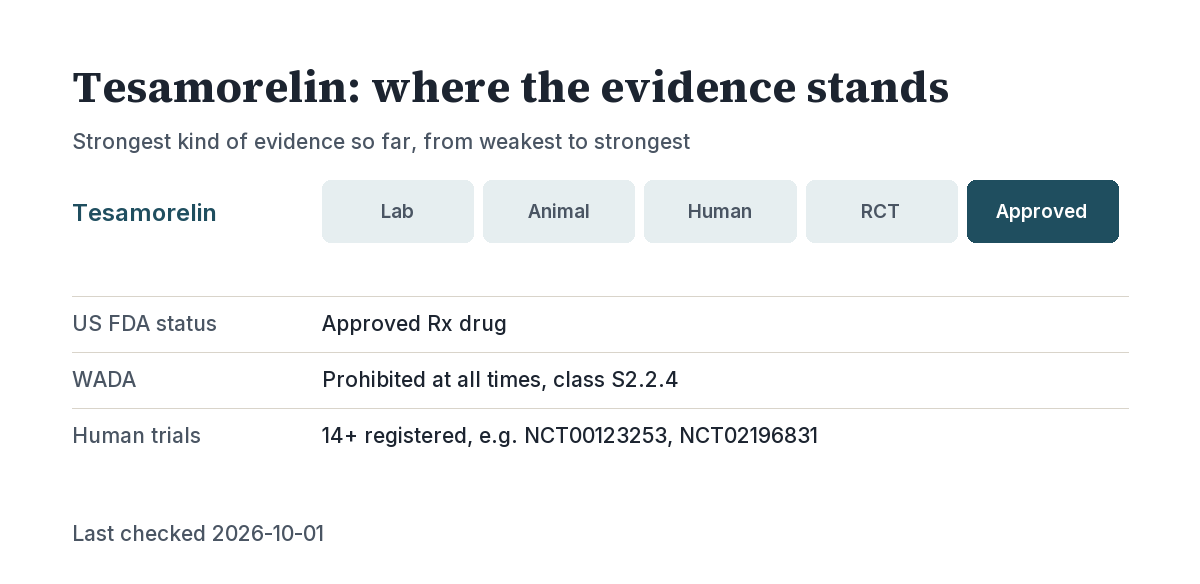
| US FDA status | Approved Rx drug (Egrifta, first approved 2010-11-10); indication limited to HIV-associated abdominal fat |
| Compounding (503A/503B) | Not on FDA’s Category 2 list; regulated as a biological product since 2020-03-23 |
| WADA 2026 | Prohibited at all times, class S2.2.4 (named) |
| Strongest evidence | Approved label; Human RCTs (n=412 and n=404) |
| Human trials | 14+ registered, e.g. NCT00123253, NCT02196831 |
| Main risks | High IGF-1, glucose intolerance, fluid retention, injection-site reactions |
| Last checked | 2026-10-01 |
Key points:
- Visceral (deep belly) fat fell about 15% more than with placebo over 26 weeks in pooled phase 3 data, and came back after the drug was stopped.
- Subcutaneous belly fat, the fat under the skin, did not change significantly.
- The European Medicines Agency’s committee judged in 2012 that the benefits did not outweigh the risks; the application was withdrawn.
- In Canada, the Egrifta listings are marked “Cancelled Post Market” and “Cancelled Pre Market” in the Drug Product Database.
- “Research use only” tesamorelin is an unapproved drug; FDA cited it in an August 2026 warning letter.
| Property | Value |
|---|---|
| Length and structure | 44 amino acids of human GHRH plus an N-terminal trans-3-hexenoyl group (label) |
| Molecular formula | C221H366N72O67S (free base) |
| Molecular weight | 5,135.9 Da (label); 5,136 (PubChem) |
| CAS number | 218949-48-5 |
| PubChem CID | 16137828 |
| Half-life | 8 min (Egrifta SV) and 11 min (Egrifta WR) in healthy adults, per the labels |
| Bioavailability | Under 4% after subcutaneous injection (label) |
| Route studied | Subcutaneous injection |
| Class | GHRH analog (growth hormone secretagogue) |
What is tesamorelin?
Tesamorelin was developed under the code name TH9507. A 12-week dose-ranging trial in 61 people with HIV was published in 2005 (Falutz 2005), followed by two phase 3 programs. The FDA approved Egrifta on 10 November 2010 under NDA 022505 (FDA approval letter). The application was deemed a biologics license on 23 March 2020. A newer formulation, Egrifta WR, was approved as a supplement on 25 March 2025 (FDA letter, BLA 022505/S-020). The label states it has a weight-neutral effect and is not indicated for weight loss.
How does tesamorelin work?
- Receptor binding: in vitro, tesamorelin binds and activates human GHRH receptors with potency similar to the body’s own GHRH [Lab (in vitro), cited in the Egrifta WR label].
- Pulsatile growth hormone release: in 13 healthy men given tesamorelin for 2 weeks, mean overnight growth hormone, pulse area and basal secretion rose, and IGF-1 increased by 181 µg/L [Human, uncontrolled, n=13] (Stanley 2011).
- IGF-1 as the downstream signal: growth hormone raises IGF-1 and IGFBP-3, and no clinically significant changes in TSH, LH, ACTH or prolactin were seen in trials [Approved label].
- Fat-depot selectivity: visceral fat fell while abdominal subcutaneous fat did not change significantly [Human RCT, n=806 pooled] (Falutz 2010, pooled).
What the research shows
| Claim | Evidence level | Best study and result |
|---|---|---|
| Reduces visceral fat in HIV lipodystrophy | Human RCT (n=806 pooled); Approved label | Falutz 2010: −24 vs +2 cm² at 26 weeks, treatment effect −15.4% |
| Effect lasts after stopping | Human RCT (n=404) | Falutz 2010: gains “rapidly lost” after switch to placebo |
| Lowers triglycerides | Human RCT (n=412) | Falutz 2007: −50 vs +9 mg/dL |
| Reduces liver fat in HIV with fatty liver | Human RCT (n=61) | Stanley 2019: −37% relative reduction in hepatic fat fraction |
| Reduces visceral fat in obesity without HIV | Human RCT (n=60) | Makimura 2012: treatment effect −35 cm² at 12 months |
| Improves cognition in older adults | Human RCT (n=152), single trial | Baker 2012: favorable composite effect, P=.03 |
| Improves cognition in HIV | Human RCT, open-label (n=73) | Ellis 2025: no significant difference vs standard care |
| Increases trunk muscle area | Human, secondary analysis (n=341) | Adrian 2019: small gains in responders only |
| General fat loss or anti-aging | No trial evidence | Label: not indicated for weight loss |
Visceral fat in HIV
In the first phase 3 trial, 412 people with HIV and excess abdominal fat received tesamorelin or placebo for 26 weeks; visceral fat fell 15.2% versus a 5.0% rise with placebo, and IGF-1 rose 81% [Human RCT, n=412] (Falutz 2007). The second trial (n=404) found −10.9% versus −0.6%, with better scores for belly-appearance distress (Falutz 2010). The reduction held at about 18% over 52 weeks of continued use, and visceral fat returned when the drug was stopped (Falutz 2008). A 2026 meta-analysis of four RCTs (909 patients) confirmed the visceral fat effect and found a trend toward more discontinuations (RR 2.25, P=0.06) (Ditta 2026).
Liver fat
A 6-month trial in 50 people with HIV reported reductions in both visceral fat and liver fat [Human RCT, n=50] (Stanley 2014). A 12-month NIH-funded trial in 61 people with HIV and fatty liver found an absolute −4.1% drop in hepatic fat fraction versus placebo; 35% on tesamorelin versus 4% on placebo fell below the 5% threshold (Stanley 2019). Among people with HIV and raised liver enzymes in the phase 3 data, those whose visceral fat fell at least 8% had larger ALT drops (Fourman 2017). Fatty liver is not an approved indication.
Obesity without HIV, diabetes and cognition
In 60 abdominally obese adults with low growth hormone secretion, 12 months of tesamorelin reduced visceral fat, triglycerides, C-reactive protein and carotid wall thickness without changing glucose (Makimura 2012). In 53 people with type 2 diabetes, 12 weeks did not change insulin response or HbA1c [Human RCT, n=53] (Clemmons 2017). The cognition data are mixed: one 20-week trial in older adults found a favorable effect on executive function, with adverse events in 68% on the drug versus 36% on placebo (Baker 2012), while a 6-month trial in people with HIV found no significant between-group difference (Ellis 2025).
Human studies and trials
ClinicalTrials.gov lists more than 20 studies with tesamorelin as the intervention. The main ones are below; the second phase 3 trial’s own registration (NCT00435136) now redirects to NCT00123253, although the label cites it as a separate study.
| Trial | Phase, n, status | Result |
|---|---|---|
| NCT00123253 HIV abdominal fat | Phase 3, 412, completed | VAT −15.2% vs +5.0% |
| NCT00608023 extension | Phase 3, 263, completed | VAT regained after switch to placebo |
| NCT01263717 liver fat, HIV | 54 enrolled, completed | Liver fat −2.9% net (JAMA 2014) |
| NCT02196831 fatty liver, HIV | 61, completed | Hepatic fat −37% relative |
| NCT00675506 obesity | Phase 2, 60, completed | VAT −35 cm² vs placebo |
| NCT00257712 aging, MCI | Phase 2, 151, completed | Executive function improved |
| NCT02572323 cognition, HIV | Phase 2, 73, completed | No significant difference |
| NCT01264497 type 2 diabetes | Phase 2, 55, completed | No change in glycemic control |
| NCT03375788 fatty liver, no HIV | Phase 2, 51, completed 2025 | Results posted; no journal paper found |
| NCT01591902 diabetic retinopathy | Phase 4, 129, terminated | Safety study, not completed |
| NCT01579695 10-year safety cohort | Observational, 391, terminated | Stopped in 2018 |
| NCT01388920 COPD | Phase 2, 3, terminated | Stopped by a non-safety corporate decision |
| NCT06554717 physical function, HIV | Phase 2, 100 planned, recruiting | Pending |
| NCT03150511 nerve injury | Phase 2, 36 planned, recruiting | Pending |
Two long-term safety studies the manufacturer ran after approval, one on diabetic eye disease and one planned as a 10-year cohort, were both terminated, so long-term safety data, which the European regulator noted were missing in 2012, remain limited (EMA). Recruiting trials test tesamorelin with exercise in older adults with HIV and after surgical repair of peripheral nerve injury.
Doses used in studies
| Route and amount | Species | Study |
|---|---|---|
| Subcutaneous, 2 mg once daily, 26–52 weeks | Human (HIV) | Falutz 2007; Falutz 2010 |
| Subcutaneous, 1 or 2 mg once daily, 12 weeks | Human (HIV) | Falutz 2005 |
| Subcutaneous, 1 mg once daily, 20 weeks | Human (older adults) | Baker 2012 |
| Subcutaneous, 1 or 2 mg once daily, 12 weeks | Human (type 2 diabetes) | Clemmons 2017 |
| 0.1–1.2 mg/kg, developmental toxicity | Rat | Egrifta WR label, section 8.1 |
No established human dose exists outside approved labels. The approved labels set 1.28 mg once daily for Egrifta WR and 1.4 mg once daily for Egrifta SV, for the approved indication only, and state that the two formulations are not substitutable.
Side effects and safety
The label pools 543 people who received tesamorelin in the 26-week placebo-controlled phases. Injection-site reactions occurred in 17% versus 6% on placebo, arthralgia in 13% versus 11%, and peripheral edema and myalgia in 6% each versus 2% [Approved label] (Egrifta WR label). The label’s main warnings are:
- High IGF-1: after 26 weeks, 47% had IGF-1 above 2 standard deviation scores and 36% above 3; the long-term effects of raised IGF-1 are unknown.
- Glucose intolerance or diabetes: HbA1c reached 6.5% or more in 5% versus 1% on placebo (hazard ratio 3.3). In one trial fasting glucose rose by 7 mg/dL more than placebo at 2 weeks, though not at 6 months (Stanley 2014).
- Cancer risk: growth hormone is a growth factor, so the drug is contraindicated with active malignancy.
- Fluid retention: edema, joint pain and carpal tunnel syndrome.
- Hypersensitivity: rash and urticaria occurred in trials.
- Critical illness: the label advises considering stopping it in critically ill patients, based on higher mortality seen with growth hormone.
The label contraindicates tesamorelin in pregnancy (it caused hydrocephaly in rat offspring), in disruption of the hypothalamic-pituitary axis, in active malignancy and in hypersensitivity to the drug. It is not indicated for children. The European committee called the IGF-1 rise, with its possible link to cancer and worsening diabetic eye disease, “a major safety concern” (EMA).
Products sold as “research use only” are a separate risk. In a warning letter dated 24 August 2026, FDA classed one seller’s “Tesamorelin” as an unapproved new drug (FDA warning letter). Such products have no approved labeling or manufacturing oversight, so their identity, purity and sterility are unverified.
What users report
These are unverified self-reports, mostly from people who used unregulated products, and they are not evidence. People who post about tesamorelin on forums and social media commonly describe a flatter or smaller waist, and many say changes were slow, often only noticed after several months. Some mention better sleep or more vivid dreams, and some say they noticed nothing at all. Frequent complaints include water retention, puffy hands, tingling or numb fingers, joint aches, redness or itching where they inject, and the cost of the branded drug. Another recurring worry is blood sugar: some posters say their fasting glucose crept up, and others ask whether their IGF-1 results are too high. Product quality is a constant argument, with people disputing whether gray-market vials contain what the label says. Users also argue about whether it is worth using without an HIV diagnosis, and whether any change lasts once they stop.
Legal and regulatory status
| Jurisdiction | Status |
|---|---|
| US FDA | Approved Rx (Egrifta SV, Egrifta WR) for HIV-associated abdominal fat; BLA 022505 |
| US compounding | Biological product since 2020; FDA guidance says 503A and 503B do not exempt biologics |
| WADA 2026 and 2027 | S2.2.4, prohibited in and out of competition, non-specified (2027 list) |
| EU (EMA) | Not authorised; application withdrawn 2012-06-21 |
| Canada | Egrifta listings cancelled (Drug Product Database) |
Dated events: FDA approval on 10 November 2010; the European application withdrawn on 21 June 2012 after the committee’s provisional view that it could not be approved, partly because the fat reduction had not been shown to bring actual health benefits (EMA); transition to a biologics license on 23 March 2020 (FDA list); approval of Egrifta WR on 25 March 2025 (FDA letter); and the August 2026 warning letter covering “research use only” tesamorelin (FDA). In sport, tesamorelin is named on the WADA 2026 Prohibited List and on the list that takes effect on 1 January 2027. The wider picture is covered in WADA banned peptides 2027.
Related peptides
Tesamorelin sits in the same WADA class, S2.2.4 growth hormone releasing factors, as sermorelin and CJC-1295 (other GHRH analogs) and the ghrelin-mimetic secretagogues ipamorelin and ibutamoren (MK-677) (WADA 2026 list). Ipamorelin (503B) and ibutamoren (503A and 503B) remain on FDA’s Category 2 compounding list. PeptideWikis entries for these peptides are not yet published.
Frequently asked questions
Is tesamorelin FDA approved?
Yes. Tesamorelin is FDA-approved as Egrifta SV and Egrifta WR, but only to reduce excess abdominal fat in adults with HIV and lipodystrophy. The label states it is not indicated for weight loss and that its long-term cardiovascular safety has not been established. Any other use is off-label, and “research use only” versions are unapproved drugs (label).
Does tesamorelin help with weight loss?
No trial shows general weight loss. The label describes a weight-neutral effect. In the phase 3 trials it shrank visceral fat around the organs while leaving subcutaneous belly fat largely unchanged, and the visceral fat returned after treatment stopped. The pooled treatment effect on visceral fat was about 15% at 26 weeks (Falutz 2010).
What are the most common side effects of tesamorelin?
The most common are injection-site redness and itching, joint pain, pain in the arms or legs, swelling and muscle aches. More serious label warnings cover high IGF-1, glucose intolerance or diabetes, fluid retention and hypersensitivity. In trials, 5% of treated patients versus 1% on placebo reached an HbA1c of 6.5% or higher (Egrifta SV label).
Is tesamorelin banned in sports?
Yes. WADA names tesamorelin under S2.2.4, growth hormone releasing factors, a class prohibited both in and out of competition, and all substances in the class are non-specified. Tesamorelin also appears, unchanged, on the Prohibited List that takes effect on 1 January 2027, so the status does not change next season (WADA 2027 list).
Is tesamorelin the same as sermorelin?
No. They are different molecules that WADA lists separately as examples of GHRH analogues under class S2.2.4. Tesamorelin, per its FDA label, is the full 44-amino-acid human GHRH sequence with a hexenoyl group added at the N-terminal tyrosine, and it is the molecule in Egrifta SV and Egrifta WR (WADA 2026 list).
Is tesamorelin safe for women?
Tesamorelin is approved for adults of either sex with HIV-associated abdominal fat, but the evidence in women is thinner: the first phase 3 trial enrolled only 14% women (Falutz 2007) [Human RCT, n=412]. The label contraindicates it in pregnancy, and its warnings on high IGF-1, blood sugar and fluid retention apply to women as well as men.
References
- Theratechnologies. Egrifta WR (tesamorelin) prescribing information. DailyMed, US National Library of Medicine, 2026. dailymed.nlm.nih.gov
- Theratechnologies. Egrifta SV (tesamorelin) prescribing information. DailyMed, 2026. dailymed.nlm.nih.gov
- US FDA. NDA 022505 approval letter, Egrifta. 10 November 2010. accessdata.fda.gov
- US FDA. BLA 022505/S-020 supplement approval letter, Egrifta WR. 2025. accessdata.fda.gov
- US FDA. List of approved NDAs for biological products that were deemed to be BLAs on March 23, 2020. fda.gov
- US FDA. Mixing, diluting, or repackaging biological products outside the scope of an approved biologics license application. Guidance, January 2018. fda.gov
- US FDA. Category 2 bulk drug substances under sections 503A and 503B. fda.gov
- US FDA. Warning letter MARCS-CMS 735127. 24 August 2026. fda.gov
- WADA. 2026 Prohibited List. wada-ama.org
- WADA. 2027 Prohibited List. wada-ama.org
- European Medicines Agency. Egrifta: withdrawn application. 2012. ema.europa.eu
- Health Canada. Drug Product Database: Egrifta. health-products.canada.ca
- PubChem. Tesamorelin, CID 16137828. pubchem.ncbi.nlm.nih.gov
- Falutz J, et al. A placebo-controlled, dose-ranging study of a growth hormone releasing factor in HIV-infected patients with abdominal fat accumulation. AIDS. 2005. PMID 16052083
- Falutz J, et al. Metabolic effects of a growth hormone-releasing factor in patients with HIV. N Engl J Med. 2007. PMID 18057338
- Falutz J, et al. Long-term safety and effects of tesamorelin in HIV patients with abdominal fat accumulation. AIDS. 2008. PMID 18690162
- Falutz J, et al. Effects of tesamorelin in HIV-infected patients with abdominal fat accumulation: a randomized placebo-controlled trial with a safety extension. J Acquir Immune Defic Syndr. 2010. PMID 20101189
- Falutz J, et al. Effects of tesamorelin (TH9507): a pooled analysis of two phase 3 trials with safety extension data. J Clin Endocrinol Metab. 2010. PMID 20554713
- Stanley TL, et al. Effects of a GHRH analog on endogenous GH pulsatility and insulin sensitivity in healthy men. J Clin Endocrinol Metab. 2011. PMID 20943777
- Makimura H, et al. Metabolic effects of a growth hormone-releasing factor in obese subjects with reduced growth hormone secretion. J Clin Endocrinol Metab. 2012. PMID 23015655
- Baker LD, et al. Effects of growth hormone-releasing hormone on cognitive function in adults with mild cognitive impairment and healthy older adults. Arch Neurol. 2012. PMID 22869065
- Stanley TL, et al. Effect of tesamorelin on visceral fat and liver fat in HIV-infected patients with abdominal fat accumulation. JAMA. 2014. PMID 25038357
- Clemmons DR, et al. Safety and metabolic effects of tesamorelin in patients with type 2 diabetes. PLoS One. 2017. PMID 28617838
- Fourman LT, et al. Visceral fat reduction with tesamorelin is associated with improved liver enzymes in HIV. AIDS. 2017. PMID 28832410
- Adrian S, et al. Tesamorelin decreases muscle fat and increases muscle area in adults with HIV. J Frailty Aging. 2019. PMID 31237318
- Stanley TL, et al. Effects of tesamorelin on non-alcoholic fatty liver disease in HIV. Lancet HIV. 2019. PMID 31611038
- Ellis RJ, et al. Effects of tesamorelin on neurocognitive impairment in persons with HIV and abdominal obesity. J Infect Dis. 2025. PMID 39813152
- Ditta AM, et al. Efficacy and safety of tesamorelin in people living with HIV with lipodystrophy: a systematic review and meta-analysis. J Int Assoc Provid AIDS Care. 2026. PMID 42538058
- ClinicalTrials.gov records NCT00123253, NCT00608023, NCT01263717, NCT02196831, NCT00675506, NCT00257712, NCT02572323, NCT01264497, NCT03375788, NCT01591902, NCT01579695, NCT01388920, NCT06554717, NCT03150511. clinicaltrials.gov
Change log
2026-10-23: links to glossary definitions added; no change to the facts.
2026-10-19: links to related entries added; no change to the facts.
2026-10-13: headline shortened on 2026-10-12 (now “Tesamorelin (Egrifta): benefits, evidence and legal status”); no change to the facts.
2026-10-04: FAQ expanded with one question readers search for (women); reviewed by the editorial team.
2026-10-01: first published after review by the editorial team.