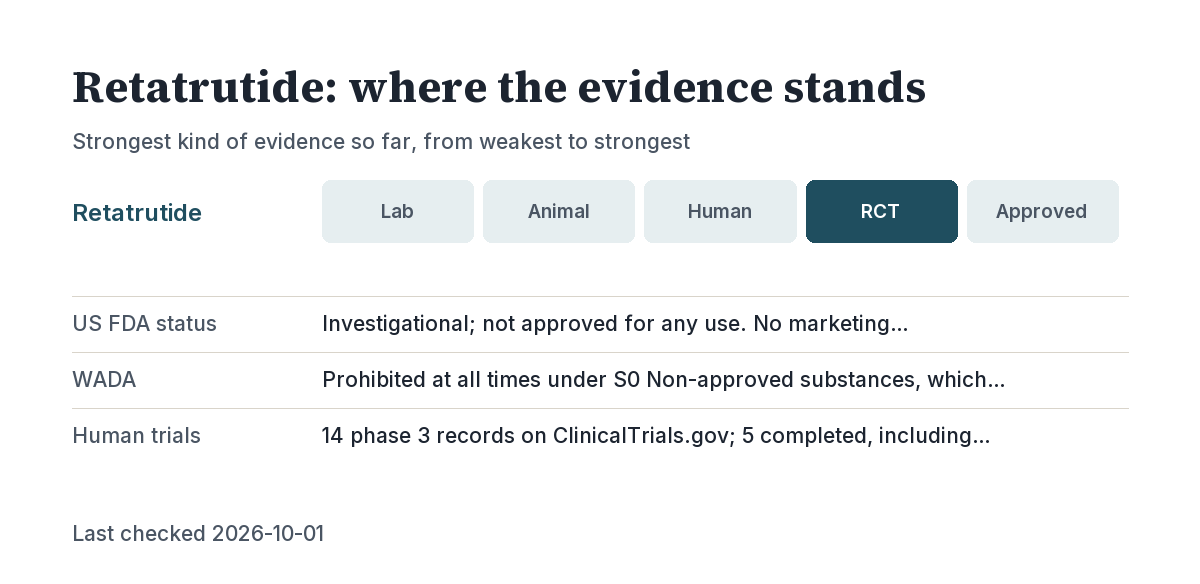
Retatrutide is not FDA approved for any use. It is an investigational once-weekly triple agonist (GIP, GLP-1 and glucagon receptors) from Eli Lilly, and its strongest evidence is a set of phase 3 randomized trials. Lilly says it plans to submit a Biologics License Application (BLA) to the FDA in the first quarter of 2027 (Lilly, 2026-07-23). Under FDA’s standard review goals, a decision would then be due about 12 months after submission, which points to early 2028; a priority review would bring that to late 2027. No approval date has been announced, and outside clinical trials retatrutide cannot be obtained legally in the US.
| Item | Status |
|---|---|
| US FDA status | Investigational; not approved for any use. No marketing application filed yet |
| Next regulatory step | BLA submission planned for Q1 2027 (Lilly Q2 2026 results, 2026-08-05); no PDUFA date exists until FDA files the application |
| Compounding (503A/503B) | Not allowed: FDA says retatrutide “cannot be used in compounding under federal law” (FDA, current as of 2026-09-01) |
| WADA 2026 | Prohibited at all times under S0 Non-approved substances, which covers drugs still in clinical development (WADA 2026 List) |
| Strongest evidence | Human RCT, phase 3 (TRIUMPH-1, n=2,339, NEJM 2026) |
| Human trials | 14 phase 3 records on ClinicalTrials.gov; 5 completed, including NCT05929066 and NCT05931367 |
| Last checked | 2026-10-24 |
Key points:
- Six phase 3 trials have reported positive topline results between December 2025 and October 2026; Lilly says the data package now supports filings for obesity, knee osteoarthritis pain and obstructive sleep apnea.
- The filing waits on the manufacturing (chemistry, manufacturing and controls) section of the application, which Lilly says it is completing.
- Lilly is filing a BLA, the pathway for biological products, even though FDA classified retatrutide as a drug; that classification is the subject of a lawsuit.
- A PDUFA date is FDA’s goal date for acting on an application, not a promised approval date.
- Outside trials, the only lawful route is a narrow, physician-requested expanded-access program for severe obesity.
What changed (October 2026): the appeals court that heard Lilly’s classification case has asked both sides whether it can hear the appeal at all; Lilly has sued US sellers of illegal retatrutide; and the sleep apnea trials are now published in full. No application has been filed yet. On 2026-10-28 Lilly reported its first head-to-head phase 3 result, against Ozempic 2 mg in type 2 diabetes (Lilly), and its third-quarter report on 2026-10-29 gave no new filing date (Lilly Q3 2026).
Retatrutide FDA approval timeline: what has happened so far
The dates below come from trial registrations, journal publications, FDA and Lilly’s own announcements. Lilly-reported weight-loss figures in press releases often use the “efficacy estimand” (people who stayed on treatment); the published papers lead with the more conservative treatment-regimen estimand, which counts everyone randomized. Both are shown where they differ.
| Date | Milestone | Source |
|---|---|---|
| 2019 | First-in-human single-dose safety study completed (n=45) | NCT03841630 |
| 2023-06-26 | Phase 2 obesity trial (n=338) and phase 2 type 2 diabetes trial (n=281) published | NEJM; Lancet |
| 2023-07 | TRIUMPH-2 begins enrolling (phase 3 program under way) | Lancet 2026 |
| 2024-09-03 | Lilly sues FDA over classifying retatrutide as a drug rather than a biological product | S.D. Indiana, No. 1:24-cv-01503 |
| 2025-09-30 | District court upholds FDA’s protein definition but sets aside its “analogous to a protein” finding and sends it back to FDA | S.D. Indiana |
| 2025-12-11 | First phase 3 topline: TRIUMPH-4 (knee osteoarthritis, n=445) | Lilly |
| 2026-05-21 | TRIUMPH-1 topline (obesity, with sleep apnea and knee pain sub-studies) | Lilly |
| 2026-06-05 | Pre-approval expanded-access record posted | NCT07629401 |
| 2026-06-06 | TRANSCEND-T2D-1 (type 2 diabetes, n=537) published | Lancet |
| 2026-07-23 | TRIUMPH-2 and TRIUMPH-3 topline; BLA target set at Q1 2027 | Lilly |
| 2026-08-05 | Q2 results repeat the Q1 2027 BLA plan | Lilly |
| 2026-08-12 | Lilly files six lawsuits against US sellers of illegal retatrutide and reports more than 14,000 listings and posts in over 100 countries for removal | Lilly |
| 2026-08-24 | FDA warning letters treat a “GLP-3R” product sold as a research peptide as unapproved retatrutide | FDA |
| 2026-09-24 | Seventh Circuit hears Lilly’s appeal on the drug-or-biologic question, then orders extra briefs on whether it has jurisdiction (filed 2026-10-08) | Seventh Circuit docket No. 26-1301 |
| 2026-09-29 | TRIUMPH-1 published in NEJM; TRIUMPH-2 published in The Lancet | PubMed |
| 2026-10-21 | Dedicated sleep-apnea trials published in full: TRIUMPH-1-OSA (n=243) and a second, previously unreported trial, TRIUMPH-2-OSA (n=448, with type 2 diabetes) | PubMed |
| 2026-10-28 | TRANSCEND-T2D-2 topline: in 1,298 adults with type 2 diabetes, retatrutide lowered A1C and weight more than Ozempic 2 mg over 80 weeks (first head-to-head phase 3 result) | Lilly |
| 2026-10-29 | Q3 2026 results list the TRANSCEND-T2D-2 result; no new US filing date given | Lilly |
| Q1 2027 | Planned BLA submission (not yet happened) | Lilly |
What the phase 3 trials found
The results behind the filing are encouraging. In TRIUMPH-1, adults with obesity and without diabetes lost a mean 17.6%, 23.7% and 25.0% of body weight on the three retatrutide doses over 80 weeks, against 3.9% on placebo [Human RCT, n=2,339] (Jastreboff et al., NEJM 2026). The same trial met its knee-pain and sleep-apnea goals: pain scores fell more than with placebo in 574 people with knee osteoarthritis, and apnea-hypopnea events fell by about 22 to 25 events per hour more than with placebo on the 9 mg and 12 mg doses in 243 people with obstructive sleep apnea [Human RCT, n=243] (Grunstein et al., NEJM 2026). A matching trial in 448 people who also had type 2 diabetes found about 14 to 15 fewer events per hour than placebo on the same doses [Human RCT, n=448]. Lilly’s press release, using the efficacy estimand, reported 28.3% at the highest dose.
In people with type 2 diabetes, TRIUMPH-2 found weight loss of 11.9% to 18.8% versus 5.1% on placebo at 80 weeks [Human RCT, n=1,152] (Lancet 2026). TRANSCEND-T2D-1, a 40-week diabetes trial, lowered HbA1c (a three-month blood sugar average) by 1.69 to 1.94 percentage points versus 0.81 on placebo, from a baseline of 7.9% [Human RCT, n=537] (Bajaj et al., Lancet 2026).
Three trials are reported so far only in Lilly releases. TRIUMPH-3, in 1,946 adults (registry enrollment) with severe obesity and established cardiovascular disease, reported 22.6% weight loss at the highest dose versus 3.2% on placebo at 80 weeks [Human RCT, topline] (Lilly, 2026-07-23). TRIUMPH-4, in 445 adults with obesity and knee osteoarthritis, reported up to 28.7% weight loss at 68 weeks and a 4.5-point drop in WOMAC pain score [Human RCT, topline] (Lilly, 2025-12-11). TRANSCEND-T2D-2, an open-label trial in 1,298 adults with type 2 diabetes on metformin (with or without an SGLT2 inhibitor), compared retatrutide 9 mg and 12 mg with Ozempic 2 mg, Ozempic’s highest approved dose. At 80 weeks, from a baseline of 8.3%, HbA1c fell 2.2 points on both retatrutide doses versus 1.8 on Ozempic, and weight fell 19.5% and 20.9% versus 9.4% [Human RCT, topline, n=1,298] (Lilly, 2026-10-28). These are efficacy-estimand figures (people who stayed on treatment); Lilly has not released the treatment-regimen figures. Superiority on HbA1c was formally shown for 12 mg; for 9 mg it was nominal only. Topline figures have not yet been through peer review.
What a PDUFA date is and how the FDA review clock runs
PDUFA is the Prescription Drug User Fee Act. Under it, companies pay fees and FDA commits to review goals. For a new molecular entity or an original BLA, FDA first spends 60 days deciding whether to file (accept) the application; the review clock then starts. FDA’s goal is to “review and act on 90 percent” of standard applications within 10 months of that 60-day filing date, and priority applications within 6 months (FDA, PDUFA VII commitment letter). The date that clock produces is what companies call the “PDUFA date”.
A PDUFA date is a goal, not a guarantee. On or before it, FDA either approves the application or sends a complete response letter that lists the deficiencies to fix. A major amendment submitted during review can extend the goal date by three months. By day 74, FDA tells the sponsor its planned review timeline and whether it expects to hold an advisory committee meeting. The current PDUFA VII goals cover fiscal years 2023 through 2027, so a review running into 2028 would fall under whatever reauthorization follows.
Priority review applies to drugs that could be a significant improvement in treating a serious condition; FDA’s stated goal is action within 6 months instead of 10 (FDA, Priority Review). None of the Lilly announcements cited here says whether Lilly will request priority review for retatrutide.
Realistic decision window for retatrutide
The windows below are arithmetic from FDA’s published goals applied to Lilly’s stated submission quarter. They are estimates, not Lilly or FDA statements, and they assume the application is filed without delay.
| Review path | FDA goal | If submitted Jan–Mar 2027 |
|---|---|---|
| Standard review | 60-day filing + 10 months | Jan–Mar 2028 |
| Priority review | 60-day filing + 6 months | Sep–Nov 2027 |
| Standard + major amendment | Goal date + 3 months | Apr–Jun 2028 |
| National priority voucher | 1–2 month target | Feb–May 2027 (no voucher announced) |
The last row is a possibility rather than a forecast. FDA’s Commissioner’s National Priority Voucher pilot targets a 1–2 month review instead of the usual 6 months or more (FDA, CNPV program). Lilly’s oral obesity drug orforglipron (Foundayo) was approved under that program on 2026-04-01, 50 days after filing and 294 days before its PDUFA date (FDA, 2026-04-01). No FDA or Lilly announcement of a voucher for retatrutide had been published at the last check.
Approval, if it comes, would cover the indications Lilly files for: Lilly names obesity, knee osteoarthritis pain and obstructive sleep apnea as supported by the current data. Approval for type 2 diabetes is a separate question, and the long-term heart and kidney outcomes trial, TRIUMPH-Outcomes (n=10,000), has a primary completion date of 2029-02 (NCT06383390).
Why the application is a BLA and not an NDA
Peptides of 40 or fewer amino acids are usually regulated as drugs through a New Drug Application (NDA). Since 2020, FDA’s rule defines a “protein”, and therefore a biological product approved through a BLA, as “any alpha amino acid polymer with a specific, defined sequence that is greater than 40 amino acids in size” (Federal Register, 2020-02-21). Retatrutide has a 39-amino-acid backbone with a fatty side chain that contains further amino-acid-like units, so FDA classified it as a drug.
Lilly challenged that decision in federal court in September 2024 (Eli Lilly and Co. v. Kennedy, S.D. Indiana). The court agreed with FDA that retatrutide is not a “protein” under the rule but set aside FDA’s finding that it is not “analogous to a protein” and returned that question to the agency. Lilly appealed to the Seventh Circuit (No. 26-1301, docketed 2026-02-17), which heard argument on 2026-09-24 and then asked both sides to brief whether it has jurisdiction over the appeal; those briefs were filed on 2026-10-08, and the docket showed no ruling when checked on 2026-10-26. The outcome matters for competition rather than for the review clock: a biological product licensed through a BLA can receive 12 years of exclusivity before a biosimilar can be approved (FDA guidance on reference product exclusivity), longer than the exclusivity a new drug receives. The PDUFA review goals are the same for an NME NDA and an original BLA.
Trials still running before and during review
Several phase 3 trials will report while the application is being prepared or reviewed. Dates are the primary completion dates registered by Lilly, which can move.
| Trial | Question | Primary completion |
|---|---|---|
| TRANSCEND-T2D-2 | vs semaglutide in type 2 diabetes (n=1,298 randomized) | 2026-08-27; topline announced 2026-10-28 (see above), full paper not yet published |
| TRANSCEND-T2D-3 | Type 2 diabetes with renal impairment (n=320) | 2026-10 |
| TRIUMPH-5 | vs tirzepatide in obesity (n=800) | 2026-11 |
| TRIUMPH-7 | Obesity with chronic low back pain (n=586) | 2027-09 |
| TRIUMPH-6 | Keeping weight off (n=643) | 2028-04 |
| TRIUMPH-Outcomes | Heart and kidney events (n=10,000) | 2029-02 |
For the trial-by-trial evidence, mechanism and study doses, see the retatrutide encyclopedia entry.
Side effects and open safety questions FDA will weigh
The trials report a side-effect profile broadly like other GLP-1-based medicines, with some signals of its own. In TRIUMPH-2, diarrhea affected 27–34% of people on retatrutide versus 13% on placebo and nausea 14–28% versus 8%; hypotension (up to 6% vs under 1%) and dysesthesia, an abnormal skin sensation (up to 7% vs 1%), were also more frequent [Human RCT, n=1,152] (Lancet 2026). Stopping treatment because of adverse events or death reached 12% on the middle dose versus 5% on placebo; investigators judged all deaths unrelated to the drug.
In TRIUMPH-4, Lilly reported dysesthesia in 20.9% at the highest dose versus 0.7% on placebo, and adverse-event discontinuation of 18.2% at that dose versus 4.0% on placebo [Human RCT, topline, n=445] (Lilly, 2025-12-11). The phase 2 obesity trial found dose-dependent increases in heart rate that peaked at 24 weeks and then declined [Human RCT, n=338] (Jastreboff et al., NEJM 2023). In TRANSCEND-T2D-2, adverse events led 4.8% (9 mg) and 7.9% (12 mg) to stop retatrutide versus 2.7% on Ozempic 2 mg; diarrhea (28–33% vs 26%) and nausea (21–24% vs 21%) were the most common side effects, and dysesthesia occurred in 4.8–6.5% versus 2.7% [Human RCT, topline, n=1,298] (Lilly, 2026-10-28). Long-term cardiovascular safety will not be settled until TRIUMPH-Outcomes reports.
Products sold before approval carry their own risk. FDA warns about retatrutide sold “for research purposes” or “not for human consumption” and says it cannot be compounded (FDA); the UK regulator reported seizing unlicensed retatrutide in its largest-ever raid on illegal weight-loss medicines on 2026-05-29 (MHRA). Such products have no verified identity, purity or sterility. In a case reported in October 2026, a woman in her mid-20s was admitted to hospital with persistent vomiting after four injections of an unverified product said to contain retatrutide, given by a wellness coach with no medical qualification (Buzzi 2026) [Human case report, n=1]. Our explainer on what the “research use only” label means covers the legal side.
Legal status until approval
| Jurisdiction | Status | Source |
|---|---|---|
| US FDA | Investigational; BLA planned Q1 2027 | Lilly |
| US compounding | Not permitted under federal law | FDA |
| US expanded access | Single-patient, physician-requested; BMI ≥35 with two or more serious complications | NCT07629401 |
| UK | Unlicensed; seized by MHRA | MHRA |
| Sport (WADA) | Prohibited at all times, S0 | WADA 2026 |
Expanded access is FDA’s pathway for a patient with a serious condition to receive an investigational product outside a trial when no comparable alternative exists and trial enrollment is not possible (FDA, Expanded access). Lilly’s program is limited to adults whose obesity has not responded to the highest available approved therapy and who cannot join a trial. For athletes, S0 applies to any substance with no current approval for human therapeutic use; see our page on peptides prohibited in sport.
What users report
These are unverified self-reports from people who usually bought unregulated products, not evidence, and they say nothing about what an approved medicine would do. Around the approval timeline, the most common posts are about waiting: people track each Lilly announcement, ask whether the 2027 filing means a 2027 launch, and are often surprised that a filing starts a review rather than ending one. Many say they will not wait and describe using gray-market “reta”; others argue that nobody knows what those vials contain and point to regulators’ seizures. People who report using such products most often describe strong appetite suppression and fast weight loss, alongside nausea, constipation, fatigue, a racing heart and tingling or sensitive skin. Recurring complaints are inconsistent results between batches, worry about contamination, and the expense. A frequent debate is whether insurers will cover retatrutide after approval, and whether people already doing well on tirzepatide or semaglutide gain anything by switching. Posters in sport communities often do not realize the substance is already banned under the anti-doping code.
Frequently asked questions
When will retatrutide be FDA approved?
No approval date exists yet. Lilly plans to submit its application in the first quarter of 2027, and under FDA’s standard goal of 10 months after a 60-day filing period, a decision would be due around early 2028. A priority review would shorten that to roughly late 2027 (FDA PDUFA goals). FDA can also act earlier or ask for more data.
Has Lilly submitted retatrutide to the FDA?
Not yet. Lilly’s July 2026 announcement said the clinical data package is complete for obesity, knee osteoarthritis pain and obstructive sleep apnea, and that it is finishing the manufacturing section before submitting a Biologics License Application in the first quarter of 2027 (Lilly). Lilly’s third-quarter report on 2026-10-29 did not give a new submission date. A PDUFA date only exists after FDA files the application.
Can retatrutide be prescribed or compounded before approval?
No. Retatrutide cannot be prescribed as an approved medicine, and FDA states it cannot be used in compounding under federal law (FDA). Outside clinical trials, the only lawful route is Lilly’s single-patient expanded-access program, which a treating physician requests for adults with severe, treatment-resistant obesity and serious complications.
Is retatrutide banned in sport?
Yes. Retatrutide falls under WADA’s S0 class, which prohibits at all times any pharmacological substance with no current approval for human therapeutic use, including drugs in clinical development (WADA 2026 List). Because S0 covers only unapproved substances, the status could change once retatrutide is approved anywhere.
Does retatrutide have a PDUFA date yet?
No. A PDUFA date is FDA’s goal date for acting on an application, and none exists until Lilly submits its planned application and FDA files it. FDA’s goal is to act within 10 months under standard review or 6 months under priority review (FDA, Priority Review), and the review would weigh phase 3 Human RCT data (TRIUMPH-1, n=2,335 enrolled).
Is retatrutide FDA approved as of 2026?
No. As of October 2026, retatrutide is investigational and not approved for any use, and Lilly has not yet submitted a marketing application; it plans to do so in the first quarter of 2027. Its strongest evidence is the completed phase 3 TRIUMPH-1 trial [Human RCT, n=2,335 enrolled] (NCT05929066), but FDA has not found it safe and effective for any condition.
References
- Eli Lilly and Company. Lilly’s triple agonist, retatrutide, successful in two additional Phase 3 obesity trials. Press release, 2026-07-23. investor.lilly.com
- Eli Lilly and Company. Lilly reports second-quarter 2026 financial results. Press release, 2026-08-05. investor.lilly.com
- Eli Lilly and Company. Retatrutide TRIUMPH-4 topline results. Press release, 2025-12-11. investor.lilly.com
- Eli Lilly and Company. Retatrutide TRIUMPH-1 topline results. Press release, 2026-05-21. investor.lilly.com
- Jastreboff AM, Kaplan LM, Davies MJ, et al. Retatrutide, a triple hormone receptor agonist, for treatment of obesity (TRIUMPH-1). N Engl J Med. 2026. doi:10.1056/NEJMoa2604169; PMID 42814954
- TRIUMPH-2 investigators. Retatrutide in adults with obesity and type 2 diabetes (TRIUMPH-2). Lancet. 2026. PMID 42810372
- Bajaj HS, et al. Efficacy and safety of retatrutide in type 2 diabetes (TRANSCEND-T2D-1). Lancet. 2026;407:2402-2413. PMID 42250575
- Jastreboff AM, et al. Triple-hormone-receptor agonist retatrutide for obesity: a phase 2 trial. N Engl J Med. 2023;389:514-526. PMID 37366315
- Rosenstock J, et al. Retatrutide for people with type 2 diabetes: a phase 2 trial. Lancet. 2023;402:529-544. PMID 37385280
- US FDA. PDUFA reauthorization performance goals and procedures, fiscal years 2023 through 2027. fda.gov
- US FDA. Priority Review. fda.gov
- US FDA. Commissioner’s National Priority Voucher (CNPV) pilot program. fda.gov
- US FDA. FDA approves first new molecular entity under national priority voucher program. 2026-04-01. fda.gov
- US FDA. FDA’s concerns with unapproved GLP-1 drugs used for weight loss. Content current as of 2026-09-01. fda.gov
- US FDA. Guidance for industry (draft): Reference product exclusivity for biological products filed under section 351(a) of the PHS Act. fda.gov
- US FDA. Expanded access. fda.gov
- US FDA. Definition of the term “biological product”. Final rule. Federal Register, 2020-02-21. federalregister.gov
- World Anti-Doping Agency. 2026 Prohibited List, S0 Non-approved substances. wada-ama.org
- MHRA. Two arrested during the MHRA’s largest-ever seizure of unlicensed weight loss medicines. 2026-05-29. gov.uk
- ClinicalTrials.gov records: NCT05929066 (TRIUMPH-1), NCT05931367 (TRIUMPH-4), NCT06354660 (TRANSCEND-T2D-1), NCT07629401 (expanded access), NCT06383390 (TRIUMPH-Outcomes), NCT03841630 (phase 1).
- Grunstein RR, et al., for the TRIUMPH-1-OSA and TRIUMPH-2-OSA Investigators. Retatrutide once weekly for treatment of obstructive sleep apnea. N Engl J Med. Published 2026-10-21. PMID 42904878
- Eli Lilly and Company. Lilly calls on online platforms, payment companies and regulators to shut down the illegal retatrutide black market. Press release, 2026-08-12. investor.lilly.com
- US FDA. Warning letter, Peak Performance Peptides, 2026-08-24. fda.gov
- Eli Lilly and Company. Lilly’s retatrutide delivered greater A1C reduction and more than double the weight loss of Ozempic’s highest approved dose in head-to-head trial (TRANSCEND-T2D-2). Press release, 2026-10-28. investor.lilly.com
- Eli Lilly and Company. Lilly reports third-quarter 2026 financial results. Press release, 2026-10-29. prnewswire.com
Change log
2026-10-29: Lilly’s 2026-10-28 TRANSCEND-T2D-2 results against Ozempic 2 mg added to the timeline, trial, safety and running-trials sections; Lilly’s 2026-10-29 third-quarter report checked (no new filing date); reviewed by the editorial team.
2026-10-26: appeal status re-checked (court asked for briefs on its jurisdiction, no ruling); Lilly’s August lawsuits and the August FDA warning letters added to the timeline; sleep apnea results cited to the trial paper; a repeated FAQ removed; reviewed by the editorial team.
2026-10-24: added 2026-10-21 milestone row for the dedicated TRIUMPH-1-OSA/TRIUMPH-2-OSA NEJM publication, including the previously unmentioned TRIUMPH-2-OSA diabetes-cohor; reviewed by the editorial team.
2026-10-23: links to glossary definitions added; no change to the facts.
2026-10-12: FAQ: added “Is retatrutide FDA approved as of 2026?”; added “Is retatrutide being filed with the FDA as a BLA?”; reviewed by the editorial team.
2026-10-11: An October 2026 case report of a hospital admission after an unverified ‘retatrutide’ product added; reviewed by the editorial team.
2026-10-08: FAQ: added “Does retatrutide have a PDUFA date yet?”; reviewed by the editorial team.
2026-10-06: trial table, appeal status and TRIUMPH-3 enrollment re-checked against ClinicalTrials.gov and the court docket; reviewed by the editorial team.
2026-10-01: first published after review by the editorial team.