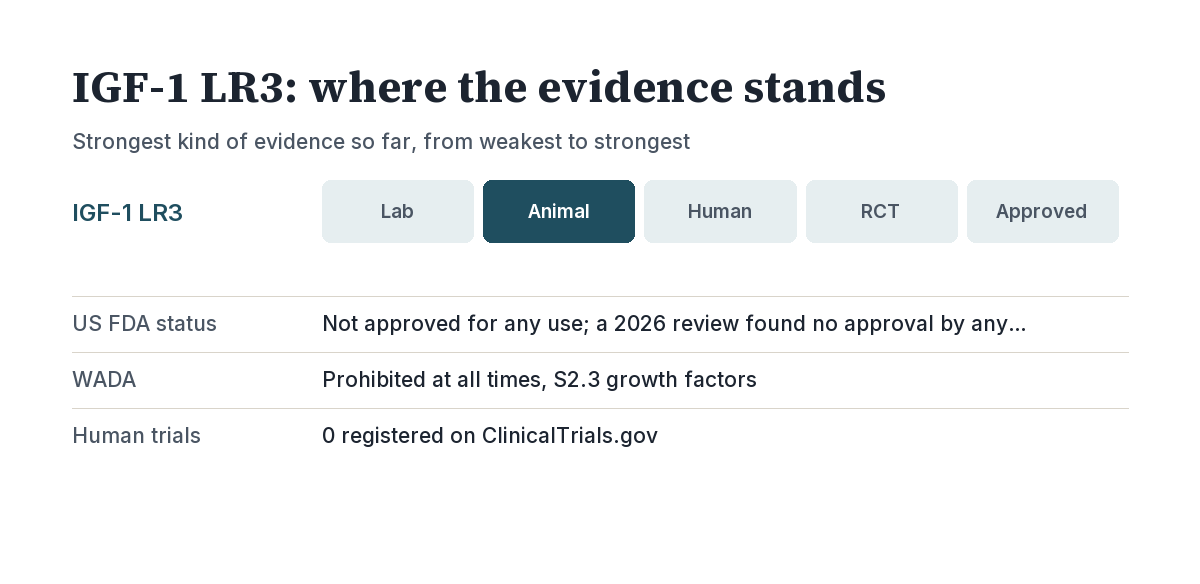
IGF-1 LR3 (Long R3 IGF-1) is an 83-amino-acid recombinant analogue of human insulin-like growth factor 1, developed as a research reagent, whose evidence so far comes only from lab and animal studies. Because it binds weakly to the proteins that normally restrain IGF-1, it was more potent than natural IGF-1 in muscle cells (Francis 1992), and in catabolic rats it matched IGF-1’s anabolic effect at about 2.5-fold lower doses [Animal] (Tomas 1992). It is not approved by FDA or any major regulator, it is prohibited in sport, and no human trial of it has been published (Dominikowski 2026).
| Item | Status |
|---|---|
| US FDA status | Not approved for any use; a 2026 review found no approval by any major regulator (Dominikowski 2026). The approved IGF-1 drug is mecasermin (Increlex), for severe primary IGF-1 deficiency in children (Increlex label) |
| Compounding (503A/503B) | Not named on FDA’s Category 2 page (updated 2026-04-22) or its 503A bulk-substances page (updated 2026-05-14); FDA places no substance nominated on or after 2025-01-07 into a category (FDA) |
| WADA | Prohibited at all times, S2.3 growth factors: “Insulin-like growth factor 1 (IGF-1, mecasermin) and its analogues”, non-Specified (2026 List). The 2027 List (approved 2026-09-10, in force 2027-01-01) announces no S2 change (WADA) |
| Strongest evidence | Animal (rats, pigs, sheep, mice); no human data |
| Human trials | 0 registered on ClinicalTrials.gov (searched 2026-10-14) |
| EU | No EMA authorisation of IGF-1 LR3 found; mecasermin (Increlex) authorised since 2007-08-03 |
| Last checked | 2026-10-14 |
Key points:
- The molecule is human IGF-1 with glutamic acid 3 swapped for arginine and a 13-residue extension made of the first 11 amino acids of porcine growth hormone plus Val-Asn (Francis 1992).
- In virgin rats this potent analogue left the blood about 11 times faster than IGF-1 (about 3 times faster in pregnant rats), and most of it circulated free rather than bound [Animal] (Bastian 1993).
- In rats carrying a mammary tumour, LR3 made tumours grow faster and did not build muscle protein [Animal] (Tomas 1994).
- An anti-doping lab found a lab-grade, His-tagged form of LR3 in a black-market injection vial (Kohler 2010).
- It is not the same drug as mecasermin, and none of mecasermin’s human safety data apply to it directly.
| Property | IGF-1 LR3 |
|---|---|
| Length | 83 amino acids: Met-pGH(1-11)-Val-Asn plus 70-residue [Arg3]-IGF-1 (Francis 1992; Increlex label) |
| Parent molecule | Human IGF-1 (70 amino acids, 7,649 Da as mecasermin) |
| Production | Recombinant, in E. coli (King 1992) |
| Plasma clearance | Rat: 9.84 vs 0.90 ml/min per kg for IGF-1 (Bastian 1993) |
| Human half-life | Not documented (Dominikowski 2026) |
| Routes studied | Subcutaneous pump, intravenous infusion, intranasal (mice) |
| Class | IGF-1 analogue (growth factor); a protein under FDA’s 40-amino-acid definition (21 CFR 600.3) |
What is IGF-1 LR3?
IGF-1 LR3 is a lab-made version of insulin-like growth factor 1 (IGF-1), the hormone that carries much of growth hormone’s effect: growth hormone binds receptors in the liver and other tissues and stimulates IGF-1 production (Increlex label). Researchers described the “Long [Arg3]-IGF-I” fusion analogue in 1992, made in E. coli and presented as one of several “very useful reagents in the investigation of IGF-I action” (Francis 1992). The same group then tested LR3 in a run of rat studies on wasting, diabetes, gut growth and tumours through the 1990s. Most of the 84 PubMed records on it (searched 2026-10-14) use it as a cell-culture or animal tool. It is a protein, not a short peptide or a steroid, although it is commonly searched as a “peptide”.
How does IGF-1 LR3 work?
- Escape from binding proteins: IGF-binding proteins (IGFBPs) are blood and tissue proteins that hold IGF-1; the Arg3 analogue “bound very poorly” to IGFBP-2, and reduced IGFBP binding, not stronger receptor binding, explains its higher potency [Lab] (King 1992).
- Same receptor, slightly weaker grip: LR3 binds the type 1 IGF receptor about 3-fold less well than IGF-1, yet was about 2.5-fold more potent in rats [Lab; Animal] (Tomas 1992).
- Anabolic signalling in muscle cells: in L6 rat myoblasts it raised protein and DNA synthesis and reduced protein breakdown more than IGF-1, but in cells that make no IGFBPs it was less potent than IGF-1 [Lab] (Francis 1992).
- Free circulation: after intravenous dosing in rats, “the majority of LR3IGF-I was detected as free peptide” and it was cleared faster than IGF-1 [Animal] (Bastian 1993).
- Feedback on the body’s own axis: infusions lowered circulating natural IGF-1 in pigs and in heifers [Animal] (Dunshea 2002; Hill 1999).
Benefits of IGF-1 LR3: what the research shows
The most promising potential benefits of IGF-1 LR3 are lean growth in wasting states and growth of the gut lining, both shown in animals. In dexamethasone-treated rats it partially reversed the catabolic state at about 2.5-fold lower doses than IGF-1, and the gain was nitrogen rather than fat [Animal, rats] (Tomas 1992). In a 3-day rat study it increased small and large intestine weight by 20%, which native IGF-1 did not [Animal, 5–6 rats per group] (Steeb 1995).
| Claim | Evidence level | Best study and result |
|---|---|---|
| More potent than IGF-1 | Lab | Francis 1992: most potent analogue in IGFBP-secreting cells |
| Counters muscle wasting | Animal | Tomas 1992: ~2.5-fold more potent than IGF-1 in dexamethasone rats |
| Faster growth in healthy animals | Animal | Tomas 1993: 44 µg/day matched 278 µg/day IGF-1 in rats |
| Restores growth in diabetes | Animal | Tomas 1993: 2.5–3× IGF-1 potency; glucosuria unchanged |
| Gut growth | Animal | Steeb 1995: intestine weight +20% in 3 days |
| Livestock weight gain | Animal | Dunshea 2002: 457 vs 386 g/day in piglets (n=18 study) |
| Fat loss | Animal | Tomas 1994: carcass fat −30%, but tumours grew |
| Alzheimer’s-type brain changes | Animal | Engel 2025: plaque remodelling; no memory benefit |
| Fetal growth restriction | Animal | White 2025: no growth gain (n=7 vs 7 sheep) |
| Muscle gain in people | No human data | No human study found (PubMed, 2026-10-14) |
Muscle and wasting
In rats made catabolic with dexamethasone, IGF-1 reduced muscle protein breakdown and raised protein synthesis, and LR3 was about 2.5-fold more potent than IGF-1 [Animal] (Tomas 1992). In healthy growing female rats over 14 days, 44 µg/day of LR3 produced effects similar to 278 µg/day of IGF-1, which raised weight gain, nitrogen retention and feed efficiency by 18–26%; human growth hormone at 213 µg/day did not stimulate growth in the same rats [Animal] (Tomas 1993). In diabetic rats, LR3 restored growth and the IGF peptides raised muscle protein synthesis by up to 50%, but they did not correct the glucose spilling into urine, which insulin did [Animal] (Tomas 1993, diabetic rats). In feed-restricted beef heifers, an 8-hour infusion “tended” to conserve body and muscle protein [Animal] (Hill 1999).
Gut growth
The gut is one of the tissues most sensitive to IGF-1. In dexamethasone-treated rats, the analogues were “consistently severalfold more potent” than IGF-1 at enlarging the gut wall [Animal] (Read 1992). Over just 3 days, LR3 lengthened duodenal and ileal crypts by 13% and 22% [Animal] (Steeb 1995). In guinea pigs, it enlarged the gut, kidneys, spleen and adrenals without increasing overall growth [Animal] (Conlon 1995).
Growth in young animals
In 18 artificially reared piglets given unlimited milk, LR3 raised daily weight gain in the second 9 days of infusion (457 vs 386 g/day, P<0.01), but a 42-piglet study on restricted feeding showed no overall effect [Animal] (Dunshea 2002). In growth-restricted fetal sheep, a 1-week infusion “did not improve growth” [Animal] (White 2025).
Brain
In male mice bred to develop Alzheimer’s-like plaques, 7 months of intranasal LR3 improved body composition and shifted plaques toward a more inert form, but did not significantly change memory or behavior; the authors wrote the data “do not support LR3 as a monotherapy” [Animal, n=19–27 per group] (Engel 2025).
Human studies and trials
No completed human trials of IGF-1 LR3 were found. A ClinicalTrials.gov search returned no registered study (ClinicalTrials.gov, searched 2026-10-14), and none of the 84 PubMed records on the molecule is a human study (searched 2026-10-14). A June 2026 review of performance peptides placed it in its lowest evidence tier, with “no peer-reviewed human studies” and support “only by preclinical extrapolation and grey-literature user narratives” (Dominikowski 2026). The human trials that do exist for IGF-1 tested native recombinant IGF-1, mecasermin, in children with primary IGF-1 deficiency; their results are summarized on the Increlex label and cannot be transferred to LR3, which is handled differently in the body (Bastian 1993).
Doses used in studies
| Route and amount | Species | Study |
|---|---|---|
| Subcutaneous pump, 44 µg/day, 14 days | Rat (female) | Tomas 1993 |
| Infusion, 2.5 mg/kg/day, 3 days | Rat (female, 110 g) | Steeb 1995 |
| Infusion, 200 or 500 µg/day, 6–7 days | Rat (tumour-bearing) | Tomas 1994 |
| Infusion, 120 µg/day, 7 days | Guinea pig | Conlon 1995 |
| Infusion, 8 then 16 µg/hour, 18 days | Neonatal pig | Dunshea 2002 |
| Infusion, 1.17 µg/kg/hour, 1 week | Fetal sheep | White 2025 |
No established human dose exists outside approved labels. The mecasermin label dose applies to that drug only, in children with primary IGF-1 deficiency, and not to IGF-1 LR3.
Side effects and safety
No human safety data exist for IGF-1 LR3; a 2026 review notes that its human half-life has not been documented and no peer-reviewed human study has reported how it was used (Dominikowski 2026). What is known comes from animals, from cell studies, and from the label of the approved IGF-1 drug.
- Low blood sugar: LR3 “markedly reduced” plasma glucose in heifers [Animal] (Hill 1999), and IGF infusions lowered glucose and insulin in tumour-bearing rats [Animal] (Tomas 1994). With native IGF-1, 30 subjects (42%) in the mecasermin program reported hypoglycemia, and severe hypoglycemia led to seizures in some patients [Approved label] (Increlex label). The 2026 review adds that self-reported effects in off-label use “frequently centre on” symptoms suggestive of hypoglycemia [unverified reports].
- Tumour growth: in rats with mammary adenocarcinoma, “tumour growth was increased by the IGFs, especially by LR3-IGF-I” [Animal] (Tomas 1994). In prostate cancer cells, LR3 raised telomerase activity 3-fold (P<0.01) [Lab] (Wetterau 2003). In people, higher natural IGF-1 levels were modestly associated with prostate cancer (OR 1.49) and premenopausal breast cancer (OR 1.65) in a 21-study meta-analysis [Human observational, 3,609 cases] (Renehan 2004). The site’s overview of cancer evidence for growth hormone peptides covers this question more broadly.
- Suppression of the body’s own hormones: infusions lowered natural IGF-1 in pigs and heifers [Animal] (Dunshea 2002).
- Class warnings for IGF-1: the mecasermin label lists intracranial hypertension, enlargement of tonsils and other lymphoid tissue (tonsillar hypertrophy in 15%), slipped capital femoral epiphysis and postmarketing reports of cancer in children [Approved label]. USADA warns that IGF-1 misuse by healthy people may cause acromegaly, in which body tissues enlarge over time, and non-reversible effects on the heart, joints and liver (USADA).
- Product quality: an anti-doping lab identified His-tagged LR3, a form “usually produced for biochemical studies”, in a black-market injection vial; its effects in humans “have not been elucidated” (Kohler 2010). The same paper notes that black-market products “frequently do not contain the declared substances”. Products sold online often carry a “research use only” label, which has legal limits.
Who should not use it: IGF-1 LR3 has no label. The approved IGF-1 drug, mecasermin, is contraindicated in people with cancer or a history of cancer, in people whose growth plates have closed, and in those hypersensitive to it [Approved label].
Legal and regulatory status
| Jurisdiction | Status (checked 2026-10-14) |
|---|---|
| US FDA | Not approved; mecasermin (Increlex) is the approved IGF-1 drug |
| US compounding | Not on FDA’s Category 2 page (2026-04-22); no category for substances nominated on or after 2025-01-07 |
| WADA 2026 | Prohibited at all times, S2.3, non-Specified |
| WADA 2027 | No S2 change announced; in force 2027-01-01 |
| EU (EMA) | No IGF-1 LR3 authorisation found; Increlex authorised 2007-08-03 |
United States. No FDA-approved product contains IGF-1 LR3, and a 2026 review found it “not approved by major regulatory agencies for any indication” (Dominikowski 2026). The approved IGF-1 medicine, Increlex, is indicated for growth failure in children aged 2 and older with severe primary IGF-1 deficiency, or with growth hormone gene deletion and neutralizing antibodies to growth hormone (Increlex label).
Compounding. IGF-1 LR3 does not appear on FDA’s list of bulk substances with significant safety risks (FDA Category 2 page), unlike several peptides sold alongside it, some since withdrawn by their nominators, such as GHK-Cu, the copper peptide. FDA says it does not intend to place substances nominated on or after January 7, 2025 into any category (FDA 503A page); the site’s explainer on what Category 1 and Category 2 mean for compounded peptides sets out how those lists work. A second point is our reading, not an FDA statement about this molecule: at 83 amino acids, IGF-1 LR3 is above the 40-amino-acid line at which FDA defines a “protein” (21 CFR 600.3(h)(6)), and FDA states that biological products are not eligible for the 503A and 503B compounding exemptions (FDA, 2020).
Sport. The 2026 WADA List names “Insulin-like growth factor 1 (IGF-1, mecasermin) and its analogues” under S2.3 growth factors, prohibited in and out of competition as non-Specified substances (WADA 2026 List). WADA approved the 2027 List on 10 September 2026, effective 1 January 2027; the announced changes concern substances of abuse, S4.2, cannabinoids, glucocorticoids and beta-blockers, not S2 (WADA). Anti-doping labs have published methods aimed specifically at synthetic IGF-1 analogues in urine and blood (Mazzarino 2023). The site’s page on which peptides WADA prohibits lists the other growth factors in the same class.
European Union. No EMA authorisation for IGF-1 LR3 was found; mecasermin (Increlex) has been authorised in the EU since 3 August 2007 for severe primary IGF-1 deficiency in children and adolescents (EMA).
Related peptides
IGF-1 LR3 acts at the end of the growth hormone axis. Peptides that act earlier, by making the pituitary release growth hormone, have their own entries: tesamorelin (Egrifta), an approved GHRH analogue; sermorelin, a formerly approved GHRH fragment; CJC-1295, a long-acting GHRH analogue; and ipamorelin, a ghrelin-receptor agonist.
What users report
What follows are unverified self-reports from people who usually bought unregulated products; they are not evidence. People who post about IGF-1 LR3 on forums, Reddit and bodybuilding boards most often describe a “fuller” look to their muscles, more pump during training and faster recovery, and some say they lost fat. Many say they noticed little or nothing, and a long-running argument is whether any effect came from the product, from training and diet, or from other drugs used at the same time. The most frequent complaints are shaky, hungry or light-headed spells they put down to low blood sugar, tiredness, and pain or redness at the site. Joint aches and water retention come up less often. Product quality is a constant theme: posters question whether products contain the molecule at all, whether it survives shipping, and why results differ between batches. Cost is another recurring complaint. Some posters raise worries about cancer risk and gut or organ growth, citing the animal findings, and others say they avoided it for that reason.
Frequently asked questions
Is IGF-1 LR3 a steroid?
No. IGF-1 LR3 is a protein of 83 amino acids, a modified form of the body’s own insulin-like growth factor 1, not a steroid hormone. It was built by adding a 13-residue extension to human IGF-1 and swapping one of its amino acids (Francis 1992). It is still prohibited in sport, under WADA’s growth-factor class rather than anabolic agents.
Is IGF-1 LR3 the same as HGH?
No. Growth hormone acts on the liver and other tissues to make IGF-1, so IGF-1 sits downstream of it (Increlex label). IGF-1 LR3 is a modified IGF-1, not growth hormone. In one 14-day rat study, growth hormone did not stimulate growth while IGF-1 and LR3 did [Animal] (Tomas 1993).
Is IGF-1 LR3 safe?
Its safety in people is unknown, because no human study has been published (Dominikowski 2026). In animals it lowered blood glucose and, in tumour-bearing rats, made tumours grow faster. The approved IGF-1 drug, mecasermin, caused hypoglycemia in 42% of treated subjects and carries warnings on cancer and raised pressure in the skull.
Is IGF-1 LR3 legal?
IGF-1 LR3 is not approved by FDA or the EMA for any use, so it cannot be marketed as a medicine. It is not on FDA’s compounding category lists as of 2026-10-14. For athletes it is prohibited at all times as an IGF-1 analogue under WADA class S2.3 (WADA 2026 List).
Does IGF-1 LR3 build muscle?
It has not been shown to in people. In diabetic rats the IGF peptides, LR3 included, raised muscle protein synthesis by up to 50%, with the variants 2.5–3 times more potent than natural IGF-1 at restoring growth [Animal] (Tomas 1993). In tumour-bearing rats it did not increase body protein at all. No controlled human study has measured muscle gain.
Does IGF-1 LR3 increase testosterone?
There is no evidence that it does. No human study of IGF-1 LR3 has measured testosterone, and none of the animal studies reviewed for this entry reported it. What the animal studies did show is feedback on the growth axis: infusions sharply lowered the body’s own IGF-1 in feed-restricted heifers [Animal] (Hill 1999).
References
- Francis GL, Ross M, Ballard FJ, et al. (1992). Novel recombinant fusion protein analogues of insulin-like growth factor (IGF)-I indicate the relative importance of IGF-binding protein and receptor binding for enhanced biological potency. J Mol Endocrinol 8(3):213–23. PubMed 1378742
- King R, Wells JR, Krieg P, et al. (1992). Production and characterization of recombinant IGF-I and potent analogues of IGF-I, with Gly or Arg substituted for Glu3. J Mol Endocrinol 8(1):29–41. PubMed 1311930
- Tomas FM, Knowles SE, Owens PC, et al. (1992). IGF-I and especially IGF-I variants are anabolic in dexamethasone-treated rats. Biochem J 282:91–7. PubMed 1371669
- Tomas FM et al. (1993). Anabolic effects of IGF-I and an IGF-I variant in normal female rats. J Endocrinol 137(3):413–21. PubMed 8371075
- Tomas FM, Knowles SE, Owens PC, et al. (1993). IGF-I and more potent variants restore growth of diabetic rats without inducing all characteristic insulin effects. Biochem J 291:781–6. PubMed 7683875
- Tomas FM et al. (1994). Effects of insulin and insulin-like growth factors on protein and energy metabolism in tumour-bearing rats. Biochem J 301:769–75. PubMed 8053901
- Bastian SE et al. (1993). Plasma clearance and tissue distribution of labelled IGF-I and an analogue LR3IGF-I in pregnant rats. J Endocrinol 138(2):327–36. PubMed 7693845
- Read LC, Tomas FM, Howarth GS, et al. (1992). IGF-I and its N-terminal modified analogues induce marked gut growth in dexamethasone-treated rats. J Endocrinol 133(3):421–31. PubMed 1613443
- Steeb CB, Trahair JF, Read LC (1995). Administration of IGF-I peptides for three days stimulates proliferation of the small intestinal epithelium in rats. Gut 37(5):630. PubMed 8549937
- Conlon MA, Tomas FM, Owens PC, et al. (1995). Long R3 IGF-I infusion stimulates organ growth but reduces plasma IGF-I, IGF-II and IGF binding protein concentrations in the guinea pig. J Endocrinol 146(2):247–53. PubMed 7561636
- Hill RA, Hunter RA, Lindsay DB, Owens PC (1999). Action of long(R3)-IGF-1 on protein metabolism in beef heifers. Domest Anim Endocrinol 16(4):219–29. PubMed 10370861
- Dunshea FR, Chung CS, Owens PC, et al. (2002). IGF-I and analogues increase growth in artificially-reared neonatal pigs. Br J Nutr 87(6):587–93. PubMed 12067429
- Wetterau LA, Francis MJ, Ma L, Cohen P (2003). IGF-I stimulates telomerase activity in prostate cancer cells. J Clin Endocrinol Metab 88(7):3354–9. PubMed 12843187
- Renehan AG, Zwahlen M, Minder C, et al. (2004). IGF-I, IGF binding protein-3, and cancer risk: systematic review and meta-regression analysis. Lancet 363(9418):1346–53. PubMed 15110491
- Kohler M, Thomas A, Walpurgis K, et al. (2010). Detection of His-tagged Long-R3-IGF-I in a black market product. Growth Horm IGF Res 20(5):386–90. PubMed 20675162
- Mazzarino M, Melis I, Quaresima E, Botrè F (2023). Detection of synthetic analogues of IGF-1 in different biological fluids by LC-QTOF mass spectrometry. Anal Bioanal Chem 415(24):6117–31. PubMed 37566232
- Engel MG et al. (2025). Intranasal long R3 IGF-1 treatment promotes amyloid plaque remodeling in cerebral cortex. J Alzheimers Dis 103(1):113–26. PubMed 39610283
- White A et al. (2025). IGF-1 LR3 does not promote growth in late-gestation growth-restricted fetal sheep. Am J Physiol Endocrinol Metab 328(1):E116–25. PubMed 39679943
- Dominikowski A, Rękoś Z, Olejarz M, et al. (2026). The emerging landscape of performance-enhancing peptides modulating GH-IGF1 axis. Front Endocrinol 17:1822475. doi:10.3389/fendo.2026.1822475
- US FDA / DailyMed. INCRELEX (mecasermin) injection, prescribing information (revised 10/2025). DailyMed
- European Medicines Agency. Increlex (mecasermin) EPAR. EMA
- US FDA. Certain bulk drug substances for use in compounding that may present significant safety risks (updated 2026-04-22). FDA
- US FDA. Bulk drug substances used in compounding under section 503A of the FD&C Act (updated 2026-05-14). FDA
- US FDA. Notice to compounders: changes that affect compounding on March 23, 2020. FDA
- 21 CFR 600.3(h)(6), definition of protein. eCFR
- World Anti-Doping Agency. 2026 Prohibited List. WADA
- World Anti-Doping Agency. WADA publishes 2027 Prohibited List. WADA
- USADA. IGF-1 and the World Anti-Doping Agency Prohibited List. USADA
- ClinicalTrials.gov search for IGF-1 LR3 (searched 2026-10-14). ClinicalTrials.gov
Change log
2026-10-23: links to glossary definitions added; no change to the facts.
2026-10-19: links to related entries added; no change to the facts.
2026-10-18: rat clearance figure limited to virgin rats (about 3 times faster in pregnant rats), as in Bastian 1993; reviewed by the editorial team.
2026-10-14: first published after review by the editorial team.