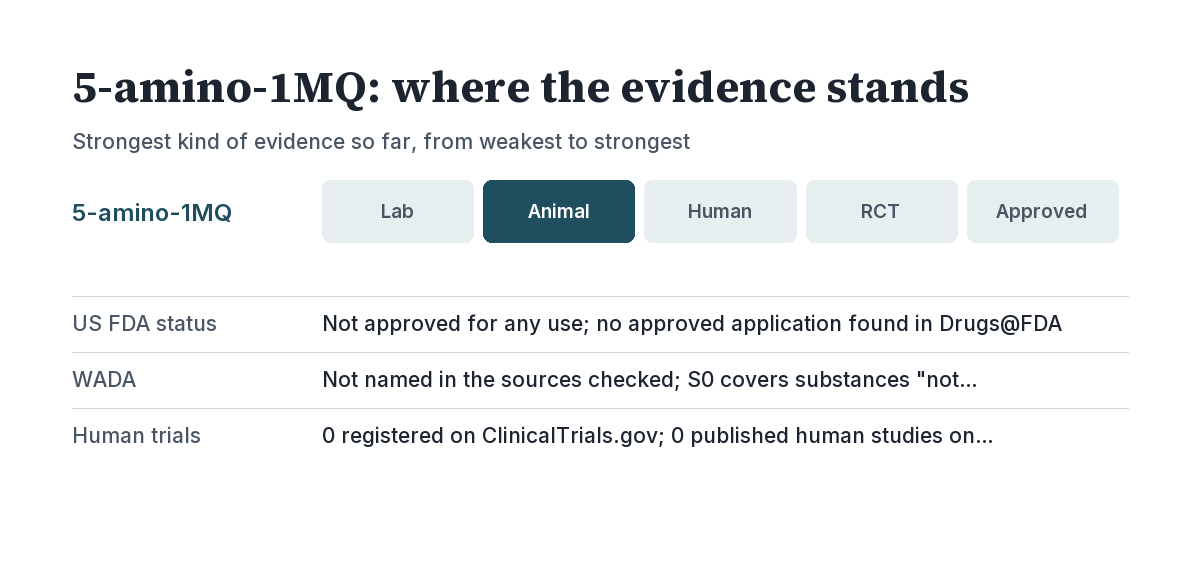
5-amino-1MQ (5-amino-1-methylquinolinium) is a small synthetic molecule, not a peptide, that blocks the enzyme nicotinamide N-methyltransferase (NNMT); its strongest evidence so far comes from studies in mice. It is not an FDA-approved drug, and no human study or registered trial was found on PubMed or ClinicalTrials.gov (both searched 2026-10-07). In obese mice it limited weight and fat gain without lowering food intake [Animal] (Babula 2024; Neelakantan 2018), and in aged mice it improved muscle repair after injury (Neelakantan 2019) and grip strength [Animal] (Dimet-Wiley 2024).
| Item | Status |
|---|---|
| US FDA status | Not approved for any use; no approved application found in Drugs@FDA (searched 2026-10-07) |
| Compounding (503A/503B) | Not on the 503A bulks list (21 CFR 216.23) or FDA’s Category 2 page. FDA warning letter of 2026-01-20: not on the 503B bulks list, so not eligible for 503B compounding. No next FDA step announced (checked 2026-10-07) |
| WADA 2026 | Not named on the 2026 Prohibited List (checked 2026-10-08); S0 covers substances “not approved by any government regulatory authority” for human use (USADA) |
| Strongest evidence | Animal (mice): obesity, fatty liver and aged-muscle studies |
| Human trials | 0 registered on ClinicalTrials.gov; 0 published human studies on PubMed (both searched 2026-10-07) |
| Last checked | 2026-10-07 |
What changed (October 2026): the sport section now explains what the 2027 WADA List changes for 5-amino-1MQ: it names “peptides” in general in S0, and 5-amino-1MQ is a small molecule, not a peptide.
Key points:
- It is a charged quinolinium compound of 159.21 g/mol that contains no amino acids (PubChem).
- In mice, oral bioavailability was 3.5%, while injection under the skin gave high blood levels within about 15 minutes [Animal] (Babula 2024).
- Nearly all in vivo studies come from one research group whose founder and staff work for Ridgeline Therapeutics (Sampson 2021).
- Mouse studies reported no observable adverse effects [Animal] (Neelakantan 2018); no human safety data were found.
- Products sold online are unregulated “research” chemicals, and FDA has cited a compounder for using it.
| Property | Value |
|---|---|
| Chemical name | 1-methylquinolin-1-ium-5-amine (5-amino-1-methylquinolinium) |
| Other names | 5-amino-1MQ, 5A1MQ, 5A-1MQ, NNMTi |
| Molecular formula | C10H11N2+ (cation; used as the iodide salt in FDA’s letter and Yang 2024) |
| Molecular weight | 159.21 g/mol (cation) |
| CAS | 685079-15-6 |
| PubChem CID | 950107 |
| Half-life (mice) | 6.3 h IV; about 13 h subcutaneous; 14.8 h oral (Babula 2024) |
| Routes studied | Subcutaneous, intraperitoneal, intravenous, oral (mice only) |
| Class | Small-molecule NNMT inhibitor (methylquinolinium); not a peptide |
What is 5-amino-1MQ?
5-amino-1MQ came out of NNMT drug-discovery work by the research group of Watowich and Neelakantan. In 2017 the group screened families of N-methylated ring compounds and found that quinoliniums inhibited NNMT at about 1 μM [Lab] (Neelakantan 2017). A 2018 follow-up showed that methylquinoliniums carrying an amine group crossed cell membranes well and left related enzymes alone [Lab] (Neelakantan 2018). 5-amino-1MQ became the group’s lead tool compound. It is often sold and searched as a “peptide,” but its structure is a single fused ring system with a methyl and an amino group (PubChem), and the papers often label it simply “NNMTi” (NNMT inhibitor).
How does 5-amino-1MQ work?
NNMT is an enzyme that attaches a methyl group to nicotinamide, a form of vitamin B3, and to other molecules, including foreign compounds (Neelakantan 2017). The proposed mechanism rests on what happens when that step is blocked:
- NNMT is raised in obesity: NNMT levels were higher in the fat and liver of obese and diabetic mice, and silencing the Nnmt gene protected mice against diet-induced obesity by raising energy expenditure [Animal] (Kraus 2014; gene knockdown, not 5-amino-1MQ).
- More NAD+ and SAM: in cultured fat cells, NNMT inhibitors lowered the reaction product 1-methylnicotinamide (1-MNA) and raised NAD+, a cell-energy cofactor, and SAM, the cell’s main methyl donor [Lab] (Neelakantan 2018).
- Less fat production: the same inhibitors suppressed lipogenesis (fat synthesis) in cultured fat cells [Lab] (Neelakantan 2018).
- Selectivity: the methylquinolinium compounds did not inhibit related SAM-dependent methyltransferases or the enzymes of the NAD+ salvage pathway [Lab] (Neelakantan 2018).
- Muscle stem cells: in aged mice, NNMT inhibition increased muscle stem cell proliferation and fusion after injury, and in C2C12 muscle cells it enhanced differentiation with shifts in NAD+/NADH balance [Animal; Lab] (Neelakantan 2019).
The NAD+ link is why the compound is often discussed alongside NAD+ products. That link has been shown in cells; no study found has measured whether 5-amino-1MQ raises NAD+ in people.
What the research shows
The research is a compact and fairly consistent set of mouse studies. Its results are encouraging for an early compound: fat loss without less eating, better liver measures and stronger aged muscle. All of it is preclinical.
| Claim | Evidence level | Best study and result |
|---|---|---|
| Limits weight and fat gain in obese mice | Animal | Babula 2024, n=8/group: high-dose mice gained 0.9 g vs 5.4 g on vehicle over 28 days |
| Speeds fat loss with a diet change | Animal | Sampson 2021, n=6–8/group: ~29.3% fat-mass loss vs 2.9% with diet alone |
| Improves insulin sensitivity | Animal | Babula 2024: better oral glucose tolerance, lower insulin in obese mice |
| Reduces fatty liver | Animal | Babula 2024: less steatosis and liver triglyceride; ALT and AST normalized |
| Lowers cholesterol | Animal | Neelakantan 2018: lower total plasma cholesterol in obese mice |
| Raises NAD+ in cells | Lab | Neelakantan 2018: higher intracellular NAD+ and SAM in fat cells |
| Improves aged muscle repair | Animal | Neelakantan 2019: ~70% higher peak torque after injury in 24-month-old mice |
| Increases strength in old mice | Animal | Dimet-Wiley 2024, n=7–10/group: ~40% greater grip strength |
| Changes gut bacteria | Animal | Dimet-Wiley 2022: more Lactobacillus, less Erysipelatoclostridium with diet change |
| Slows tumor growth | Animal | Yang 2024: reduced bladder tumor growth in mice |
| Any effect in humans | None | No human study found (PubMed, 2026-10-07) |
Weight and body fat
In diet-induced obese mice, systemic treatment with 5-amino-1MQ reduced body weight and white fat mass, shrank fat cells and lowered total cholesterol, without changing food intake [Animal] (Neelakantan 2018; compound named in Babula 2024). In the 2024 study, obese mice on a high-fat diet received 10 or 32 mg/kg once daily for 28 days. The high-dose group gained 0.9 g against 5.4 g for vehicle (p<0.01), and its fat-mass gain was 1.3 g against 4.7 g [Animal] (Babula 2024). The low dose did not differ from vehicle (5.2 g gain). When obese mice were also switched to a lean diet, the treated group lost 6.3 g against 2.9 g for the diet alone, and lost about 29.3% of its fat mass against 2.9% [Animal] (Sampson 2021). By the end, the treated group’s body composition matched that of lean control mice.
Blood sugar and liver
The 2024 obesity study also found better oral glucose tolerance and insulin sensitivity, lower insulin levels, less fat and immune-cell build-up in the liver, and normal ALT and AST liver enzymes in treated obese mice [Animal] (Babula 2024). The 2021 diet study likewise reported improved hepatic steatosis (fatty liver) [Animal] (Sampson 2021).
Aging muscle
In 24-month-old mice given a chemical muscle injury, 5 or 10 mg/kg of the inhibitor for one to three weeks produced nearly twice the muscle-fiber cross-sectional area of controls and about 70% higher peak torque in the injured muscle [Animal] (Neelakantan 2019). In a later study, mice treated from 22 to 24 months of age with 10 mg/kg daily had about 40% greater grip strength than sedentary controls, against 20% for exercise alone and 60% for both together [Animal] (Dimet-Wiley 2024). The 40% gain was seen in mice that did not exercise.
Other areas
In a mouse model of bladder cancer, 5-amino-1-methylquinolinium iodide reduced tumor growth and strengthened the effect of an anti-PD-L1 immunotherapy antibody [Animal] (Yang 2024). A 2026 review notes that earlier NNMT inhibitors faced “insufficient target engagement, reduced bioavailability,” while newer compounds show promising safety profiles in preclinical work [Review] (Puleo 2026).
Human studies and trials
No completed human trials. A search of ClinicalTrials.gov on 2026-10-07 returned no registered study for “5-amino-1MQ”, none for the intervention “methylquinolinium” and none for “NNMT inhibitor”. A PubMed search the same day found lab and mouse papers only, and a search for NNMT inhibitors filtered to clinical trials or human studies found no human trial of 5-amino-1MQ. The 2026 review of NNMT inhibitors treats clinical translation as a future step (Puleo 2026). Claims about results in people, including “before and after” photos, have no published trial behind them.
Doses used in studies
| Route | Amount (species, length) | Study |
|---|---|---|
| Subcutaneous | 10 or 32 mg/kg once daily (obese mice, 28 days) | Babula 2024 |
| Subcutaneous | 10 mg/kg daily (aged mice, 8 weeks) | Dimet-Wiley 2024 |
| Injection | 4 mg/mL at 10 µL per gram body weight, daily (obese mice, 7 weeks) | Sampson 2021 |
| Not stated in abstract | 5 or 10 mg/kg (aged mice, 1–3 weeks) | Neelakantan 2019 |
| Intraperitoneal | 10 mg/kg every 12 h (tumor-bearing mice) | Yang 2024 |
| IV / oral / subcutaneous | 5 / 30 / 25 mg/kg for pharmacokinetics (mice) | Babula 2024 |
No established human dose exists outside approved labels.
Side effects and safety
In people: no adverse-effect data were found, because no human study was found (PubMed, searched 2026-10-07). Online lists of “5-amino-1MQ side effects” therefore do not rest on trial data.
In mice: the 2018 study reported no observable adverse effects and no change in food intake [Animal] (Neelakantan 2018). In the 2021 study, seven weeks of daily dosing “did not produce any adverse effects and was well tolerated,” and serum chemistry did not differ between groups apart from total protein and albumin [Animal] (Sampson 2021). These were efficacy studies lasting weeks, not formal toxicology studies.
Theoretical risks:
- Handling of other substances: NNMT methylates foreign compounds as well as nicotinamide (Neelakantan 2017), so blocking it could in principle change how some other substances are processed; no study found has tested this.
- Methylation changes: NNMT activity influences SAM levels and histone methylation (Kraus 2014); the long-term effects of shifting these in people are unknown.
- Oral products: in mice, oral 5-amino-1MQ reached a peak blood level of 14.5 ng/mL, with 3.5% bioavailability, while its mouse NNMT IC50 is 78 ng/mL [Animal] (Babula 2024). Whether oral capsules reach active levels in people is unknown.
Product quality: 5-amino-1MQ is sold online as a “research use only” chemical, outside drug-quality oversight (see our explainer on what the research-use-only label means legally). In a 2026-01-20 warning letter, FDA cited an outsourcing facility for compounding with 5-amino-1MQ; the same letter describes patients who had low blood pressure and shaking after a separate NAD+ product from that firm that had high bacterial endotoxin.
Who should not use it: with no approved label, there are no labelled contraindications. Pregnant people, children and people with medical conditions have no safety data of any kind, and athletes face the anti-doping position described below.
Conflicts of interest: the obesity and muscle studies were led by researchers who founded or work for Ridgeline Therapeutics (Dimet-Wiley 2024). No independent replication of the obesity findings was found in the PubMed records searched on 2026-10-07.
What users report
These are unverified self-reports from people who usually bought unregulated products, not evidence. People who post about 5-amino-1MQ on forums and social media most often describe it as a fat-loss or “metabolism” aid, frequently in capsule form, and often alongside NAD+ products, GLP-1 drugs or other peptides, which makes any single effect hard to attribute. Some say they noticed less body fat or more energy over several weeks; many others say they noticed nothing at all. Recurring complaints include mild stomach upset, headache, poor sleep, high cost and doubt about whether capsules contain what the label says. A frequent argument is whether oral forms can work at all, given the low oral absorption seen in mice, and whether mouse results mean anything for people. Others debate whether “before and after” posts reflect the compound or diet changes made at the same time.
Legal and regulatory status
| Jurisdiction | Status (checked 2026-10-07) |
|---|---|
| US FDA | Not approved; no application found in Drugs@FDA |
| US 503A compounding | Not on 21 CFR 216.23; not on FDA’s Category 2 page (updated 2026-04-22) |
| US 503B compounding | Not on the 503B bulks list, per FDA warning letter (2026-01-20) |
| WADA / USADA | Not named on the 2026 Prohibited List (checked 2026-10-08); S0 covers substances with no government approval for human use (USADA) |
The 503A system sorts nominated substances into Categories 1–3, but FDA has said it does not intend to place substances nominated on or after January 7, 2025, into these categories (FDA); our explainer on what FDA’s Category 1 and Category 2 compounding lists mean covers how that system works. The key dated event for 5-amino-1MQ is the January 2026 warning letter, in which FDA stated that drug products compounded with it “are not eligible for the exemptions provided by section 503B.”
For sport, USADA describes WADA’s S0 class as covering substances “not approved by any government regulatory authority” and not approved for human use (USADA). 5-amino-1MQ has no such approval, so on that wording it falls within S0. Our overview of which peptides WADA prohibits in sport explains S0 and the 2027 List. That List, in force from 2027-01-01, names “peptides” in general in S0; 5-amino-1MQ is a small molecule, not a peptide, so the new wording does not change its position, and S0 still reaches it as a substance with no approval for human use (USADA athlete advisory). No UK, EU or Australian regulator status was found in the sources checked for this page.
Related peptides
- MOTS-c: a mitochondria-derived peptide studied in metabolism research, often discussed alongside 5-amino-1MQ.
- SS-31 (elamipretide): a mitochondria-targeted peptide.
- Retatrutide: an investigational obesity drug, not obtainable legally outside clinical trials; its FDA approval timeline, trial readouts and filing window are tracked on a separate page.
Frequently asked questions
Is 5-amino-1MQ a peptide?
No. 5-amino-1MQ is a small synthetic molecule, a methylated quinoline ring with an amino group, and it contains no amino acids. Its formula is C10H11N2+ and its molecular weight is 159.21 g/mol, according to PubChem. It is grouped with peptides because the same online sellers and communities discuss it, not because of its chemistry.
What is 5-amino-1MQ used for?
It has no approved medical use. Researchers use it to block the enzyme NNMT and study obesity, fatty liver and aging muscle in mice. Online it is marketed for fat loss; the evidence behind that is in mice, where it limited weight and fat gain (Babula 2024). No human study has tested it.
Does 5-amino-1MQ work?
In mice, it improved several measures: it limited weight gain, eased fatty liver and increased strength in old animals. Whether it works in people is unknown, because no human study was found as of 2026-10-07. In aged mice, treated sedentary animals had about 40% greater grip strength than controls (Dimet-Wiley 2024).
Is 5-amino-1MQ FDA approved?
No. 5-amino-1MQ is not approved by the FDA for any use, and it is not on the 503A or 503B bulk substance lists used for compounding. In a January 20, 2026 warning letter, FDA said drug products compounded with it are not eligible for the 503B exemptions.
What are the side effects of 5-amino-1MQ?
No human side-effect data were found, because no human study was found. In obese mice given daily injections for seven weeks, treatment “did not produce any adverse effects and was well tolerated” (Sampson 2021). Short mouse studies cannot reveal rare or long-term effects, and unregulated products add quality risks.
Is 5-amino-1MQ banned in sport?
It is not named in the sources checked, but WADA’s S0 class prohibits substances with no government approval for human therapeutic use. USADA describes S0 as covering substances “not approved by any government regulatory authority” (USADA). 5-amino-1MQ has no such approval, so on that wording it falls within S0, although the WADA List does not name it.
References
- National Center for Biotechnology Information. PubChem Compound Summary for CID 950107, 5-amino-1-methylquinolinium. PubChem.
- Neelakantan H, Wang HY, Vance V, Hommel JD, McHardy SF, Watowich SJ. Structure-activity relationship for small molecule inhibitors of nicotinamide N-methyltransferase. J Med Chem. 2017;60(12):5015-5028. PubMed 28548833.
- Kraus D, Yang Q, Kong D, et al. Nicotinamide N-methyltransferase knockdown protects against diet-induced obesity. Nature. 2014;508(7495):258-262. PubMed 24717514.
- Neelakantan H, Vance V, Wetzel MD, et al. Selective and membrane-permeable small molecule inhibitors of nicotinamide N-methyltransferase reverse high fat diet-induced obesity in mice. Biochem Pharmacol. 2018;147:141-152. PubMed 29155147.
- Neelakantan H, Brightwell CR, Graber TG, et al. Small molecule nicotinamide N-methyltransferase inhibitor activates senescent muscle stem cells and improves regenerative capacity of aged skeletal muscle. Biochem Pharmacol. 2019;163:481-492. PubMed 30753815.
- Sampson CM, Dimet AL, Neelakantan H, et al. Combined nicotinamide N-methyltransferase inhibition and reduced-calorie diet normalizes body composition and enhances metabolic benefits in obese mice. Sci Rep. 2021;11:5637. PubMed 33707534.
- Dimet-Wiley A, Wu Q, Wiley JT, et al. Reduced calorie diet combined with NNMT inhibition establishes a distinct microbiome in DIO mice. Sci Rep. 2022;12:484. PubMed 35013352.
- Dimet-Wiley AL, Latham CM, Brightwell CR, et al. Nicotinamide N-methyltransferase inhibition mimics and boosts exercise-mediated improvements in muscle function in aged mice. Sci Rep. 2024;14:15554. PubMed 38969654.
- Babula JJ, Bui D, Stevenson HL, Watowich SJ, Neelakantan H. Nicotinamide N-methyltransferase inhibition mitigates obesity-related metabolic dysfunction. Diabetes Obes Metab. 2024;26(11):5272-5282. PubMed 39161060.
- Yang M, Wang B, Hou W, et al. NAD+ metabolism enzyme NNMT in cancer-associated fibroblasts drives tumor progression and resistance to immunotherapy by modulating macrophages in urothelial bladder cancer. J Immunother Cancer. 2024;12(7):e009281. PubMed 39067875.
- Puleo N, Allega MF, Niemann CU, Lengyel E. Emerging opportunities for nicotinamide N-methyltransferase (NNMT) inhibitor clinical translation. Trends Pharmacol Sci. 2026;47(6):638-654. PubMed 42067476.
- US Food and Drug Administration. Warning letter to GenoGenix LLC, MARCS-CMS 718739, January 20, 2026. FDA.
- US Food and Drug Administration. Certain bulk drug substances for use in compounding that may present significant safety risks (updated April 22, 2026). FDA.
- US Food and Drug Administration. Bulk drug substances used in compounding under section 503A of the FD&C Act (content current May 14, 2026). FDA.
- Code of Federal Regulations. 21 CFR 216.23, Bulk drug substances that can be used to compound drug products. eCFR.
- US Food and Drug Administration. Drugs@FDA: FDA-approved drugs (searched October 7, 2026). FDA.
- US Anti-Doping Agency. #AskUSADA: What is a non-approved substance and why are they prohibited? USADA.
- ClinicalTrials.gov. Search results for “5-amino-1MQ” (searched October 7, 2026). ClinicalTrials.gov.
- USADA. Athlete advisory: 2027 Prohibited List (2026-10-06). usada.org
Change log
2026-10-27: sport section updated for the 2027 WADA List (5-amino-1MQ is not a peptide); own page title; reviewed by the editorial team.
2026-10-23: links to glossary definitions added; no change to the facts.
2026-10-12: links to related entries added; no change to the facts.
2026-10-08: source link restored; a second citation and a dated WADA check added; reviewed by the editorial team.
2026-10-07: first published after review by the editorial team.