The FDA PCAC peptide vote of July 23–24, 2026 was an advisory recommendation, not an approval. FDA’s Pharmacy Compounding Advisory Committee voted, by narrow margins, to recommend adding BPC-157, KPV, TB-500, MOTS-c, Semax and Epitalon to the 503A bulks list that compounding pharmacies may use, and voted against emideltide (DSIP). FDA’s own reviewers had proposed that none of the seven be listed. None of the seven is FDA-approved, none is on the list yet, and the strongest human evidence for any of them is small, short trials.
| Item | Status |
|---|---|
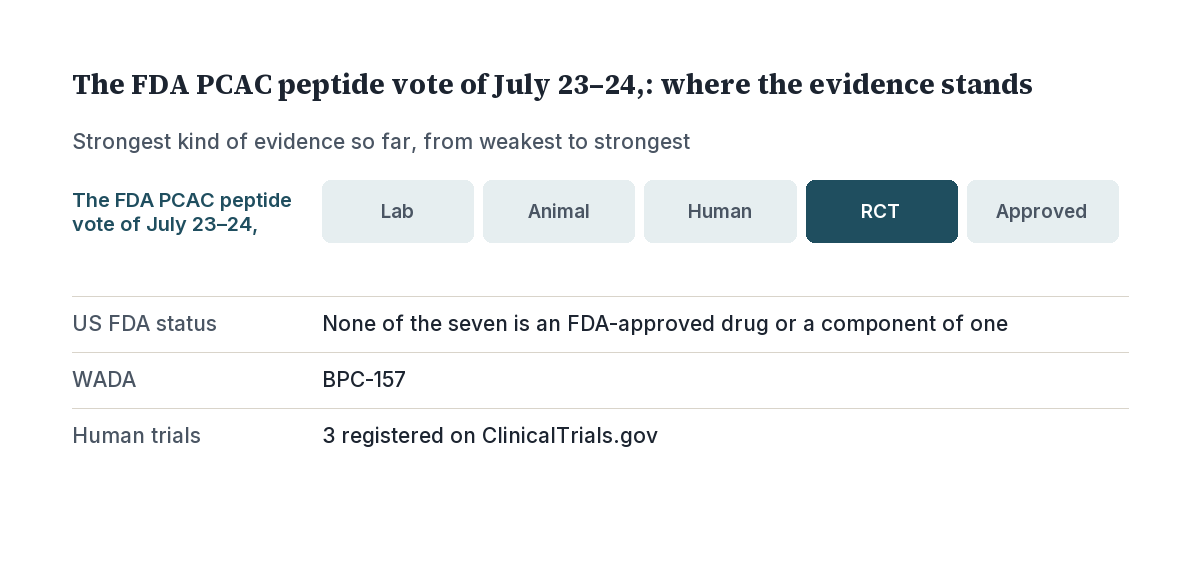
| US FDA status | None of the seven is an FDA-approved drug or a component of one (FDA briefing documents) |
| Compounding (503A) | As reported by trade press (FDA has posted no vote summary), PCAC voted 8–6 (1 abstention) for BPC-157, KPV and TB-500 on 2026-07-23; 7–5 for MOTS-c; Semax 8–5 and Epitalon 7–4 (1 abstention) for on 2026-07-24; emideltide 6–7 against. Advisory only: no proposed rule yet, and none is on the 503A bulks list (FDA meeting page) |
| WADA 2026 | BPC-157 (S0), TB-500 (S2) and MOTS-c (S4) are named and prohibited at all times; KPV, Semax, Epitalon and emideltide are not named (WADA list) |
| Strongest evidence | Human RCT reported only as a meeting abstract (BPC-157, n=53, ulcerative colitis); Animal or Lab only for KPV, TB-500 and MOTS-c (FDA BPC-157 review) |
| Human trials | 3 registered on ClinicalTrials.gov: NCT02637284, NCT07752381, NCT07803250; none has posted results |
| Next regulatory step | FDA decides whether to accept the votes, then a proposed rule, public comment and a final rule; none announced |
| Last checked | 2026-10-18 |
Key points:
- Each peptide got two separate votes, one for the free base and one for the acetate salt, because FDA lists only the exact salt form it evaluates.
- FDA has posted no minutes; the tallies come from trade press, and two outlets report the Epitalon count differently (7–4 or 7–5 with one abstention).
- FDA found no human data at all for KPV, TB-500 and MOTS-c.
- All seven nominations were withdrawn by their nominators, but FDA chose to present them to the committee anyway.
- The 503A bulks list in the federal regulations still holds the six substances placed there in 2019.
What did the FDA PCAC vote on in July 2026?
The FDA meeting page lists seven peptides “being considered for inclusion on the 503A Bulks List”, each for specific uses FDA reviewed. The committee’s voting questions asked, for each peptide, “Should [it] (free base) be placed on the list?” and the same for its acetate salt, so the panel answered 14 questions over four sessions. The tallies below are as reported by STAT News, AJMC and RAPS; FDA has not posted a vote summary.
| Peptide (use FDA reviewed) | Reported vote | Outcome |
|---|---|---|
| BPC-157 (ulcerative colitis) | 8–6, 1 abstention, 2026-07-23 | Recommended |
| KPV (wound healing, inflammatory conditions) | 8–6, 1 abstention, 2026-07-23 | Recommended |
| TB-500 (wound healing) | 8–6, 1 abstention, 2026-07-23 | Recommended |
| MOTS-c (obesity, osteoporosis) | 7–5, 2 abstentions, 2026-07-23 | Recommended |
| Epitalon (insomnia) | 7–4 (STAT) or 7–5, 1 abstention (RAPS), 2026-07-24 | Recommended |
| Semax (cerebral ischemia, migraine, trigeminal neuralgia) | 8–5, 2026-07-24 | Recommended |
| Emideltide / DSIP (opioid withdrawal, chronic insomnia, narcolepsy) | 6–7, 1 abstention, 2026-07-24 | Not recommended |
Vote totals differ from peptide to peptide because some members sat only for certain topics. The final meeting roster marks several voting and temporary members as “Topics Only”, for example one member for the Semax topic only and another for the BPC-157 topic only. STAT reported that the dissenting panelists “were largely physicians from academic institutions and patient representatives”, and ABC News reported that six of the eight recently appointed members run clinics that offer peptides.
The outcome is notable because it went against FDA staff. The FDA briefing introduction lists 14 proposals, and every one reads that the substance should “NOT be included on the 503A Bulks List”.
What is an FDA advisory committee vote?
An advisory committee is a panel of outside experts that answers questions FDA puts to it. In FDA’s own words on the meeting page, advisory committees “make non-binding recommendations to the FDA, which generally follows the recommendations but is not legally bound to do so.” The Pharmacy Compounding Advisory Committee (PCAC) advises specifically on which bulk drug substances, meaning raw active ingredients, pharmacies may use to compound medicines.
The FDA briefing introduction states that FDA “does not intend to issue a final determination on the issues at hand until input from the advisory committee process has been considered and all reviews have been finalized,” and that the final determination “may be affected by issues not discussed at the advisory committee meeting.” A yes vote therefore moves a peptide one step along a process; it does not change what a pharmacy may legally do today.
Why the free base and the salt were voted on separately
FDA’s July 23 presentation explained that when FDA places a substance on the list “and a salt or ester of an active moiety is listed, only that particular salt or ester may be used.” BPC-157 free base and BPC-157 acetate are, in law, two different bulk drug substances. FDA added that “common and company names are highly problematic for experimental substances”, because different molecules can be sold under one name.
Why FDA’s reviewers recommended against all seven
FDA weighs four criteria set by its 2019 rule: physical and chemical characterization, safety, evidence of effectiveness, and historical use in compounding, balanced “on a substance-by-substance basis” (FDA briefing introduction). For every peptide, the reviewers judged the substance not well characterized and the human evidence too thin. The table summarizes what each briefing document found.
| Peptide | Human evidence FDA found | Main FDA concern |
|---|---|---|
| BPC-157 (15 amino acids) | Five small clinical studies; one UC trial (n=53) only as a 2005 meeting abstract | Immunogenicity; no long-term safety data |
| KPV (3 amino acids) | None in humans | No human data by any route |
| TB-500 (7 amino acids) | None in humans | No toxicity studies; failed a lab wound test |
| MOTS-c (16 amino acids) | None in humans | Rodent data only; molecular targets unknown |
| Emideltide (9 amino acids) | Small IV studies since 1981; none by the nominated route | Possible addiction risk; hypotension |
| Epitalon (4 amino acids) | Melatonin studies; none in insomnia | Telomerase activation, theoretical cancer risk |
| Semax (7 amino acids) | Two small studies, intranasal only | Bleeding risk; no human PK data |
The findings still show why these peptides draw interest. For BPC-157, the FDA briefing document notes that animal studies reported it could prevent colonic fistulas, liver lesions and gut lesions in rats [Animal], and a 53-person randomized ulcerative colitis trial reported a larger fall in a disease activity score on BPC-157 than on placebo [Human RCT (n=53), meeting abstract]. FDA judged that abstract “inadequate to support the efficacy and safety” of the treatment because the endpoint, inclusion criteria and statistics were not described, and the between-group difference was not statistically clear. For Semax, the FDA Semax review records that it “is a registered drug in Russia and is available as 0.1% and 1% nasal drops”, and that in rodents it showed neuroprotective, analgesic and antidepressant-like effects [Animal].
For TB-500, the FDA TB-500 review found that TB-500 itself “did not induce wound healing” in a scratch-wound fibroblast culture [Lab], while one of its breakdown products, N-acetylated LKKTE, “appeared to have wound-healing properties in vitro” [Lab]. For MOTS-c, the FDA MOTS-c review notes the peptide “was discovered in 2015” and that its studies were “limited to in-vitro and in-vivo rodent models” [Animal, Lab].
What has to happen before any peptide is on the 503A list?
A 503A pharmacy may compound from a bulk ingredient only if it has a USP or NF monograph, is a component of an FDA-approved drug, or appears on the 503A bulks list (FDA 503A bulks page). The seven peptides meet none of these today: each briefing document states there is no USP monograph and that neither form is a component of an approved drug. The list itself is built only “through notice-and-comment rulemaking”. The FDA page records that a February 2019 final rule placed six substances on the list, and a September 2019 proposed rule proposed five more and rejected 26. For a different look at what each pathway allows, see our explainer on 503A vs 503B peptides.
For any of the six recommended peptides, the remaining steps are:
- FDA decision. FDA reviews the votes, the docket comments and its own reviews, and decides whether to propose listing. It is not bound by the committee.
- Proposed rule. FDA publishes a proposed rule in the Federal Register naming each substance and salt form.
- Public comment. Anyone may comment; law firm Orrick estimated comment periods of 60–90 days and the whole process at 12 to 24 months.
- Final rule. Only when a final rule is published does the substance join the list in 21 CFR 216.23.
As of 2026-10-04, a search of the Federal Register found no proposed rule for any of the seven peptides, and 21 CFR 216.23 still lists only the six substances added in 2019. The pharmacists’ trade group NCPA summarized the same point: pharmacies “will not be permitted to compound them until the final rulemaking is in place”.
Where the Category 2 withdrawal fits
Before the meeting, all seven peptides had already moved off FDA’s safety-risk list. The FDA Category 2 page lists BPC-157, KPV, TB-500, MOTS-c, Semax, Epitalon and emideltide under “Bulk drug substances nominated but withdrawn”, which it describes as substances “previously in category 2 of the interim policies” that “were withdrawn by the nominators.” Withdrawal is not a move to Category 1. The FDA 503A page adds that FDA “does not intend to place bulk drug substances nominated on or after January 7, 2025, into these categories.” The background is covered in our guide to Category 1 vs Category 2 peptides.
Where each peptide stands now
The tracker below records the status of each reviewed peptide after the meeting. Our entries for BPC-157, TB-500, KPV and MOTS-c cover the research in full.
| Peptide | 503A status (checked 2026-10-04) | WADA 2026 |
|---|---|---|
| BPC-157 | PCAC for; not listed; no proposed rule | Prohibited, S0 |
| KPV | PCAC for; not listed; no proposed rule | Not named |
| TB-500 | PCAC for; not listed; no proposed rule | Prohibited, S2.3 |
| MOTS-c | PCAC for; not listed; no proposed rule | Prohibited, S4.4.1 |
| Epitalon | PCAC for; not listed; no proposed rule | Not named |
| Semax | PCAC for; not listed; no proposed rule | Not named |
| Emideltide (DSIP) | PCAC against; not listed | Not named |
Law firm Orrick reported that a second PCAC meeting is expected before the end of February 2027 to review LL-37, GHK-Cu, dihexa acetate, Melanotan II and PEG-MGF. No notice for that meeting had appeared in the Federal Register by 2026-10-04.
What the vote means for athletes
A compounding recommendation does not change anti-doping rules. The WADA 2026 Prohibited List, in effect from 1 January 2026, names BPC-157 in class S0 (non-approved substances), “Thymosin-ß4 and its derivatives e.g. TB-500” in class S2.3 (growth factors), and MOTS-c in class S4.4.1 (metabolic modulators); all three classes are prohibited at all times. USADA states that BPC-157 is prohibited under S0 and “not approved for human clinical use” by FDA “or any other global health authority”. KPV, Epitalon and emideltide are not named on the list, but S0 covers any pharmacological substance not addressed elsewhere on the list and “with no current approval by any governmental regulatory health authority for human therapeutic use”. Semax is registered in Russia, so whether S0 reaches it is a question for the anti-doping agencies. Our page on WADA banned peptides tracks the list.
Side effects and safety concerns FDA raised
The safety record for all seven is thin rather than alarming: few people have been studied, so harms are unknown more than they are documented.
- Immunogenicity: injected peptides may trigger immune reactions, “potentially amplified by aggregation as well as potential peptide-related impurities,” FDA wrote of BPC-157 (FDA BPC-157 review). The same concern appears in the TB-500, Epitalon and Semax reviews [theoretical, regulator assessment].
- BPC-157 reports: no serious adverse events were reported in the five small studies; headache and flatulence were the most frequent effects after enemas in healthy volunteers [Human, small studies]. FDA’s adverse-event database search through December 4, 2025 found three reports, all with injected BPC-157: injection-site redness and swelling, shortness of breath leading to an emergency visit, and skin and gum darkening that recurred on re-use of a BPC-157 and TB-500 product labeled “research purposes only” [case reports; causality unclear].
- Emideltide: in opioid-withdrawal studies, transient headache, nausea and vertigo were common, with cases of low blood pressure; in one 1984 study, 95 of 107 people had no significant adverse events (FDA July 24 slides) [Human, uncontrolled].
- Epitalon: FDA noted it activates telomerase and lengthens telomeres, and “longer telomeres are generally associated with increased risk for cancer” (FDA Epitalon review) [theoretical].
- Semax: possible anti-thrombotic effects raise “concern about the risk of bleeding”, and in mice it potentiated amphetamine-induced dopamine release (FDA Semax review) [Animal, theoretical].
Products sold outside pharmacies add a separate risk: identity and purity are unverified. At the meeting an FDA quality official asked what form patients actually receive from a TB-500 prescription, as ABC News reported, and the BPC-157 case report above involved a product labeled for research only. Our explainer on research use only peptides covers what that label means.
What users report
These are unverified self-reports from people who usually bought unregulated products, not evidence. After the July meeting, people who post about BPC-157, TB-500 and MOTS-c on forums and social media commonly described the vote as a turning point, and many threads read it as legalization, which it is not; other users repeatedly correct that reading and point out that no rule exists yet. A recurring hope is that pharmacy-made versions would end worries about underdosed or contaminated vials, and complaints about inconsistent product quality and high cost run through most discussions. Posters who use these peptides for joint, tendon or gut problems often say they noticed improvement within a few weeks, while others report no effect at all. Common complaints include pain or redness where injections were given, headaches and tiredness. The panel’s makeup is argued about constantly: supporters call the vote overdue, critics point to members with clinic ties. Many posters also say they plan to wait for the final rule before changing what they do.
Frequently asked questions
Did the FDA approve BPC-157 in July 2026?
No. The July 23, 2026 vote was an advisory recommendation from FDA’s Pharmacy Compounding Advisory Committee to add BPC-157 to the 503A bulks list, which would let pharmacies compound it. It is not a drug approval. FDA’s BPC-157 review states there is no approved BPC-157 product in any country.
Can pharmacies compound BPC-157 or TB-500 now?
Not under the 503A bulks pathway. A peptide joins the list only through a proposed rule, public comment and a final rule, and no proposed rule had been published by 2026-10-04. FDA’s 503A page says the list is built through notice-and-comment rulemaking.
Is FDA bound by the committee’s vote?
No. FDA describes its advisory committees as making non-binding recommendations that the agency generally follows but is not legally bound to follow. In this case FDA staff had proposed that none of the seven peptides be listed, so the agency must now weigh the committee’s votes against its own briefing reviews before any rulemaking.
Why was emideltide (DSIP) rejected?
The panel voted 6–7 against it. FDA’s emideltide review found its insomnia studies “inconclusive and at best preliminary”, found no data for the proposed under-the-skin route, and flagged a possible addiction risk because it stimulates the body’s opioid system. FDA also noted that approved treatments exist for all three uses.
References
- US Food and Drug Administration. July 23-24, 2026: Meeting of the Pharmacy Compounding Advisory Committee. FDA; content current as of 2026-08-06. fda.gov
- US Food and Drug Administration. FDA Briefing Document: Pharmacy Compounding Advisory Committee, July 23-24, 2026 — Introduction. 2026. fda.gov/media/193342
- US Food and Drug Administration. PCAC Meeting July 23-24, 2026 — Questions. 2026. fda.gov/media/193711
- US Food and Drug Administration. PCAC Meeting July 23-24, 2026 — Final Meeting Roster. 2026. fda.gov/media/193772
- US Food and Drug Administration. July 23, 2026 PCAC Meeting — FDA Presentations. 2026. fda.gov/media/193773
- US Food and Drug Administration. July 24, 2026 PCAC Meeting — FDA Presentations. 2026. fda.gov/media/193774
- US Food and Drug Administration. FDA Briefing Document for BPC-157-Related Bulk Drug Substances. 2026. fda.gov/media/193343
- US Food and Drug Administration. FDA Briefing Document for KPV-Related Bulk Drug Substances. 2026. fda.gov/media/193346
- US Food and Drug Administration. FDA Briefing Document for TB-500-Related Bulk Drug Substances. 2026. fda.gov/media/193349
- US Food and Drug Administration. FDA Briefing Document for MOTS-c-Related Bulk Drug Substances. 2026. fda.gov/media/193347
- US Food and Drug Administration. FDA Briefing Document for Emideltide-Related Bulk Drug Substances. 2026. fda.gov/media/193344
- US Food and Drug Administration. FDA Briefing Document for Epitalon-Related Bulk Drug Substances. 2026. fda.gov/media/193345
- US Food and Drug Administration. FDA Briefing Document for Semax-Related Bulk Drug Substances. 2026. fda.gov/media/193348
- US Food and Drug Administration. Bulk Drug Substances Used in Compounding Under Section 503A of the FD&C Act. Content current as of 2026-05-14. fda.gov
- US Food and Drug Administration. Certain Bulk Drug Substances for Use in Compounding that May Present Significant Safety Risks (Category 2). Content current as of 2026-04-22. fda.gov
- World Anti-Doping Agency. The 2026 Prohibited List, International Standard. In effect 1 January 2026. wada-ama.org
- US Anti-Doping Agency. BPC-157: Experimental Peptide Creates Risk for Athletes. USADA. usada.org
- ClinicalTrials.gov. PCO-02 – Safety and Pharmacokinetics Trial (NCT02637284). Phase 1, status unknown. clinicaltrials.gov
Change log
2026-10-26: links to related entries added; no change to the facts.
2026-10-23: links to glossary definitions added; no change to the facts.
2026-10-18: removed ClinicalTrials.gov record NCT07437547 (BPC-157, phase 2), whose sponsor posts example records, from the status box; BPC-157 registered trials now 3; reviewed by the editorial team.
2026-10-12: links to related entries added; no change to the facts.
2026-10-05: status box re-checked; BPC-157 registered trials corrected to 4 and the Epitalon vote given as 7–4 (1 abstention); reviewed by the editorial team.
2026-10-04: byline removed from the opening so the answer leads; Federal Register re-checked (no proposed rule, no new committee notice) and eCFR 21 CFR 216.23 re-checked (unchanged), dates updated; reviewed by the editorial team.
2026-10-03: first published after review by the editorial team.