Cerebrolysin is a prescription drug made from pig brain: a mixture of low-molecular-weight peptides and free amino acids, studied as a neurotrophic agent in stroke, dementia and brain injury, with evidence from human randomized trials (Ziganshina 2023).
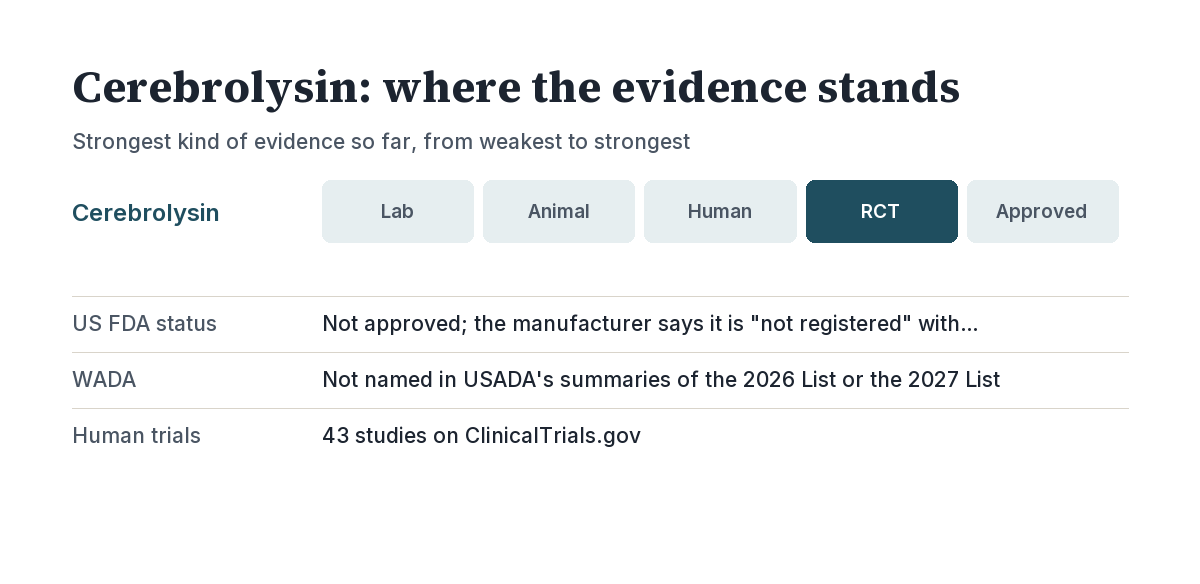
Its most promising results come from stroke rehabilitation: in two pooled CARS trials (n=442), patients given cerebrolysin with rehabilitation regained more arm function by day 90 than those given placebo [Human RCT] (Guekht 2017). It is not FDA approved; its Austrian manufacturer states it is not approved for sale in the United States (EVER Neuro Pharma). The 2023 Cochrane review found it probably does not prevent deaths after acute stroke and may raise non-fatal serious adverse events.
| Item | Status |
|---|---|
| US FDA status | Not approved; the manufacturer says it is “not registered” with the FDA and “not approved for sale or distribution in the United States” (EVER Neuro Pharma). No US filing announced as of 2026-10-24. |
| Compounding (503A/503B) | Not on the 503A bulks list in 21 CFR 216.23; not named on FDA’s Category 2 page (updated 2026-04-22). No next step scheduled. |
| WADA | Not named in USADA’s summaries of the 2026 List or the 2027 List (in force 2027-01-01) (USADA). S0 covers substances with no government approval anywhere; no WADA or USADA ruling on cerebrolysin found. |
| Outside the US | Marketing authorization held by EVER Neuro Pharma (Austria); widely used in Russia, Eastern Europe, China and other Asian countries (Cochrane 2023). |
| Strongest evidence | Human RCTs and meta-analyses; positive in rehabilitation trials, neutral on death and on the primary outcome of the largest acute-stroke trial. |
| Human trials | 43 studies on ClinicalTrials.gov (searched 2026-10-24), e.g. NCT00868283 (CASTA, n=1,071, completed). |
| Last checked | 2026-10-24 |
Key points:
- Cerebrolysin is not one peptide with a fixed sequence but a standardized mixture; each mL contains 215.2 mg of cerebrolysin concentrate, according to the EVER Neuro Pharma label.
- A 2021 European Academy of Neurology guideline recommends it for early rehabilitation after ischemic stroke (Beghi 2021).
- In Alzheimer’s trials, the cognitive gain was statistically significant at 4 weeks but not at 6 months (Gauthier 2015).
- The manufacturer supported three of the seven trials in the 2023 Cochrane stroke review (Ziganshina 2023).
- The label lists epilepsy and severe kidney impairment as contraindications.
| Property | Value |
|---|---|
| Composition | Low-molecular-weight peptides and amino acids from porcine brain (Cochrane 2023) |
| Sequence / formula | None: a mixture, not a single molecule |
| Strength | 215.2 mg concentrate per mL (label) |
| Manufacturer | EVER Neuro Pharma GmbH, Unterach, Austria |
| Routes studied | Intravenous (human), intramuscular (human), intranasal (mice) |
| Class | Neurotrophic peptide preparation |
What is cerebrolysin?
Cerebrolysin is a brain-derived drug produced by EVER Neuro Pharma in Unterach, Austria. Its label lists Alzheimer’s-type dementia, vascular dementia, stroke and head trauma as indications, and it comes as a solution for injection and infusion (EVER Neuro Pharma). The Cochrane stroke review describes it as a mixture of peptides and amino acids from pig brain and notes that it is widely used in Russia, Eastern Europe, China and other Asian and post-Soviet countries (Ziganshina 2023). Human trials go back at least to the 1990s, including a 1998 study in healthy volunteers (Funke 1998). Because it is a mixture, it has no single sequence or molecular weight, and no FDA-reviewed identity standard in the US.
How does cerebrolysin work?
How cerebrolysin works in people has not been established. The leading hypothesis is that its peptides act like the brain’s own growth factors:
- Growth-factor-like activity: the Cochrane authors describe peptides “with proposed neuroprotective and neurotrophic properties similar to naturally occurring growth factors” [Review; proposed, not proven] (Ziganshina 2023).
- Amyloid processing: in mice engineered to make human amyloid precursor protein, six months of treatment lowered amyloid burden and the activity of two kinases, CDK5 and GSK-3β, and improved maze performance [Animal] (Rockenstein 2006).
- New nerve cells: in the same mouse model, it increased neural progenitor cells in the hippocampus and reduced markers of cell death [Animal] (Rockenstein 2007).
- Stroke tissue: in rats after an embolic stroke, doses of 2.5 mL/kg or more improved neurological scores and 5 mL/kg reduced lesion volume [Animal] (Zhang 2016).
- Inflammation and IGF-I: in 207 people with Alzheimer’s disease, it lowered blood TNF-α (an inflammatory signal) and raised IGF-I compared with placebo, in a dose-related way [Human RCT biomarker analysis, n=207] (Alvarez 2009).
Benefits of cerebrolysin: what the research shows
The most encouraging potential benefit of cerebrolysin is better recovery after stroke when it is added to rehabilitation. Pooled CARS data (n=442) showed better arm function at day 90, with one extra responder for about every seven patients treated [Human RCT] (Guekht 2017). A 2025 trial in people with post-stroke aphasia (difficulty producing speech) found 14.8 more points of language recovery than placebo [Human RCT, n=123] (Homberg 2025).
Results for survival and overall outcome in acute stroke are neutral, and the dementia evidence is short-term or of low certainty, as the table shows.
| Claim | Evidence level | Best study and result |
|---|---|---|
| Arm recovery after stroke | Human RCT (2 trials, n=442) | Guekht 2017: ARAT effect 0.62, p<0.0001; NNT 7.1 |
| Language after stroke | Human RCT (n=123) | Homberg 2025: +14.8 points vs placebo, P<0.001 |
| Early neurological recovery | Meta-analysis (9 RCTs, n=1,879) | Bornstein 2018: NIHSS effect 0.60, p<0.0001 |
| Fewer deaths after acute stroke | Not supported (6 RCTs, n=1,689) | Ziganshina 2023: RR 0.96 (0.65–1.41) |
| Better overall acute-stroke outcome | Not supported (Human RCT, n=1,070) | Heiss 2012: no difference on primary outcome |
| Cognition in Alzheimer’s | Meta-analysis (6 RCTs) | Gauthier 2015: SMD −0.40 at 4 weeks; p=0.17 at 6 months |
| Vascular dementia | Cochrane review (6 RCTs, n=597), very low certainty | Cui 2019: cognition SMD 0.36 |
| Traumatic brain injury | Human RCT (2 trials, n=185) | Vester 2021: effect 0.60 at day 90, p=0.0146 |
| Post-COVID smell and taste loss | Human RCT (n=250) | Hamed 2023: complete recovery 61.5% vs none with training alone |
| Memory in healthy people | Human RCT (n=48) | Funke 1998: 10 mL changed EEG activity; memory findings were only a trend |
| Less amyloid in the brain | Animal (mice) | Rockenstein 2006: lower amyloid burden |
The “effect” figures for stroke and brain injury are Mann-Whitney estimators: 0.5 means no difference, and values above 0.5 favor cerebrolysin.
Stroke rehabilitation
In CARS, patients started 30 mL a day within 24–72 hours of stroke for 21 days, alongside standard rehabilitation. Arm function at day 90 favored cerebrolysin, with an effect of 0.71 (95% CI 0.63–0.79), and only 3.8% stopped early [Human RCT] (Muresanu 2016). The authors called the trial exploratory and asked for larger confirmation. A 70-patient trial found no overall difference, but a gain in the subgroup with severe motor impairment [Human RCT] (Chang 2016). A European Academy of Neurology guideline recommends cerebrolysin for early neurorehabilitation after ischemic stroke; its author list includes investigators from the cerebrolysin trials (Beghi 2021).
Acute stroke and survival
The largest trial, CASTA, gave 30 mL a day for 10 days within 12 hours of stroke to 1,070 patients in Asia and found no difference on its combined primary outcome [Human RCT] (Heiss 2012). In a post hoc subgroup with severe stroke, 90-day mortality was 10.5% versus 20.2%, a finding that would need testing in a dedicated trial. Added to the clot-dissolving drug alteplase, it improved early neurological scores but not day-90 disability (n=119) (Lang 2013). The 2023 Cochrane review, which used death and serious adverse events as its main outcomes, found no effect on all-cause death at moderate certainty (Ziganshina 2023).
Alzheimer’s disease and vascular dementia
Across six Alzheimer’s trials, cerebrolysin improved cognition at 4 weeks (SMD −0.40, p=0.0031) and global clinical change at 4 weeks and 6 months; the cognitive effect at 6 months was not statistically significant (p=0.1710) [Meta-analysis] (Gauthier 2015). One dose-finding trial (n=279) saw the cognitive gain only at the lowest dose, which the authors called a “reversed U-shaped” response (Alvarez 2006). In vascular dementia, a 242-patient trial reported a 6.17-point larger improvement on the ADAS-cog+ scale (p<0.0001) (Guekht 2011), but the Cochrane review rated the overall evidence as very low quality and said the effects may not be clinically meaningful (Cui 2019).
Traumatic brain injury and other uses
The CAPTAIN trials enrolled people with moderate to severe head injury. Pooled across 185 patients, outcomes at days 30 and 90 favored cerebrolysin with a small-to-medium effect [Human RCT] (Vester 2021). The smaller CAPTAIN I (n=46) just missed statistical significance in its main intention-to-treat analysis (Poon 2020). In a trial of 250 people with lasting smell and taste loss after COVID-19, 61.5% of the cerebrolysin group recovered fully, compared with none of those given smell training alone (Hamed 2023).
Human studies and trials
ClinicalTrials.gov lists 43 studies of cerebrolysin, three of them with posted results (searched 2026-10-24). Published trials shown below without an NCT number are ones we did not match to a registry record. The main ones:
| Trial | Design, n, status | Result |
|---|---|---|
| CASTA, acute stroke (NCT00868283) | Phase 4 RCT, 1,071, completed | Neutral primary outcome (Heiss 2012) |
| With alteplase (NCT00840671) | Phase 3 RCT, 119, completed | No day-90 benefit (Lang 2013) |
| CARS-1 and CARS-2, stroke rehabilitation | RCTs, 442 pooled | Better arm function (Guekht 2017) |
| ESCAS, post-stroke aphasia | RCT, 132 enrolled | +14.8 language points (Homberg 2025) |
| Vascular dementia (NCT00947531) | Phase 4 RCT, 242, completed, results posted | Better cognition (Guekht 2011) |
| Alzheimer’s vs donepezil (NCT00911807) | Phase 2, 217, completed, results posted | Results on the trial record |
| CAPTAIN I, brain injury (NCT01606111) | Phase 4 RCT, 46, terminated | Missed ITT significance (Poon 2020) |
| CAPTAIN II, brain injury | RCT, 139 analyzed | Small-to-medium effect, P=0.0119 (Muresanu 2020) |
| Aphasia (NCT06897176) | Phase 4, 40 planned, recruiting | Pending |
| After thrombectomy (NCT06339411) | Phase 2, 100 planned, not yet recruiting | Pending |
| CADASIL (NCT05755997) | Phase 2, 30 planned, active | Pending |
Our clinical trials inventory tracks registered trials for other peptides in the same format.
Doses used in studies
| Route and amount | Population | Study |
|---|---|---|
| IV 30 mL/day for 10 days | Acute stroke, n=1,070 | Heiss 2012 |
| IV 30 mL/day for 21 days | Stroke rehabilitation | Muresanu 2016 |
| IV 10, 30 or 60 mL over 12 weeks | Alzheimer’s, n=279 | Alvarez 2006 |
| IV 20 mL/day, two periods over 24 weeks | Vascular dementia, n=242 | Guekht 2011 |
| IV 50 mL/day for 10 days, then 10 mL/day | Brain injury, n=185 | Vester 2021 |
| IM 5 mL/day, 5 days a week | Post-COVID smell loss, n=250 | Hamed 2023 |
| 0.8–7.5 mL/kg for 10 days | Rats after stroke | Zhang 2016 |
| Intranasal 1 mL/kg daily | Mice, aging model | Pourmemar 2017 |
No established human dose exists outside approved labels. Labels in the countries that authorize cerebrolysin set their own terms, and there is no US label.
Side effects and safety
In most individual trials, adverse events with cerebrolysin were about as frequent as with placebo. The strongest safety signal comes from pooled data:
- Non-fatal serious adverse events: in acute stroke, the 2023 Cochrane review found more of them with cerebrolysin, about 30 versus 12 per 1,000 people (RR 2.39, 95% CI 1.10–5.23; 3 trials, n=1,335; moderate certainty) [Systematic review] (Ziganshina 2023). Total serious adverse events (RR 1.16) and total adverse events (RR 1.03) did not differ.
- Common complaints: in an Alzheimer’s trial of 192 people, adverse events occurred in 64% on cerebrolysin and 73% on placebo; the most common were headache, dizziness, weight loss and anxiety [Human RCT] (Panisset 2002).
- Dementia trials: the vascular dementia Cochrane review found no difference in adverse events (RR 0.91), at very low certainty (Cui 2019).
- Who should not use it, per the label: people with hypersensitivity to its components, epilepsy or severe kidney impairment (EVER Neuro Pharma).
Two limits apply to the safety record. Several of the large trials and meta-analyses were sponsored by the manufacturer (Bornstein 2018), and the participants had stroke, dementia or brain injury, so the data say little about healthy people using it for focus or memory. In the United States the product is not approved for sale, so anything sold there under a “research use only” label has no FDA-reviewed quality or identity standard; our explainer on what the research-use-only label means legally covers that market.
Anyone who suspects a side effect from cerebrolysin or any other drug or product can report it to the FDA through MedWatch.
Legal and regulatory status
| Jurisdiction | Status (checked 2026-10-24) |
|---|---|
| US FDA | Not approved; “not approved for sale or distribution in the United States” (manufacturer) |
| US compounding | Not on the 503A bulks list or the Category 2 page |
| WADA 2026 List | Not named in USADA’s 2026 summary |
| WADA 2027 List | Not named; peptides in general now listed under S0 (USADA 2027 summary) |
| Outside the US | Marketing authorization held by EVER Neuro Pharma, Austria; local labels vary |
In US compounding, cerebrolysin sits outside the 2026 peptide debates. Peptides such as GHK-Cu, the copper tripeptide, and Semax were once in FDA’s Category 2 and were withdrawn by their nominators; cerebrolysin does not appear on that page at all (FDA, updated 2026-04-22). FDA has also said it does not intend to place substances nominated on or after 2025-01-07 into the interim categories (FDA 503A page).
In sport, the WADA status is unsettled rather than clear-cut. S0 covers substances not “approved for human therapeutic use by any governmental health agency anywhere in the world” (USADA), and cerebrolysin is marketed under authorizations outside the US. The 2027 List names BPC-157 as an S0 example and places AOD-9604, the HGH fragment under S2, and USADA warns that a peptide not named on the List may still be prohibited. We found no published WADA or USADA ruling on cerebrolysin itself, so its status for an athlete is a question for that athlete’s anti-doping organization. The 2027 WADA peptide list explainer and our peptide legal status tracker cover the wider picture.
Related peptides
- Semax: a synthetic heptapeptide in the same nootropic class, withdrawn from FDA’s Category 2 list.
- Selank: selank acetate (TP-7), a sibling nootropic peptide, also withdrawn from Category 2.
- Pinealon: a short bioregulator peptide from aging research.
- DSIP: emideltide, a neuropeptide studied for sleep.
What users report
What follows are unverified self-reports from people who usually bought unregulated products; they are not evidence. People who post about cerebrolysin on forums and social media most often describe sharper focus, better word-finding and less “brain fog”, and some recovering from concussion or stroke credit it with faster progress. Many say any effect is subtle and hard to separate from expectation, and a sizeable share report no effect at all. Recurring complaints are headache, tiredness, irritability or restlessness, soreness where it was given, and cost. Product quality is a constant argument: posters question whether products sold online under the cerebrolysin name are genuine. Other debates are whether results from hospital patients apply to healthy people, how it compares with Semax and other nootropic peptides, and whether its pig-brain origin raises religious or safety concerns.
Frequently asked questions
Is cerebrolysin a peptide?
Partly. Cerebrolysin is not a single peptide but a mixture of low-molecular-weight peptides and free amino acids obtained from pig brain, so it has no fixed sequence or molecular formula. The Cochrane stroke review describes it as “a mixture of low‐molecular‐weight peptides and amino acids derived from porcine brain” (Ziganshina 2023).
Is cerebrolysin FDA approved or legal in the US?
No, it is not FDA approved. Its manufacturer states it “is not registered with the U.S. Food and Drug Administration (FDA) and is not approved for sale or distribution in the United States” (EVER Neuro Pharma). It is also absent from the federal 503A bulks list that compounding pharmacies may draw on, as of 2026-10-24.
Is cerebrolysin approved in Europe?
It is marketed in individual countries rather than through one EU-wide approval that we could verify. Its marketing-authorization holder is EVER Neuro Pharma in Austria, and the manufacturer notes that prescribing information varies by country. The Cochrane stroke review describes wide use in Russia, Eastern Europe, China and other Asian countries, which is where most of its trials were run.
Is cerebrolysin safe?
In trials it was generally well tolerated, with adverse events close to placebo rates, but it is not risk-free. The 2023 Cochrane review of acute stroke trials found more non-fatal serious adverse events with cerebrolysin, about 30 versus 12 per 1,000 people (RR 2.39, moderate certainty). The label excludes people with epilepsy or severe kidney impairment.
Is cerebrolysin halal?
Cerebrolysin is derived from porcine (pig) brain, according to the Cochrane review of the drug. Whether a pig-derived medicine is acceptable, and under what circumstances, is a question for religious authorities rather than a pharmacological one, and this page does not give a religious ruling. A cattle-derived peptide mixture, Cortexin, appears in the same review.
Is cerebrolysin given subcutaneously?
The trials reviewed here gave cerebrolysin into a vein, and one used intramuscular dosing; none of them tested the subcutaneous route. The manufacturer’s label describes a solution for injection and infusion. In the largest trial, CASTA, patients received 30 mL intravenously each day for 10 days (Heiss 2012).
References
- Ziganshina LE, Abakumova T, Nurkhametova D, Ivanchenko K. Cerebrolysin for acute ischaemic stroke. Cochrane Database Syst Rev. 2023;10:CD007026. PubMed 37818733
- Guekht A, Vester J, Heiss WD, et al. Safety and efficacy of Cerebrolysin in motor function recovery after stroke: a meta-analysis of the CARS trials. Neurol Sci. 2017. PubMed 28707130
- Muresanu DF, Heiss WD, Hoemberg V, et al. Cerebrolysin and Recovery After Stroke (CARS). Stroke. 2016;47(1):151-9. PubMed 26564102
- Bornstein NM, Guekht A, Vester J, et al. Safety and efficacy of Cerebrolysin in early post-stroke recovery: a meta-analysis of nine randomized clinical trials. Neurol Sci. 2018. PubMed 29248999
- Heiss WD, Brainin M, Bornstein NM, Tuomilehto J, Hong Z. Cerebrolysin in patients with acute ischemic stroke in Asia (CASTA). Stroke. 2012;43(3):630-6. PubMed 22282884
- Lang W, Stadler CH, Poljakovic Z, Fleet D. Combined treatment with alteplase and Cerebrolysin in acute ischaemic stroke. Int J Stroke. 2013;8(2):95-104. PubMed 23009193
- Homberg V, Jianu DC, Stan A, et al. Speech therapy combined with Cerebrolysin in enhancing nonfluent aphasia recovery (ESCAS). Stroke. 2025;56(4):937-947. PubMed 39957612
- Chang WH, Park CH, Kim DY, et al. Cerebrolysin combined with rehabilitation promotes motor recovery in patients with severe motor impairment after stroke. BMC Neurol. 2016. PubMed 26934986
- Beghi E, Binder H, Birle C, et al. EAN and EFNR guideline on pharmacological support in early motor rehabilitation after acute ischaemic stroke. Eur J Neurol. 2021. PubMed 34152062
- Gauthier S, Proaño JV, Jia J, et al. Cerebrolysin in mild-to-moderate Alzheimer’s disease: a meta-analysis of randomized controlled clinical trials. Dement Geriatr Cogn Disord. 2015;39(5-6):332-47. PubMed 25832905
- Alvarez XA, Cacabelos R, et al. A 24-week, double-blind, placebo-controlled study of three dosages of Cerebrolysin in patients with mild to moderate Alzheimer’s disease. Eur J Neurol. 2006. PubMed 16420392
- Panisset M, Gauthier S, Moessler H, Windisch M. Cerebrolysin in Alzheimer’s disease: a randomized, double-blind, placebo-controlled trial with a neurotrophic agent. J Neural Transm. 2002. PubMed 12111446
- Alvarez XA, Sampedro C, Cacabelos R, et al. Reduced TNF-α and increased IGF-I levels in the serum of Alzheimer’s disease patients treated with the neurotrophic agent cerebrolysin. Int J Neuropsychopharmacol. 2009. PubMed 19531281
- Cui S, Chen N, Yang M, et al. Cerebrolysin for vascular dementia. Cochrane Database Syst Rev. 2019;CD008900. PubMed 31710397
- Guekht AB, Moessler H, et al. Cerebrolysin in vascular dementia: improvement of clinical outcome in a randomized, double-blind, placebo-controlled multicenter trial. J Stroke Cerebrovasc Dis. 2011. PubMed 20656516
- Vester JC, Buzoianu AD, Florian SI, et al. Cerebrolysin after moderate to severe traumatic brain injury: prospective meta-analysis of the CAPTAIN trial series. Neurol Sci. 2021;42(11):4531-4541. PubMed 33620612
- Poon W, Matula C, Vos PE, et al. Safety and efficacy of Cerebrolysin in acute brain injury and neurorecovery: CAPTAIN I. Neurol Sci. 2020. PubMed 31494820
- Muresanu DF, Florian S, Hömberg V, et al. Efficacy and safety of cerebrolysin in neurorecovery after moderate-severe traumatic brain injury: results from the CAPTAIN II trial. Neurol Sci. 2020. PubMed 31897941
- Hamed SA, Ahmed MAA. The effectiveness of cerebrolysin, a multi-modal neurotrophic factor, for treatment of post-covid-19 persistent olfactory, gustatory and trigeminal chemosensory dysfunctions: a randomized clinical trial. Expert Rev Clin Pharmacol. 2023. PubMed 37950370
- Funke M, Fiehler J, Mewes I, et al. Dose-dependent effects of Cerebrolysin on EEG and short-term memory of healthy volunteers during control and hyperventilation induced cerebral ischemia. J Neural Transm Suppl. 1998. PubMed 9700674
- Rockenstein E, et al. Cerebrolysin decreases amyloid-beta production by regulating amyloid protein precursor maturation. J Neurosci Res. 2006. PubMed 16511867
- Rockenstein E, et al. Effects of Cerebrolysin on neurogenesis in an APP transgenic model. Acta Neuropathol. 2007. PubMed 17131129
- Zhang L, et al. Cerebrolysin dose-dependently improves neurological outcome in rats after acute stroke. Int J Stroke. 2016. PubMed 26763925
- Pourmemar E, Majdi A, Haramshahi M, et al. Intranasal Cerebrolysin attenuates learning and memory impairments in D-galactose-induced senescence in mice. Exp Gerontol. 2017. PubMed 27894939
- ClinicalTrials.gov. Search results for intervention “cerebrolysin” (43 studies, searched 2026-10-24). ClinicalTrials.gov
- US FDA. Certain bulk drug substances for use in compounding that may present significant safety risks (updated 2026-04-22). FDA
- US FDA. Bulk drug substances used in compounding under section 503A of the FD&C Act (content current 2026-05-14). FDA
- 21 CFR 216.23, Bulk drug substances that can be used to compound drug products in accordance with section 503A. eCFR
- EVER Neuro Pharma. About Cerebrolysin: prescribing information. cerebrolysin.com
- USADA. Athlete Advisory: What’s new on the 2027 WADA Prohibited List? USADA
- USADA. Athlete Advisory: What’s new on the 2026 WADA Prohibited List? USADA
Change log
2026-10-26: links to related entries added; no change to the facts.
2026-10-24: first published after review by the editorial team.