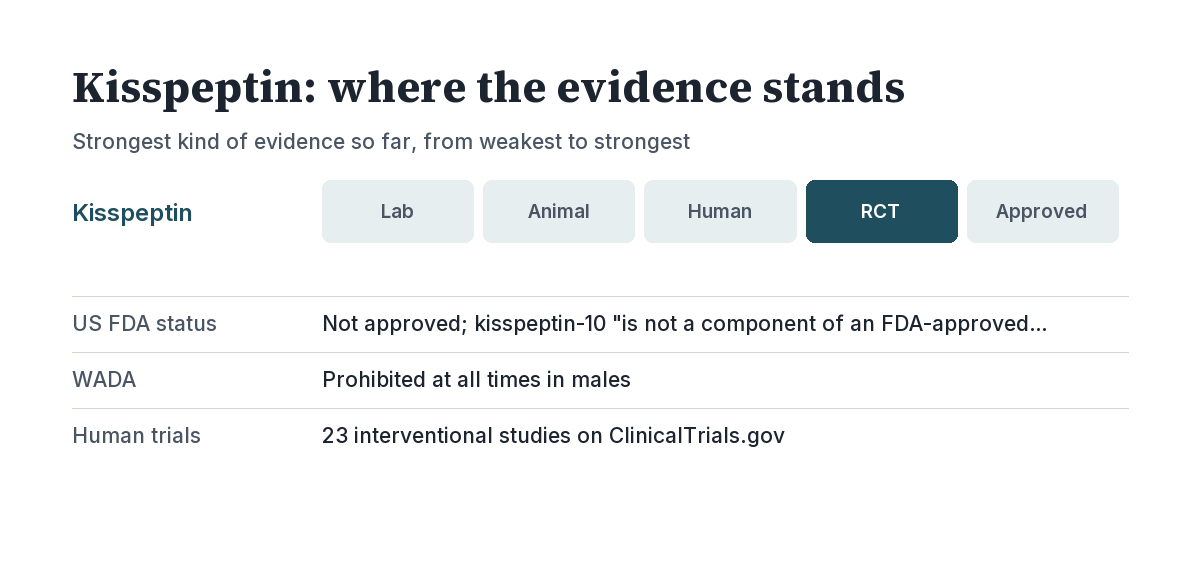
Kisspeptin is a family of natural peptide hormones, 54 to 10 amino acids long, made from the KISS1 gene, that switch on the reproductive axis by triggering the release of gonadotropin-releasing hormone (GnRH). It is not FDA approved for any use, and its strongest evidence comes from small human randomized trials run mostly at Imperial College London, including IVF egg-maturation and sexual-desire studies. FDA keeps kisspeptin-10 in compounding Category 2, and WADA prohibits it in male athletes.
| Item | Status |
|---|---|
| US FDA status | Not approved; kisspeptin-10 “is not a component of an FDA-approved drug” (FDA briefing, 2024) |
| Compounding (503A/503B) | Kisspeptin-10 in Category 2 for 503A since 2023-09-29 (FDA page, current 2026-04-22). FDA’s advisory committee voted 0–11 against 503A listing on 2024-10-29; the vote is advisory (minutes). Not on the 503A Bulks List as of 2026-10-05 |
| WADA 2026 | Prohibited at all times in males: S2.2.1, “kisspeptin and its agonist analogues” (WADA 2026 List) |
| Strongest evidence | Human RCTs and controlled studies, mostly n=5 to n=95, short-term, IV or single injections |
| Human trials | 23 interventional studies on ClinicalTrials.gov (searched 2026-10-07): 13 completed, 4 recruiting, 4 terminated, 2 withdrawn |
| Other countries | FDA’s global search found no approved product containing kisspeptin-10 in any country (2024 briefing) |
| Last checked | 2026-10-13 |
Key points:
- People born with broken KISS1 or kisspeptin-receptor genes do not go through puberty, which is how kisspeptin was recognized as a master switch of reproduction.
- A single kisspeptin-54 injection matured eggs in 95% of 60 IVF patients at high risk of ovarian hyperstimulation syndrome (OHSS), and none developed moderate or severe OHSS.
- Repeated twice-daily injections lose effect within two weeks (tachyphylaxis), a central obstacle to using it as an ongoing treatment.
- No human study has tested kisspeptin-10 by intramuscular injection, the route compounders proposed, according to FDA’s 2024 review.
| Property | Value |
|---|---|
| Forms | Kisspeptin-54, -14, -13 and -10; all share the same last 10 amino acids |
| Kisspeptin-10 sequence | Tyr-Asn-Trp-Asn-Ser-Phe-Gly-Leu-Arg-Phe-NH2 (10 amino acids) |
| Other names | Metastin (kisspeptin-54); metastin 45-54 and kisspeptin 112-121 (kisspeptin-10) |
| Molecular formula (kisspeptin-10) | C63H83N17O14 |
| Molecular weight (kisspeptin-10) | 1302.4 g/mol |
| CAS number (kisspeptin-10) | 374675-21-5 |
| PubChem CID | 25240297 |
| Half-life | Kisspeptin-10: 3.8 minutes (healthy men); kisspeptin-54: 27.6 minutes (healthy men) |
| Receptor | KISS1R (formerly GPR54), a G-protein-coupled receptor |
| Routes studied in humans | Intravenous, subcutaneous, intranasal |
| Class | Reproductive neuropeptide (RF-amide peptide family) |
What is kisspeptin?
Kisspeptin is an endogenous hormone: the body makes it, mainly in two groups of nerve cells in the hypothalamus. The KISS1 gene was first described in 1996 by researchers at Penn State’s Hershey medical campus as a gene that suppressed the spread of melanoma cells [Lab] (Lee 1996). In 2001 two groups found its peptide products in human placenta: Takeda named the 54-amino-acid form “metastin” (Ohtaki 2001), and a Brussels team named the 54-, 14- and 13-amino-acid peptides “kisspeptins” (Kotani 2001). The reproductive role came in 2003, when families with inherited GPR54 mutations were found to lack puberty (de Roux 2003; Seminara 2003). In 2012 an inactivating mutation in KISS1 itself was shown to cause “failure of pubertal progression” (Topaloglu 2012). The peptide sold online is usually kisspeptin-10, the shortest active fragment.
How does kisspeptin work?
- Receptor: all kisspeptins bind KISS1R (GPR54), a receptor highly expressed in the hypothalamus and also in the pituitary, placenta and pancreas [Lab, Animal] (FDA briefing, 2024).
- GnRH release: activating the receptor on GnRH neurons releases GnRH, which drives the pituitary to secrete luteinizing hormone (LH) and follicle-stimulating hormone (FSH). In 6 men, a 90-minute IV infusion of kisspeptin-54 raised mean LH from 4.2 to 10.8 U/liter versus saline [Human RCT, n=6] (Dhillo 2005).
- Cycle dependence in women: the LH response to the same injection was largest just before ovulation (mean rise 20.64 IU/liter) and smallest in the early follicular phase (0.12 IU/liter) [Human, n=8] (Dhillo 2007).
- Pulse generator: kisspeptin neurons in the arcuate (infundibular) nucleus also make neurokinin B and dynorphin, and are thought to set the rhythm of GnRH pulses (FDA briefing). Continuous kisspeptin restored LH pulses in patients with neurokinin B pathway mutations [Human, case series] (Young 2013).
- Desensitization: constant high exposure switches the system off. In monkeys, the LH surge from a continuous infusion lasted about 3 hours before LH fell back to baseline [Animal] (FDA briefing); in women with hypothalamic amenorrhea, twice-daily injections cut the LH response from 24.0 to 2.5 IU/liter by day 14 [Human RCT, n=10] (Jayasena 2009).
What the research shows
| Claim | Evidence level | Best study and result |
|---|---|---|
| Triggers egg maturation in IVF | Human, uncontrolled phase 2, n=53 | Jayasena 2014: embryo transfer in 49/53; clinical pregnancy 12/53 |
| Safer IVF trigger when OHSS risk is high | Human RCT (dose-finding), n=60 | Abbara 2015: maturation in 95%; no moderate or severe OHSS; live birth 45% per transfer |
| A second dose improves egg yield | Human RCT, n=62 | Abbara 2017: yield ≥60% in 71% vs 45% (P=0.042) |
| Restarts hormones in hypothalamic amenorrhea | Human RCT, small; effect fades with frequent dosing | Jayasena 2010: hormones raised after 8 weeks of twice-weekly dosing |
| Raises testosterone in men | Human, short infusions, n=4 to n=15 | George 2011: testosterone 16.6 → 24.0 nmol/liter over 22.5 h |
| Boosts sexual brain responses in low desire | Human RCT, crossover, n=32 men; n=32 women | Mills 2023: penile tumescence up to 56% more than placebo |
| Predicts who will enter puberty | Human cohort, n=16 | Chan 2020: LH response separated outcomes (P=.0002) |
| Induces ovulation in PCOS | Human pilot, n=12 | Romero-Ruiz 2019: 2 of 12 ovulated; “incomplete efficacy” |
| Aids weight loss or appetite | Human RCT, n=27; no effect found | Yang 2021: no change in brain response to food or appetite |
| Raises bone-formation marker | Human RCT, n=26, 90 min | Comninos 2022: osteocalcin up to 20.3% |
| Reduces anxiety | Human RCT, n=95; no effect found | Mills 2025: state anxiety unchanged (P=.13) |
Fertility and IVF
The most developed use is as a “trigger” that makes eggs mature at the end of IVF stimulation. In the first study, a single injection of kisspeptin-54 matured eggs at every dose tested, and 12 of 53 women had a clinical pregnancy [Human, phase 2, n=53] (Jayasena 2014). The appeal is safety in women who over-respond to stimulation: among 60 such women, eggs matured in 95%, and no one developed moderate, severe or critical ovarian hyperstimulation syndrome [Human RCT, n=60] (Abbara 2015). These were not head-to-head trials against the standard hCG trigger; the 2017 trial’s authors wrote that “further studies are warranted to directly compare kisspeptin-54 to more established triggers” (Abbara 2017).
Hypothalamic amenorrhea and other cycle disorders
Hypothalamic amenorrhea, one of the most common causes of lost periods in women of reproductive age, involves deficient LH pulses (Jayasena 2014). A single kisspeptin injection strongly stimulates LH in these women, but twice-daily dosing caused near-complete desensitization in two weeks [Human RCT, n=10] (Jayasena 2009). Twice-weekly dosing produced only partial desensitization, and hormone levels were still raised after 8 weeks [Human RCT] (Jayasena 2010). A low-dose IV infusion tripled LH pulse frequency in 5 women (1.6 to 5.0 pulses per 8 hours) [Human, n=5] (Jayasena 2014). In polycystic ovary syndrome the response was weaker: 2 of 12 women ovulated during 21 days of treatment (Romero-Ruiz 2019).
Testosterone and male hypogonadism
In healthy men, kisspeptin-10 infusions raised LH and testosterone within hours [Human, n=4 to n=6] (George 2011). In 4 men with type 2 diabetes and low testosterone, an 11-hour infusion raised testosterone from 8.5 to 11.4 nmol/l [Human, n=4] (George 2013). A 2026 Imperial study found that daily 8-hour subcutaneous infusions kept gonadotropins raised for 12 days, whereas a continuous 5-day infusion did not [Human, n=15] (Yeung 2026). FDA’s 2024 review concluded there is “insufficient evidence to make a conclusion on the effectiveness of kisspeptin-10” for secondary hypogonadism in men (FDA briefing).
Sexual desire and the brain
Imperial’s imaging studies found that kisspeptin enhanced limbic brain activity in response to sexual and couple-bonding images in 29 healthy young men [Human, placebo-controlled, n=29] (Comninos 2017). In 32 women with hypoactive sexual desire disorder (HSDD), it changed brain processing of erotic videos and attractive faces, with no reported adverse effects [Human RCT, n=32] (Thurston 2022). In 32 men with HSDD, kisspeptin modulated sexual brain processing (Cohen d 0.81) and raised penile tumescence by up to 56% versus placebo [Human RCT, n=32] (Mills 2023). These trials tested single infusions in a lab, not repeated use. For the approved desire drug in this space, see the PT-141 (bremelanotide) entry.
Metabolism, bone and mood
Kisspeptin increased insulin secretion after an IV glucose load in 15 healthy men without changing appetite or food intake [Human RCT, n=15] (Izzi-Engbeaya 2018). It did not change brain responses to food images [Human RCT, n=27] (Yang 2021), which gives no support to the weight-loss claims FDA found on clinic websites. In 95 volunteers it raised LH without affecting anxiety, cortisol, blood pressure or heart rate [Human RCT, n=95] (Mills 2025).
Human studies and trials
A search of ClinicalTrials.gov on 2026-10-07 returned 23 interventional studies giving kisspeptin or an analogue. Several key studies, including Imperial’s sexual-desire trials (ISRCTN) and the MVT-602 trials (EudraCT), were registered elsewhere, so the registry count understates the research. The three records labelled phase 3 are small physiology studies of kisspeptin-10 in 14 to 30 people from Quaid-e-Azam University investigators, not drug-approval trials. Our clinical trials inventory tracks registrations across peptides.
| Trial | Design and n | Status and result |
|---|---|---|
| NCT01667406 (Imperial, IVF trigger) | Phase 2, n=175 enrolled | Completed; published as Jayasena 2014 and Abbara 2017 |
| MVT-602 phase 1 and 2a (EudraCT) | RCTs, n=24 and n=75 healthy women | Completed; ovulation within 5 days in 75–100% vs 60% of 5 women on placebo (Abbara 2024) |
| TAK-448 (later MVT-602) phase 1 (healthy men, prostate cancer) | n=82 on drug, 30 placebo | Completed; sustained use pushed testosterone to castration range (MacLean 2014) |
| NCT02381288 (TAK-448, low testosterone) | Phase 2, n=17 | Terminated |
| NCT07224438 (MGH, hypothalamic amenorrhea) | Phase 2, n=20 planned | Recruiting; subcutaneous kisspeptin |
| ISRCTN17271094 (Imperial, HSDD) | Crossover RCTs, n=32 men; n=32 women | Completed; brain and arousal changes (Mills 2023; Thurston 2022) |
| Intranasal kisspeptin-54 (Imperial) | Crossover RCT, men, women, HA | Completed; LH rose in all groups with no adverse events (Mills 2025) |
MVT-602, previously known as Takeda’s TAK-448, is an engineered kisspeptin-receptor agonist that produced an LH surge peaking later than native kisspeptin-54 (21.4 versus 4.7 hours) [Human, n=9 healthy women] (Abbara 2020). Myovant Sciences, which licensed it from Takeda, described it in its annual report filed 2022-05-11 as having “completed a Phase 2a study for the treatment of female infertility as a part of assisted reproduction” (Myovant 10-K). Its trials in women were registered in EudraCT; under the TAK-448 name ClinicalTrials.gov lists three Takeda studies in men, all terminated (searched 2026-10-07), and the 10-K announced no phase 3.
Doses used in studies
| Route and amount | Population | Study |
|---|---|---|
| IV kisspeptin-54, 4 pmol/kg/min for 90 min | Healthy men (n=6) | Dhillo 2005 |
| SC kisspeptin-54, single 1.6–12.8 nmol/kg | Women in IVF (n=53) | Jayasena 2014 |
| SC kisspeptin-54, 6.4 nmol/kg twice daily for 2 weeks | Women with HA (n=5 per arm) | Jayasena 2009 |
| IV kisspeptin-54, 1 nmol/kg/h for 75 min | Men and women with HSDD (n=32 each) | Mills 2023 |
| IV kisspeptin-10 bolus, 0.01–3.0 μg/kg | Healthy men | George 2011 |
| Intranasal kisspeptin-54, 12.8 nmol/kg | Men, women, women with HA | Mills 2025 |
| SC MVT-602, single 0.1–3.0 μg | Healthy women (n=75) | Abbara 2024 |
No established human dose exists outside approved labels. Most study doses were single injections or infusions lasting hours, given under medical supervision; the longest kisspeptin-54 regimen ran 8 weeks of twice-weekly injections (Jayasena 2010). FDA’s 2024 review found no published trial of kisspeptin-10 given “chronically or on a fixed schedule for over one day” (FDA briefing, 2024); a 2026 study later gave healthy men daily 8-hour infusions for 12 days (Yeung 2026).
Side effects and safety
Reported in trials: short-term studies report kisspeptin as well tolerated. FDA counted roughly 300 people given kisspeptin-10 by IV or subcutaneous injection and found that “no serious adverse events were reported,” while noting the studies “were of short duration, had small sample sizes, and often did not include information on adverse events” [Human, pooled small studies] (FDA briefing, 2024). The HSDD trial in women recorded no adverse effects [Human RCT, n=32] (Thurston 2022). With the analogue TAK-448, grade 1–2 adverse events occurred in 26% of healthy men [Human, phase 1, n=112 including 30 on placebo] (MacLean 2014).
Paradoxical shutdown: the same TAK-448 study shows the main theoretical risk of frequent or continuous use. Single doses raised testosterone, but during a 14-day infusion at doses above 0.1 mg a day it fell below castration level by day 8.
Single adverse-event report: FDA’s adverse-event database held one kisspeptin-10 report through October 2023: a 17-year-old with hypogonadotropic hypogonadism who used a compounded product for six weeks gained weight and had a rise in estrone, though causality could not be established.
Cardiovascular signal in animals: kisspeptin-10 is a vasoconstrictor, and a 4-week infusion accelerated aortic plaque in atherosclerosis-prone mice [Animal] (Sato 2017). FDA called these effects “concerning” but of unclear clinical relevance, since the cell-study concentrations were about 7,400 times higher than human plasma levels after an IV dose.
Unknowns: FDA found no genotoxicity, carcinogenicity or reproductive-toxicity studies, and warned that injected kisspeptin-10 “may pose a significant risk for immunogenicity,” including antibodies that could in theory neutralize the body’s own kisspeptin. Products sold as “research use only” are not made to drug standards; FDA noted websites selling kisspeptin-10 as a 10 mg product for research use. Our guide to research use only labels explains what that label means. Because no kisspeptin product is approved, there is no official label listing who should avoid it.
Legal and regulatory status
| Jurisdiction | Status (checked 2026-10-07) |
|---|---|
| US FDA | Not approved; no FDA-approved drug contains kisspeptin-10 (FDA briefing) |
| US 503A compounding | Category 2 since 2023-09-29 (FDA); PCAC 0–11 against listing; not on the 503A Bulks List |
| US 503B outsourcing | No outsourcing-facility reports of kisspeptin-10 products, January 2017 to June 2023 (FDA briefing) |
| Sport (WADA 2026) | S2.2.1, prohibited at all times in males; non-Specified (WADA) |
| Rest of world | No approved kisspeptin-10 product found in any country by FDA’s 2024 search |
Kisspeptin-10’s position differs from most popular peptides. Peptides such as BPC-157 and TB-500 now sit in FDA’s “nominated but withdrawn” group, but kisspeptin-10 remains in the active Category 2 table on the FDA page dated 2026-04-22, alongside the 503B listing for ipamorelin. Category 2 means FDA has identified “significant safety risks” with compounding the substance (FDA 503A categories); our Category 1 vs Category 2 guide explains the lists.
Key dated events:
- 2023-09-29: kisspeptin-10 placed in 503A Category 2.
- 2024-10-29: FDA’s Pharmacy Compounding Advisory Committee voted 0 yes, 11 no on adding kisspeptin-10 to the 503A Bulks List for secondary hypogonadism in men, citing “the lack of convincing safety and efficacy data” (PCAC minutes). FDA staff had recommended against listing. The vote is advisory; kisspeptin-10 remains in Category 2.
- 2026 WADA List: kisspeptin and its agonist analogues are named under S2.2.1 “testosterone-stimulating peptides in males,” next to hCG, LH and GnRH (gonadorelin). The WADA banned peptides page covers the whole class.
Related peptides
- PT-141 (bremelanotide, Vyleesi): a melanocortin-class peptide studied for low sexual desire, covered in its own entry linked above.
- Gonadorelin (GnRH): the hormone kisspeptin releases; FDA’s briefing notes GnRH was more potent than either kisspeptin form in 3-hour infusions in men. Not yet covered on this site.
- Ipamorelin: another peptide FDA keeps in Category 2, for 503B compounding.
For every peptide’s FDA, compounding and WADA status in one table, see the peptide legal status tracker.
What users report
What follows summarizes unverified self-reports from people who usually bought unregulated products; it is not evidence. People who post about kisspeptin-10 on forums and social media most often describe it as a way to raise their own testosterone, either alone or alongside testosterone therapy, and some women describe trying it for libido or cycle problems. Commonly reported effects are a short-lived rise in morning energy or libido and, for those who test, higher LH or testosterone on blood work. A recurring complaint is that the effect seems to fade after a few weeks, which users argue about in terms of “receptor fatigue.” Others report no noticeable change at all. Complaints also include irritation where it was injected, high cost and doubts about whether a vial contained what the label said. Debates center on whether kisspeptin works better than hCG or gonadorelin for keeping natural production going, and whether lab results from small trials apply to home use.
Frequently asked questions
What is kisspeptin and what does it do?
Kisspeptin is a hormone made in the hypothalamus that starts the reproductive hormone chain. It triggers GnRH release, which raises LH, FSH and, downstream, testosterone or estrogen. People with inactivating mutations in its receptor gene do not enter puberty, which shows how central it is (Seminara 2003).
Is kisspeptin FDA approved?
No. Kisspeptin is not approved by the FDA for any use, and FDA’s 2024 review found no approved product containing kisspeptin-10 in any country. FDA places kisspeptin-10 in compounding Category 2, and its advisory committee voted 0–11 against adding it to the 503A Bulks List, a vote that is advisory (PCAC minutes, 2024). It remains investigational.
Is kisspeptin safe?
Short-term studies in supervised settings report it as well tolerated, with no serious adverse events among about 300 people given kisspeptin-10. Long-term safety is unknown: published scheduled kisspeptin-10 dosing has run only days (12 at most in a 2026 study), and FDA found no cancer or reproductive-toxicity studies and a possible immunogenicity risk (FDA briefing, 2024). Unregulated products add quality risks.
Can kisspeptin cause weight gain?
There is no trial evidence that kisspeptin changes weight in either direction. In a controlled study of 27 healthy men it did not alter appetite or brain responses to food (Yang 2021). FDA’s one adverse-event report for kisspeptin-10 described a teenager who gained weight on a compounded product, but causality could not be established.
Is kisspeptin for men or women?
Both. The same receptor drives reproductive hormones in both sexes, and trials have studied men with low testosterone or low desire and women undergoing IVF or with hypothalamic amenorrhea. Responses in women vary with the menstrual cycle and are largest just before ovulation (Dhillo 2007). WADA prohibits it for male athletes.
Is kisspeptin taken daily?
There is no approved regimen, but studies show why frequent use is a problem. In women with hypothalamic amenorrhea, twice-daily injections lost most of their effect within two weeks, while twice-weekly injections caused only partial desensitization (Jayasena 2010). In a 2026 study, daily 8-hour kisspeptin-10 infusions kept hormones raised for 12 days in healthy men, whereas a continuous 5-day infusion did not (Yeung 2026).
References
- U.S. Food and Drug Administration. Certain bulk drug substances for use in compounding that may present significant safety risks (Category 2). Content current 2026-04-22. fda.gov
- U.S. Food and Drug Administration. Bulk drug substances used in compounding under section 503A of the FD&C Act. fda.gov
- U.S. Food and Drug Administration. FDA Briefing Document: Kisspeptin-10. Pharmacy Compounding Advisory Committee, October 29, 2024. fda.gov/media/182089
- U.S. Food and Drug Administration. Final Summary Minutes, Pharmacy Compounding Advisory Committee, October 29, 2024. fda.gov/media/185412
- 21 CFR 216.23. Bulk drug substances that can be used to compound drug products under section 503A. eCFR
- World Anti-Doping Agency. Prohibited List 2026. wada-ama.org
- ClinicalTrials.gov. Search: kisspeptin (intervention). Searched 2026-10-07. clinicaltrials.gov
- ClinicalTrials.gov. NCT01667406: The use of the hormone kisspeptin in IVF treatment. clinicaltrials.gov
- ClinicalTrials.gov. NCT02381288: Effects of TAK-448 in middle-aged and older men with low testosterone. clinicaltrials.gov
- ClinicalTrials.gov. NCT07224438: Kisspeptin administration subcutaneously to patients with hypothalamic amenorrhea. clinicaltrials.gov
- Myovant Sciences Ltd. Annual report (Form 10-K) for fiscal year ended March 31, 2022. SEC. sec.gov
- PubChem. Kisspeptin-10, CID 25240297. pubchem.ncbi.nlm.nih.gov
- Lee JH, et al. KiSS-1, a novel human malignant melanoma metastasis-suppressor gene. J Natl Cancer Inst. 1996. PubMed 8944003
- Ohtaki T, et al. Metastasis suppressor gene KiSS-1 encodes peptide ligand of a G-protein-coupled receptor. Nature. 2001. PubMed 11385580
- Kotani M, et al. The metastasis suppressor gene KiSS-1 encodes kisspeptins, the natural ligands of the orphan G protein-coupled receptor GPR54. J Biol Chem. 2001. PubMed 11457843
- de Roux N, et al. Hypogonadotropic hypogonadism due to loss of function of the KiSS1-derived peptide receptor GPR54. Proc Natl Acad Sci USA. 2003. PubMed 12944565
- Seminara SB, et al. The GPR54 gene as a regulator of puberty. N Engl J Med. 2003. PubMed 14573733
- Topaloglu AK, et al. Inactivating KISS1 mutation and hypogonadotropic hypogonadism. N Engl J Med. 2012. PubMed 22335740
- Dhillo WS, et al. Kisspeptin-54 stimulates the hypothalamic-pituitary gonadal axis in human males. J Clin Endocrinol Metab. 2005. PubMed 16174713
- Dhillo WS, et al. Kisspeptin-54 stimulates gonadotropin release most potently during the preovulatory phase of the menstrual cycle in women. J Clin Endocrinol Metab. 2007. PubMed 17635940
- Young J, et al. Kisspeptin restores pulsatile LH secretion in patients with neurokinin B signaling deficiencies. Neuroendocrinology. 2013. PubMed 22377698
- Jayasena CN, et al. Subcutaneous injection of kisspeptin-54 acutely stimulates gonadotropin secretion in women with hypothalamic amenorrhea, but chronic administration causes tachyphylaxis. J Clin Endocrinol Metab. 2009. PubMed 19820030
- Jayasena CN, et al. Twice-weekly administration of kisspeptin-54 for 8 weeks stimulates release of reproductive hormones in women with hypothalamic amenorrhea. Clin Pharmacol Ther. 2010. PubMed 20980998
- Jayasena CN, et al. Increasing LH pulsatility in women with hypothalamic amenorrhoea using intravenous infusion of kisspeptin-54. J Clin Endocrinol Metab. 2014. PubMed 24517142
- Jayasena CN, et al. Kisspeptin-54 triggers egg maturation in women undergoing in vitro fertilization. J Clin Invest. 2014. PubMed 25036713
- Abbara A, et al. Efficacy of kisspeptin-54 to trigger oocyte maturation in women at high risk of OHSS during IVF therapy. J Clin Endocrinol Metab. 2015. PubMed 26192876
- Abbara A, et al. A second dose of kisspeptin-54 improves oocyte maturation in women at high risk of OHSS: a phase 2 randomized controlled trial. Hum Reprod. 2017. PubMed 28854728
- George JT, et al. Kisspeptin-10 is a potent stimulator of LH and increases pulse frequency in men. J Clin Endocrinol Metab. 2011. PubMed 21632807
- George JT, et al. Kisspeptin-10 stimulates serum testosterone and LH secretion in men with type 2 diabetes and mild biochemical hypogonadism. Clin Endocrinol (Oxf). 2013. PubMed 23153270
- Yeung AC, et al. Chronic subcutaneous kisspeptin-10 stimulates gonadotropin secretion for 12 days in healthy men. Eur J Endocrinol. 2026. PubMed 42549827
- Comninos AN, et al. Kisspeptin modulates sexual and emotional brain processing in humans. J Clin Invest. 2017. PubMed 28112678
- Thurston L, et al. Effects of kisspeptin administration in women with hypoactive sexual desire disorder: a randomized clinical trial. JAMA Netw Open. 2022. PubMed 36287566
- Mills EG, et al. Effects of kisspeptin on sexual brain processing and penile tumescence in men with hypoactive sexual desire disorder: a randomized clinical trial. JAMA Netw Open. 2023. PubMed 36735255
- Chan YM, et al. Using kisspeptin to predict pubertal outcomes for youth with pubertal delay. J Clin Endocrinol Metab. 2020. PubMed 32232399
- Romero-Ruiz A, et al. Kisspeptin treatment induces gonadotropic responses and rescues ovulation in a subset of preclinical models and women with polycystic ovary syndrome. Hum Reprod. 2019. PubMed 31820802
- Izzi-Engbeaya C, et al. The effects of kisspeptin on β-cell function, serum metabolites and appetite in humans. Diabetes Obes Metab. 2018. PubMed 29974637
- Yang L, et al. The effects of kisspeptin on brain response to food images and psychometric parameters of appetite in healthy men. J Clin Endocrinol Metab. 2021. PubMed 33075807
- Comninos AN, et al. Acute effects of kisspeptin administration on bone metabolism in healthy men. J Clin Endocrinol Metab. 2022. PubMed 35244717
- Mills EG, et al. Kisspeptin administration stimulates reproductive hormones but does not affect anxiety in humans. J Clin Endocrinol Metab. 2025. PubMed 40036336
- Mills EG, et al. Intranasal kisspeptin administration rapidly stimulates gonadotropin release in humans. EBioMedicine. 2025. PubMed 40215751
- Abbara A, et al. Kisspeptin receptor agonist has therapeutic potential for female reproductive disorders. J Clin Invest. 2020. PubMed 33196464
- Abbara A, et al. Endocrine profile of the kisspeptin receptor agonist MVT-602 in healthy premenopausal women with and without ovarian stimulation: results from 2 randomized, placebo-controlled clinical trials. Fertil Steril. 2024. PubMed 37925096
- MacLean DB, et al. Sustained exposure to the investigational kisspeptin analog, TAK-448, down-regulates testosterone into the castration range in healthy males and in patients with prostate cancer. J Clin Endocrinol Metab. 2014. PubMed 24762108
- Sato K, et al. Potent vasoconstrictor kisspeptin-10 induces atherosclerotic plaque progression and instability: reversal by its receptor GPR54 antagonist. J Am Heart Assoc. 2017. PubMed 28411243
Change log
2026-10-26: links to related entries added; no change to the facts.
2026-10-23: links to glossary definitions added; no change to the facts.
2026-10-19: links to related entries added; no change to the facts.
2026-10-13: first published after review by the editorial team.