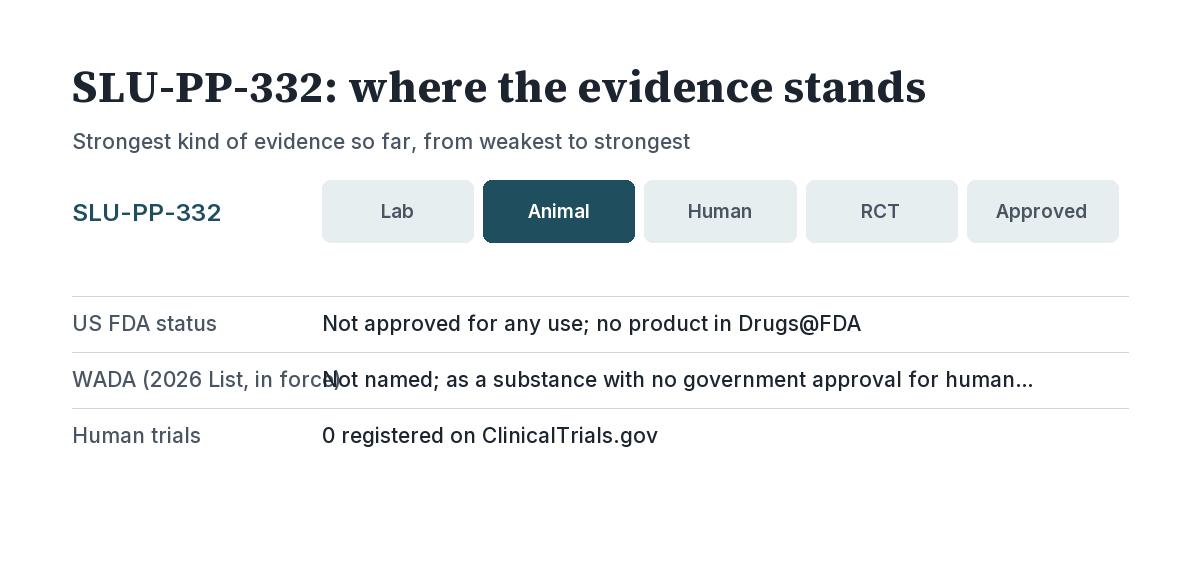
SLU-PP-332 is a synthetic small molecule, not a peptide: a non-peptide acyl hydrazone (C18H14N2O2) that switches on the estrogen-related receptors ERRα, ERRβ and ERRγ, studied as an “exercise mimetic”. Its strongest evidence is from mice, where it raised running endurance and reduced fat gain in obese animals [Animal]. It has no FDA approval and no registered human trial (ClinicalTrials.gov searched 2026-10-12), so its effects and side effects in people are unknown. WADA names it on the 2027 Prohibited List.
| Item | Status |
|---|---|
| Is it a peptide? | No. Small molecule, MW 290.3 (PubChem CID 5338394) |
| US FDA status | Not approved for any use; no product in Drugs@FDA (searched 2026-10-12) |
| Compounding (503A/503B) | Not on FDA’s Category 2 list or 503A category pages as of 2026-10-12; no FDA step scheduled |
| WADA (2026 List, in force) | Not named; as a substance with no government approval for human use it falls under S0 non-approved substances, prohibited at all times |
| WADA (2027 List, from 2027-01-01) | Named in S4 hormone and metabolic modulators, with SLU-PP-915 |
| Strongest evidence | Animal (mice); lab studies in human muscle cells |
| Human trials | 0 registered on ClinicalTrials.gov (searched 2026-10-12) |
| Last checked | 2026-10-12 |
Key points:
- After 7 days of dosing, treated mice ran about 70% longer and 45% further than controls; the effect disappeared in mice lacking muscle ERRα [Animal].
- Obese mice weighed about 12% less after 28 days without eating less, and their glucose tolerance improved [Animal].
- Its developers report that SLU-PP-332 lacks oral bioavailability; every animal study cited here used injection into the abdominal cavity.
- A 2026 review calls it metabolically unstable and not a classic drug candidate; analogues such as SLU-PP-915 are newer.
- Anti-doping chemists have already mapped its metabolites for drug testing [Lab].
| Property | Value |
|---|---|
| Structure type | Acyl hydrazone small molecule (not an amino-acid chain) |
| IUPAC name | 4-hydroxy-N-[(E)-naphthalen-2-ylmethylideneamino]benzamide |
| Molecular formula | C18H14N2O2 |
| Molecular weight | 290.3 g/mol |
| CAS number | 303760-60-3 |
| PubChem CID | 5338394 |
| Other names | ERR pan-agonist 332; SR9861 |
| Potency (EC50) | ERRα 98 nM · ERRβ 230 nM · ERRγ 430 nM |
| Routes studied | Intraperitoneal injection (mice); cell culture |
| Class | Pan-ERR agonist (“exercise mimetic”) |
What is SLU-PP-332?
SLU-PP-332 is a laboratory compound from the group of Thomas Burris and colleagues, characterized in a 2023 ACS Chemical Biology paper as an agonist of all three estrogen-related receptors, most potent at ERRα (EC50 98 nM). Chemically it belongs to the acyl hydrazone family and, according to a 2026 review by the same group, keeps the phenolic ring of an older ERR tool compound, GSK4716. It is often sold and searched as a “peptide”, but it contains no amino acids: PubChem lists it as a 290-dalton organic molecule. Three authors of the 2023 paper disclosed that they are stockholders in Myonid Therapeutics, a company focused on ERR-based therapeutics.
How does SLU-PP-332 work?
Estrogen-related receptors are nuclear receptors (proteins that switch genes on or off) which, despite their name, do not bind estrogens. They are highly expressed in the heart, skeletal muscle and liver, where they control genes for mitochondrial biogenesis (making new mitochondria) and fat burning.
- ERR activation: SLU-PP-332 activates ERRα, ERRβ and ERRγ in cell assays, with the highest potency at ERRα, per Billon et al., 2023 [Lab].
- Exercise-like gene program: in mouse muscle it switched on an acute aerobic-exercise gene program, and its endurance effect needed muscle ERRα, per the same paper [Animal].
- More mitochondria: in C2C12 muscle cells it raised maximal mitochondrial respiration and mitochondrial biogenesis [Lab].
- Fat oxidation: in obese mice it lowered the respiratory exchange ratio, a sign the body was burning more fat, and raised energy expenditure, per Billon et al., 2024 [Animal].
- Autophagy: ERR agonists raised expression of TFEB, a master switch of cellular recycling, in rat heart cells and mouse muscle cells, per Losby et al., 2024 [Lab].
What the research shows: SLU-PP-332 benefits, claim by claim
The research is early but consistent: across several mouse models, activating ERRs with SLU-PP-332 produced effects that resemble parts of endurance training. Every in vivo result below comes from mice given the compound by intraperitoneal injection.
| Claim | Evidence level | Best study and result |
|---|---|---|
| Raises endurance | Animal | Billon 2023, n=6/group: ran ~70% longer, ~45% further after 7 days |
| More oxidative muscle fibers | Animal | Billon 2023: type IIa fibers increased |
| Reduces weight and fat gain in obesity | Animal | Billon 2024, n=7–8/group: ~12% lower weight at 28 days; fat gain <0.5 g vs ~5 g |
| Improves blood sugar control | Animal | Billon 2024: better glucose tolerance, lower fasting glucose and insulin |
| Reduces fatty liver | Animal | Billon 2024: lower liver triglycerides; less steatosis in ob/ob mice |
| Protects the failing heart | Animal | Xu 2024: better ejection fraction and survival after aortic constriction |
| Reverses kidney aging | Animal | Wang 2023, n=5–6/group, 21-month mice: less albuminuria, podocyte loss |
| Counters aging muscle cell damage | Lab | Bonanni 2025, cells from 10 women: ROS −37.7% |
| Fat loss or endurance in people | No human data | 0 trials on ClinicalTrials.gov (2026-10-12) |
Exercise endurance
In the first study, male mice given SLU-PP-332 for 7 days ran about 70% longer and 45% further on a treadmill than vehicle-treated mice, and their muscles shifted toward oxidative type IIa fibers, according to Billon et al., 2023 [Animal]. Mice lacking ERRα in muscle gained nothing from the compound, which ties the effect to that receptor. A 2026 follow-up found the oral analogue SLU-PP-915 raised running distance and duration to a similar extent [Animal].
Fat loss and metabolic syndrome
This is the result behind most searches about SLU-PP-332 for fat loss. In diet-induced obese male mice, 28 days of treatment left animals about 12% lighter than controls; controls gained about 5 g of fat while treated mice gained less than 0.5 g, with no difference in food intake, per Billon et al., 2024 [Animal]. Glucose tolerance improved and fasting glucose and insulin fell. In genetically obese ob/ob mice, fat mass, liver weight and fatty liver fell over 12 days. The paper links the change to higher energy expenditure and fat oxidation, with food intake unchanged.
Heart and kidney
In mice with pressure-overload heart failure, SLU-PP-332 and SLU-PP-915 “significantly improved ejection fraction, ameliorated fibrosis and increased survival”, per Xu et al., 2024 [Animal]. In 21-month-old mice, 8 weeks of treatment reversed age-related albuminuria (protein in the urine) and podocyte loss, per Wang et al., 2023 [Animal]; the same paper found ERR levels lower in aging human kidney tissue [Human tissue, observational].
Aging muscle cells
In muscle precursor cells taken from 10 inactive women around 79 years old, 48 hours of SLU-PP-332 cut reactive oxygen species by 37.7% and senescence-marker activity by 26.1%, and promoted myotube formation, per Bonanni et al., 2025 [Lab]. These are cells in a dish, not treated people.
Human studies and trials
No completed human study of SLU-PP-332 has been published, and searches of ClinicalTrials.gov for SLU-PP-332, SLU-PP-915 and “estrogen-related receptor agonist” returned no registered trials on 2026-10-12. The only human material in the literature is tissue or cells studied in the lab (the kidney and myoblast work above), so no “before and after” results in people exist in the scientific record. For a sense of what a full human program looks like for a metabolic drug, see retatrutide’s phase 3 readouts and FDA filing timeline.
Doses used in studies
| Route and amount | Species | Study |
|---|---|---|
| i.p. 50 mg/kg twice daily, 7 days | Mouse | Billon 2023 |
| i.p. 50 mg/kg twice daily, 12–28 days | Mouse (obese) | Billon 2024 |
| i.p. 25 mg/kg twice daily, 6 weeks | Mouse (heart failure) | Xu 2024 |
| i.p. 25 mg/kg daily, 8 weeks | Mouse (aged) | Wang 2023 |
| 10 µM, 48 hours | Human cells | Bonanni 2025 |
No established human dose exists outside approved labels. Mouse doses per kilogram do not translate directly to people. Capsule products are widely searched, but the developers state that SLU-PP-332 lacks oral bioavailability, and no published study has tested it by mouth.
SLU-PP-332 side effects and safety
No human safety data exist. With no registered trial (ClinicalTrials.gov, 2026-10-12), its side effects, drug interactions and long-term effects in people are unknown.
- Tolerance in mice [Animal]: the ob/ob study “was shortened to 12 days due to reduced tolerance of twice per day intraperitoneal administration”, per Billon et al., 2024. Other studies reported “no overt toxicity” at 50 mg/kg for 10 days (Billon 2023) and at 25 mg/kg for 6 weeks (Xu 2024). None was a formal toxicology study.
- Chemistry concerns [Review]: a 2026 review from the developing lab states the compound “lacks oral bioavailability and is metabolically unstable” and that its hydrazone linkage “is considered problematic in medicinal chemistry due to its rapid metabolism and possible toxicity” (Radwan et al., 2026). This is a theoretical risk, not an observed harm.
- Limits of exercise mimetics [Review]: a 2026 review titled “Exercise pills for cardiometabolic health cannot mimic the exercise milieu” notes that exercise also acts through vascular function, autonomic balance and inflammation.
- Unregulated products: no FDA-reviewed SLU-PP-332 product exists, so the identity, purity and strength of anything sold online are unverified. A web search on 2026-10-12 found no FDA warning letter naming SLU-PP-332; the wider legal picture for products labelled “for research only” is covered in our explainer on what the research-use-only label means.
Who should not use it: there is no label and no regulator guidance, because no regulator has reviewed it. Use in pregnancy, breastfeeding, heart, liver or kidney disease, or alongside other drugs has never been studied.
Legal and regulatory status
| Jurisdiction | Status (checked 2026-10-12) |
|---|---|
| US FDA | Not approved; no product in Drugs@FDA |
| US compounding | Not in any 503A category; FDA does not categorize substances nominated on or after 2025-01-07 |
| US clinical trials | None registered on ClinicalTrials.gov |
| WADA 2026 (in force) | S0 non-approved substance, per USADA’s S0 definition |
| WADA 2027 (from 2027-01-01) | Named in S4, per USADA |
For athletes, the status is clear: SLU-PP-332 is prohibited at all times now under S0, and from 2027-01-01 it is also named outright in S4 as a metabolic modulator “acting on oxidative metabolism”, together with SLU-PP-915, according to USADA’s 2027 advisory. Two 2026 papers have already catalogued its breakdown products for doping control: nine metabolites in Möller et al. and twenty-two in vitro metabolites in Avliyakulov et al. [Lab]. Our page on peptides and compounds banned by WADA in 2027 lists the other changes. For what FDA’s compounding categories mean in general, see Category 1 vs Category 2 under FDA’s 503A compounding lists. No UK, EU or Australian authorization or scheduling decision specific to SLU-PP-332 was found for this entry.
Related compounds
- SLU-PP-915: a chemically distinct pan-ERR agonist from the same lab (Hampton et al., 2023) that is orally bioavailable in mice; no human trials registered.
- MOTS-c: a mitochondria-derived peptide, often searched alongside SLU-PP-332 but, unlike it, a true peptide.
- 5-Amino-1MQ: another non-peptide small molecule that is searched and sold alongside peptides.
- SS-31 (elamipretide): a mitochondria-targeted peptide in the same research area.
What users report
The following are unverified self-reports from people who usually bought unregulated products; they are not evidence. People who post about SLU-PP-332 on Reddit, YouTube and biohacking forums commonly describe feeling warmer, sweating more during workouts and having more stamina for cardio, and some describe gradual fat loss over several weeks, usually while also dieting or training. A recurring complaint is that nothing noticeable happened at all, which many posters link to doubts about whether capsules are absorbed. Others mention a raised resting heart rate, restlessness or poor sleep, and some report stomach upset. Cost is another frequent complaint. Much of the discussion is about product quality: whether a given product contains SLU-PP-332 at all, and whether third-party test reports can be trusted. Posters also argue about whether it is worth combining with other compounds, and athletes are often reminded in these threads that anti-doping rules prohibit it.
Frequently asked questions
Is SLU-PP-332 a peptide?
No. SLU-PP-332 is a synthetic small molecule with the formula C18H14N2O2 and a molecular weight of about 290, with no amino acids in its structure, according to PubChem. It is grouped with peptides because it is marketed in the same online channels, but chemically it belongs to the acyl hydrazone class of ERR agonists.
What is SLU-PP-332 used for?
It is a research tool for switching on estrogen-related receptors, which control mitochondrial and fat-burning genes. Scientists have used it in mice to study endurance, obesity, heart failure and kidney aging. In obese mice it cut weight by about 12% over 28 days [Animal], per Billon et al., 2024. It has no approved medical use.
Does SLU-PP-332 work in humans?
That is not yet known. It works in mice: treated animals ran about 70% longer than controls [Animal], per Billon et al., 2023. No human trial is registered on ClinicalTrials.gov (searched 2026-10-12), and its developers report it is not orally bioavailable, so mouse results cannot be assumed to carry over to people taking capsules.
What are the side effects of SLU-PP-332?
Human side effects are unknown because it has never been tested in a clinical trial. In mice, one study was cut short because obese animals tolerated twice-daily injections poorly, while others reported no overt toxicity [Animal]. A 2026 review flags its hydrazone linkage for “possible toxicity” (Radwan et al.), a theoretical concern.
Does SLU-PP-332 increase heart rate?
There are no human data to answer this; no clinical trial has measured it. The published mouse studies examined heart function in a heart-failure model, where SLU-PP-332 improved ejection fraction and survival [Animal], per Xu et al., 2024. Its effect on heart rate in healthy people has not been studied.
Is SLU-PP-332 banned in sport?
Yes. Under the 2026 List it counts as an S0 non-approved substance, prohibited at all times. From January 1, 2027, WADA names it, with SLU-PP-915, in class S4 as a metabolic modulator, per USADA. Anti-doping laboratories have already published methods to identify its metabolites.
References
- Billon C, Sitaula S, Banerjee S, et al. (2023). Synthetic ERRα/β/γ agonist induces an ERRα-dependent acute aerobic exercise response and enhances exercise capacity. ACS Chemical Biology. PubMed 36988910
- Billon C, Schoepke E, Avdagic A, et al. (2024). A synthetic ERR agonist alleviates metabolic syndrome. Journal of Pharmacology and Experimental Therapeutics. PubMed 37739806
- Xu W, Billon C, Li H, et al. (2024). Novel pan-ERR agonists ameliorate heart failure through enhancing cardiac fatty acid metabolism and mitochondrial function. Circulation. PubMed 37961903
- Wang XX, Myakala K, Libby AE, et al. (2023). Estrogen-related receptor agonism reverses mitochondrial dysfunction and inflammation in the aging kidney. American Journal of Pathology. PubMed 37717940
- Bonanni R, Falvino A, Matticari A, et al. (2025). Targeting ERRs to counteract age-related muscle atrophy associated with physical inactivity: a pilot study. Frontiers in Physiology. PubMed 40692696
- Losby M, Hayes M, Valfort A, et al. (2024). The estrogen receptor-related orphan receptors regulate autophagy through TFEB. Molecular Pharmacology. PubMed 39168657
- Billon C, Appourchaux K, Côté I, Burris TP (2026). An orally active estrogen receptor-related receptor agonist, SLU-PP-915, enhances aerobic exercise capacity. Journal of Pharmacology and Experimental Therapeutics. PubMed 41421047
- Hampton CS, Sitaula S, Billon C, et al. (2023). Development and pharmacological evaluation of a new chemical series of potent pan-ERR agonists, identification of SLU-PP-915. European Journal of Medicinal Chemistry. PubMed 37421886
- Radwan MO, Guin S, Burris TP (2026). Pharmacology of estrogen-related receptors (ERRs) agonists. RSC Chemical Biology. PubMed 42256350
- Plaza-Florido A, Lindholm ME, Carrera-Bastos P, et al. (2026). Exercise pills for cardiometabolic health cannot mimic the exercise milieu. Trends in Endocrinology and Metabolism. PubMed 40784868
- Möller T, Krug O, Thevis M (2026). In vitro metabolism and analytical characterization of SLU-PP-332 and SLU-PP-915: novel pan-ERR agonists with doping potential. Rapid Communications in Mass Spectrometry. PubMed 41588687
- Avliyakulov NK, Sobolevsky T, Ahrens E (2026). Analysis and identification of in vitro metabolites of exercise mimetic SLU-PP-332 ERRα/β/γ agonist for doping-control purposes. Drug Testing and Analysis. PubMed 41688415
- National Center for Biotechnology Information. PubChem Compound Summary for CID 5338394, SLU-PP-332. PubChem
- ClinicalTrials.gov. Search for SLU-PP-332 (searched 2026-10-12). ClinicalTrials.gov
- US Food and Drug Administration. Drugs@FDA: FDA-approved drugs. FDA
- US Food and Drug Administration. Bulk drug substances used in compounding under section 503A of the FD&C Act (content current as of 2026-05-14). FDA
- US Food and Drug Administration. Certain bulk drug substances for use in compounding that may present significant safety risks (content current as of 2026-04-22). FDA
- USADA. Athlete advisory: what’s new on the 2027 WADA Prohibited List? USADA
- USADA. #AskUSADA: What is a non-approved substance and why are they prohibited? USADA
Change log
2026-10-23: links to glossary definitions added; no change to the facts.
2026-10-12: first published after review by the editorial team.