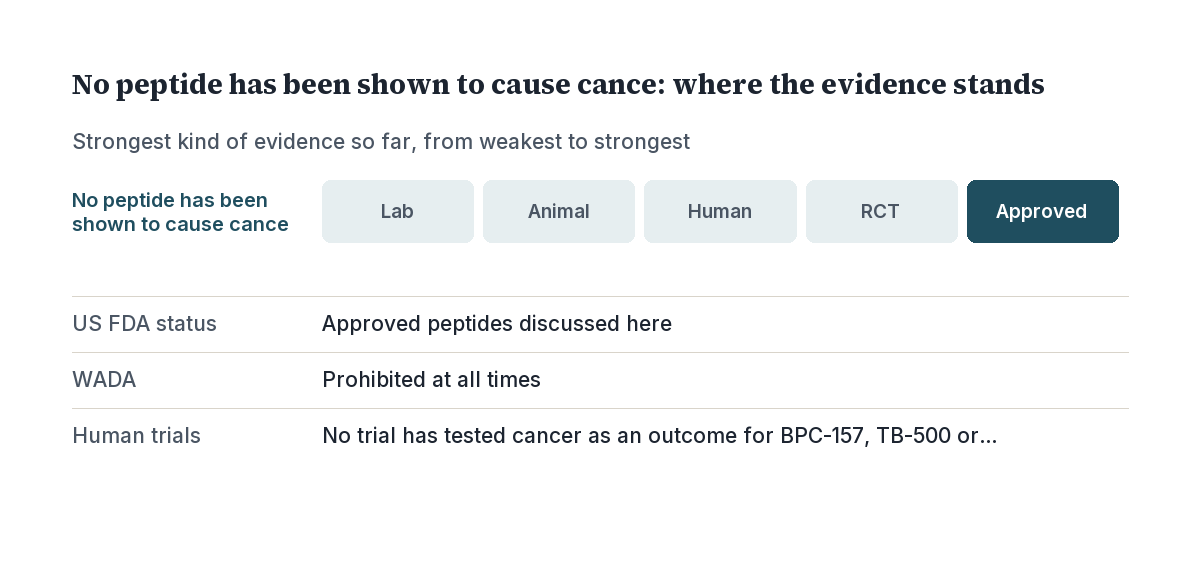
No peptide has been shown to cause cancer in people, but that is not the same as proof that none does. The evidence differs by peptide group: GLP-1 drugs such as semaglutide and tirzepatide cause thyroid C-cell tumors in rodents and carry an FDA boxed warning; growth-hormone-releasing peptides raise IGF-1, a hormone linked to several cancers in large human cohorts; and BPC-157 and TB-500 promote blood-vessel growth in lab and animal studies, with almost no human data. BPC-157, TB-500, CJC-1295 and ipamorelin are unapproved drugs that FDA flags for compounding safety concerns (FDA).
| Item | Status |
|---|---|
| US FDA status | Approved peptides discussed here: semaglutide (Wegovy), tirzepatide (Zepbound), tesamorelin (Egrifta). BPC-157, TB-500, CJC-1295, ipamorelin and GHK-Cu (injectable) are not approved drugs |
| Compounding (503A/503B) | Ipamorelin (503B) and ibutamoren still in Category 2; BPC-157, TB-500, CJC-1295, GHK-Cu withdrawn from Category 2 by nominators (FDA). PCAC voted 8–6 (1 abstention, as reported by trade press) on 2026-07-23 to recommend 503A listing of BPC-157 and of TB-500; advisory, no FDA rule yet (FDA meeting page) |
| WADA 2026 | Prohibited at all times: BPC-157 (S0), GHRH analogues such as CJC-1295, sermorelin and tesamorelin, GH secretagogues such as ipamorelin (S2.2.4), thymosin-β4 and TB-500 (S2.3); GLP-1 drugs not named (WADA 2026 List) |
| Strongest evidence | Approved label (rodent tumors for GLP-1 drugs); human cohorts and meta-analyses for IGF-1 and GLP-1 drugs; lab and animal only for BPC-157, TB-500 and GHK-Cu |
| Human trials | No trial has tested cancer as an outcome for BPC-157, TB-500 or GHK-Cu; 15 RCTs (84,237 people) pooled for GLP-1-type drugs and thyroid cancer |
| Last checked | 2026-10-05 |
What changed (October 2026): FDA’s own 2026 compounding reviews are added where they bear on cancer: the theoretical telomerase concern FDA raised for epitalon, and the missing long-term cancer studies for epitalon, KPV and DSIP.
Key points:
- The tesamorelin label contraindicates use in people with active cancer because the drug releases growth hormone, “a known growth factor”.
- Semaglutide was not mutagenic or clastogenic in the standard genotoxicity tests listed on its label, and rodent thyroid C-cells carry far more GLP-1 receptors than human ones.
- Two large analyses of GLP-1 drugs disagree: a French case-control study found more thyroid cancer, a Scandinavian cohort did not.
- People with a genetic inability to respond to growth hormone had one nonlethal cancer over 22 years, against a 17% cancer prevalence in control subjects.
- FDA cites published case reports of melanoma with Melanotan II and nonclinical findings that LL-37 “can be protumorigenic in some tissues”.
Do peptides cause cancer? How to read the question
“Peptides” covers hundreds of molecules with opposite effects, so no single answer applies. Some peptides are cancer treatments: Lutathera, a radiolabeled somatostatin analog built on a cyclic peptide, is approved for neuroendocrine tumors of the gut and pancreas (Lutathera label) [Approved label]. The concern for the peptides people buy for recovery, body composition or weight loss falls into three mechanisms: raising growth hormone and insulin-like growth factor 1 (IGF-1), growing new blood vessels (angiogenesis), and stimulating hormone-sensitive cells such as thyroid C-cells. Two different questions sit inside “cause cancer”: whether a substance starts a tumor, for example by damaging DNA, and whether it speeds the growth of one that already exists. The studies below mostly speak to the second question, and for most peptides they come from cells and animals rather than people. For background on how peptides are defined and regulated, see what peptides are.
Claim-by-claim evidence
| Claim | Evidence level | Best study and result |
|---|---|---|
| Semaglutide causes thyroid C-cell tumors | Approved label (rodents) | Mouse and rat 2-year studies: more C-cell adenomas at all doses (Wegovy label) |
| GLP-1 drugs raise thyroid cancer in people | Human RCT meta-analysis (n=84,237) | OR 1.52 (0.86–2.68), not significant; certainty very low (Eisa 2026); a 64-trial pooling was borderline significant (Silverii 2024) |
| High IGF-1 is linked to breast cancer | Human observational + Mendelian randomization (n=206,263) | HR 1.11 per 5 nmol/l; genetic OR 1.05 (Murphy 2020) |
| GHRH analogues raise IGF-1 | Human RCT (healthy adults) | CJC-1295: IGF-I up 1.5- to 3-fold for 9–11 days (Teichman 2006) |
| Growth hormone treatment raises cancer risk | Human cohort (n=23,984) | No clear raised risk in children without other major disease (SAGhE 2017) |
| BPC-157 promotes angiogenesis | Lab + Animal | More vessels, VEGFR2 up-regulation in rat hind limb (Hsieh 2017) |
| BPC-157 causes or speeds cancer | No data | Three human pilot studies, none measuring cancer (McGuire 2025) |
| Thymosin β4 aids tumor spread | Animal | Over-expressing melanoma cells: 46.7 vs 10.9 lung nodules in mice (Cha 2003) |
| Melanotan II and melanoma | Human case reports | Four reported cases; causality not established (Habbema 2017) |
Growth hormone secretagogues and IGF-1
The growth hormone secretagogues covered here are peptides that make the pituitary release more growth hormone. They come in two families: GHRH analogues (sermorelin, tesamorelin, CJC-1295) and ghrelin mimetics (ipamorelin, GHRP-2, GHRP-6), all listed together under S2.2.4 of the WADA 2026 List. Growth hormone raises blood IGF-1, which stimulates cell division and blocks cell death (Swerdlow 2002), so the cancer question for this whole class is largely a question about IGF-1.
What IGF-1 epidemiology shows
A 2004 meta-analysis of 21 studies (3,609 cases) found that people with IGF-1 at the 75th rather than the 25th percentile had higher odds of prostate cancer (OR 1.49) and premenopausal breast cancer (OR 1.65), and the authors called the associations “modest” [Human observational] (Renehan 2004). Pooled data from 17 prospective studies put the odds of breast cancer at 1.28 for the highest versus lowest fifth of IGF-1, confined to estrogen-receptor-positive tumors [Human observational, 4,790 cases] (EHBCCG 2010). In 394,388 UK Biobank participants, each 5 nmol/L higher IGF-1 went with more colorectal, breast, prostate and thyroid cancer, and less ovarian and liver cancer [Human cohort] (Knuppel 2020). Genetic analysis, which is less open to confounding, supports a “probable causal relationship” for breast cancer (Murphy 2020).
Natural experiments and growth hormone treatment
Conditions of lifelong high or absent growth-hormone signaling give the clearest human picture. In acromegaly, where a pituitary tumor drives growth hormone very high, a Danish cohort of 809 patients followed for a median 12.2 years found no clear rise in overall cancer (IRR 1.10, 0.93–1.30) but more colorectal cancer (IRR 1.78) and thyroid cancer (IRR 3.68) [Human cohort] (Rosendal 2026). A meta-analysis of 23 acromegaly studies gave an overall cancer ratio of 1.5, with signs of selection bias in older studies (Dal 2018). At the other extreme, Ecuadorians with growth hormone receptor deficiency had one nonlethal malignancy over 22 years of monitoring, against a 17% cancer prevalence in control subjects from the same community [Human cohort] (Guevara-Aguirre 2011).
Growth hormone given as a drug tells a more reassuring but incomplete story. Among 1,848 UK patients given pituitary-derived growth hormone between 1959 and 1985, cancer mortality was raised (SMR 2.8), driven by small numbers of colorectal and Hodgkin cases, and the authors noted the data said nothing about modern doses (Swerdlow 2002). The larger SAGhE cohort of 23,984 children treated with recombinant growth hormone found “no clear raised risk” in children with growth failure and no other major disease, while flagging bone, bladder and Hodgkin lymphoma signals for further study (SAGhE 2017).
Tesamorelin, sermorelin, CJC-1295 and ipamorelin
Tesamorelin is approved in the US as Egrifta to reduce excess abdominal fat in adults with HIV-associated lipodystrophy. Its label lists “Increased risk of neoplasms” as a warning, contraindicates use in active malignancy, and says the effects of prolonged IGF-1 elevation “are unknown”; after 26 weeks, 47% of treated patients had IGF-1 above 2 standard deviation scores [Approved label] (Egrifta SV label). Sermorelin was once approved as Geref; FDA determined in 2013 that it was not withdrawn for reasons of safety or effectiveness (Federal Register). No published study has followed sermorelin users for cancer; the only cancer paper found is a computer screen of glioma gene data that ranked sermorelin as a possible treatment, with no patient dosed [In silico] (Chang 2021). In healthy adults, CJC-1295 raised IGF-1 1.5- to 3-fold for 9–11 days after one injection, with no serious adverse reactions over 28 to 49 days [Human RCT] (Teichman 2006). Large controlled human data on the ghrelin route come from anamorelin, an oral ghrelin-receptor agonist tested in people who already had advanced lung cancer: lean body mass rose over 12 weeks without more grade 3–4 treatment-related adverse events [Human RCT, n=979] (Temel 2016), and in the 12-week extension deaths were 10.5% with anamorelin and 13.8% with placebo, none judged drug-related (Currow 2017). These trials were not designed to measure tumor growth.
BPC-157, TB-500 and angiogenesis
Angiogenesis, the growth of new blood vessels, helps wounds heal, and tumors use it too: in mice, melanoma cells that drove more vessel growth formed larger tumors (Cha 2003). BPC-157 increased vessel density in a chick-embryo assay and in endothelial cell culture, sped blood-flow recovery in rats with an ischemic hind limb, and up-regulated the vascular endothelial growth factor receptor VEGFR2 [Lab + Animal] (Hsieh 2017). The Zagreb group that developed BPC-157 argues the reverse of the cancer worry in its own review, writing that it “presents prominent anti-tumor potential in vivo and in vitro”; this is the developers’ position, summarizing their lab and animal work, not an independent finding [Developer review of Lab + Animal studies] (Sikiric 2025), while a 2026 clinical review lists “pathological angiogenesis, carcinogenesis” among the potential risks of unregulated “biohacking” drugs, a group it says includes BPC-157 and TB-500 [Review] (Moiz 2026). Neither position rests on a human cancer study. Only three small human pilot studies of BPC-157 exist (McGuire 2025); the intravenous one enrolled two adults and followed them for three days [Human case series, n=2] (Lee 2025). FDA says it “lacks sufficient information to know whether the drug would cause harm when administered to humans” (FDA).
TB-500 is a fragment of thymosin beta-4 (Tβ4), a protein the body makes and that cancer researchers have studied for decades. When mouse melanoma cells were engineered to over-produce Tβ4, tumors grew larger (21.7 vs 13.3 mm) and seeded more lung nodules (46.7 vs 10.9), with 4.4-fold more blood vessels [Animal] (Cha 2003). In human colorectal cancer samples, Tβ4 levels were relatively higher in liver metastases than in the matching primary tumors [Human tissue + Lab] (Wang 2004). These studies concern Tβ4 made inside tumor cells, not an injected fragment, so they show a plausible pathway rather than a measured risk. Intravenous full-length Tβ4 given daily for 14 days to healthy volunteers produced no serious adverse events in a 40-person randomized trial [Human RCT] (Ruff 2010), far too short to detect cancer.
GLP-1 drugs and thyroid tumors
Semaglutide and tirzepatide carry an FDA boxed warning for thyroid C-cell tumors. In mice and rats, semaglutide caused dose- and duration-dependent C-cell tumors at clinically relevant exposures, and the label states it is unknown whether it causes medullary thyroid carcinoma (MTC) in humans; it is contraindicated in people with a personal or family history of MTC or with MEN 2 [Approved label] (Wegovy label). Tirzepatide’s label carries the same warning based on a 2-year rat study (Zepbound label). The rodent finding may not transfer: rodent C-cells carry GLP-1 receptors, human and monkey C-cells have few, and 20 months of liraglutide at more than 60 times human exposure caused no C-cell hyperplasia in monkeys [Animal + Lab] (Bjerre Knudsen 2010).
Human data conflict. A French case-control study of 2,562 thyroid cancer cases found higher risk after 1–3 years of GLP-1 drug use (adjusted HR 1.58 for all thyroid cancer, 1.78 for medullary) [Human observational] (Bezin 2023). A Scandinavian cohort of 145,410 GLP-1 users compared with DPP-4 inhibitor users found no increase (HR 0.93, 0.66–1.31) over a mean 3.9 years [Human cohort] (Pasternak 2024). Pooling 64 trials gave a borderline result (OR 1.52, 1.01–2.29, fragility index 1) with a five-year number needed to harm of 1,349 [Human RCT meta-analysis] (Silverii 2024), while a 2026 pooling of 15 trials that included tirzepatide found 28 cases versus 15 and no significant difference (OR 1.52, 0.86–2.68; Eisa 2026). The European Medicines Agency’s safety committee concluded in 2023 that the evidence “does not support a causal association” with thyroid cancer and asked companies to keep monitoring (EMA PRAC). On other cancers, an observational study of 1.65 million people with type 2 diabetes linked GLP-1 drugs with lower risk of 10 of 13 obesity-associated cancers compared with insulin, but not compared with metformin, against which kidney cancer was higher (HR 1.54) [Human observational] (Wang 2024).
GHK-Cu: what is known in brief
GHK-Cu, the copper-bound tripeptide used in skin products, has no study showing it causes cancer and no long-term human cancer data either. A review by researchers at a GHK skin-care company reports gene-expression work suggesting GHK as a possible agent against metastatic colon cancer [Lab, review] (Pickart 2015), a hypothesis rather than a tested effect. For injectable GHK-Cu, FDA notes “limited data in humans to inform safety-related considerations” (FDA), and it is on the agenda of an FDA compounding advisory meeting planned before the end of February 2027 (FDA PCAC).
Other peptides with a cancer signal
Two unapproved peptides have more direct warnings. FDA’s compounding page states that published case reports describe melanoma with Melanotan II, a tanning peptide (FDA). One such report describes a 20-year-old woman diagnosed with melanoma three months after self-injecting melanotan-II alongside sunbed use [Human case report] (Hjuler 2014), and a review counts four such cases while noting that “conclusive evidence linking these phenomena is lacking” (Habbema 2017). The same FDA page says nonclinical research suggests the antimicrobial peptide LL-37 “can be protumorigenic in some tissues”. Epitalon, sold as an “anti-aging” peptide on the strength of telomerase claims, carries a theoretical warning from FDA’s own 2026 review: continuous activation of telomerase, the enzyme that keeps chromosome ends from shortening, is a mechanism cancer cells also use. FDA judged the available mouse studies inadequate to settle the question (fixed doses, female animals only, short duration) and found no two-year cancer study [Theoretical, regulator-stated] (FDA briefing document, epitalon, review memo 2026-05-12).
What is not known
- Long-term human exposure: no study has followed users of BPC-157, TB-500, CJC-1295, ipamorelin or GHK-Cu for cancer. The large Scandinavian GLP-1 cohort averaged 3.9 years of follow-up (Pasternak 2024), and cancers can take longer to appear.
- People who already have cancer: the tesamorelin label treats existing malignancy as a reason not to start and a reason to stop (Egrifta SV label); for unapproved growth-promoting peptides there is no data either way.
- What is in the vial: FDA lists immunogenicity and peptide-related impurities as risks of compounded BPC-157, TB-500 and GHK-Cu, and says it has no human exposure data for TB-500 (FDA). Unregulated products may not match their label at all; see what “research use only” means.
- Standard cancer studies: FDA’s 2026 reviews for its compounding committee found no two-year carcinogenicity study for epitalon, KPV or DSIP (emideltide) (FDA briefing documents: epitalon, KPV, DSIP). These are the studies normally required before a drug meant for long-term use is approved.
- Whether rodent results apply: human relevance of the GLP-1 rodent tumors “has not been determined”, in the words of the Wegovy label (Wegovy label).
Legal and regulatory status
| Peptide | US FDA / compounding | WADA 2026 |
|---|---|---|
| Semaglutide, tirzepatide | Approved (Wegovy, Zepbound); boxed thyroid warning | Not named |
| Tesamorelin | Approved (Egrifta, HIV lipodystrophy) | Prohibited, S2.2.4 |
| Sermorelin | Geref discontinued, not for safety reasons | Prohibited, S2.2.4 |
| CJC-1295 | Not approved; withdrawn from Category 2 | Prohibited, S2.2.4 |
| Ipamorelin | Not approved; Category 2 (503B) | Prohibited, S2.2.4 |
| BPC-157 | Not approved; PCAC 8–6 for 503A, no rule yet | Prohibited, S0 |
| TB-500 | Not approved; PCAC 8–6 for 503A, no rule yet | Prohibited, S2.3 |
| GHK-Cu (injectable) | Not approved; PCAC review planned by Feb 2027 | Not named |
Sources: FDA labels, the FDA Category 2 page and PCAC meeting pages, and the WADA 2026 List, all cited above. The PCAC vote counts are as reported by trade press; FDA has posted no minutes. A peptide-by-peptide view is kept in the peptide legal status tracker.
What users report
The following summarizes unverified self-reports from people who usually bought unregulated products; it is not evidence and may not reflect what those products contained. On forums, Reddit and YouTube, cancer is one of the most argued-about topics around peptides. A recurring view is that healing peptides such as BPC-157 and TB-500 are harmless because no human cancer cases have been reported, and the counter-argument, often from people with a family history of cancer, is that absence of reports reflects absence of studies. Many posters say they avoid growth-hormone-releasing peptides after a cancer diagnosis or while waiting on a suspicious scan, and some describe asking for IGF-1 blood tests. People taking semaglutide or tirzepatide often post about the thyroid warning on the box, about neck lumps they had checked, and about whether the rodent data matter. Other common themes are worry about what unregulated vials actually contain and frustration that doctors will not discuss unapproved peptides. Moles that darkened or appeared after tanning peptides are a frequent complaint in tanning communities.
Frequently asked questions
Does BPC-157 cause cancer?
No study has shown that BPC-157 causes cancer, and none has tested it. In rats and cell culture it promotes new blood-vessel growth through the VEGFR2 receptor, a pathway tumors also use, which is the basis of the theoretical concern (Hsieh 2017). Human data are limited to three small pilot studies, none of which measured cancer.
Can semaglutide cause thyroid cancer?
It causes thyroid C-cell tumors in mice and rats, which is why Wegovy carries an FDA boxed warning; whether it does so in humans is unknown. A French case-control study found higher thyroid cancer risk after one to three years of GLP-1 drug use, while a Scandinavian cohort of 145,410 users found no increase (HR 0.93) (Pasternak 2024).
Do growth hormone peptides increase cancer risk?
No trial has measured it directly. These peptides raise IGF-1, and higher natural IGF-1 is linked with more breast, prostate and colorectal cancer in large cohorts (Knuppel 2020). The approved GHRH analogue tesamorelin is contraindicated in active malignancy, and its label says the effects of long-term IGF-1 elevation are unknown.
Can people who have had cancer use peptides?
No study answers this for unapproved peptides. The clearest guidance comes from the tesamorelin label: preexisting malignancy should be inactive and its treatment complete before starting, and treatment should stop at any sign of recurrence. In the SAGhE cohort, raised cancer risk after growth hormone was concentrated in people treated after an earlier cancer (SAGhE 2017).
References
- US FDA. Certain bulk drug substances for use in compounding that may present significant safety risks (content current 04/22/2026). fda.gov
- US FDA. July 23–24, 2026 Meeting of the Pharmacy Compounding Advisory Committee. fda.gov
- US FDA. Meeting of the Pharmacy Compounding Advisory Committee (LL-37, GHK-Cu, dihexa, Melanotan II, PEG-MGF). fda.gov
- World Anti-Doping Agency. Prohibited List 2026. wada-ama.org
- EGRIFTA SV (tesamorelin) prescribing information. DailyMed. dailymed.nlm.nih.gov
- WEGOVY (semaglutide) prescribing information, revised 6/2026. DailyMed. dailymed.nlm.nih.gov
- ZEPBOUND (tirzepatide) prescribing information, revised 8/2026. DailyMed. dailymed.nlm.nih.gov
- LUTATHERA (lutetium Lu 177 dotatate) prescribing information. DailyMed. dailymed.nlm.nih.gov
- US FDA. Determination that GEREF (sermorelin acetate) injection was not withdrawn from sale for reasons of safety or effectiveness. Federal Register 2013;78(42). govinfo.gov
- European Medicines Agency. Meeting highlights from PRAC, 23–26 October 2023. ema.europa.eu
- Renehan AG et al. 2004. IGF-I, IGFBP-3, and cancer risk: systematic review and meta-regression analysis. Lancet. PubMed
- Endogenous Hormones and Breast Cancer Collaborative Group 2010. IGF1, IGFBP3, and breast cancer risk: pooled analysis of 17 prospective studies. Lancet Oncol. PubMed
- Knuppel A et al. 2020. Circulating IGF-I concentrations and risk of 30 cancers: UK Biobank. Cancer Res. PubMed
- Murphy N et al. 2020. IGF-1, IGFBP-3, and breast cancer risk: observational and Mendelian randomization analyses. Ann Oncol. PubMed
- Swerdlow AJ et al. 2002. Risk of cancer in patients treated with human pituitary growth hormone in the UK, 1959–85. Lancet. PubMed
- Swerdlow AJ et al. 2017. Cancer risks in patients treated with growth hormone in childhood: the SAGhE European cohort study. J Clin Endocrinol Metab. PubMed
- Dal J et al. 2018. Cancer incidence in patients with acromegaly: cohort study and meta-analysis. J Clin Endocrinol Metab. PubMed
- Rosendal C et al. 2026. Long-term cancer risk in acromegaly: population-based cohort with 44 years of follow-up. Eur J Endocrinol. PubMed
- Guevara-Aguirre J et al. 2011. Growth hormone receptor deficiency is associated with a major reduction in pro-aging signaling, cancer, and diabetes in humans. Sci Transl Med. PubMed
- Teichman SL et al. 2006. Prolonged stimulation of GH and IGF-I secretion by CJC-1295 in healthy adults. J Clin Endocrinol Metab. PubMed
- Temel JS et al. 2016. Anamorelin in non-small-cell lung cancer and cachexia (ROMANA 1 and 2). Lancet Oncol. PubMed
- Currow D et al. 2017. ROMANA 3: phase 3 safety extension study of anamorelin. Ann Oncol. PubMed
- Chang Y et al. 2021. A potentially effective drug for patients with recurrent glioma: sermorelin. Ann Transl Med. PubMed
- Hsieh MJ et al. 2017. Therapeutic potential of pro-angiogenic BPC157 is associated with VEGFR2 activation and up-regulation. J Mol Med. PubMed
- Sikiric P et al. 2025. Stable gastric pentadecapeptide BPC 157 as a therapy and safety key. Pharmaceuticals. PubMed
- McGuire FP et al. 2025. Regeneration or risk? A narrative review of BPC-157 for musculoskeletal healing. Curr Rev Musculoskelet Med. PubMed
- Lee E, Burgess K. 2025. Safety of intravenous infusion of BPC157 in humans: a pilot study. Altern Ther Health Med. PubMed
- Moiz A et al. 2026. Dangers of injectable peptides and other unregulated “biohacking” drugs. Mo Med. PubMed
- Cha HJ et al. 2003. Role of thymosin beta4 in tumor metastasis and angiogenesis. J Natl Cancer Inst. PubMed
- Wang WS et al. 2004. Overexpression of the thymosin beta-4 gene and distant metastasis of human colorectal carcinoma. Oncogene. PubMed
- Ruff D et al. 2010. Randomized, placebo-controlled study of intravenous thymosin beta4 in healthy volunteers. Ann N Y Acad Sci. PubMed
- Bjerre Knudsen L et al. 2010. GLP-1 receptor agonists activate rodent thyroid C-cells causing calcitonin release and C-cell proliferation. Endocrinology. PubMed
- Bezin J et al. 2023. GLP-1 receptor agonists and the risk of thyroid cancer. Diabetes Care. PubMed
- Pasternak B et al. 2024. GLP-1 receptor agonist use and risk of thyroid cancer: Scandinavian cohort study. BMJ. PubMed
- Silverii GA et al. 2024. GLP-1 receptor agonists and risk of thyroid cancer: meta-analysis of randomized controlled trials. Diabetes Obes Metab. PubMed
- Eisa N, Barood O. 2026. Incretin-based therapy and thyroid cancer risk: meta-analysis of randomized controlled trials. AACE Endocrinol Diabetes. PubMed
- Wang L et al. 2024. GLP-1 receptor agonists and 13 obesity-associated cancers in patients with type 2 diabetes. JAMA Netw Open. PubMed
- Pickart L et al. 2015. GHK peptide as a natural modulator of multiple cellular pathways in skin regeneration. Biomed Res Int. PubMed
- Hjuler KF, Lorentzen HF. 2014. Melanoma associated with the use of melanotan-II. Dermatology. PubMed
- Habbema L et al. 2017. Risks of unregulated use of alpha-melanocyte-stimulating hormone analogues: a review. Int J Dermatol. PubMed
- US FDA. FDA briefing document: Epitalon, Pharmacy Compounding Advisory Committee, July 23–24, 2026 (review memo 2026-05-12). fda.gov
- US FDA. FDA briefing document: KPV, Pharmacy Compounding Advisory Committee, July 23–24, 2026 (review memo 2026-05-12). fda.gov
- US FDA. FDA briefing document: Emideltide (DSIP), Pharmacy Compounding Advisory Committee, July 23–24, 2026 (review memo 2026-05-11). fda.gov
Change log
2026-10-27: FDA’s 2026 compounding reviews added: epitalon’s theoretical telomerase concern and the missing long-term cancer studies for epitalon, KPV and DSIP; reviewed by the editorial team.
2026-10-23: links to glossary definitions added; no change to the facts.
2026-10-12: links to related entries added; no change to the facts.
2026-10-05: first published after review by the editorial team.